Near-Miss Assassination Attempt On Donald Trump Was Likely An Inside Job

Donald Trump literally dodged a bullet last week.

There are many indicators that the attempted assassination was premeditated and allowed to happen as revealed by an ever-growing chorus of whistleblowers, former Secret Service agents, intelligence analysts, special military operators and members of Congress who all agree that this could not have been merely an endless cavalcade of catastrophic failures. There are so many smoking guns it’s hard to know where to start. From the FBI’s laughably contradictory stories to the criminally compromised presidential security detail to the record shorts against Trump’s stock the day before, a long list of perplexing anomalies and official contradictions continues to upend the FBI’s pathetic narrative. An avalanche of suspicious evidence has piled up since the shooting that strongly suggests it was an inside job.

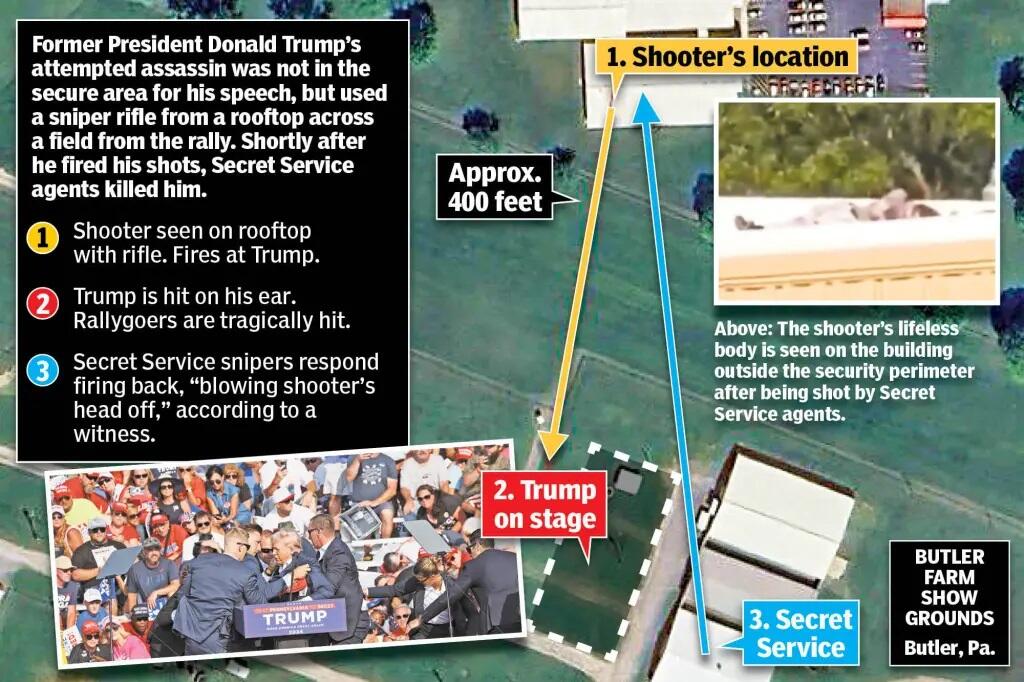
Set outside the rural town of Butler in the north-west corner of Pennsylvania, the Trump campaign scheduled a routine rally last Saturday on their way to Milwaukee’s Republican National Convention. On the afternoon of Saturday, 13 July 2024 at approximately 6:11:33 PM local time (EDT) a would-be assassin fired 8 shots intended to kill former President Donald Trump. The Pennsylvania shooting marks the ninth assassination attempt on Trump since he began his political career.

Trump asked the audience just moments before the chaos erupted, “Do you mind if I go off teleprompter?” Referring to a chart on a projector screen to his right, Trump turned his head and leaned forward at the exact moment his would-be assassin squeezed the trigger of his rifle.

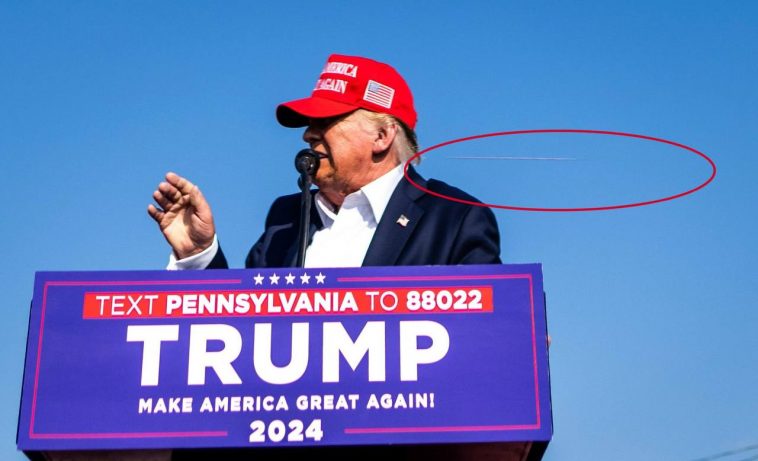
The first bullet struck the top of Trump’s right ear. A well-timed photo captured the metallic streak at the exact moment the first bullet whizzed past Trump’s head. Donald ducked behind the podium as several more shots rang out. Three audience members were struck. 50-year-old retired fire chief Corey Comperatore was struck in the head and instantly killed. 57-year-old David Dutch and 74-year-old James Copenhaver were also severely injured according to police.

The four counter-sniper teams staged around the event took their time neutralizing the threat, and after a long 26 seconds, finally did so with a single shot to the head. Witnesses heard Secret Service personnel shout, “Shooter is down!”

Trump’s bodyguards rushed the stage and dogpiled themselves onto Trump. Before they could whisk him away he demanded they wait so he could pump his fist in the air with blood streaming down his face and address to the crowd with his now infamous rallying cry, “Fight!” Fight! Fight!”

Exactly how the would-be assassin was able to successfully fire so many shots so close to the stage involves a mind boggling series of absolutely inexcusable security blunders. Both United States Secret Service (USSS) and FBI admitted Wednesday that the shooter was identified as a Person Of Interest roughly 50 minutes before Trump began speaking. Video taken by onlookers has since shown the shooter pacing nervously back and forth in front of the building and surveying the roof over an hour prior to the shots.

Authorities photographed the shooter 26 minutes prior to the shooting, identified him as a “suspicious person”, and still allowed Trump to walk onto the stage:

26 minutes after the second picture of Crooks was taken by law enforcement and the information called in, shots were fired from the roof of the American Glass Research building. Seconds later, a Secret Service sniper returned fire and killed Crooks.”

Greg Smith told the BBC that he noticed the shooter and attempted to flag the police and Secret Service for at least three to four minutes prior to the shooting:

We could clearly see him with a rifle. Absolutely. We’re pointing at him. The police are down there running around on the ground. We’re like, ‘Hey, man, there’s a guy on the roof with a rifle.’ And the police were like, ‘Huh? What?’ …

I’m like, ‘Why is Trump still speaking? Why have they not pulled him off the stage?’ I’m standing there pointing at him for you know, two, three minutes. Secret Service is looking at us from the top of the barn. I’m pointing at that roof, just standing there like this. And next thing, you know, five shots ring out.”

A compilation video called “Two Fucking Minutes” synchronized the footage from multiple cell phones that captured the litany of citizen alerts that were ignored by authorities. Documenting this catastrophic security failure, several onlookers took video of the shooter repositioning himself on the rooftop prior to the shooting:

Rally-goer Michael Difrischia, who captured the moment the shooter fired and was fired upon, told TMZ that he and his wife Amber were watching the Trump rally from outside the main grounds with about 30 to 40 other people.”

Butler County Sheriff Michael T. Slupe told CNN that local officers tried to stop the gunman but were just unable to engage:

During the search for the suspicious person, officers with township police discovered that the gunman was on the roof, and one local officer hoisted another to get up to the ledge. The shooter turned around, saw the officer peering over and pointed his gun at him.”

The local police officer who saw the shooter on the roof failed to adequately alert anyone of the situation’s urgency, as did the officer who hoisted him. Either one of the officers could have fired their service pistol into the air and stopped everything. It wasn’t enough that entire crowds of onlookers were literally shouting, “He’s on the roof! He’s got a gun!” The FBI claims they’re investigating this officer’s retreat.

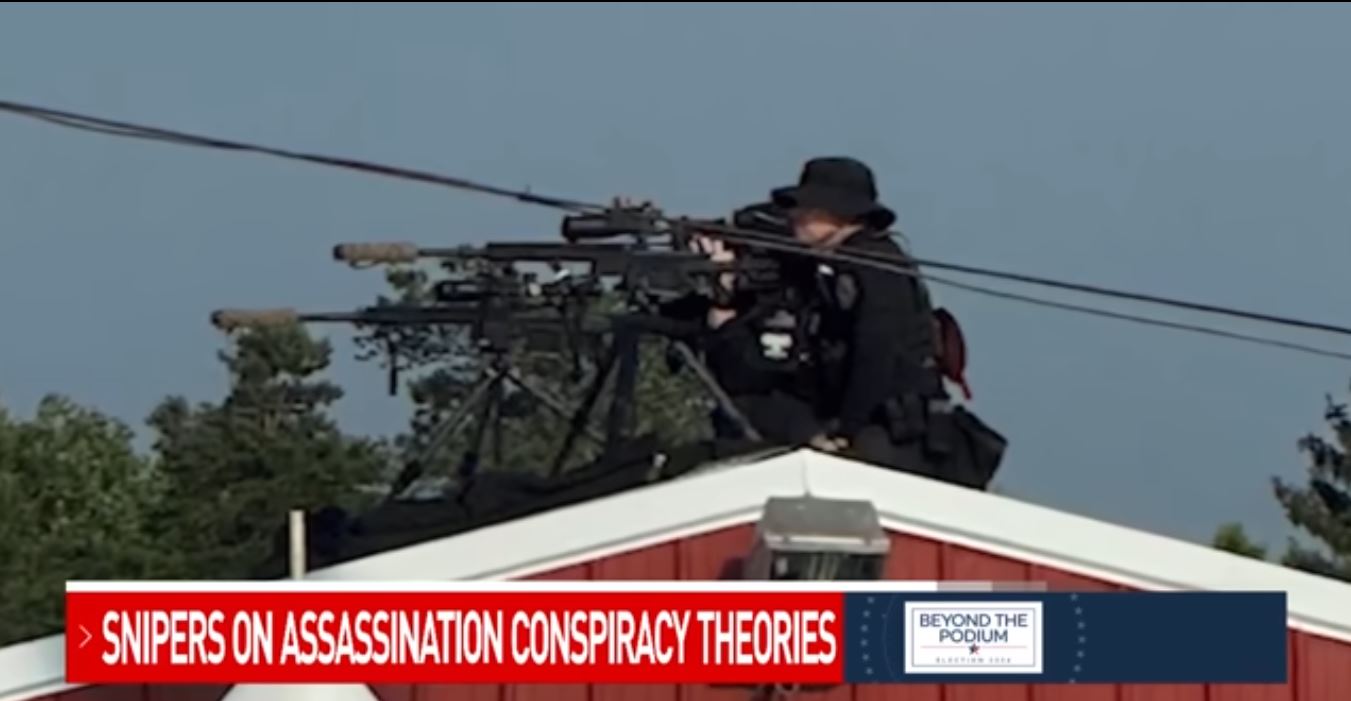
Adding yet more insult to injury was the fact that a sniper team was inside the very building from which the shooter launched his attack:

Crooks came back, sat down and looked at his phone. At that point, one of the snipers took a picture of him. Crooks took out a rangefinder and the sniper radioed to the command post. Crooks disappeared again and then came back a third time with a backpack. The snipers called in with information that he had a backpack and said he was walking towards the back of the building.”

The AGR roof wasn’t only identified as a “well-known, high-priority vulnerability” the day prior, it also happened to be the Tactical Operations Center for the counter-sniper detail. We’re told that the shooter somehow infiltrated the highly guarded perimeter of the police tactical staging area and took aim at his target from only 150 meters away, in plain sight of both the Secret Service and rally-goers. According to the New York Post:

The building — the AGR International Inc. factory in Butler, Pennsylvania — was being used by local police as a “watch post” for snipers to scan for threats as the former president spoke onstage only 130 yards away. … Cops were inside, but not on the roof.

Crooks was able to scale the building unchallenged before firing off eight shots with an AR-style assault rifle, grazing Trump in the ear, killing one Trump supporter and wounding two others.

Secret Service snipers watched the man with the rifle through their scopes and waited until shots were fired to respond. Despite rumors that the counter-snipers were not given clearance to do their jobs, NBC was told that they, in fact, “did not need approval to shoot”.

Witness Robert Philpot told NBC News that security was “noticeably lax” compared to previous Trump rallies, where “Every rooftop of every hanger had three, four, five guys on top,” as opposed to the complete lack of rooftop coverage in Butler.

Another witness named Ben Macer told reporters that the shooter had plenty of time to comfortably “move from roof to roof”. Indeed, time was on the shooter’s side. The suspicious person was identified as early as 5:13 PM and spotted on the roof by the Secret Service at 5:45 before Trump took the stage at 6:03 and was shot at 6:11. Large crowds of onlookers shouted for nearly three minutes at authorities that there was a man on the roof with a gun, and were all ultimately ignored.

Everyone knew there was an active threat on the roof with a rifle and the Secret Service allowed Trump to enter onto the stage when they could have easily postponed the event.

The Secret Service’s flimsy and ever-changing excuses became even more absurd when Secret Service Director (and former security chief for PepsiCo) Kimberly Cheatle actually made the absolutely laughable claim that snipers weren’t on top of the AGR building because it was sloped:

That building in particular has a sloped roof at its highest point. And so, you know, there’s a safety factor that would be considered there that we wouldn’t want to put somebody up on a sloped roof.”

Director Cheatle also shamelessly blamed the local cops for the close call, claiming that the AGR rooftop was “under the jurisdiction of local law enforcement”. But Butler County District Attorney Richard Goldinger exposed this claim as another blatant lie:

They had meetings in the week prior. The Secret Service ran the show. They were the ones who designated who did what. In the command hierarchy, they were top. They were No. 1.”

According to Butler’s police commissioner, the local cops weren’t even responsible for security at the event in the first place:

In response to the Secret Service trying to pin the blame on local PD, Butler Township commissioner Edward Natali said that the Butler Township Police Department had no security responsibility at the event – and that there were just seven officers, all assigned to traffic detail.”

Cheatle later admitted that the agency was “totally responsible” for Trump’s security, but not before the Fraternal Order of Police blasted her for blaming local law enforcement. But criticisms from the enforcement class didn’t end there.

Former Long Beach SWAT Commander Steve Nottingham called the shooting “a fundamental security failure”. Retired CIA analyst Larry Johnson raised obvious questions about the security detail’s abysmal lack of coverage. And former JSOC sniper and Republican Congressman Cory Mills suggested the security failures were “intentional”.

Then pictures surfaced of female agent Melissa McCarthy literally ducking behind the Presidential dogpile for cover – the same agent who drew her sidearm for no reason and was unable to place it back in the holster. Former FBI special agent Kenneth Gray blamed the Secret Service “screw up” on the Biden Administration’s prioritization of diversity hiring policies that have allowed applicants that are too short and inexperienced into an otherwise elite unit. USSS spokesman Anthony Guglielmi whined to NBC about how “appalled” he was by the “baseless” criticisms.

Trump’s regular security team was reportedly overworked to the point of exhaustion, and many of them were reassigned at the last minute. Missouri Senator Josh Hawley said agency whistleblowers with direct knowledge of the event approached his office to reveal that most of Trump’s bodyguards on Saturday “were not even Secret Service” but “unprepared and inexperienced” DHS “investigations” personnel who were assigned to the Butler rally on the grounds that it was considered a “loose” security event.

After the FBI tried to forcibly remove Senator Hawley from the Butler crime scene, he appeared on Sean Hannity’s show to confirm that the personnel of Trump’s security detail didn’t know what they were doing because so many of them were from other federal agencies:

They didn’t know what the procedures were. They did not have the site locked down. They were not adequately patrolling the perimeter.”

Retired Army psychological warfare officer and State Department counter-terrorism analyst Scott Bennett told Sputnik, “The Secret Service were remarkably — if not suspiciously — slow in their protecting of the President, similar to how they were slow in protecting President John F. Kennedy when he was shot in Texas.”

Former Navy SEAL and Blackwater founder Erik Prince stated, “The fact that USSS allowed a rifle armed shooter within 150 yards to a pre-planned event is either malice or massive incompetence.” Prince went on to describe how the Secret Service ignored their own procedures by failing to secure obvious sniper perches or erect barriers to block direct line of sight to the stage.

Elite Canadian sharpshooter Dallas Alexander who holds the world record for “longest confirmed sniper kill” also questioned the official story, suggesting the shooter had help in a plot that looks like an “inside job”:

I’m very familiar with the layout of these types of things and what the job should be, and yesterday what happened, I have no doubts in my mind that the shooter had help from somewhere within an agency, an organization or the government.”

Adding fuel to the fire is the fact that one male Secret Service agent on the ground behind Trump’s stage can be seen actually ducking down several moments prior to the shots, as if in anticipation of them, before kneeling down altogether instead of rushing the stage.

12-year Secret Service veteran Dan Bongino was livid over the security failure, asserting that the lack of security resources for non-Democrats was always a politically motivated decision. Appearing with Tucker Carlson at the RNC, Bongino went on to say that an “unimpeachable source” told him someone was supposed to be on the roof where the assassin shot from but “didn’t show up.” As Dan stated in a tweet:

Secret Service Director Kim Cheatle should’ve already resigned. Inexcusable that this incompetent mess of a Director is still holding on, while protectees are in danger.”

Several lawmakers have joined Bongino in calling for Cheatle’s immediate resignation. After claiming that “the buck stops with me,” director Cheatle rejected calls for her resignation and was immediately subpoenaed to testify before the House Oversight and Accountability Committee on Monday, 22 July. House Committee on Homeland Security Chairman Mark Green demanded testimony from the entire chain of command, including FBI director Christopher Wray, DHS Secretary Alejandro Mayorkas, and Secret Service Director Kimberly Cheatle.

Texas Congressman Michael Cloud revealed that DHS are already withholding information from the Oversight Committee and taking steps to further cover up what happened in Butler. Alejandro Mayorkas also lied about the fact that they “rebuffed multiple requests from Mr. Trump’s security detail to increase protective resources.”

Florida Congressman Mike Waltz affirmed that Secretary Mayorkas denied requests on multiple occasions for increased Secret Service protection for Trump. Even after an alleged threat from Iran necessitated the dramatic increase in security resources, the exact opposite happened. If there was an imminent concern, why not set up the giant wall of bullet-proof glass that shielded President Obama during his 2013 speech in Berlin? Nevertheless, a minority of officials claim that Iran is actively “plotting” retribution against Trump for the drone bombing of General Soleimani in 2020 despite the fact that the Butler shooter has no connections to Iran whatsoever.

After trolling the police with accusations of dropping the ball, the USSS later admitted that it lied about denying additional security resources for Trump. Even the Bezos-owned Washington Post admitted this fact:

Top officials at the U.S. Secret Service repeatedly denied requests for additional resources and personnel sought by Donald Trump’s security detail in the two years leading up to his attempted assassination at a rally in Pennsylvania last Saturday.”

In spite of all these failures, Trump survived the encounter, and the nation’s attention turned toward identifying the trigger man. As usual, the official story ladled out by the feds makes absolutely no sense.

The day after the shooting, FBI officials announced a familiar and tired cliché that, “the shooter acted alone.” They claimed that an anonymous source revealed that the rifle was stashed away in advance but couldn’t say where it had been hidden. Authorities declared that explosive devices were discovered in the shooter’s car but provided no photographs. They stated that he bought a ladder from Home Depot that is noticeably different than the one photographed against the AGR building.

The FBI identified the shooter as one Thomas Matthew Crooks of Bethel Park, but released no additional information. Crooks was identified despite the fact that he has no criminal record and had no physical ID on his person (the FBI allegedly identified him through the magic of DNA). No motive. No social media history. No manifesto.

The Daily Mail reported that Thomas Matthew Crooks was rejected from his high school rifle team for being a “terrible shot”:

Fellow classmate Jameson Murphy added: ‘He tried out…and was such a comically bad shot he was unable to make the team and left after the first day.’

So a 20-year-old kid with no training and no experience was able to outsmart and outmaneuver the legendary precision of the Secret Service?

The FBI also claim that Crooks was able to fly a drone undetected over the entire Butler Farm Show Grounds for the purposes of obtaining aerial footage. Crooks also apparently had access to “three encrypted overseas bank accounts” and owned two phones, one of which only had 27 contacts.

Then we were told that Crooks posted an alarming message on Steam days before the event that read, “July 13 will be my premiere, watch as it unfolds.” The FBI has since rescinded this detail, announcing that it was posted by an account different from the one Crooks was using.

Another perplexing narrative element involves Crooks’ parents contacting local police just hours before the incident, apparently “expressing concerns over their son’s sudden disappearance”. Crooks and his parents are described as “very private” people with his uncle Mark Crooks telling reporters “I haven’t seen that part of my family in years.”

Former Bethel Park High classmate Jason Kohler told KDKA that Crooks was a “loner” and the target of “relentless” bullying, adding that he was “known for wearing hunting outfits to class”. Former classmate Vincent Taormina disputes the notion that Crooks was either a loaner or was ever the subject of bullying, telling reporters that Crooks hated politicians and was “passionate” about politics.

Crooks was also featured in a 2022 BlackRock advert – the very same firm tied up in the scandalous 800% shorts on Donald Trump’s stock the day before the shooting.

After the shooter’s name was officially released, a video of a young man claiming to be Thomas Matthew Crooks surfaced online. Though some have dismissed this video on the grounds that its creator is “just a troll,” the subject bears a strong resemblance to photographs and footage of Thomas Crooks. The account is still active though he’s updated his page to a private status since posting the “you’ve got the wrong guy” video.

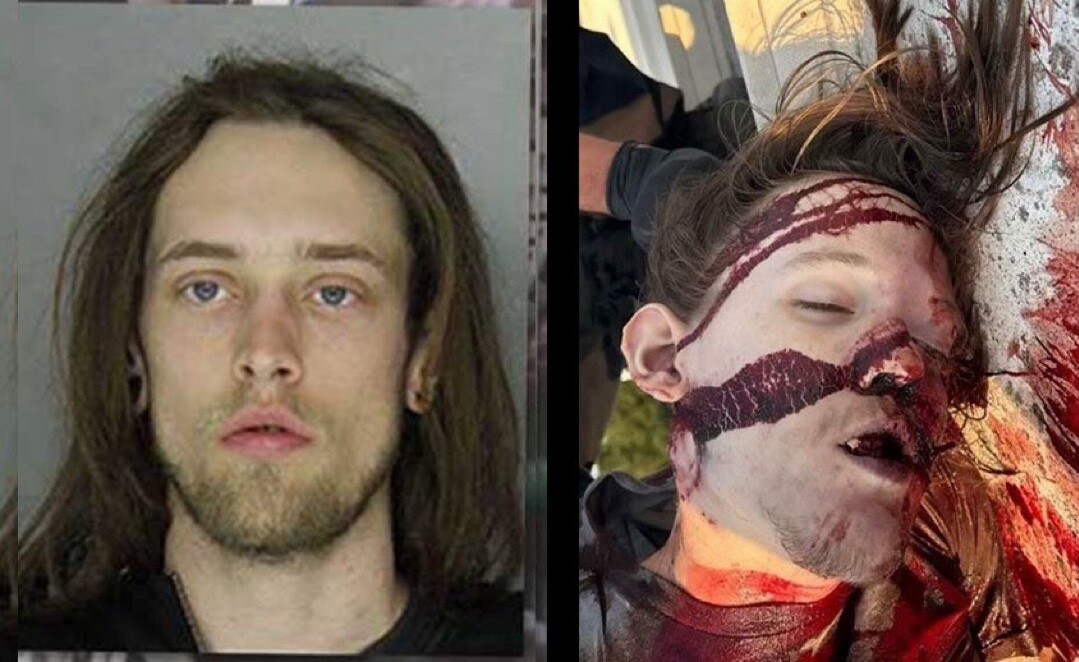
Moreover, the photographs of the deceased shooter do not convincingly identify Thomas Crooks. They do, however, strongly resemble the likeness of antifa activist Maxwell Yearick.

According to Assets Magazine, “Maxwell Yearick was under FBI radar before he shot Trump.” The 30-year-old antifa activist didn’t just have an extensive history of attending lefty protests around the country, but also a criminal career beginning with a convenience store burglary when he was 17. Interestingly, Yearick was also arrested in 2017 for assaulting a police officer in Pittsburgh at a Trump rally.

Photo evidence clearly favors the hypothesis that Maxwell Yearick was the shooter, not Thomas Crooks. If this is true, it means the FBI lied yet again to the American people, deliberately hiding the identity of a suspect with a history of getting arrested at antifa actions. This is the same FBI that lied to the FISA court 17 times to tap Donald Trump’s phone, the same FBI that lied about Hunter Biden’s laptop, and the same FBI that raided Trump’s Mar-a-Lago property. They’re not beyond lying to the public. It’s part of their job description.

Yearick’s social media accounts were also scrubbed.

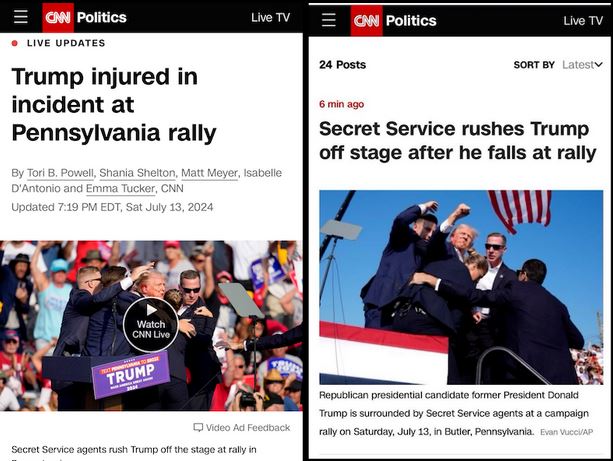
Meanwhile, the corporate media fell all over itself trying to frame the story as anything but an assassination attempt. The Washington Post’s front page headline read, “Trump rushed off stage after loud noises at rally.” CNN ran with the headline, “Secret Service rushes Trump off stage after he falls at rally.”

After the shots rang out in Butler, the Biden Administration wasted no time politicizing the assassination attempt to disarm Americans through more anti-gun legislation, explicitly to outlaw the AR-15. The Biden White House also pulled their “Trump is Hitler” adverts before hypocritically wagging a finger at their opponents to “tone down the political rhetoric.” Senator J.D. Vance of Ohio tweeted in response to this hypocrisy on the night of the shooting:

Today is not just some isolated incident. The central premise of the Biden campaign is that President Donald Trump is an authoritarian fascist who must be stopped at all costs. That rhetoric led directly to President Trump’s attempted assassination.”

President Biden got himself in hot water for reportedly saying to donors: “I have one job, and that’s to beat Donald Trump… So, we’re done talking about the debate, it’s time to put Trump in a bullseye. Biden has since attempted to walk back his “bullseye” statement by claiming that, I intended to say crosshairs.”

Just two weeks earlier, on 01 July 2024, the Huff Post published an article entitled, “Supreme Court Gives Joe Biden The Legal OK To Assassinate Donald Trump.” Legal experts weighed in on how the SCOTUS decision granting Presidential immunity for “official acts” might now extend as far as “the power to assassinate a rival”.

At 6:00 p.m. Saturday, just moments before the shooting, Biden’s Facebook page posted that “Americans want a president, not a dictator.” Two weeks earlier Biden called Trump a “genuine threat to this nation” in a tweet. But 90 minutes after the shooting failed, Biden flipped his narrative completely and said that he was “grateful” for Donald’s safety, and that, “There’s no place for this kind of violence in America.” Remember that it was Biden’s DHS that smeared Trump supporters and military veterans as potential domestic terror threats.

It’s also worthy to note that the day before the shooting, LinkedIn co-founder and Democrat mega-donor Reid Hoffman joked that he wished he had made Trump “an actual martyr.” Then Hoffman’s top political adviser declared the assassination attempt was a hoax staged by Trump, calling it a “classic Russian tactic”.

Two weeks prior to the shooting, Lea DeLaria from the Netflix series Orange Is The New Black actually begged President Joe Biden to “blow him up.” Lincoln Project co-founder Rick Wilson said it was time to “put a bullet in Donald Trump.”

The countless occasions that Hollywood personalities have publicly fantasized about violence against Trump also include Snoop Dogg’s portrayal of shooting Trump in the head with a pistol, Kathy Griffin’s decapitated and bloodied Trump head, and Madonna announcing in front of a crowd that she was thinking “an awful lot about blowing up the White House.”

One month prior to the shooting, the FBI rooted out Trump supporters from their ranks. FBI employees were all asked whether they have affinity for President Trump or not, and dismissed from their jobs if they did.

It’s not therefore surprising that an FBI staffer named Jenna Howell deleted her social media accounts after expressing regret that Trump had not been killed in Butler. But she’s not the only state official who took to social media to condone high acts of treason.

Democrat Congressman Bennie Thompson – who led an effort to remove Trump’s Secret Service detail altogether on the grounds that he’s a convicted felon and therefore “disgraced” – was forced to terminate his field director for posting a “don’t miss next time” statement on social media:

After the failure to pass the DISGRACED Former Protectees Act and the unsuccessful assassination of the former president, a staffer for Thompson reportedly made a now-deleted Facebook post suggesting that the now-deceased 20-year-old shooter Thomas Matthew Crooks “needed shooting lessons” to succeed.

Adding to the suspicious circumstances is the fact that CNN doesn’t ever live-stream Trump rallies but for some reason decided to stream the one in Butler on July 13th. Had the bullets hit their mark, CNN would have almost definitely played the horrific footage on repeat for the rest of the day exactly like they replayed the collapse of the Twin Towers on September eleventh.

Also reminiscent of 9/11 was the Bush-connected Texas hedge fund called Austin Private Wealth LLC that got caught massively shorting Trump’s stock as if they knew that something was about to dramatically affect Trump’s business empire. APW shorted 12 million shares of Trump Media stock and 34 million shares of Rumble the day before the assassination attempt, betting against the health of those stock prices in a corrupt reflection of “put options” intended to short airline stocks in the days leading up to 9/11. Financial magazine Finbold revealed:

This surge indicates that individuals or large organizations anticipated a significant drop in the stock’s value by July 15, a scenario that would likely have materialized had President Trump died in Pennsylvania.”

A plurality of voices are calling Trump’s survival an act of divine intervention. Christian visionary Brandon Biggs foresaw Trump’s bloodied ear three months before the assassination attempt occurred and the doctor who later attended to Trump called his survival a “miracle”.

Archbishop Carlo Maria Viganò noted how anti-globalist political leaders are being targeted with assassination attempts:

The archbishop pointed out that Slovak Prime Minister Robert Fico and Hungarian Prime Minister Victor Orbán have suffered “similar criminal attacks,” and share with Trump a “staunch opposition to the New World Order” and “defense of national sovereignty.”

Diane Sare, an Independent New York candidate for Senate, explicitly issued a warning two weeks earlier that an assassination attempt on Trump was imminent, in part due to his stance on Ukraine:

On July 1, I warned of a possible threat to the life of the former president. (See “Sare Warns of Possible Threat to Trump” in July 2024 The New Federalist) I warned of this in the context of the failed assassination attempt against Slovakian Prime Minister Robert Fico, who miraculously survived after being hit by several bullets on May 15. Like President Fico, former President Donald Trump is committed to bringing an end to the Russia/Ukraine conflict.

Tucker Carlson was previously mocked by corporate media earlier this year for correctly anticipating the obvious escalation against Trump as likely leading toward assassination. And now that Trump has literally dodged a bullet, can’t we can expect the escalation against him to continue even further? Democrats have repeatedly insisted that he must be prevented from entering the White House “at all costs.” Does that also entail a willingness to commit an act of high treason? Tucker Carlson has since asserted the conclusion that seems obvious enough to everyone paying attention:

“It was an effort to kill Trump. It wasn’t just a lone gunman.”

The shooting took place just two days before the Republican National Convention which Trump was not dissuaded from attending. The episode has dramatically increased Trump’s popularity, coaxed closet Trump supporters out of the shadows, and transformed his most loyal supporters into fanatics. While the Democratic Party continues to fall apart, the assassination attempt on Trump has galvanized Republicans and united them like never before. The Republican National Convention wasn’t just a landslide for Trump. It was unanimous.

Trump’s popularity didn’t only see a dramatic boost with conservatives. Even Meta CEO Mark Zuckerberg had to admit that the Trump photograph was, “one of the most badass things I’ve ever seen in my life,” adding that,I think you’re going to see our services play less of a role in this election than they have in the past.” This is quite a statement given the overwhelming influence that social media platforms have enjoyed during previous elections.

Meanwhile in Florida, Jack Smith’s prosecution effort over the alleged mishandling of classified documents was immediately thrown out on the grounds that Smith was illegally appointed to his office. Ben Whedon opines that the dismissal spells the end to the ongoing lawfare against the Trump estate.

The most burning questions remain unanswered: How was the shooter able to get so close? Why was that roof unoccupied? Why didn’t authorities respond when they were warned about a man with a gun? Why didn’t they postpone the event to deal with the threat? Since when are the Rules of Engagement for the Presidential security detail: “do not fire unless fired upon”? And why did they fail to clear the roofs of several nearby buildings with Line Of Sight to the stage?

Plotting to murder a president is undoubtedly an act of treason, the culpability of which extends to all relevant accomplices. So what is the penalty for treason? For the answer to that, look no further than former Massachusetts governor Bill Weld‘s declaration in 2019. Appearing on CNN to spew unsubstantiated conspiracy theories about the debunked Russian collusion narrative, Weld proudly stated that:

The penalty for treason under the US code is death. That’s the only penalty,”

The smart money agrees with Bill. Conspiring to assassinate the American President easily fits the textbook definition of treason. But as is the case with any deep state assassination or military coup, we may never know what really happened on 13 July 2024. When it comes to state crimes, evidence tends to get destroyed and witnesses are liable to disappear while the feds spoon-feed lies to the corporate media. Nevertheless, the catastrophic lapses in protocols are too numerous and mind-boggling to excuse as just a security failure. The sum of the failures extends well beyond the simplistic notion of coincidental incompetence. Beyond that, the GOP had already begun investigating the Secret Service before last Saturday’s assassination attempt even occurred. Butler was clearly a setup, though we may never find out who ultimately orchestrated it.

The Julian Assange Victory Is A Triumph Worth Celebrating

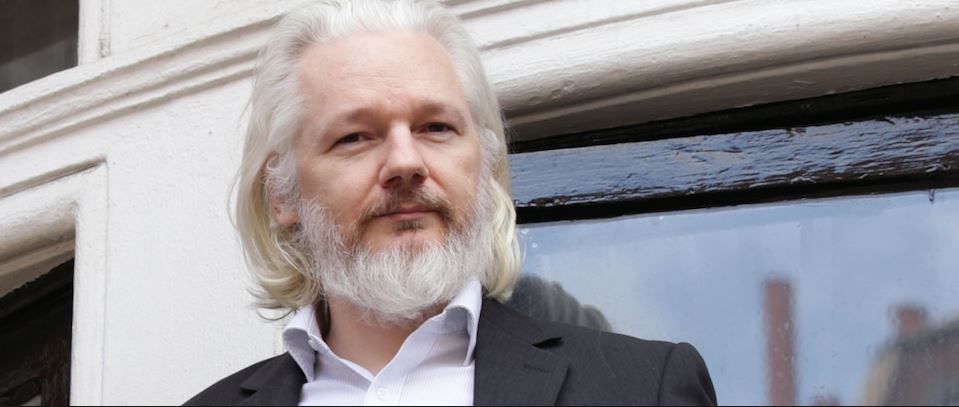
After nearly fourteen years in exile, WikiLeaks founder Julian Assange was finally reunited with his family last week. Assange survived a decade-and-a-half of incarceration, from his 2010 London arrest to seven years of “asylum” in the Equadorian embassy and then 1,901 days of solitary confinement that involved psychological torture (Assange endured a kind of “chemical lobotomy” when he was psychologically tortured with a psychotropic drug known as 3-quinuclidinyl benzilate, aka “BZ”).

What the American and British governments have done to the world’s most important journalist can be described as nothing short of monstrous and really shows how effective his organization was. WikiLeaks exposed more government corruption and corporate crimes than all other news agencies combined, delivering countless successive master strokes that cumulatively crippled the deep state.

WikiLeaks proved to the world that CIA created ISIS. WikiLeaks published the secret bibles of Scientology. WikiLeaks chronicled America’s illegal 2003 invasion in the Iraq War logs, confirmed the existence of the shadowy Bilderberg Group meetings, and made us aware of the monstrous “trade agreements” known as TPP, TISA and TTIP – elaborate corporate wish-lists aimed toward achieving total fascistic rule. Wikileaks also thoroughly documented Israel’s crimes against humanity.

The Afghan War Diaries outlined how, “U.S. Units are inclined to classify civilian kills as insurgent kills, downplay the number of people killed or otherwise make excuses for themselves.The Stratfor emails revealed how activists were targeted by a private intelligence agency working on behalf of corporate America. The Guantanamo Bay Camp Delta Standard Operating Procedures confirmed the incarceration of the innocent.

In 2017 WikiLeaks posted a trove of CIA documents called “Vault 7,” revealing capabilities such as the ability to remotely commandeer phones, browsers, TVs and even automobiles, and then Vault 8 which revealed the source code behind CIA malware programs.

And let’s not forget that WikiLeaks was instrumental in scuttling Edward Snowden out of Hong Kong ahead of extradition efforts.

But the primary reason for Assange’s persecution was always the dissemination of the notorious Collateral Murder video and subsequent egg on the Pentagon’s face after the world watched in horror as the crew of an AH-64 Apache gunship audibly delight in mowing down a crowd of unarmed civilians (including two Reuters reporters) with recurrent volleys of 30mm rounds.

John Pilger puts it thusly:

No investigative journalism in my lifetime can equal the importance of what WikiLeaks has done in calling rapacious power to account.

Comedian and journalist Lee Camp elaborates:

“WikiLeaks posted videos of Tibetan dissidents in China fighting back, videos which were not allowed to be viewed in China. They revealed the Peru oil scandal, and that Russia was spying on its citizens’ cell phones, and the Minton Report on toxic dumping in Africa, and the Syria Files—showing the inner workings of the Syrian government. And WikiLeaks displayed to the global audience a secret Australian supreme court gag order that stopped the Australian press from reporting on a huge bribery scandal that involved the central bank and international leaders.”

None of the criminals implicated by the evidence supplied by Julian Assange were ever indicted or arrested for their crimes, but Assange was punished severely for revealing them. Assange embarrassed many of the world’s most powerful sociopaths who have since done everything in their power to destroy him. Nils Melzer, the United Nations’ special reporter on torture, determined that Assange has undergone “prolonged psychological torture” at the hands of British authorities:

“I was able to visit Mr. Assange in Belmarsh Prison,” Melzer said in the interview. “I was accompanied by two medical experts—a forensic expert and a psychiatrist. Both of them were specialized in identifying, examining and documenting psychological and physical torture. What we found was Mr. Assange showed all the symptoms that are typical for a person who has been exposed to prolonged psychological torture. What we’re talking about is severe traumatization. Chronic anxiety. Intense, constant stress, and an inability to relax or focus, to think in a structured, straight line. Someone who is in a constant, hyper-stimulated stage and can no longer relax.”

Washington has bent itself over backwards trying to destroy Julian Assange, but there’s arguably nobody who wanted his head more than Hillary Clinton, who is on record asking,

Can’t we just drone this guy?

The DNC emails provided proof that the Democratic primaries are rigged, that the corporate news media were colluding with Hillary, that Obama’s entire cabinet was chosen for him by Citibank, that Trump was chosen by Clinton as the Republican nominee, and that millions of Saudi dollars had found their way into the Clinton Foundation. As Chris Hedges put it:

We learned from the emails published by WikiLeaks that the Clinton Foundation received millions of dollars from Saudi Arabia and Qatar, two of the major funders of Islamic State. As secretary of state, Hillary Clinton paid her donors back by approving $80 billion in weapons sales to Saudi Arabia, enabling the kingdom to carry out a devastating war in Yemen that has triggered a humanitarian crisis, including widespread food shortages and a cholera epidemic, and left close to 60,000 dead. We learned Clinton was paid $675,000 for speaking at Goldman Sachs, a sum so massive it can only be described as a bribe. … We learned the Clinton campaign worked to influence the Republican primaries to ensure that Donald Trump was the Republican nominee. We learned Clinton obtained advance information on primary-debate questions. We learned, because 1,700 of the 33,000 emails came from Hillary Clinton, she was the primary architect of the war in Libya. We learned she believed that the overthrow of Moammar Gadhafi would burnish her credentials as a presidential candidate.”

Writing for Mint Press, Alan MacLeod adds:

“The Hillary Clinton campaign alleges the emails were hacked from Podesta’s computer. The published communications, the authenticity of which is not in doubt, informed the country of the machinations of the Democratic Party, how it tipped the electoral scales in favor of Clinton and against Bernie Sanders in the primary, how Clinton stated to Wall Street that she had a “public” and a “private” position on regulation, insinuating she was lying to the nation, how representatives of Qatar wanted to meet with her husband Bill for “five minutes” to present him with a $1 million check for his birthday, and how her own staff held her in contempt.”

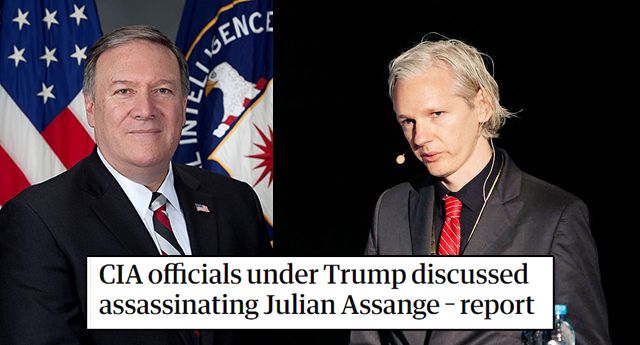
Many leading figures of the Anglo-American Empire have publicly endorsed the assassination of Julian Assange. The Snowden leaks revealed that Assange was on America’s “manhunt target list.” Pompeo, Trump’s CIA chief, referred to WikiLeaks a “non-state hostile intelligence service.” And while they certainly didn’t do anything as high profile as droning him, assassinations were nevertheless attempted, albeit with more conventional methods. According to WikiLeaks’ lawyer Edward Fitzgerald, American spies plotted to kidnap Julian Assange, poison him, and make it look like an accident, in cooperation with Ecuador’s security outfit UC Global.

When news of this assassination plot started making its way through the courts, a plea deal was suddenly negotiated and Assange was instantly freed.

On Monday, 24 June 2024, Julian Assange was released from Britain’s Belmarsh Prison under the arrangement that he would be flown to a US court and plead guilty to a single count of Espionage Act violation. Assange was then flown to Saipan of the Pacific’s Northern Mariana Islands for his court appearance.

On Wednesday, 26 June 2024, Assange pled guilty to violations of the American Espionage Act, even though he’s not an American citizen, admitting to possessing and accessing materials related to America’s national defense.

From Anti War:

During the court proceedings, Assange said he was guilty of violating the Espionage Act. “Working as a journalist, I encouraged my source to provide classified information to publish it. I believe the First Amendment protected that,” he told the court. “I accept it’s a violation of an espionage statute.”

He added, “The First Amendment and the Espionage Act are in contradiction.”

The fact that Assange is the first-ever journalist to be prosecuted successfully under the Espionage Act has flustered free speech advocates as a precedent-setting decision in Law. However, as we’ll discuss more thoroughly in a moment, this plea doesn’t necessarily set legal precedent as much as it protects the US Government from future legal actions in the form of compensation for wrongful imprisonment, cruel and unusual punishment, etc.

WikiLeaks was so effective in its ability to expose the powerful that it quickly became a priority for the intelligence community to intervene. Since WikiLeaks publications couldn’t be disproved and Assange never committed any criminal acts, the Deep-State-“Blob“-brain-trust decided that the best way to undermine the organization was to destroy Assange’s image and discourage people visiting WikiLeaks, even if it meant portraying WikiLeaks as “in cahoots with the Taliban” and Osama Bin Laden.

Legendary journalist John Pilger outlined the DoD’s coordinated attack on Assange’s reputation, which included the Hollywood movie that deliberately insulted Assange’s character as “callous” and “damaged”:

In 2008, a plan to destroy both WikiLeaks and Assange was laid out in a top secret document dated 8 March, 2008. The authors were the Cyber Counter-intelligence Assessments Branch of the US Defense Department. They described in detail how important it was to destroy the “feeling of trust” that is WikiLeaks’ ‘centre of gravity’.”

The intelligence community also manufactured and repeated the highly dubious accusation that the actions of Assange and WikiLeaks have somehow endangered American service personnel. According to Aaron Kesel :

U.S. lawyers have falsely claimed that Assange’s publishing of the Iraq and Afghanistan war diaries endangered lives, a claim that is debunked by the Pentagon’s own admission that there is no evidence that any of WikiLeaks’ actions have caused even a single death, as Glenn Greenwald previously reported for Salon during the court trial of whistleblower Chelsea Manning.”

Assange didn’t endanger Americans, but he did expose Hillary Clinton. In retaliation, the Democratic Party sued Russia, Trump and WikiLeaks for “conspiring to hurt Hillary in 2016”. In another unprecedented move, the DNC served WikiLeaks with the lawsuit via twitter following what they claimed was a failed attempt to serve the papers by Email.

American intelligence services went on to claim that the Hillary and DNC Emails released by WikiLeaks were “stolen by Russian hackers.” As purported evidence of this claim, Guccifer 2.0 publicly postured as WikiLeaks’ source, first boasting that it hacked the DNC but then later admitting the documents originated from DNC staffer Seth Rich (whose murder led WikiLeaks to offer a $20,000 reward for finding the culprit). Then there was the “explosive” Guardian report about Secret Manafort-Assange Meetings that turned out to be nothing more than evidence-free propaganda puff.

As MintPress’ Mnar Muhawesh wrote in 2019:

The allegations that Assange conspired with Putin to undermine the 2016 election and American democracy as a whole fell completely flat earlier this month when a U.S. District Court for the Southern District of New York dismissed this case as “factually implausible,” with the judge noting that at no point does the prosecution’s “threadbare” argument show “any facts” at all, and concluding that the idea that Assange conspired with Russia against the Democratic Party or America is “entirely divorced from the facts.”

The “Blob” eventually abandoned their flimsy attempts to link Assange to Russia altogether. Shifting gears, it was decided that a good old sex scandal might finally do the trick, and Assange’s visit to Sweden would provide the setting for their next great plan. Researchers Kevin Zeese and Margaret Flowers outlined just a few of the eyebrow-raising circumstances of the Swedish sex fiasco:

Sweden’s charges against Assange were initially dropped by the chief prosecutor, two weeks later they found a prosecutor to pursue a rape investigation. One of the women had CIA connections and bragged about her relationship with Assange in tweets she tried to erase. She even published a 7-step program for legal revenge against lovers. The actions of the women do not seem to show rape or any kind of abuse. One woman held a party with him after the encounter and another went out to eat with him. In November 2016, Assange was interviewed by Swedish prosecutors for four hours at the Ecuadorian embassy. In December 2016, Assange published tweets showing his innocence and the sex was consensual. Without making a statement on Assange’s guilt, the Swedish investigators dropped the charges in May 2017.”

Nils Melzer explained a critical detail that’s been overlooked by most western media outlets:

“What is called a rape allegation [in the Swedish case] is not what would be called a rape in English or Swedish or any other language in the world,” Melzer said. “I know what I’m talking about because I speak Swedish. What the rape allegation refers to is an offense that doesn’t involve any violence. He has been alleged of intentionally ripping a condom during consensual intercourse with a woman. She said it was intentional. He said it was an accident. Predictably, this is something no one will ever be able to prove. The piece of evidence submitted to the prosecution, the condom, was examined and did not have any DNA on it from him, or from the complainant, or anyone else.”

John Pilger also helped reveal that, “Neither woman claimed she had been raped. Indeed, both denied they were raped and one of them has since tweeted, ‘I have not been raped.’” Pilger went on to say that the Assange case has never been about Swedish sexual misconduct allegations, and the behavior of prominent officials in the case seemed inherently suspicious:

On 30 August [2010], Assange attended a police station in Stockholm voluntarily and answered the questions put to him. He understood that was the end of the matter. Two days later, Ny announced she was re-opening the case. …

For five weeks, Assange waited in Sweden for the renewed “rape investigation” to take its course. The Guardian was then on the brink of publishing the Iraq “War Logs”, based on WikiLeaks’ disclosures, which Assange was to oversee in London.

Finally, he was allowed to leave.As soon as he had left, Marianne Ny issued a European Arrest Warrant and an Interpol “red alert” normally used for terrorists and dangerous criminals.

After Swedish authorities issued the international arrest warrant, Assange turned himself in to the London police. In December 2010 the British court granted bail for Julian under the understanding that his extradition to Sweden was pending. Until his court cases were resolved, he was required to remain in England.

In August of 2012 Julian Assange was granted asylum at the Equadorian Embassy in London by then Ecuadorian president Rafael Correa, who was sympathetic to WikiLeaks and disliked by western industrial powers. The UK court declined to reverse Assange’s arrest warrant for violating his bail terms. It was understood that if Julian left the embassy at any time he would immediately arrested by British authorities for “skipping bail,” a situation he remained trapped within for over five years and depicted by CNN as a literal shit-smearing imposition upon the Ecuadorians.

While Assange was holed up in the embassy, a Spanish security company called UC Global conducted espionage operations targeting him on behalf of the CIA. Everything in the embassy from fire extinguishers to the women’s bathroom was bugged to monitor Assange’s every move.

Glen Greenwald outlined how Assange’s rapport with Ecuador began to deteriorate when NATO became outraged that WikiLeaks was calling attention to Spain’s brutal treatment of the Catalan independence movement. Ecuador blamed Assange for putting its relationships with other countries at risk:

The tensions between Ecuador and Assange center on the debate in Spain over Catalan independence. On October 1, 2017, the autonomous region of Catalonia held a referendum for independence. The Spanish government declared this referendum illegal. Protests and arrests of Catalan activists ensued, as well as the seizure of ballots and raids on polling stations by the government in Madrid. …

“El País, days later, began depicting Catalan activists as a tool of the Kremlin. The paper published an article alleging that not only Assange, but also Edward Snowden, were helping Russian propaganda networks spread “fake news” about Catalonia. El País repeated these claims in subsequent stories, which were echoed in reports from other anti-separatist organizations, such as the Spanish think tank Elcano Royal Institute, Atlantic Council’s Digital Forensics Research Lab, and NATO’s StratCom.”

In January 2018, Julian was granted citizenship by Ecuador. But just a few months later Lenín Moreno became the newly-elected president of Ecuador, which was bad for Assange. It would be an understatement to describe Moreno as less sympathetic to Assange’s situation and more subservient to the Anglo-American Empire. Ecuador’s former foreign minister Guillaume Long described Moreno as “a Shakespearean traitor” whom he says “betrayed Correa, he betrayed his party, he betrayed his electorate…he betrayed Ecuadorians, and he betrayed democracy, and he certainly betrayed Assange.”

Between March and October 2018 the Equadorian government cut off Assange’s access to internet and phone. Moreno’s administration immediately began preparations to hand Assange over to the British while publicly declaring that Assange was a “hacker“, “an inherited problem” and a “stone in the shoe.” Motivating these statements was the $4.2 billion worth of loan guarantees from the International Monetary Fund (IMF) to Ecuador in the form of a debt relief package”:

“In March 2019, the International Monetary Fund (IMF) approved a $4.2 billion financing deal to support the Ecuador government over the next three years. Authorities subsequently “suspended” Assange’s citizenship and ended his asylum, without much notice, on April 11.”

Three weeks after Ecuador secured their giant IMF loan, Moreno authorized British authorities to circumvent international law by entering the Ecuadorian embassy in London. And on 11 April 2019 Julian Assange was forcibly removed from the embassy and subsequently placed into a year of solitary confinement in Belmarsh’s isolation wing.

The English court originally sentenced Assange to a single year in jail for the crime of skipping bail. But just a few months later the judge ordered Assange’s incarceration be extended indefinitely while his extradition was negotiated.

The US government pursued 18 charges against Assange in his 2020 extradition hearing that would have amounted to an unprecedented sentence totaling 175 years in prison. Caitlin Johnstone summed up the 2020 extradition hearings as “a self-contradictory kafkaesque nightmare.

The judge had strong conflicts of interest and should have recused herself since her husband was previously exposed by WikiLeaks for his role in bribing officials in exchange for lucrative arms contracts.

Then there was the humiliating glass cabinet.

In a scene straight out of Mike Judge’s Idiocracy, Julian Assange was confined within in a glass box at the back of the courtroom during his 2020 extradition hearings. Beyond this humiliating exhibition of the state’s sadism grew a cacophony of bizarre circumstances that created incomprehensible delays throughout Assange’s extradition hearings.

The judge ultimately ruled against extradition, but only on the grounds that America’s draconian prison system was determined to present a high suicide risk to Assange.

Glenn Greenwald tweeted at the time of the ruling:

“This wasn’t a victory for press freedom. Quite the contrary: the judge made clear she believed there are grounds to prosecute Assange in connection with the 2010 publication. It was, instead, an indictment of the insanely oppressive US prison system for security ‘threats’.”

The 17 charges of Espionage Act violations attempted in vain to criminalize activities protected by the First Amendment, while the single hacking charge was demonstrably false given that Assange never hacked into anything. Even after Washington unveiled the Orwellian charge of “offering to hack into a government computer” (allegedly to help Chelsea Manning conceal her identity) the government was forced in the end to concede that no such hack ever took place because there wasn’t any evidence and Manning refused to testify.

Throughout their campaign to destroy WikiLeaks and ruin Julian Assange, Washington has consistently touted violations of its Espionage Act. But the notion that standard newsroom practices (like source protection) can be conflated with “criminal conspiracy” was always a flimsy claim founded on a dubious interpretation of law.

Ecuadorian President Moreno’s termination of Assange’s asylum was unlawful by international standards, as was UK Prime Minister Theresa May’s order of British police to cross onto sovereign territory to arrest a person who has never committed a crime. Going back even further, Attorney General Jeff Sessions insisted that arresting Assange was a top priority even though Assange was not an American citizen and his organization was not based in the states.

The fundamental question was articulated by Caitlin Johnstone:

Should journalists be jailed for exposing US war crimes? Yes or no?”

Chris Hedges began answering this question in 2019:

“The publication of classified documents is not a crime in the United States, but if Assange is extradited and convicted it will become one. Assange is not an American citizen. WikiLeaks, which he founded and publishes, is not a U.S.-based publication. The message the U.S. government is sending is clear: No matter who or where you are, if you expose the inner workings of empire you will be hunted down, kidnapped and brought to the United States to be tried as a spy.”

While Hedges was correct to assert that publishing classified documents is not a crime, whether Assange’s extradition would have changed that seems dubious because there are countless constitutional lawyers who would have never stood for such a thing. It would have been challenged in court because selective enforcement of the Law does not then nullify the Law. Abuses are not precedent-changing when they were illegal to begin with. And on top of it all, Assange was never successfully extradited to the United States.

Beyond that, altering precedent requires a ruling by an appellate court:

[…] Bruce Afran, a US constitutional lawyer, argued that Assange’s plea will not expand the Justice Department’s powers to target journalists. “A plea is not precedent. Precedent consists of a decision interpreting a matter of law by an appeals court that will govern future cases on the same legal principle,” he explained. “In contrast, a plea is merely a factual agreement by a given defendant that they did a certain act, but does not bind future defendants in similar cases.”


It’s also important to acknowledge that Julian Assange’s plea was given under duress, further nullifying the entire legal process, and only as a mercy to prevent him from dying in prison. This brings us to Blob-Monster-Mike Pompeo’s preposterous double standard that First Amendment protections don’t extend to foreigners but our courts do:

We also learned that the United States do not consider foreign nationals to have a First Amendment protection, so the US is effectively saying that the long arm of US law can extend to get you anywhere, but they also don’t have to extend its protections.”

Judges and juries are required to align their decisions based solely on the Law, and the First Amendment remains the judicial standard of the land here, regardless of circumstances. The US Constitution explicitly protects publishers, journalists and whistleblowers. The courts cannot lawfully ignore the First Amendment just because they don’t like a person. In fact, they’ll very likely be overturned later if they decide to forgo constitutional jurisprudence for a short-term gain. The First Amendment guarantees each citizen’s right to offend others, and others’ right to say offensive things back because that’s how arguments are resolved.

Bullshit legal presumptions can and should always be rebutted, and it’s the duty of active citizens to participate in swatting down the dangerous delusions of pernicious parasites and exploitative predators who abuse the law for their own profit and gain. Lawfare intimidation cannot ever be allowed to set legal precedent, which is why unlawful presumptions must always be challenged by citizens of conscience who understand that eternal vigilance is the price of liberty.

Throughout his career, Chris Hedges repeatedly told his audiences:

“I do not fight fascists because I will win. I fight fascists because they are fascists.”

Johnstone echoed this sentiment at the top of 2021 when she wrote,

“I’m not going to take that as a sign that we’ve won the war, or even the battle. But it is a sign that our punches are landing. And that we’ve got a fighting chance here.”

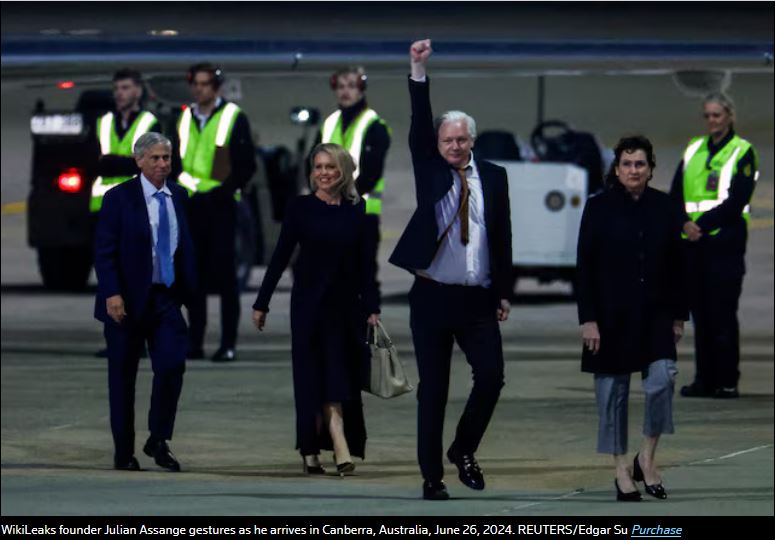
As soon as Assange was safely reunited with his family in Australia we learned about the $520,000 airplane bill. Because Assange was denied any opportunity to fly commercially, the Australian government chartered a private plane which left him half-a-million dollars in debt. Whether this debt amounted to a final “fuck you” from the authorities or not, it did not rain on the welcome parade.

After the airline’s price tag was announced on social media, donations poured in from every corner of the globe and within ten hours the debt was paid in full.

Assange’s supporters have achieved nothing short of a series of decisive victories for press and speech freedom by securing his release. They’ve succeeded in preserving his reputation in the face of an overwhelmingly well-funded and state-sanctioned smear campaign and in preventing his extradition to the United States. Many of us expected the government to make sure Assange died in prison, but public pressure ultimately prevailed. And even when it seemed his freedom had come with an enormous price tag, his supporters overcame that as well.

While it’s absolutely true that the powerful may try their damnedest to corrupt the law, that doesn’t mean the rest of us must accept their corruption. It’s the other way around. When authorities become irrational the citizenry must stop cooperating with them. And this spirit of defiance made manifest is the real triumph of WikiLeaks.

Julian and Stella Assange embrace after nearly fourteen years apart

This Is Why Missoulians Can’t Have Nice Things

Who benefits from rising property taxes? Why does Missoula need another special tax levy to keep the firefighters in business when property taxes are already sky high as it is? And why are the lords of Missoula’s budget exempt from the election process?

As Missoulians reluctantly brace for the imminent effects of last year’s 37% property assessment increase (and subsequent 21% property tax increase) a major share of the fault lies with the unorthodox drain on municipal budgets that’s always justified through the ever-profitable concept of redevelopment. An unelected body of members loyal to the Missoula Redevelopment Agency (MRA) now ultimately decides where Missoula’s tax money goes and how it’s divvied out. More often than not large quantities of our tax money gets skimmed and funneled to crony donors instead of where it should be going: schools, roads and municipal services.

Missoula locals are constantly forced to accept special tax levies to sustain services we’re already paying for because the general fund never seems to have any money in it. Taxpayers cannot reverse this trend through voting because none of the bureaucrats responsible for these tax abuses were ever elected by voters. By dominating the management of Missoula’s tax dollars and what those dollars pay for, the MRA consistently proves that it has more power than any elected figurehead. Mayors come and go but the permanent bureaucracy of the MRA maintains a uniform continuity of governance, and they do it with something called Tax Increment Financing (TIF).

The stated and primary purpose of TIF is “to increase taxable value,” which is great for banks, developers and bureaucrats who profit from the plight of workers and retirees. For property owners, increasing the taxable value of their homes means paying higher property taxes, but without any kind of corresponding increase in government services. For renters that means increased rents. For the countless workers who cannot magically double their income overnight, such increases signal their imminent displacement. This game of musical chairs leaves someone without a place to live at the end of every round and only the biggest bank accounts can prevail.

Naturally, the intractable parasites who’ve grown addicted to tax money have a deep-seated fear of public awareness. Runaway redevelopment agencies all too often rely on public ignorance of the law to abuse it to the extent that they have, and make claims of public benefit that are demonstrably false to cover their tracks. After Missoula officials publicly mocked their constituents in 2020 for our alleged ignorance of TIF, Fortune 500 CFO Bob Moore publicly declared to the City Council:

I understand [TIF] very well. It’s nothing but taking taxpayer money and giving it to developers and builders and calling it investment.”

TIF bonds are so coveted and controversial that those who consistently profit from them expend great deals of energy and resources attempting to convince the public that our lives would collectively fall apart without them. But beyond the hypothetical promises of “free money” and healthier cities, TIF turns out to be just another insidious profiteering scheme that feeds off of public money. This mechanism remains shrouded by acronym and is cleverly designed to smokescreen reality behind complicated financial terminology that ensures most people will never bother figuring out what makes it tick, including legislators and policy makers.

Over the decades the TIF law has morphed from a pledge to eliminate urban blight into the duct-tape solution for every municipal pipe dream. Since their inception half a century ago, urban renewal agencies around the country have often abused their authority and consistently transformed TIF into a mechanism to rob struggling taxpayers in order to provide giant subsidies to large organizations and fund the pet projects of favored donors. Whatever its original intentions, TIF has proven as vulnerable to nefarious activity in the Treasure State as it has in many others.

The word “blight” as defined in the Montana State code allows for any and every possible interpretation, including wildly imaginative perversions like “future blight” and several shades of figurative blight. The law as currently written is rife with loophole opportunities, allowing TIF addicts to interpret whatever definition of blight they want while also technically operating within the letter of the law. As a result, local officials bend themselves into pretzels figuring out as many new ways as possible to spend taxpayer dollars on anything but what they’re intended for: schools, roads and municipal services!

To “improve” these so-called “blighted” areas, TIF-addicted governments accept debt from banks to catalyze solutions. That debt is supposedly paid off with revenue generated by new residents and businesses that benefit from the blight remediation. Since TIFs theoretically pay for themselves by raising the property values of surrounding areas, those adjacent properties are directly affected by the newly elevated values because they create higher tax burdens. Therefore, TIF is meant to increase taxable value of property, and this hurts local citizens and fixed-income taxpayers. Worse still, since many TIF subsidies are provided to out-of-state corporations, local businesses are forced to stand idly by as their tax dollars are literally weaponized against them, economically prioritizing the interests of outside competition. Short-term gains leave long-term residents holding the shit-end of the stick.

Officials who’ve grown dependent on TIF will insist it’s the only tool they have. They’ll say they need it to subsidize affordable housing, to provide incentives for business developments and real estate investment, for job creation, to assist nonprofits, and to grow the tax base. But former Montana Legislator (and former Missoula City Councilman) Adam Hertz asserts that TIF isn’t meant to pay for any of that:

Those are all great things. None of them are mentioned in state law when it comes to urban renewal districts.”

Despite what tax addicts may claim, the TIF statute says nothing about economic development, job creation or housing. It’s for blight remediation, not a blank check for vertical development.

If the only tool you have is a hammer, every problem tends to look like a nail. After years of increasingly misusing and abusing the TIF hammer, Missoula began attracting criticism from a former MRA director. Geoff Badenoch, who directed the Missoula Redevelopment Agency for the 18 years before the reign of Ellen Buchanan, had this to say about Missoula’s dependence on and addiction to TIF:

If you find there’s a temptation to use a tool too often, you’re not a good craftsman. … The thing about tax increment is, it’s so tempting to use it because you don’t have to go to the voters for it. There’s millions lying around.”

One of the core problems with TIF in modern Montana lies with the fact that public money is spent against popular will by an unelected body. The most powerful bureaucrats in our governments are never vetted by voters, but appointed to their positions, sometimes for decades. Ellen Buchanan is working on her third consecutive decade as chief meddler in Missoula’s piggy bank, and there’s nothing that voters can do about it.

Ellen Buchanan, Master of Deficit

Windbag politicians flap their jaws advocating for things like workforce housing, zoning reform, increased subsidies, housing-choice vouchers and trickle-down rent relief to address the symptom of rising homelessness because those “solutions” favor the status quo while ignoring the real problems. Those same windbags then help parasitic redevelopment agencies hollow out the city’s general fund on unnecessary and irrelevant “improvement” projects. As a result, firefighters must now beg taxpayers to approve special levies that further drive taxes up for people who can barely afford them, which pushes even more people toward displacement. As former Montana legislator Brad Tschida explicates in his recent Missoulian op-ed:

[…] if the liberal Dem mayor and city councilors were frugal stewards of the tax dollars we’ve already sent them, there would currently be plenty of money to adequately fund our firefighters.

The stuffed shirts calling the shots in Missoula’s secret government all too often treat their municipalities like a sadistic game of Sim City 2000 or CityState. Myopic officials relentlessly propound their failed solutions because they’ve run out of excuses to accrue more TIF debt. As the dumpster fire grows we’re told that dousing it with more gasoline will help extinguish the flames.

TIF was the mechanism through which Missoula’s unelected officials borrowed millions of dollars from banks to provide giant gifts to those same banks. Decades worth of taxpayer-funded interest payments were provided to First Interstate Bank and Stockman Bank by borrowing said gifts from the same banks and packaging those gifts in the wrapping paper of Tax Increment Financing. The taxpayers get stuck with decades of unwelcome interest payments instead of the municipal services they expect from government. In fact, those services steadily deteriorate to the point that extra taxes are proposed, euphemistically referred to as “levies”. Case in point, Missoula’s firefighter levy would not be a topic of conversation if the City’s handling of the budget weren’t so flagrantly corrupt.

Officials addicted to tax increment loans have cultivated relationships with the financial industry to the point that they don’t know how to operate their towns without the banks. In a rare case of pissing-on-our-leg-and-telling-us-it’s-raining, we’re told that without TIF there just aren’t any resources for governments to fix the roads. This irrational claim was actually made by MRA director Ellen Buchanan in 2023:

Without TIF investment in public facilities, roads, bridges, parks, other infrastructure, this puts more pressure on local governments to find ways to pay for these services.”

Buchanan strategically frames the argument from a brazenly dishonest perspective, presuming that scheduled maintenance cannot occur without accruing debt. But we don’t need a bank loan to fix the roads if our tax dollars are handled honestly. Property taxes are collected into the general fund but the account always seems to have insufficient funds to pay for services when the check comes due. Beyond that, municipal services now receive their funding directly from the redevelopment agency. The very idea of redevelopment seems to have become deliberately conflated with the concepts of maintenance and management to the point that many officials have forgotten how to fund services without the MRA.

Missoula County Public Schools admitted to an unconventional funding gift from the Missoula Redevelopment Agency in an Email last month. According to the employee newsletter, the MRA provided $2 million in funding to the school district in the form of a “remittance”. Because the MRA seems to enjoy exclusive control over the city budget, the only way to get a slice of that budget is to cozy up to MRA director Ellen Buchanan.

The fact that a redevelopment agency now funds schools through a nebulous “remittance” process seems outrageous. Why exactly is the school district receiving funding through the MRA instead of directly from the general fund? The MRA was supposed to only deal with issues pertaining to redevelopment, not the maintenance or staffing of every local government body.

Who benefits when scores of locals are displaced by skyrocketing rent increases? It is not possible to pull yourself up by your bootstraps when the free-money cult of tax addicts keeps taking your boots away. The inevitable corruption of the scheme itself demonstrates its irredeemable nature. We can explore the theoretical benefits of this economic voodoo until the cows come home, but the rhetoric that justifies TIF spending is simply never backed up by facts.

Public money addicts actively ignore the overwhelming impacts that their policies inflict on average citizens. They can be expected to further minimize the disproportionate burden placed on Montana taxpayers caused by their overindulgence on this financial instrument. To acknowledge such “side effects” would interrupt the rush of their high. Reality is a buzzkill for addicts forced to come to terms with the harm their actions cause. The MRA desperately needs an intervention before they sell Missoula’s proverbial kitchen sink to score another hit.

Thorough analysis of the literature generated by regulatory professionals who’ve attempted to curtail TIF abuse with amendments to existing law makes it clear that the abuse continues regardless of what kind of new regulations are put into place. The fanatics who feel they’re entitled to the subsidy don’t ever take “no” for an answer and never will. Whenever the will of the voters becomes bad for business, the industry’s lawyers weave a tapestry of new loopholes to continue spending public money without voter knowledge or consent.

The parasites who’ve turned the government budget into their own personal piggy bank will also predictably point their hypocritical little fingers at “the evil Republicans” at the State Capital as the reason for rising property taxes, no matter how obvious it is that more and more of the municipal tax base has been “captured” and re-routed to subsidize the private development delusions of transplants.

TIF addicts will often and loudly mention that TIF is practiced by a majority of the states, but probably won’t mention that it was killed in the very state in which it was created. TIF was born in California and died in California after bankrupting the Golden State. But California isn’t the only state with a robust record of abusing TIF, nor is California the only state to attempt to curtail TIF abuse.

Montana’s first real attempt to reign in the abuse during the 2023 legislative session revealed the primary tactic of the TIF addicts, who relied on scaring the legislators with fibs about how the sky will fall without these subsidies to hold it up. It’s a simplistic deception, but it has always been easier to fool a man than to convince him that he’s been fooled, and the lie succeeded in shutting down the regulations proposed by Senator Greg Hertz.

As this nightmare carousel of circular logic revolves into another election season, let’s consider how much longer we’re willing to passively accept the anti-human outcomes scripted for us by society’s ruling psychopaths.

Take Your “Workforce Housing” And Shove It

There’s a new focus-grouped term to re-brand the relentless addiction to unnecessary development.

Since the so-called “involuntary homeless” now occupy a cornered market of government-subsidized housing projects, the term “workforce housing” has come into play. This latest evolution of the “affordable housing” scheme helps guarantee that developers can exploit a whole new market of desperate people. The expression was recently redefined by the Montana Legislature during the 2021 session, causing many public-money addicts to begin licking their chops. The newly minted legal idiom has become a favorite answer to homelessness and poverty by the irrational authorities who daily abuse the public trust.

Now that housing in the United States has become universally unaffordable, an alliance of parasites and predators insist the only solution lies in more development, destruction and debt. But we don’t need to build affordable housing; we need to make existing housing affordable. Our goals should involve the restoration and preservation of what we already have, and doing so would easily house and employ many dormant sectors of the economy.

Not only are new homes poorly built (because everyone cuts corners these days), we simply don’t need them if the goal is merely housing the unhoused. Why construct new buildings when 15.1 million American homes sat vacant in 2022? That’s more than 10% of the country’s total housing inventory. Yet developers and their loyal cronies continue, in vain, to build their way out of the approaching economic disaster, thereby accelerating the financial ruin of everyone else.

Homes that are actually affordable for locals are all too often bought by tourists and tend to get bundled into packages by fund managers who gobble up as many of the smaller fish as they can. During the plandemic such agencies purchased properties like never before as they capitalized on the wave of foreclosures that resulted from the subsequent economic crash. This practice of real estate roulette calls into question the ethics of owning a home without actually having to live in it. Hedge funds and corporations are able to buy large swaths of homes and they can charge exorbitant rents for them. Now that this economic piracy has displaced an entire sector of the economy, the game is on to figure out how to profit from corralling the dispossessed into even smaller cells.

Modern workers already live in cramped stack-and-pack apartments that atomize individuals and maximize isolation which deters any possible sense of community. Every cheap apartment unit crapped out by development firms is a facsimile of all the others. Anonymous neighbors behind every wall, ceiling and floor who either make too much noise or complain about everyone else’s. Our formerly strong communities were robbed from the people who built them because most of us cannot afford the real estate anymore. If you’re “just a worker” then a quiet home with a private yard or garden isn’t just out of reach. It’s out of the question. According to CBS News, the majority of Americans cannot afford homes in 99% of America. Perhaps people will soon turn to solar-powered sleeping pods as the next innovative solution.

Nothing about the euphemism “workforce housing” inspires confidence because it essentially translates to substandard conditions. Reading between the lines one is able to sense the opposite of quality in this definition:

Workforce housing is generally understood to mean affordable housing for households with earned income that is insufficient to secure quality housing in reasonable proximity to the workplace.”

The politically loyal true believers in Missoula’s power rings are obsessed with increasing housing density, but they wrongly assume that people will desire (or even tolerate) life inside a stack-and-pack apartment.

According to Missoula Mayor Andrea Davis, prospective transplants earning salaries up to $130k declined to move here because they couldn’t secure housing.

Davis, one of the panelists, offered one example she had just come across at a meeting in Kalispell. She said Applied Industrial Technologies, a significant employer in the Flathead, could hire 200 workers tomorrow at salaries of $60,000 to $130,000, but there are no homes for them to move into.

Since most American workers earn less than $35,000 annually (and service jobs in Missoula pay less than $13,000) it doesn’t take an advanced degree in economics to figure out that Montana’s long-time locals are certainly screwed by this formula in the long term. At current rates of economic inflation and the associated property tax increases, the threat of financial displacement now affects all wage-earners, not just service workers.

Press events that highlight the homelessness catastrophe in Missoula have become great opportunities for officials to prattle on about “workforce housing” developments as the solution because doing so allows for further feeding frenzies on their primary addiction of public money; the approval of more TIF bonds (debt) that benefit the donor class at the expense of Missoula’s municipal tax base.

Because this process is ugly and complex, Missoula’s public-money addicts enlist the public relations services of the Montana Democratic Party’s former spokesman. When the City of Missoula needs a party loyalist to put a positive spin on miserable policy decisions (like the relentless abuse of Tax Increment Financing), they turn to stenographer-in-chief Martin “Gomer” Kidston. After the State of Montana reworked the definition of “workforce housing”, Kidston championed the new opportunities available to everybody’s favorite local band of tax addicts, the Missoula Redevelopment Agency:

The term workforce housing may mean different things to different groups, and cities across the state are wrestling with how to define it. But if MRA can ramp up a new program around such housing using tax increment as a catapult, it could help spark a new tool for development.”

As the 2023 legislative session approached, Gomer confirmed the primary goal of Missoula’s rulers:

Other city priorities include protecting Tax Increment Financing and aligning it with the state’s new definition of workforce housing.

Perhaps the most offensive aspect of the euphemism “workforce housing” seems its rather obvious manifestation of Klaus Schwab’s “own nothing and be happy” ideology that governs the World Economic Forum’s murderous “Sustainable Development” agenda. The ruling class want us all reliant on the state to satisfy all of our needs, including housing.

Since housing has become so appallingly unaffordable, the state increasingly offers vouchers for residents to offset the rising cost of property taxes. But nothing is free. Signing up for vouchers can automatically nullify many of your rights and often results in inconveniences like unannounced inspections of your apartment. And if the inspectors decide you’re not behaving in accordance to the rigid standards of the corporate policy, you’ll have a whole new set of problems. Just ask anyone who has lived in a property managed by the Missoula Housing Authority and endured the stringent legal terms and conditions inherent in subsidized living arrangements.

The sterile tone of the phrase “workforce housing” indicates how economic elites feel about the plebes. The ruling class and their loyal bureaucratic puppets see workers as just a temporary phenomenon of America’s cities, not a cornerstone of them. The globalist models treat workers like temporary drones and inconsequential statistics because they’re based on an obsession with predictability modules and social control. We can never build solid communities if people must constantly relocate out of financial necessity.

Pathetic Mayors Ignore Catastrophe By Twisting The Law

What transformed the formerly safe neighborhoods of the American west into the post-apocalyptic bazaars of meth, trafficking and murder they are today? Within less than a decade tent cities rapidly emerged from public parks and sidewalks and grew into shantytowns and Hoovervilles like the ghastly disgrace called “the Zone” in Phoenix, Arizona. Over the past five years, these symptoms of societal decay have grown visibly worse. In the face of this humanitarian crisis, many public officials have made an institutional commitment to ignoring the problem, claiming that their hands have been tied by a decision made by the Ninth Circuit Court of Appeals in 2018. This technocratic abdication of duty is not only legally inappropriate, it normalizes a sadistic indifference toward human suffering that dramatically accelerates the urban decay of the American west. After a five-year long headache, this colossal policy failure now lies before the US Supreme Court for reconsideration.

Timothy Sandefur of the Goldwater Institute writes:

Five years ago, the Ninth Circuit Court of Appeals decided a case called Martin v. City of Boise that radically transformed how local governments address the problem of homelessness and vastly worsened the nation’s homelessness crisis. Now, the Supreme Court is poised to consider whether to overrule that decision—and a subsequent decision called Johnson v. Grants Pass.”

Both Martin and Johnson proclaimed that it is unconstitutional to enforce anti-vagrancy laws unless there are adequate shelter beds available for homeless persons. These lawsuits rely on a ruling from the 1962 case, Robinson v. California, wherein the Supreme Court held that people cannot legitimately be punished for immutable characteristics; in this case, the immutable characteristic of being “involuntarily homeless” – a term that has yet to be defined.

That argument held sway in the case of Martin v. Boise. This case began after a Boise man named Robert Martin fell asleep on an Idaho park bench and was cited by police for doing so. Martin and five other homeless Boiseans in turn sued the City after being cited for sleeping in public spaces. The decision climbed up the ladder to the Federal Appellate Court who eventually ruled against the City. In that case, a panel of judges from the U.S. Court of Appeals for the Ninth Circuit ruled that punishing homeless persons for sleeping in public violates the Eighth Amendment’s prohibition on “cruel and unusual punishment” if shelters are not available for them. As a result, this ruling conveyed to every western court that the City of Boise had violated the constitutional rights of homeless people by imposing criminal penalties for sleeping and camping outdoors.

The expansion of the Martin ruling began in 2018 when a homeless woman named Debra Blake (alongside fellow plaintiffs John Logan and Gloria Johnson) sued the city of Grants Pass, Oregon in federal court for similar reasons. “The city of Grants Pass is trying to run homeless people out of town,” the lawsuit stated. “On any given day or night, hundreds of individuals in Grants Pass, Oregon, are forced to live outside due to the lack of emergency shelter and affordable housing in their community.” The Ninth Circuit ruled in favor of the plaintiffs, citing Martin v Boise as precedent.

These rulings were meant to reiterate that people have an inherent right to exist in public spaces. Martin established that municipalities cannot criminalize people for sleeping in public and Grants Pass ultimately reiterated the human need for insulation against the elements.

Lazy bureaucrats have twisted these legal decisions into the end-all absolution from municipal responsibilities. Duly-unelected interim-mayor Jordan Hess demonstrated this point perfectly in his County Courthouse Address on 26 April 2023:

We don’t have – the reality is that we do not have enough indoor shelter in our community for everybody. … Uh, cities across the west have, of course, seen a high increase to the cost of living and the cost of housing as, um, these – as our desirable communities have become destinations for, uh, for people moving into our communities. …

Municipalities cannot criminalize homelessness, uh, nor can we ticket nor arrest or remove people who are camping in public places because there are no shelter beds, um, because there are no shelter beds for them. So since we don’t have, uh, shelter beds we cannot remove, uh, someone from an encampment, um, in a public space.”

Hess strategically actuates the predictable “criminalizing homelessness” strawman. Relying on public ignorance, lazy bureaucrats ladle out helpings of such logical fallacies frequently and generously. In this case, Jordan relies on the intentionally misrepresented proposition of “criminalizing homelessness” because such fallacies are easier to defeat than the real arguments concerning the actual issues like addiction, mental illness, and financial collapse. Hence “attacking a strawman”.

Arizona Judge Freddy Brown expounds on the folly of “criminalizing homelessness”:

“Martin’s presumption of helplessness is also manifested in such rhetorical tricks as the Respondents engage in when they accuse Petitioners of “criminalizing homelessness.” This is a semantic device intended to substitute intimidation and accusation in place of rational legal analysis. It’s safe to say that no party or amicus in this case seeks to criminalize homelessness. Rather, the laws in question are laws against sleeping in public parks, polluting public areas, and other acts which are voluntary, at least in the vast majority of cases, and that the exceptions can only be discerned on a case-by-case basis.”

Despite what lazy officials and mayoral liars may allege, City governments can still enforce anti-camping ordinances. But Martin’s bizarre application of the concept of “involuntary homelessness” has created a legally unworkable situation that combines a lack of shelter beds alongside a declaration of “involuntariness” that then entitles a person to reside indefinitely in public spaces—while completely exempt from law enforcement intervention as a matter of constitutional entitlement.

At least that’s how many municipal officials interpret Martin. Notwithstanding the caveats in that case, such officials have taken Martin’s bizarre “involuntariness” theory as an opportunity to shrug off their responsibility to enforce laws that are wholesome and necessary for the public good. The result is a stark homelessness crisis in cities across the west.”

Since the Ninth Circuit enjoys jurisdiction over the entire American West from Arizona to Washington and even Alaska and Hawaii, their rulings set precedent for all lower courts of nine western States, including Montana.

With Grants Pass up for review before the US Supreme Court, the city attorneys from that case point out the obvious effects of this ludicrous policy in a separate brief:

“This Court can see the track record under Martin in the Ninth Circuit — sprawling encampments, rising deaths, and widespread harms to the community, as localities are forced to surrender their public spaces.”

Timothy Sandefur’s amicus brief elucidates on this observation:

One need only look at the multitude of dangerous and dehumanizing homeless encampments and open-air drug markets in cities under the jurisdiction of the Ninth Circuit—such as the Zone in Phoenix—to see the profound impact that Martin and Grants Pass have had. … And the decisions also provide a convenient excuse for other city leaders that wish to do nothing while such encampments grow and fester.”

In January the Supremes agreed to hear an appeal from the City of Grants Pass of the 2022 ruling by the Ninth Circuit that expanded the 2018 Martin ruling. As Bob Egelko of the San Francisco Chronicle reported in January:

The U.S. Supreme Court agreed Friday to hear a case that could dramatically reshape how cities across the West respond to the homelessness crisis. Gov. Gavin Newsom, governments in 20 other states and organizations of cities and counties had asked the court to review and overturn a September 2022 decision by the 9th U.S. Circuit Court of Appeals that prohibited local governments from sweeping homeless encampments unless shelter was available for the camp’s residents.” …

Families can no longer walk the streets of Portland, San Francisco, and Seattle in safety,” said lawyers for the 20 states, led by Idaho and Montana.

Writing for Planetizen, Irvin Dawid clarifies that the appeal was filed under “Grants Pass” even though the case that originally created this monstrous precedent was Martin v. Boise:

Now that the Supreme Court has agreed to hear the appeal, the case goes by title, City of Grants Pass v. Johnson. Note that the high court refused to hear an appeal of Martin v. Boise in December 2019. Since the Grants Pass ruling involved precedent set by Martin, consideration of appeal means that both are up for reconsideration.”

MISSOULA RESCUED BY THE STATE OF MONTANA, AGAIN

When Missoula drops the ball on enforcement, the State of Montana must often mop up the mess. Both the $250,000+ Reserve Street shantytown eviction as well as the $20,000 burrows rebuild came out of the State budget because both areas are owned by the Montana Department of Transportation. So while Jordan Hess and other pathetic bureaucrats whine about the State legislature hoarding budgets from Missoula, these overwhelmingly expensive mistakes—made by Missoula ideologues—were paid for by all Montanans.

Why was the State of Montana allowed to do what Hess said couldn’t be done?

Jordan Hess reflects on time in office

Jordan Hess demonstrates a profound misunderstanding of the law when he claims—falsely—that his government wasn’t allowed to protect innocent taxpayers against people who are unable to control their own actions. By this nincompoopery, if a shelter runs out of vacancies then the police and citizens must stand down and watch the town burn.

While the City of Missoula claimed its hands were tied regarding the Clark Fork Colonies proliferating around the Reserve Street Bridge, the State of Montana took legal action against Missoula County to enforce an eviction of 100+ John Doesfrom accessing, residing on, or otherwise occupying the Property.” The 2022 complaint from the State of Montana addresses factors like health, dangerous fires, improper disposal of waste, the building of permanent structures on land owned by MDT, and vandalism:

The lawsuit includes five counts including forcible detainer, trespass, a claim for public and private nuisance, a request for injunction and a declaratory action.”

According to the complaint:

One such health and safety risk involved the continual risk of contamination to the Clark Fork River due to the encampment’s improper waste disposal system and the encampment’s proximity to the river. …

In Montana, a nuisance is defined as anything that is injurious to health, indecent or offensive to the senses, or an obstruction to the free use of property, so as to interfere with the comfortable enjoyment of life or property, or that unlawfully obstructs the free passage or use, in the customary manner, of any….public park, square, street, or highway.

An abandoned sliver of the 2022 Reserve Street Shantytown

A similar situation arose this past November when Chinese President Xi Jinping was due to arrive in San Francisco, whereupon California’s Governor Newsom cleaned up his city literally overnight. Presenting a kind of Potemkin Village, the entire downtown was barricaded by miles of black fencing while authorities purged the district of tents, garbage and homeless. Newsom didn’t hide behind the Ninth Circuit decision, admitting that the cleanup was only performed for Xi’s arrival.

By legal precedent, Federal law is supposed to supersede state and local laws, but with several caveats. Since individual states exist within the regional boundaries of the Ninth Federal Circuit District’s jurisdiction, the Martin and Grants Pass decisions are technically binding. But since Federal rulings are not supposed to infringe on states’ rights, decisions can be lawfully challenged and presumptions rebutted.

The State of Montana would seem well within its rights to file a complaint petition, as it did two years ago in the case of the Reserve Street Shantytown. Article IX of the Montana Constitution guarantees that “the state and each person shall maintain and improve a clean and healthful environment in Montana for present and future generations.”

Furthermore, the Ninth Circuit never declared the west was a free-for-all to make encampments wherever anyone desires, nor did it legalize public endangerment, the contamination of public waterways or the degradation of public spaces. Their ruling was narrowly defined. But that hasn’t stopped municipalities like Missoula from twisting the decision into a one-size-fits-all excuse to ignore a profitable catastrophe while redirecting public funds into private partnerships and blaming fallout on those dastardly Republicans at the State Legislature.

Sandefur elaborates:

The Martin/Grants Pass rule has not only worsened the homelessness problem—by confusing and frustrating city officials who want to do something to clean up their communities and help the unsheltered—but it has also encouraged irresponsible and foolhardy policies that only exacerbate the homelessness crisis. Cities such as Phoenix and San Francisco responded to those precedents by adopting the failed policy known as “Housing First,” which has actually increased homeless populations. And some cities, including Phoenix, took Martin and Grants Pass as handy excuses to do nothing about the homelessness problem—ignoring the laws they’re supposed to enforce, and endangering the hardworking taxpayers who have the right to police protection. We saw the practical consequences of that in The Zone.

The idea behind “Housing First” is simple: there will be no more homelessness if everyone has a home. The fault with that logic is that there are many individuals who do not want housing—at least, not at the cost of giving up their addictions—and for that reason choose not to take advantage of available aid.”

Despite what their pushers may allege in the corporate media, so-called “Housing First” policies have overwhelmingly proven themselves a failed strategy in the west. From 2014 to 2020, the States of Oregon, California and Washington all initiated “Housing First” initiatives that resulted, quite ironically, in dramatic increases in homelessness on the streets of their cities.

Liberal mayors in both Missoula and San Francisco committed to ending homelessness within a decade. Missoula’s ten-year plan to end homelessness was called “Reaching Home” and ended in such utter failure that by its conclusion in 2022 none of its former proponents were enthusiastic about its mention.

In the meantime, Missoula burns while mayor Andrea Davis fiddles with her “urban camping” working group, which concluded earlier this month “without clear recommendations” for policymakers. This doesn’t seem particularly surprising given that Davis introduced her working group back in February on KGVO with murky statements like this:

So, our plan here is in addition to obviously, long-term community planning that we’re doing, to come up with our next plan to address homelessness, is to make homelessness rare, brief and one time only.”

Andrea Davis discusses the unhoused in Missoula

It is already the case that most people who become homeless are only so for a day or two, according to Dennis Culhane’s Five Myths about America’s Homeless, which reveals that chronic homelessness is usually the result of addiction or mental illness. Once again, the reality on the ground doesn’t fit with the narrative being forced down from above.

The reality-averse bureaucrats pulling the purse-strings of local government will constantly assert that the solutions lie in constructing more affordable housing. They’ll never discuss whether it’s possible to make existing housing affordable because their developer donors want subsidies to build new apartment complexes. Whether the proposed solutions are effective at “eliminating homelessness” becomes completely irrelevant once the money changes hands.

CRUEL AND UNUSUAL

Prohibiting homeless persons from sleeping, camping, and lodging wherever they want, whenever they want, cannot be construed as torture. Nevertheless, that’s exactly what the lawyers in these cases argued, and the Ninth-Circuit-Numbskulls bought it. The arguments bolstering the Martin ruling (and by extension, Grants Pass) hinge entirely on the bastardization of the Eighth Amendment’s clause prohibiting “cruel and unusual punishment”. Timothy Sandefur expounds on this misinterpretation:

The Martin and Grants Pass cases declared that it’s unconstitutional to arrest people for living in tents in public parks or other public property, any time there aren’t enough beds available in government-run homeless shelters to accommodate the city’s unsheltered population. Relying on a 1962 precedent called Robinson v. California, which said that the Eighth Amendment’s prohibition on “cruel and unusual punishment” bars the government from punishing people for things that are outside their control, the Ninth Circuit reasoned that if the number of homeless people is greater than the number of shelter beds available, those who sleep on the streets must be doing so because they can’t help it. Everyone must sleep, after all, so a person who can’t find a place to stay, and falls asleep on a sidewalk, is doing so as part of what the judges called the “inevitable consequences of being human.”

It seems obviously dubious that anyone who chooses to live indefinitely outdoors can be said to be doing so only as an unavoidable “consequence of being human.” Nevertheless, this is where legislators and bureaucrats tend to get lost in the weeds.

From the appeal:

Dissenting, Judge Bumatay stated that nothing in the text, history, and tradition of the Eighth Amendment’s Cruel and Unusual Punishments Clause comes close to prohibiting enforcement of commonplace anti-vagrancy laws, like laws against sleeping on sidewalks and in parks.”

While homeless individuals are certainly entitled to the utmost respect and compassion, they are not therefore immune from the law. Breathing in public is quite different than building structures into the riverbank and polluting the waterway with dangerous chemicals and hazardous substances. Judge Bumatay describes how the Martin decision flipped the Eighth Amendment completely upside-down:

Today, we let stand an injunction permitting homeless persons to sleep anywhere, anytime in public in the City of San Francisco unless adequate shelter is provided. The district court’s sweeping injunction represents yet another expansion of our court’s cruel and unusual Eighth Amendment jurisprudence. Our decision is cruel because it leaves the citizens of San Francisco powerless to enforce their own health and safety laws without the permission of a federal judge. And it’s unusual because no other court in the country has interpreted the Constitution in this way. …

Based on this innovative reading of the Clause, our court thought it was “compel[led]” to prohibit enforcement of Boise’s anti-camping and disorderly conduct ordinances whenever shelter is not offered. Id. Martin reasoned that sitting, lying, and sleeping are “universal and unavoidable consequences of being human” so that the “conduct . . . is involuntary and inseparable from status.” … So Martin felt that governments cannot criminalize the “state of being homeless in public places” if “there is no option of sleeping indoors.”

Sandefur illustrates the logical fallacy inherent in this reasoning:

By the Ninth Circuit’s logic, if a person drives home intoxicated from a bar, and gets into a collision that kills someone, she cannot be held criminally responsible—because the government failed to provide her with a taxicab. That is illogical. Likewise, someone who chooses to start a fire that gets out of control and consumes a neighbor’s house has no “involuntariness” defense to an arson charge just because the government did not give him an electric heater. And a person who pours poisonous waste into a river is not “involuntarily polluting” simply because the government failed to provide her with a toxic waste disposal service.”

Among other “unintended consequences” of the Ninth Circuit’s dimwitted decision was the explicit validation of an extraordinarily vague term: “involuntarily homeless”. According to dissenting judge Patrick J. Bumatay, “The district court didn’t even define what it means to be “involuntarily homeless” and gave conflicting signals on the point.

But comparing involuntary homelessness to voluntary substance abuse seems an inappropriate conflation on the verge of non sequitur. Voluntary intoxication is not a defense in criminal proceedings per Montana v. Egelhoff. Sandefur further explains the absurdity of associating human behavior under the auspices of “involuntary”:

[…] both rulings embody an untenable assumption that people lack free will—and therefore cannot be held responsible for their actions—whenever the government fails to provide them with a free-of-charge alternative to breaking the Law.

A corollary mistake in both cases is the assumption that the government cannot penalize “involuntary” conduct—and is thus powerless to protect innocent citizens from harms inflicted by people who are unable to control their actions. … The law cannot punish people for who they are, but it certainly can arrest and incarcerate people for what they do.

To regard the homeless as lacking free will—or, in today’s fashionable jargon, as lacking “agency”—not only paralyzes public officials and harms the hardworking taxpayers who expect their public employees to enforce the law for the protection of their neighborhoods; it’s also dehumanizing to the homeless themselves. To treat the destitute as choice-less underestimates their capacities and, by failing to regard them as ordinary people, risks denying them full humanity.”

Sandefur further describes why overly-simplistic declarations like “the answer to homelessness is housing” represent the flawed reasoning of low-effort thinkers and their antisocial shepherds who ignore the phenomenon of “shelter resistant” individuals:

Take, for example, the plaintiffs in an ongoing federal lawsuit brought by the ACLU involving Phoenix’s infamous “Zone”—which until recently was occupied by as many as 1,000 people living in tents on downtown sidewalks. In that case, the plaintiffs are a man who admits he’s lived on the streets for nearly 25 years, and a woman who is not only physically and mentally competent, but even maintains a credit card account. These people are clearly not incapable of making decisions in their lives, and characterizing them as “involuntarily homeless” is ludicrous. So is giving them a constitutional right to reside indefinitely in tents on public property.

The infamous “Zone” of Phoenix, Arizona

SCOTUS REVIEW WILL LIKELY OVERTURN DISASTROUS NINTH CIRCUIT DECISION

The Supremes appear to be siding with the City of Grants Pass in this case, though they haven’t ruled yet and probably won’t until the very end of their session next month. According to the New York Times:

A majority of the Supreme Court appeared inclined on Monday to uphold a series of local ordinances that allowed a small Oregon city to ban homeless people from sleeping or camping in public spaces. … The conservative majority appeared sympathetic to arguments by the city of Grants Pass, Ore., that homelessness is a complicated issue that is best handled by local lawmakers and communities, not judges.”

Another factor that makes a SCOTUS overturn of Martin very likely is the multilateral support the appeal has garnered from a wide variety of unlikely allies. The San Francisco Chronicle notes that, “The case has become a rare instance in which officials across the political spectrum, from Newsom to conservative state senators in Arizona, are seeking the same outcome.”

Jamie Parfitt of KGW8 likewise notes that:

Dozens of parties have submitted amicus curiae or “friend of the court” briefs, many of them backing Grants Pass in its bid to overturn the ruling. And the case has produced some strange bedfellows, including California Gov. Gavin Newsom and the conservative Goldwater Institute, not to mention the attorneys general of Idaho, Montana, Nevada and other western states. …

“What’s really striking is how many states, how many counties, how many cities here on the West Coast — governments run by liberal Democratic mayors and governors — have filed briefs with the court saying that ‘This is unworkable.’

Beyond being unworkable, the Martin ruling results in policies that ironically mock the very compassion their authors purport to embody. Sandefur’s amicus brief concludes:

Leaving people to remain living indefinitely on the streets, or in tents in a park—precisely on the grounds that they are unable to do otherwise!–is not a compassionate response. On the contrary, it simply reasserts, under the strangest of disguises, the cold attitude of a past era that viewed the poor as a mere “surplus population” beyond possibility of rescue. …

A compassionate response would consist of providing people with the care they need—including taking them into custody against their will if they are unable or unwilling to manage themselves. … Finally, the law-abiding, taxpaying public deserves compassion, also. The victims of municipalities’ abdication of their law-enforcement duties aren’t just the homeless—who certainly deserve better than to be left to live on the streets—but also members of the community who must suffer threats, pollution, damage to their properties, and the ruin of their businesses as the consequence of a legal principle that is indefensible.”

Picking Up Trash in Missoula, Montana Could Land You In Jail

It’s a dark and snowy morning in Missoula, Montana. A billow of smoke rises up from beneath a pedestrian bridge where several hooded figures huddle around a morning campfire near the river’s shore. A path through the foliage leads away from the campfire toward a shoreline shantytown of tents and lean-tos. Further down the trail a man solemnly lugs a large section of tree recently chopped down by the Parks department that he plans to use for firewood. The morning traffic of the city hums anonymously overhead along the bridges that span the Clark Fork River.

A new society has formed on the banks of the Clark Fork River within the Missoula Valley. From Deer Creek to Deep Creek, an anonymous community of laborers, vagrants, addicts, gypsies and criminals has embedded itself into the riverbanks and adjacent parks. In the spring, this dissociated network tends to cluster into a central village near the California Street Bridge where the real estate is wide and inviting, at least until the river rises with the April runoff.

This was the location of an incident on 02 January 2024 involving several propane tanks that ignited and exploded. The discharge launched flaming shrapnel past several firefighters.

Near Yoke‘s grocery store on West Broadway, the steep banks leading down to the Clark Fork River are smothered by multicolored detritus blobs. Gnome homes stand sculpted into the turf alongside tree houses, meth-dens and shanty settlements built onto the vertical banks above the beach. An abandoned hammock swings in the morning breeze as the tarp suspended above it rattles between the trees. The band of contiguous settlements lines both sides of the river for as far as the eye can see. This is Missoula’s New Hellgate Village, a living topography that shifts with the tides and continues to grow.

When Missoula was first getting started as a trading-post town in the mid-1800s it was originally called “Hellgate Village” and it was a very violent place where duels and killings were a regular occurrence.

Today, paintball shootings and tent stabbings characterize the more charming incidents that transpire in New Hellgate Village. The now infamous Authorized Camping Site (ACS) was the home of so many instances of meth dealing, human trafficking and violent attacks that it had to be shut down in November of 2022 after only ten months in operation. A body was also purportedly found hanging from a tree near the Reserve Street Bridge.

As a result, Missoula’s riverfront has transformed into a veritable dumping ground for what’s left of the American dream. Endless strings of discarded refuse coagulate into sloppy amalgamations of plastic bags, broken glass, rotting fabric, human feces, aluminum cans, hypodermic needles, rubber gloves, disintegrating bed mattresses, bicycle tires, sex toys and cigarette butts.

Many locals are understandably heartbroken by the condition of the city’s riverfront. Citizens with jobs don’t have the time or the energy to clean up after the shantytown catastrophe unfolding all around them, or address the structural reasons for its existence. Taxpayers expect their government to do something about the problem but popular will gets stifled by the red tape of bureaucracy. Eventually some citizens inevitably grow tired of the lack of response and simply take matters into their own hands.

ARRESTED FOR UNAUTHORIZED BEAUTIFICATION

The trouble began when an apparently “mysterious private group or solitary citizen” removed “an entire dump-truck load of garbage” from Missoula’s West Broadway island and left it on the sidewalk. According to the Missoulian, the trash included dozens of syringes and was castigated as unauthorized:

“We don’t really know who’s doing the cleanup, that’s still being investigated,” said Charmell Owens, the city’s code compliance program manager. “We were just surprised early (Monday) morning by six larges piles of garbage and trash that had been collected and was placed adjacent to the sidewalk on Broadway. When that occurs, we have to then pull crews from streets to do a cleanup.”

In the days that followed, NBC Montana noted trash was continuing to find its way up the riverbank and sought the identity of the “Clark Fork Custodian”:

Ryan Tollefson and his dog, Avaya, often stroll along the Clark Fork River, and recently Tollefson says he’s noticed things piling up, like needles, human waste and garbage he never expected there. Tollefson grew up in Missoula, and he’s never seen it like this before, so he did what he thought was right. In late February, he took it upon himself to start cleaning the bank of the river — spending his time off from work to tidy up the place he loves.

Ryan Tollefson and his dog Avaya

“There has to be a solution, man,” Tollefson said. “I just don’t think that giving them syringes and clothing and food and watching it all end up in the river is the solution.”

When he started cleaning, he placed the trash where everyone could see it — on the sidewalk — reminding others that just because it’s out of sight doesn’t mean it should be out of mind. That’s when he got in a little trouble. In early March, Tollefson received a citation from the city for blocking the sidewalks. He said police showed up and questioned his motives.

“I said, ‘Are you going to take me to jail for picking up garbage?’” Tollefson said. But the citation didn’t deter him. Now he’s just strategic about where he’s placing the debris.

Tollefson was initially cited by law enforcement for blocking the sidewalk on 05 March 2024.

While his efforts were appreciated by local taxpayers, they managed to attract fury from several of the Village’s more aggressive residents. On 14 March 2024, Ryan was assaulted with a chain and lock that were whipped down on top of his head by an unstable individual. He wasn’t concussed, unconscious, or bleeding, but law enforcers were reticent to press charges against his attacker.

“The first incident, when I got hit with the lock with the chain, they came and they didn’t even arrest that guy. After he hit me with the chain, he pulled out a big knife –like a Crocodile Dundee knife– that was at least 12” long. But they just said it was my word against his and there were no witnesses or evidence so they let him go scot-free. I asked the officer to feel the back of my head because there was a big lump back there. She just said, ‘“’That could just be your skull.’”

On 20 March 2024 Ryan returned to his beachhead and continued his work, and was again physically assaulted, this time by a different homeless individual than the week prior, and with a different weapon. As reported by Travis Mateer:

“A man allegedly pushed Ryan three times, resulting in Ryan calling 911, but according to Ryan nothing was done to address the issue, so he continued working to remove trash from near the river bank. The man who pushed Ryan got increasingly agitated, then chucked two hockey sticks at him, so Ryan broke the hockey sticks in half and added them to the trash pile, which is when the man began “wailing” on Ryan. When the police responded to a passerby who called 911, they allegedly accused RYAN of stealing the man’s personal belongings.”

Authorities charged Ryan with disorderly conduct, the one-size-fits-all excuse to arrest anyone at any time for any reason. According to NBC Montana:

“Ryan Tollefson said police arrested him after he defended himself when a homeless person attacked him. The man accused Tollefson of taking away his possessions.”

Ryan elaborates:

“This incident happened a week and a half later [than the chain lock incident] at the same spot. A different guy was pushing me around at first so I called the police because he was pushing me. He got upset and they warned him about putting his hands on people. And right after they left, that’s when he threw a hockey stick at me. I broke the hockey stick and that antagonized him. So he started punching me in the face. And then a passer-by called 911 and the police came back. They arrested him for assault and they arrested me for disorderly conduct. But they didn’t have to arrest anyone.”

Three weeks after Tollefson’s arrest, internationally-recognized “firebrand” journalist Travis Mateer conducted his annual cleanup with a crew of volunteers on 08 April 2024. Within a week of this effort, Mateer also was arrested and detained in the Missoula County Detention Center.

In effect, it appears these individuals were cited and arrested for picking up garbage.

Meanwhile the individuals doing the littering are shielded from prosecution because they’re protected by the law. So-called “involuntary homeless” individuals can litter the river, cause a scene and assault citizens with impunity. But if anyone tries to do anything about the trolls living under the bridge, the authorities throw them in the clink.

As someone who oversaw homeless outreach for the Poverello Center from 2008-2016, Travis Mateer sees Ryan’s arrest as symptomatic of a notable deterioration in substantive outreach by relevant authorities:

“If I was still coordinating the Homeless Outreach Program–a program I grew from its infancy in 2010 to a well-respected part of the service delivery system when I left in 2016–this incident with Ryan Tollefson would NEVER have happened.”

Speaking of things that would never have happened, that gaping hole in the burrows beneath Broadway that MDT repaired was only discovered because Tollefson excavated the mountain of trash piled in front of it.

Ryan began his work across the street from the Yoke’s grocery on Broadway. “That’s where I was concentrating my clean up efforts because that’s where it’s the worst,” he said. In the process of excavating this area, he discovered the hidey-hole.

“I found that. [Authorities] didn’t even know that was there until I started cleaning up. … all I was doing was putting the garbage on the sidewalk. And I took such a huge amount of trash out of the river when they came to clean it up, they saw that the hole was there. All the garbage was all around that and was covering it up before I removed it.”

The burrows below Broadway were so badly damaged by the illegal settlements that Montana taxpayers paid upwards of $20,000 for the repair:

“When NBC Montana started reporting on trash cleanups in the West Broadway Street area, we learned about holes dug into the bank of the Clark Fork River. After removing some of the retaining wall, individuals dug underneath the sidewalk, creating nooks for belongings.”

Whether anyone will be charged for the damage remains to be seen. Ryan reflected on whether the people on the beach committing offenses are breaking the law or not.

“No, they’re not. They’re protected somehow. And these guys are just running the streets, stealing, building houses on the river, and throwing needles everywhere. These people aren’t even getting a misdemeanor. And I understand that the court system is flooded and the prison is flooded. I don’t see any point in locking anybody who is addicted to substances up because there is a better way around addiction.

“I said [to police], ‘Why aren’t you guys doing anything about the needles on the ground?’ I mean, if you were investigating a crime that I had supposedly committed and there were syringes all around my feet, would you or would you not assume those were my syringes? And wouldn’t you want to search my person to see if I have drugs on me? You have probable cause to search any one of these people that have syringes within their reach and you don’t do it. You have all the time to encourage them to go to the shelters and places where they can get help, and you’re not doing that either. You guys are sitting in your cars, driving around, doing nothing’.

“When I called the police about the lock and chain incident it took them 25 minutes to respond to the scene, and they drove by three times without stopping. And I was so sick of them driving by without stopping I finally flagged down a Sheriff who was driving by. And then a city police officer called me five minutes later and was like, ‘Where are you at?’

“Instead of helping the issue, instead of helping to solve the problem, they’re going to ticket me for cleaning?’ And they’re like, ‘Well, you’re breaking the law’.”

This isn’t the first time that a citizen has ignored institutional limitations and taken the responsibility for cleaning up the riverfront onto their own shoulders. Last year a group of volunteers directed by Travis Mateer launched the 2023 Earth Day Meth-Den clean-up and successfully removed nearly 3 metric tons of garbage from a segment of riverfront by the Missoula College at great personal cost to its organizer. Mateer spent $1,200 of his own money to ultimately be ignored by the City and local media. A fellow journalist from the Missoula Current purportedly covered the event only to have the story axed by her boss, Martin “Gomer” Kidston. Mateer has a long history of assisting such clean ups.

Tavis Mateer gives the thumbs-up following the successful liquidation of the Meth-Den in 2023. Above: before and after pictures of said beachfront Meth-Den.

The 2023 Meth-Den clean-up yielded literally thousands of glass test tubes along the riverbank. It seems ironic that summertime river floaters are constantly reminded to make sure they never ever bring glass onto the water lest they be cited by law enforcement for potentially littering the shorelines with dangerous shards of fractured glass.

If you have an address and a life and things to lose, the authorities can threaten you with fines and court as a means of controlling your behavior. But the vagrants living on the riverbank don’t have anything left to lose so fines and court won’t do much to change the situation.

So what will? And who’s responsible?

A JURISDICTIONAL JIGSAW PUZZLE

Many local Missoulians have become outraged in recent years at the accelerated deterioration of their community. Permanent residents who pay taxes to the City and County and State are rightfully beginning to wonder why no organization or agency of government can coherently name who is responsible for maintaining cleanliness and order along the riverbank. As it turns out, determining who bears responsibility depends on which part of the riverbank we’re talking about.

All land below the low water mark along the riverbank seems to be managed exclusively by the Department of Natural Resources and Conservation (DNRC) as corroborated by this 2020 DNRC announcement:

“Based on historical evidence the Bitterroot River is commercially navigable from the mouth of Jenning’s Camp Creek on the east fork (SW1/4, Sec.27, T2N, R18W) to its confluence with the Clark Fork River. Therefore, the state claims ownership of the riverbed below the low water mark between these two points. … DNRC has no jurisdiction above the low water mark.”

Meanwhile, the land above the low water mark along the riverbank is managed by a plurality of agencies and offices including (but not limited to) the Montana Department of Transportation (MDT), US Army Corps of Engineers, Conservation District, Floodplain Administrator, and others. Depending on which segment of Missoula’s riverfront jigsaw-puzzle we’re talking about, the jurisdictional finger-pointing can also regard lands owned by the US Forest Service, the University of Montana, as well as Fish Wildlife and Parks (FWP). For example:

“The two major camps – off the Kim Williams Trail and under the Reserve Street Bridge – are on U.S. Forest Service and Montana Department of Transportation ground, respectively.”

Meanwhile, the West Broadway Island is operated exclusively by Missoula Parks And Recreation, who’ve closed it for reasons of “vegetation management.” It certainly is true that vegetation has a hard time competing with propane explosions.

Riverfront jurisdictions carve their way through a gauntlet of boundaries and the resulting confusion allows for selective enforcement of the law. Some of these agencies belong to the City of Missoula, some represent Missoula County, and still others are managed by the State of Montana. That’s a lot to juggle, and we haven’t even covered the relevant Federal jurisdiction that’s thrown a wrench into this already byzantine structure.

MDT was placed between a rock and a hard place in 2020 when they faced steep fines from the Missoula City-County Health Department for the human waste ending up in the river as a result of unchecked illegal camping settlements under the Reserve Street Bridge. There were also serious concerns of rampant fires that threatened to close said bridge and necessitate detouring Highway 93 through the heart of Missoula.

Under the constraints of a 9th Circuit Court of Appeals decision known as Martin v Boise, MDT couldn’t legally move the encampments without an answer to the question of “Where do they go?” So the now infamous Authorized Camping Site experiment was created as a temporary landing platform in January 2022. MDT spent more than $163,000 on a chain-link perimeter fence to deter future settlements. This fence was soon thereafter cut and penetrated by persistent individuals. So in mid-April of 2022, MDT sought a court order to begin a formal eviction process of the remaining encampments under the bridge.

According to the complaint:

“At its peak, approximately one hundred and forty individuals resided on the Property in tents and temporary structures built with scavenged materials.”

Following a summer where literally dozens of fires ran ablaze below the Reserve Street Bridge, the area was cleared of illegal camps in 2022 and remains mostly clear to this day. MDT Maintenance Chief Steve Felix was happy to report that the site formerly home to more than 100 “urban campers” remains largely empty following the eviction.

Felix’s name comes up whenever repairs are necessary due to illegal settlements that threaten to destroy the highway infrastructure flowing through Missoula, as was the case with the 2022 Reserve Street Camps eviction:

“The fires, propane tanks, and other heaters present in the encampment also posed a risk of significantly damaging the integrity of the Reserve Street Bridge, a vital aspect of Missoula’s public infrastructure. The fires have already caused damage to the Reserve Street Bridge in the form of concrete delamination. … “The only way to abate the ongoing health and safety hazards and threatened damage to public infrastructure is to remove Defendants and their personal belongings from the Property.”

EARTH DAY SCHMEARTH DAY

Government is not capable of solving our problems, as more people are beginning to realize. The riverfront got cleaned up in spite of the City government’s attempts to keep it contaminated. As Mateer attests:

“I can coordinate a safer, cheaper, more efficient cleanup than ANY individual or entity in this town, and if you doubt me, just scroll through the 20+ links featured in yesterday’s post if you want proof about how kick-ass I am.”

Regardless of what any individual or organization might claim about the complexity of managing this ongoing zombie apocalypse transpiring in our streets, it’s obvious to everyone that the problem is growing worse, and government’s solutions are haphazard at best. Activists are exhausted and community clean-up efforts become more difficult to organize when everyone is struggling financially.

Institutions can never solve our problems. They are an impediment to change. The moment they are formed their existence hinges on fooling us into believing we could never live without them.

You don’t need your city officials and you don’t need your government. Your government needs you. No matter how the corporate forces might try to twist “the consent of the governed” into some kind of religious obligation to the state, the power ultimately lies in the hands of We The People no matter how many of us have fallen asleep at the wheel. Public servants exist at the pleasure of the electorate. They’re not our overlords and we’re not their subjects. They’re employees of the public trust.

The inhabitants of New Hellgate Village aren’t bad people. Most of them are a bit rough because they have to be to survive in difficult circumstances. The city’s riverfront was not meant to house tent dwellings, and our society did not have to choose the cruelty of publicly ignoring such profound human suffering on such a massive scale. The City of “Missoula has spent roughly $138,000 on ‘urban camping’ cleanups” in the past year with no end in sight. Will Mayor Davis’ Urban Camping Working Group task force yield competent solutions or prove to be one more instance of institutional cruelty? If Engen’s 10-Year-Plan-To-End-Homelessness is any indication, the answer won’t feel encouraging.

It’s no secret that our miserable status quo actually benefits some people and organizations. Hence the business that is the Homeless-Industrial-Complex and its cousin the NonProfit-Industrial Complex. The people and organizations who profit from the lethal misery in our streets tend to expand the powers of government to benefit authoritarian cronies. These parasites don’t want to problem to be solved because it would end the disaster-capitalism gravy-train.

Tucker Carlson elaborated this point last week on the Joe Rogan Podcast:

“There’s an entire sector of the economy now that feeds off of human misery. The drug treatment centers that don’t work, the homeless advocates who create more homeless migrant workers, American-born aid agencies, … the arms manufactures that help kill people in foreign countries; people are making money off of this.”

Those who profit from industries related to homelessness are keenly aware of how the optics of what they do could work against them. As a result, a tremendous amount of effort has gone into maintaining public ignorance.

County Commissioner Emails recovered during a FOIA request revealed a conspiracy of silence in 2021. According to Mackenzie Smith, the Emails are evidence that Missoula County officials have deliberately kept constituents in the dark regarding “collaborations” with the private nonprofits who consistently profit from the homelessness crisis:

Emails released in a Freedom of Information Act request appear to show Missoula County commissioners using private partnerships to advance their projects in an effort to intentionally keep plans out of public view.

“We asked United Way to start convening to try to tackle this issue outside the public/media eye,” wrote Commissioners’ Office Chief Administrative Officer Chris Lounsbury to the three Missoula County commissioners in a March 27 email.

“We definitely want to structure this in a way to avoid media parachuting in and derailing productive staff conversations,” replied District 2 Commissioner David Strohmaier.

The commissioners’ emails regarding the TSOS are riddled with this type of language and blatant desire to conceal their actions from the public and media. And with the aid of United Way of Missoula County, it appears they are able to do it.

Nonprofits like United Way alongside private sector partners like Blue Line Development (owners of the real estate beneath the Transitional Safe Outdoor Space) work with governments to profit from the disaster while their government counterparts flasely claim their hands are tied. None of the companies or individuals want the causes and conditions of the disaster to be addressed because that would end their gravy train. It would seem community outreach has become co-opted by corporate forces.

HOMELESSNESS IS NOT THE ISSUE HERE, DUDE!

While homeless Americans freeze in the makeshift dwellings of illegal “urban camps,” 15.1 million empty houses remain unoccupied at the behest of their owners, primarily BlackRock. If the answer to homelessness is “housing” – as United Way Executive Director Susan Hay Patrick contends – then why can’t “the richest country in the world” free up some of the 15.1 million empty homes that Wall Street continues sitting on?

There’s no doubt that Missoula’s homeless catastrophe pales in comparison to that of San Fransisco, Portland or Seattle. It is, however, representative of the same institutional indifference toward human suffering that the 9th Circuit has apparently mandated for Western States. The common excuse that “it’s not that bad here” seems quite obtuse when considering that San Fransisco didn’t burn in a day. There were incremental steps that led formerly great cities down this skid-row abyss, such as their deliberate indifference toward theft, vandalism, arson, assault and murder.

As the former homeless outreach coordinator for Montana’s largest homeless shelter, Travis Mateer knows the difference better than most between the legit local homeless population and the harmful criminal elements taking advantage of services meant for said locals:

“I’m including the deteriorating situation in San Francisco in today’s report because of my concern that fear will lead our own community to degrade our ability to make distinctions between houseless people who are dangerous and need to be held accountable, and houseless people who are NOT dangerous, and face just as much risk, if not more, from the dangerous people riding the carousel between the jail, the hospital, and the streets.”

While it’s true that society cannot ethically outlaw homelessness or addiction or mental illness, many of the most violent incidents that occur in Missoula (and require taxpayer-funded services) are perpetrated by drifters, not locals. Peaceful people who’ve fallen on tough times cannot depend on our shelters because criminal gangs have taken them over:

“[R]esidents of this camp don’t feel safe staying at the Poverello Center. Incidents of sexual assault and violence INSIDE THE [Poverello Center] is confirmation of those claims that some people feel safer living outside than they do in an overcrowded shelter where active drug and alcohol use has led to some very bad outcomes.”

It has also become an observable reality that local homeless individuals differ significantly from their transplant counterparts. In 2014 the Missoulian reported that transient Gilbert “Jack” Berry “was brutally beaten, tortured and killed by several non-local transients”:

“[Missoula Police Officer Andy] Roy, who is the city’s main bicycle police officer, primarily deals with the homeless and transient population. He said there’s a big difference between the local transient population and the newcomers. The locals heed his warnings and abide by city ordinances, for the most part. But when he approaches the new transients, Roy said he’s consistently met with a “lousy” attitude.”

We shouldn’t welcome everyone because some people are criminals and bending over backwards to provide them services will result in increased exploitation of said services. If too many people overwhelm the life boat, it sinks. As Mateer explained in 2020:

“The majority of humans across the socio-economic spectrum are not bad, violent people. But some are, and Missoula residents shouldn’t be shamed for worrying about that fact. Do I need to remind readers that a sweet, old man by the name of Lee Nelson had his skull bashed in last month because he and the monster who senselessly murdered him were both staying at the Poverello Center? … So yes, I understand the concern about “who our new neighbors are”, but I also understand how the illuminated braintrust operates, and they will hide behind their homeless-people-guilt-shields all day long if critics wade into this area of criticism without the constructive focus on policy.”

Nobody can assert for sure where any of these people are from, and it only takes one psychopath to keep a whole town busy. Train hoppers and seasonal vagrants aren’t from here, but they’ll gladly exploit any services offered by enablers practicing “fool’s compassion”.

Enforcing the law with regards to murder, assault, battery, vandalism, and theft cannot be conflated with “outlawing homelessness”. Regardless of who owns the land beneath New Hellgate Village, criminal activity within the City Limits is the City’s prerogative, and therefore ultimately the Mayor’s responsibility. The highest overlap of jurisdictions occur within the City Limits. In the past Missoula County Commissioners have proclaimed a state of emergency regarding hazardous waste entering the Clark Fork River. But if criminal activity occurs on the riverfront and someone calls the DNRC or MDT, they will tell the caller to dial 911 and report it to City law enforcement.

Andrea Davis can choose to do something about the crime in the streets or she can continue to serve the interests of global elites. Given that she received her training in the “proper” management of her community at Harvard at the start of her term alongside 26 other freshmen Mayors from around the country, she may likely favor the latter.

The Clark Fork Coalition holds an annual Earth Day cleanup that is undoubtedly commendable. But every year the camps consistently reappear the very next day. The task couldn’t be more Sisyphean and locals have taken notice.

In 2021 volunteer efforts successfully removed more than 15 tons of trash from the Missoula riverfront. In 2022 volunteers collected more than 67 tons of trash. Locals are worried the problem is growing worse and believe that people of means and ability can and should do something about it.

On 26 April 2023, duly-unelected interim-mayor Jordan Hess told Missoulians to donate to charity if they want to see these problems solved, because the City apparently lacks the funds to do its job:

“First of all, uh, we, we suffer from a shortage of resources to address these issues. Uh, members of the public can make a meaningful difference by donating to organizations that work in this space, um, such as the Poverello Center or other organizations that help such as Hope Rescue Mission.”

Did you get that, Missoula? As the City of Missoula wastes money on mountains and hotels, Jordan Hess thinks overburdened taxpayers should donate even more money they don’t have to solve these problems.

But the favorite excuse of Missoula “leaders” whenever the abomination of our public spaces are brought to their attention revolves around the now infamous 9th Circuit ruling on Martin v Boise. This is how Hess framed the limitations imposed by the Martin ruling:

“Municipalities cannot criminalize homelessness, uh, nor can we ticket nor arrest or remove people who are camping in public places because there are no shelter beds, um, because there are no shelter beds for them. So since we don’t have, uh, shelter beds we cannot remove, uh, someone from an encampment, um, in a public space.”

He goes on to deputize the public and further eschew any institutional responsibility:

“We’re asking the public to visit the City website and to follow the information on the homepage, uh, to learn how to report, uh, situations that involve threats to help their safety. People need to understand that if we investigate and we don’t find threats, we cannot ask the campers to leave. Uh, nor will we. …

“We receive dozens of complaints each day and we lack the finances and the staff to get to every situation. Years of cuts at the State level and at the Federal level, uh, but especially at the State level, to mental health services and a lack of support at the Federal level, have put us and other communities in a really untenable position where we’re dealing with these issues as best we can.

Mateer jumps to the observable punchline:

“Ok, so is there anything our hamstrung leaders CAN do? Yes, they can blame the state, which they always do. And they can beg the public to give more money to enablers, like my former employer, the Poverello Center. …

“Are we, as a community, going to be held hostage by these petulant tax addicts who can’t achieve their transformative utopia without squeezing every spare penny from taxpayers while complaining all the way to the bank that it’s never enough when evidence of their failure becomes too obvious for the narrative controllers to hide?

Travis Mateer operates his bullhorn during a post clean-up poetry reading.

Problems that remain perpetually unsolved tend to be profitable for lazy bureaucrats with an inflated feeling of importance. So, we’re told over and over that there either just isn’t enough money to do what needs to be done or sent on a jurisdictional wild-goose chase.

The onus here is not on citizens. Wall Street has hoarded all of the real estate, the economy is in the dumps, people are desperate, our politics are corrupt and our infrastructure is crumbling. This isn’t about solving the problems exacerbated by those who profit from them. Standards of living have fallen nationwide and supposedly “compassionate” communities have overwhelmingly chosen to ignore the ongoing humanitarian disaster. This is simply about survival.

Missoulians already pay taxes to a City government hell-bent on wasting them. The City of Missoula takes in hundreds of millions of dollars, always needs a little more, and can never complete basic objectives—like fixing roads—with what it has. So the Fire Department has to ask the citizens if they’d like to pay more taxes through a special levy that can’t be robbed by City bureaucrats who’ve depleted the tax base from the General Fund toward projects that gentrify the community, driving up housing costs, driving out locals, and starving municipal services.

Due to the fact that government officials seem reticent to accept uniform responsibility for the abortion that our rivers and streams have become, the work of cleaning them up has fallen on community activists and other people who are tired of watching their community rot before their eyes.

Travis and Ryan have both illustrated their unconditional and uncompromising love for the Missoula Valley. If more locals participated in the management of their communities perhaps we wouldn’t have to outsource said management to disconnected bureaucrats.

In the face of all the adversity he’s experienced, Ryan remains committed to restoring Missoula’s riverfront:

“I’m just trying to be a better person and give back to the city, because I love Missoula so much. It’s my home town. I was born here 43 years ago and I love this place so much. And I just can’t stand to see what it’s becoming.”

“It seems like the whole Pacific Northwest is becoming like this, except for Idaho. I don’t know what Idaho does to keep their state so clean. But everywhere else there’s homeless people and fentanyl and meth. It’s crazy.”