FLUSHING CARLYLE: Privatization Is Drowning Missoulians in an Ocean of Leaks, Bills, and Propaganda

WATER YOU THINKING?

3 April 2015 concluded the third and final week of Missoula’s District Court Battle with the Carlyle Group and Mountain Water, anticipating closing statements from both sides on Monday, April 6th after which Judge Karen Townsend will determine whether it is necessary to condemn the Water System through eminent domain.

The final days of Missoula’s trial curiously coincided with a related event in California making national headlines this past Wednesday, as California Governor Jerry Brown ushered in unprecedented state-wide water restrictions. Standing in a patch of brown grass in the Sierra Nevada Mountains, the Governor called attention to the fact that there should be a minimum of 6 feet of snow where he stood, estimating California’s 2015 snow pack at 6% of normal.

“People should realize we are in a new era,” he said at press time on Wednesday. “The idea of your nice little green lawn getting watered every day, those days are past.”

California’s water restrictions will dramatically affect the citizens, and while I agree wholeheartedly that watering lawns is a waste of time, money and resources it is doubtful if water restriction enforcement will pertain to Nestle’s water bottling facilities, or even restrict the number of gallons Nestle are permitted to bottle from the millions they currently do.

The fact that our very own Mountain Water Company’s previous parent company Park Water is based in California establishes a very real connection between the healthy abundance of our water system, and the ongoing drought currently underway in California. The water deficit in California signals two possibilities for us here: a sudden influx of climate refugees from California inland toward places like Montana, and the export of Missoula’s water resources into increasingly thirsty regions such as California.

It appears that that California Gold Rush has given way to a new kind of rush away from California for the so-called Blue Gold of water resources seen by investors looking to capitalize on the worldwide drought situation by privatizing the resource and selling it to thirsty communities.

Beings as Missoula’s Water System has been privatized for nearly a hundred-fifty years, the implications of this past month’s eminent domain proceedings are so immense it’s difficult to appreciate the severity of this situation for what it really is. But I will nevertheless do my best to convey the seriousness of the circumstances.


THE LATEST ON THE MOUNTAIN WATER TRIAL

Mountain’s current owner Carlyle, has signed a proposal to sell Mountain to Liberty Utilities, a subsidiary of Canadian-based Algonquin Power and utilities Corp.

While Algonquin’s CEO Ian Robertson has refused to testify in Missoula County District Court, an executive representing Algonquin’s subsidiary Liberty Utilities took the stand on Wednesday, April 1st. This is the same firm that offered Mayor Engen $2.5 million to forget about this trial, as it stands directly in the way of their desired purchase.

Greg Sorenson, a division president of Liberty Utilities could not confirm that ownership by Liberty would result in faster fixes. Under cross-examination by lawyer Harry Schneider, Sorensen also could not promise the subsidiary of a Canadian conglomerate would even make an attempt to do “a little better than the current owner.” This isn’t promising considering the fact that even Mountain Water Co. admits it is not fixing pipes at a rate that is adequate to avoid main failures.

Sorenson also said Liberty has no plans to bottle tap water in Missoula, and has promised to state regulators that it will adhere to the conservation clauses in the same agreement signed by Carlyle, the city of Missoula, and the Clark Fork Coalition in 2011. However, Liberty never signed an agreement, so that statement by Liberty that it will adhere to the clause prohibiting the bottling of Missoula water is not legally binding, as the clause only applies to Carlyle’s use of the water. Liberty wouldn’t be legally liable if they decided to reverse their verbal pledge to adhere to the pledge not to bottle Missoula water. For the pledge to be anything more than empty promises, we’d need it in writing. And under cross-examination, Sorensen admitted Liberty itself has no written agreement with the city or the Clark Fork Coalition.

When Missoula’s utility was sold to the Carlyle group by Sam Wheeler’s Park Water in 2011, the agreement signed by Carlyle’s Bobby Dove prohibited Carlyle from setting up a bottling plant in Missoula. But now Carlyle wants to do exactly that, according to Clark Fork Coalition director Karen Knudsen who testified on 27 March, revealing that Mountain Water’s president John Kappes invited her out for coffee to explain Carlyle’s desire to bottle Missoula’s water for export and sale throughout the world.


INTO THE GARDEN A SERPENT DID CRAWL

Then on Thursday, April 2nd, Carlyle’s very own, Robert Dove took the stand, rebutting the claim that his firm failed to consider any offer made by the city of Missoula to purchase the Water System “in good faith.” He said that the City’s offer of $65 million in 2013 was unreasonable, estimating the appraised value of the system at nearly double that. From Carlyle’s corporate perspective, this probably seems reasonable.

The three water companies Carlyle own are together referred to as Western Water Holdings, the total estimated value of which floats around the vicinity of $220 million (considerably more than when they purchased them four years ago for $157 million). Algonquin’s offer to Carlyle for Western Water Holdings is $327 million, and is not contingent upon the result of Missoula’s condemnation hearing, meaning that Carlyle gets paid the same amount even if the sale does not include Mountain Water Company. Obviously, Carlyle stands to profit immensely regardless of what happens.

At Carlyle’s request following their 2011 purchase of Mountain Water, Mayor John Engen waited until 2013 to present an offer to purchase the system. But in an email to Dove early that same year, another Carlyle executive said the firm would lose $2.1 million in revenue every year if it sold the utility; that money is paid by Mountain to its new parent company Western Water Holdings, also based in California.

After agreeing to consider “in good faith” any offers by the city to buy Mountain Water Company, Carlyle refused both offers by the city, and declined to negotiate, offering no counter to Missoula’s proposed $65 million and $50 million deals. Dove stated that sale to the city would be “An optimal outcome” but that the offers had been much too low.

Dove also admitted Carlyle never estimated the value of Mountain as a standalone asset despite being aware of the city’s ongoing interest in its purchase. He also acknowledged Carlyle had earned $11 million in profit from those water companies since the firm took ownership in late 2011, turning eleven million dollars in four years.

Dove also agreed that his firm did not put any additional capital into infrastructure in Missoula, saying:

“There was not a need to do so.”


AN EXERCISE IN FUTILITY

 One of the City’s arguments in favor of municipal ownership of the water system this past week, pertained to the City operated Waste-water treatment plant the city referred to as “world class.” So in an attempt to challenge this assertion, Carlyle called an engineering expert Wednesday to testify that the city plant was not “world class,” pointing to photos of spilled grease, a “sludge island” in a basin and rust on equipment in an effort to illustrate the facility is “inadequate” in some areas. When asked how a world-class facility would stack up he said such facilities will go years without any violations.

However, upon cross examination he admitted that the city run plant is generally meeting its permit requirements, and doing so at customer rates that are well below average. He also admitted that his assessment of the facility found it “clean with minimal odors” and gave it an “excellent” rating in multiple areas.

Bill Mercer and Joe Connor have done an exemplary job of attempting to instil doubt in our minds through their efforts in court, and with the help of Mountain’s President John Kappes and Liberty Utilities, the private firms have done an excellent job of propagandizing condemnation for something it isn’t with exorbitant advertising campaigns designed to influence public perception away from its best interests.

But regardless of what we think “condemnation” means, this isn’t some kind of government takeover. Local government represents the constituency far better than Federal institutions ever can. The citizens have a voice in the chambers of their locally elected representatives, and a say in what happens to their community.

If people don’t trust the government, that’s perfectly understandable, but can they honestly say they have more trust in private equity firms like the infamous war profiteers at the Carlyle Group? Even if the city has to increase rates, it’s highly unlikely that they would do so at 13% annually, which has thus far been Carlyle’s modus operandi revealed in projected earnings documents they fought hard to keep out of the public eye in the initial days of this trial.

To really drive the point home is Bobby Dove’s assertion that Carlyle has not put any additional capital into Missoula’s infrastructure because “There was not a need to do so,” is an outright lie that in and of itself should be enough of a head turner to get some light bulbs flickering above our heads. They’re quick to raise rates and stuff their pockets from the sweat of our brows, but when it comes to our health and well-being, all we’ll ever get from them are excuses. How could we expect it to be otherwise – they’re not accountable to us because nowhere in the equation can elected representatives enforce responsibility or ethical practices. This is the true face of privatization.


SPEAKING OF RATE INCREASES

Yesterday was the final day of the trial, and City Attorney Jim Nugent took the stand. Nugent was questioned at length concerning the details of Mountain Water Company proceedings in municipal court over the last 11 years. Nugent said several times that “Mountain Water Company has petitioned to raise rates every single year, and that city officials have almost always intervened. So the accusation that city control will result in rate hikes is directly contradicted by countless instances to the contrary. Nevertheless, the corporate-sponsored rumor that city control is bad for Missoulians perpetuates, thanks to their concerted advertising campaigns.

Carlyle’s attorney Bill Mercer also asked several times if the city ever called witnesses to testify on rates/operations of Mountain Water Company. Nugent said that such witnesses had been called in District Court, and also in municipal court by the Public Service Commission.

On cross examination from the City Nugent was asked “do you agree that the sale of Mountain Water Company to yet another for-profit out-of-state enterprise would not be in the city’s interest?”

Carlyle’s Bill Mercer stood and shouted, “Objection!”

Judge Karen Townsend responded, “Overruled.”

The city asked again, “Do you agree that the sale of Mountain Water Company to yet another for-profit out-of-state enterprise would not be in the city’s interest?”

Nugent responded by saying, “Absolutely.”


 IS THIS THE END?

So where are we now? Our system leaks. It needs repaired. Private owners have proven repeatedly to the point of tedium that pocketing profits is more important to them than making necessary improvements. The repairs are estimated at nearly $100 million on the high end. But beings as the city has a AA credit rating, and beings as rate payers pay more than twelve-and-a-half million dollars annually, it doesn’t take a PhD in mathematics to figure out that we have options to purchase this thing, fix it, pay for it, and enjoy the fruits of our labor in under ten years.

Then again, I wish to express enthusiastic solidarity with Dan Brook’s article in Number 13 of the Missoula Independents’ 26th Volume. Brooks makes the case that Missoula should absolutely have control over its own water system (after all, 128 other cities and towns in the state already do), but that we shouldn’t buy it. It’s ours. Why can’t we tell these private firms to grow up and quit exploiting the people? Would they sue us as they did Bolivia? Probably they would. But this is Montana, and even personalities like Bobby Dove would do well to remember where they are. American Imperialism ends here, starting with the Corrupt Practices Act.

I fear that many Missoulian’s who either don’t have time to be informed about this or simply don’t care are in for a rude awakening when the world’s water woes come here to roost. It’s easy to care when its too late to matter; during rate spikes and amid bottling deals, sinkholes and catastrophic failures won’t matter to our owners as the drought spreads. If Missoula fails to take control now, no one will hear our protests when its too late to matter.

Missoula’s privatizations woes began shortly after Missoula became a colonized settlement a century and a half ago whereupon Higgins and Pattee constructed the Rattlesnake and Waterworks infrastructure. That system was bought by the Missoula Mercantile Company, who promptly thereafter named it the Missoula Water Company. Then copper baron William Clark bought it and changed the name to the Missoula Light and Water Company. Montana Power bought the system in 1930. Nearly four decades later in 1979 Sam Wheeler’s Park Water bought the system thus creating Mountain Water. Three decades after that, the Carlyle Group purchased multiple water systems from Sam Wheeler, including Mountain Water, and consolidated them together into what is now Western Water Holdings. Now Liberty Utilities, a subsidiary of Canadian-based Algonquin power, wishes to purchase Western Water Holdings from Carlyle.

Are Missoulian’s tired yet of this endless for-profit, out-of-state, corporate privatization of our most vital resource?

Are Missoulians jaded by decades of high rates and leaky pipes?

Have Missoulians had enough of this game of Hot-Potato constantly tossing our

Water System into the hands of a new owner every few years?

Aren’t Missoulians weary of the consequences of continued privatization amid the ongoing climate crisis currently drying up water resources worldwide?

To pull control of our water system away from corporations, the City has to prove that municipal ownership of the drinking water system is “more necessary” than private ownership. What defines what is “necessary” might be a subjective statement.

But given the fact that Missoula’s water system is among the leakiest in the nation, leaking more than 4 billion gallons of water per year; given that Mounain Water’s answer to leaky infrastructure has been to construct additional pumps to pump more water through increasingly leaky pipes; given that Missoulians are paying $600,000 a year to power those pumps; beings as Missoulian’s have what are among the highest rates in the region; given that there is no monetary incentive for a private firm to reinvest profits into repairing the leaky infrastructure; and beings as the city could likely run the utility for nearly $7 million less per year, I would say the case for condemnation couldn’t be more clear.

worldGabrielle Lafayette is a journalist, writer, and executive producer for the Outer Limits Radio Show.
Catch the cloudcast at mixcloud.com/outerlimitsradioshow
Check out the more frequently updated tumblr page at outerlimitsradioshow.tumblr.com
Contact the research team at outerlimitsradioshow@fastmail.fm
Diving Into the Flathead Water Compact

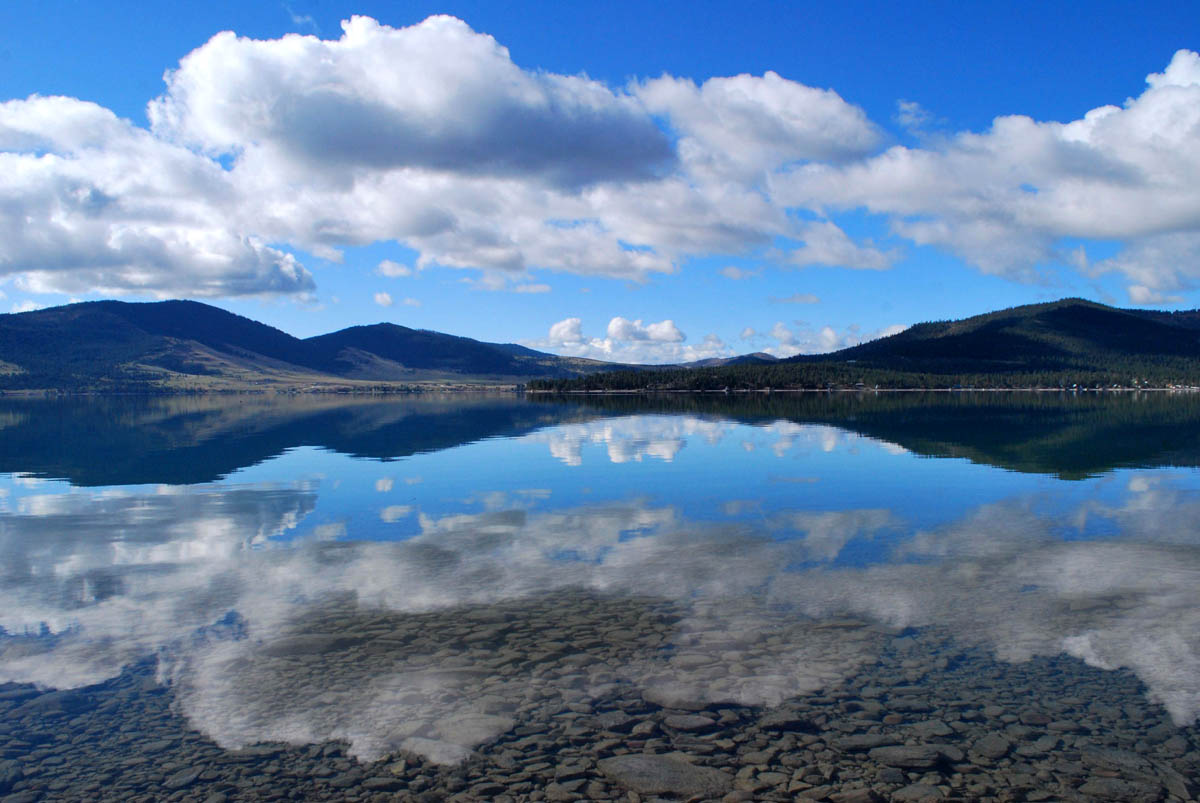
Flathead-Lake-PhotoFlathead Lake is the United States’ largest fresh-water lake west of the Mississippi, as well as being one of the least polluted. For the last 15 years the Confederated Salish and Kootenai Tribes have been negotiating an agreement with the United States and Montana governments to permanently codify the exact details of who has water rights to Flathead Lake and its drainage, as well as regulate other dam and irrigation projects around the Flathead Indian Reservation. The agreement, commonly known as the Flathead Water Compact, has been approved by the state senate and is now facing debate in the state House of Representatives, after which it requires approval from the Tribes and the US Congress if it is to be ratified. Understanding of some of the finer points of the Flathead Water Compact can be a complicated issue, indeed its complexity was one of the initial arguments against its approval in the State Senate. It has been negotiated between the tribes and government water regulators over the last decade, and came before the Senate as a simple yes or no vote, without the Senate being enabled to propose amendments, in which regard it is fairly irregular.

At its core, the Flathead Water Compact finalizes a compromise agreement to the water rights awarded to the tribes in the 1855 treaty that established the Flathead Indian Reservation. The compact allows the tribes control of “in stream flow” rights on the Flathead drainage, which essentially means that the tribes are allowed to dictate the amount of water that must be left in rivers and streams of the Flathead drainage, primarily for the purposes of fishing and maintaining fish hatcheries. The tribes also can limit amounts of water taken from downstream sources off the reservation if the extraction of water would have an impact upstream on tribal territory. Opponents of the bill argue that this in stream flow control would give the tribes too much power and that irrigation projects depending on water from Flathead Lake could be jeopardized, hurting local business and agriculture. However, supporters of the compact point out that without the compact to regulate control, that the Tribes could still secure the same water rights, and potentially much more through litigation in the courts, arguing for all the rights officially awarded to them in the 1855 treaty.

Another issue at the heart of opposition to the Flathead Water compact is the agreement’s hefty fifty-five million dollar price tag. This expense represents the cost of upgrading outdated and inefficient irrigation infrastructure across the Flathead drainage area. In a guest article published in The Missoulian, former republican gubernatorial candidate Rick Hill argues that this $55 million dollar expense is a metaphorical drop in the bucket compared to the cost of litigation should the compact fail to pass. Hill estimates that the costs of litigating the hundreds or thousands of claims covered by the compact in court would easily reach into the hundreds of millions, and that the cost of adjudicating the 36 different drainage areas covered by the compact would be as high as $70 million. One further observation made by Hill is that these costs wouldn’t be paid by the state from the state’s general budget, but would instead fall on the individual water users who would be required to pay legal fees to argue against the tribes in court for their historic use of Flathead water, which is protected in the compact.

This and other statements of support by prominent state republicans brings to light another complex issue about the Flathead Water Compact, that issue being the difficulty of determining exactly who supports and who opposes he compact. The state senate bill to approve the compact was introduced by a republican senator, and received the support of republican Attorney General Tim Fox, and democratic governor Steve Bullock (as well as Rick Hill, Bullock’s republican opponent in the last election). It was approved in the senate by 8 of the senate’s 29 republicans, and 20 of the 21 democrats. So support for the Flathead Water Compact is an impressively bi-partisan issue. In any sane democracy, support across both parties based on the facts of the issue and the good of the people wouldn’t be surprising or unusual, but given the current political climate in state and federal government, the inability to predict an official’s position on an issue based on the (D) or (R) next to their name raises eyebrows. Even outside of the legislature, predicting what groups support and oppose the agreement is difficult, with many irrigators on both sides of the issue, as well as outspoken tribal members representing a vocal minority in opposition. A look deeper into opposition to the compact only muddies the waters further.


FOLLOWING THE DARK MONEY

Over the last few years, a number of private organizations and political action committees have sprung up across the state in support of or in opposition to the long-debated agreement. With such names as “Concerned Citizens of Western Montana”, “Western Montana Water User’s Association” or “The Senior Water Rights Coalition” it can be difficult or impossible to determine at face value exactly who and what these groups represent. For instance, “Concerned Citizens of Western Montana” who represents the most outspoken private opposition to the compact turns out to be the brain-child of prominent Ronan businessman and former state representative Rick Jore. Jore’s family business, The Jore Corporation, got its start producing and selling cutthroat trout eggs to private stream owners as well as Fish Wildlife and Parks department hatcheries across the Western United States. Jore’s influence has since spread to the point where his name can be found on now-defunct companies across the Flathead area with such diverse functions as: construction, medical technology, bankruptcy services, tool and bullet manufacturing and more. At one time, the Jore Corporation was the single largest employer in Lake County, before filing for bankruptcy and appearing again a few years later in state ledgers as a technically new but still family owned incarnation.

689c5be2-db6b-50af-bdfb-95cdf5489d4e.preview-300

Rick Jore

Jore’s tenure in the state House of Representatives also established him as belonging to the extreme right of the extreme right in state politics. In fact, after failing to gain re-election in 2004 (the vote was an exact tie and the election was awarded to his opponent by the State Supreme Court), he then ran again in 2006 as a third party candidate. His successful third party campaign shocked many around the state, and made him the first official from the national Constitution Party elected to a statewide office. The Constitution Party is an extreme right-wing party founded heavily on anti-abortion principles, and has widely been regarded as a predecessor to the Tea Party. Indeed, both “Concerned Citizens of Western Montana” and the “Western Montana Water Rights Association” have been identified as Tea Party lobbying groups, both of whom have managed to exploit a loophole in state campaign finance laws that states that groups representing citizen water rights are not required to report their campaign contributions or reveal their donors.

Of these two tea-party dark money groups, the “Western Montana Water User’s Association” seems to be the more scandal-prone. The leader of the group is Steve Kilhorn, a convicted felon, who was convicted of “tampering with public records”. Another prominent figure in the Western Montana Water User’s Association is Kate Vandemoer, a self-proclaimed expert on water rights who has been the author of a prominent blog denying President Obama’s American birth, as well as calling for the overthrow of his administration in 2009 in the so-called “Usurpathon”.

Concerned Citizens of Western Montana has not been without its fair share of scandals in recent months either. Particularly embarrassing among these scandals was a recent accidental inclusion in an email to state legislators of a discussion between “Concerned Citizens” founder Terry Backs and the above-mentioned Kate Vandemoer about how emails to these legislators should be written, and whether emails on the groups’ positions should even be included to Senator Bruce Tudvedt and Representative Dan Salomon, both republicans who vocally supported the Flathead Water Compact. In the final Email to legislators outlining the groups’ objections to the agreement, Terry Backs mistakenly included an email string of an exchange between himself and Vandemoer speculating about the possibility of keeping the two prominent legislators out of the loop.

Another key group in opposition to the Flathead Water Compact is the Flathead Joint Board of Control. Unlike the aforementioned citizen lobbying groups, the Flathead Joint Board of control is a group of elected officials who regulate irrigation rights in Flathead County. The board recently released a privately-commissioned study which stated that irrigators will receive substantially less water under the proposed Water Compact than is necessary to sustain agriculture for farms on the project. However, this study was found to have been commissioned in secret by newly-elected chairman Jerry Laskody and three other members of the board in opposition to the Compact. Laskody, who ousted the previous long-sitting chairman of the Flathead Joint Board of Control thanks in large part to contributions from Tea Party groups like “Concerned Citizens of Western Montana”, said that he felt the study was essential to get the information they needed, and that secrecy was critical. The four board members had planned to pay for the report from their own private funds, and upon presenting it to the board would then ask for reimbursement, however, after the report was commissioned, the cost for it quietly showed up on the general expenditure budget for the board, meaning that the anti-compact study commissioned in secret had been paid for with taxpayer funds.

An interesting side-note to the Flathead Joint Board of Control and their influence on water policy across the state, is that a search of public contributions to political campaigns across Montana on followthemoney.org, shows that the Flathead Joint Board of Control is in fact the fourth largest single donor of publicly recorded funds in the state, having contributed $15000 to political campaigns state-wide. This figure is confirmed by the official state election commission report found at politicalpractices.mt.gov. As mentioned previously, Concerned Citizens and Western Montana Water User’s Association do not have to reveal their political donations, but their contribution is speculated to be much larger.


THE WHITE SUPREMACIST CONNECTION

Laskody and other right-wing members of the Flathead Joint Board of Control also made headlines when they were recorded on the board’s official meeting recording system making racist statements against Native Americans. During a meeting, board member Boone Cole said of Native Americans “Well, they’re not Americans, first [of all]”, to which chairman Jerry Laskody responded “Well they are the first Americans right?” soliciting a chorus of groans and laughter from the assembled board members. Laskody went on to say that they have all the benefits of living in the United States but that they “don’t pay for the roads in the county” and are “not really a government”.

Racism against the tribes has been a common charge of compact supporters against those groups who oppose it, and “Concerned Citizens of Western Montana” and “The Western Montana Water User’s Association” have been no exception. Both groups have been widely accused of distributing racist flyers, and several prominent members of both groups have been tied to white-supremacist organizations. State legislators however are quick to dismiss racism as a real factor in public or private groups’ opposition to the compact.

As of today the Flathead Water compact has been approved by the State Senate, and is awaiting approval by the state house of representatives, where its fate is uncertain. Should it pass both houses of the state legislature, it still requires approval from the Tribes and the US congress. While its approval by the tribes is likely, its fate in congress is less predictable. Democratic senator Jon Tester has publicly stated that he will support it, but his republican counterpart Steve Daines and Republican Congressman Ryan Zinke have both refrained from stating a position either in support of or in opposition to the agreement. While Tribal Water compacts are fairly common (there are currently 17 in effect across the state), the Flathead Water Compact is unique, not because of the provisions it contains, but because of the scale and value of the water rights at question. Flathead Lake is one of the largest and cleanest sources of fresh water in the country, and additionally, the Flathead Indian reservation has among the highest property values of any Indian Reservation nationwide, meaning that more money and more special interests have been poured into both sides of this debate than any tribal water compact previously. The inflow of dark money as well as the vitriolic accusations of racisms on both sides have only served to muddy the waters of the debate further, making it difficult to discern who stands on which side and why.

19-sunset2-on-flathead-lake

This post was composed by Outer Limits gumshoe Myron Gagarin.
Catch the cloudcast at mixcloud.com/outerlimitsradioshow
Check out the more frequently updated tumblr page at outerlimitsradioshow.tumblr.com
Contact the research team at outerlimitsradioshow@fastmail.fm

The Leakiest Pipes In America

What’s In The Water?

The City of Missoula Versus Mountain Water and the Carlyle Group raged through its seventh day this past week and is on course to conclude this coming week, after which Judge Karen Townsend will determine whether it is necessary to condemn the infrastructure through eminent domain. The case for condemnation gathered steam this week, notably on Monday with the revelation that Missoula’s water system is among the leakiest in the country, if not outright the single leakiest municipal water system in the nation.

Testifying on Monday, 23 March 2015, speaking on behalf of Henningson, Durham and Richardson, Inc. HDR’s Senior Vice President of engineering Craig Close displayed several images depicting rusty pipes, leaky pumps, and crumbling dams that he collected during his survey of Missoula’s water system. According to Close, the Mountain Water system is leaking more than 4 billion gallons of water a year, which amounts to 50 percent of total water pumped, putting Missoula well above the national average for leaky systems and far outside the acceptable range. But instead of addressing the cause of the leaks, Mountain Water has repeatedly decided to alleviate the symptoms of the problem by constructing more pumps, thereby exacerbating the problem while simultaneously raising rates to account for the additional flow charges. And guess who gets to pay for all of that excessive waste? The costs associated with pumping more water through increasingly leaky pipes costs Missoulians more than $600,000 annually, and that’s just the electrical costs to power the additional pumps to keep up with the increasing leakage.

Close mentioned that this volume of leak is unprecedented with regards to the modest size of Missoula’s water system, which is composed of a mere 319 miles of main. In terms of amount by volume, Missoula’s leak rate is the highest Close has ever seen.

Then on Wednesday, 25 March, Kees Corssmit of Geitner Environmental Management Group admitted not only that the leakage rate at Mountain Water reveals “significant” problems, but that he has only seen one other instance of a system that leaked anywhere near the rate of Mountain Water during more than 4 decades of studies.

But coming back to Close’s revelation that Mountain Water leakage totals more than four billion gallons of water lost annually, he went on to explain that not only does that leakage pour chlorine and other contaminates into our aquifer, but it creates a conduit between the surface and the aquifer through which surface level contaminates such as fertilizers, pesticides and automotive chemicals can seep into the aquifer more easily thus sullying our groundwater with a chemical cornucopia. In other words, contaminates are whisked into our aquifer directly by Mountain Water’s extraordinarily leaky infrastructure.

This problem would be less alarming if there weren’t so many surface-level contaminates leeching into the Earth already. Earlier this year Jessica Mayrer published a column in the Missoula Independent featuring Travis Ross from the Missoula City-County Health Department. Ross calculated that every single day, as much as 300 gallons of chemical waste are being released from a single, leaky underground storage tank owned by Montana Rail Link and operated by Emerald Services on Missoula’s North side at the Phillips Street Chemical Transfer Facility. The tank farm contains chemicals like petroleum, antifreeze and windshield wiper fluid, and could be leaking contaminants into the soil. More than 80 complaints circulated from residents in the vicinity of the Tank farm who reported feeling ill, citing symptoms such as nausea and sore throats, that seemed to be attributed to some kind of chemical contaminant in the area. Though the city has launched a formal inquiry, the task force assigned to the case is waiting for warmer spring temperatures before continuing with the investigation.

As bad as a chemical leak of 300-gallons per day is, that situation would be less severe if Mountain Water’s leaky infrastructure wasn’t providing a direct go-between for these surface level contaminants and the aquifer that we source our water from. The pipes wouldn’t be so leaky had money been spent on reinforcing and rebuilding sections of leaky and condemned infrastructure; that infrastructure wouldn’t have been so neglected had the money collected from Missoula rate-payers been reinvested into the system instead of getting shuffled into the stock portfolios of a few wealthy executives and shareholders. With more than a million-dollars a month collected from Missoulians who rely on Mountain Water, there is no excuse for this situation other than simple greed – a direct manifestation of private ownership of a public utility that is, for all intents and purposes, a natural monopoly, since it is literally impossible for a competing agency to offer the same service.

peak-generation-waterglass

Gabrielle Lafayette is a journalist, writer, and executive producer for the Outer Limits Radio Show.
Catch the cloudcast at mixcloud.com/outerlimitsradioshow
Check out the more frequently updated tumblr page at outerlimitsradioshow.tumblr.com
Contact the research team at outerlimitsradioshow@fastmail.fm

Water Is NOT The “New Oil”

????????????????????????????????????????THE BIG SQUEEZE

The great Mountain Water debate is on in Missoula County District Court as the City of Missoula takes its eminent domain case for public ownership against Mountain Water Company and its new owner, the infamous global equity firm, the Carlyle Group. The trial comes as a consequence of Carlyle reneging on its promise to sell Mountain Water to the City of Missoula after Carlyle acquired Mountain’s parent company, California based Park Water.

This trial also comes as another step in the age-old fight for Missoulians to gain control of their water system. Missoula is the only city in Montana that does not own its own water, and never has, dating back to 1905-06 when the Water Works diversion became privately owned.

In fact, this all goes back to the 1870’s When Frank Worden, C.P. Higgins and David Pattee constructed the reservoir and infrastructure from Rattlesnake Creek to Water Works Hill and the reservoir that was bought by Missoula Mercantile Company, naming it Missoula Water Company. Then a dam was constructed in 1901-02 to divert the waters. By 1905 Senator and copper-king William A. Clark plaid $900,000 for the system, and a year later changed the name to the Missoula Light and Water Company.

the Diversion dam on Water Works Hill was reconstructed with concrete in 1924, at which point Mayor William Beacom suggested that the public purchase the water, offering $600,000 for the system. But the roaring 20’s being what they were, Missoulians didn’t bite, and the utility remained under private ownership.

By 1930, Missoula’s population had grown to 14,657. The Montana Light and Water Company had also grown to provide a central heating system for the city as well as the trolley system, in addition to the utilities of water and electricity. It was at this point that the Montana Power Company bought the system. Established in 1912, Montana Power was a private firm founded by John Ryan, President of the Anaconda Copper Mining Company. Shortly thereafter it was determined that that Water Works Infrastructure was insufficient to provide water to the demands of an ever expanding population, inspiring the addition of five wells into the system.

Jump forward to 1979 when Montana Power sold our water system outright to a California based firm in the creation of Mountain Water as a subsidiary utility service to provide water to some 4,000 Missoulians residing outside of the city limits. Mountain Water was and still is owned by Park Water, a California based company owned by a man named Sam Wheeler. Following the Public Service Commission’s approval of the deal, the city missed its chance to buy the utility in 1979. The vice chairman of Montana Power, Jack Burke, was determined to confirm whether the city of Missoula was interested in purchasing the utility, and went out of his way to do so. Montana Power contacted Mayor Bill Cregg to inform him that the utility was available, but before the city council could even consider the proposal, Montana Power announced their sale to Sam Wheeler for $8 million. Wheeler claimed that the city missed its chance to purchase the system because the delays associated with municipal financing took too long, stating that the city didn’t have the money and lacked the time and resources to raise it, whereas Wheeler who had the cash in hand was able to bypass the bureaucracy of city decision making.

By 1983, 40,000 people called the Missoula valley their home, whereupon the Water Works system was abandoned completely for the utilization of Missoula’s Aquifer. Water Works was to remain an emergency back-up, but nothing more. Though Water Works was providing nearly half of the city’s water (45%) a giardia outbreak that infected the digestive systems of thousands of residents led to the realization that Water Works required millions of dollars of additional improvements for more sophisticated filtering and improvement costs. The following year the city again attempted to purchase Mountain Water, valued at $11million in 1984. The city proposed a bond, but Mountain Water’s general manager Lee Magone appraised the system’s worth at $16 million.

The city announced that the salaries of Mountain Water employees would be cut in the event of the sale, resulting in employees accusing the City of failing to account for the impact on their lives. Thus a handful successfully opposed the popular majority of Missoulians who wanted to see the water owned locally, obtaining a voter initiative to block the sale to the City. After the city’s failed litigation against those individuals, Mayor John H. Toole began eminent domain proceedings against Mountain Water with tremendous support from Missoula residents. That trial ensued in March of 1986, and ended dismally in August of that same year when the court determined that the city had, “failed to prove that the condemnation was necessary.” The battle created bad blood and hard feelings on both sides, turning the relationship between the City and Mountain Water from civil to hostile. The city had to pay for Mountain Water’s massive legal fees, and Sam Wheeler vowed that he would never allow the City that tried to wrestle his property away from him, any opportunity to purchase it.

Though attempts to bury the hatchet have been made, it appears as though Wheeler kept his word.

In 2011 Sam Wheeler sold Park Water (and in-turn Mountain Water) to the Carlyle Group. Carlyle knew Wheeler wouldn’t sell to Missoula, but also understood Missoula’s desire to gain control of the utility. So Carlyle had to assure Mayor Engen that while Wheeler wouldn’t sell to Missoula, they would, but they needed to buy it from Wheeler first. Enter the notorious Robert Dove who swooped in to convince Mayor Engen to back the transfer, promising to consider “in good faith” any offer Missoula made to purchase the system from Carlyle later on.

Carlyle has since rejected at least two offers that we know of (one of $50 million and one of $65 million) leading the city to accuse Carlyle of ‘bait and switch’ techniques, subsequently taking Carlyle to court. In April of 2014, filing eminent domain proceedings which remained on track for trial in the spring of 2015.

Carlyle is arguing that with regards to the wording of their written agreement with Mayor Engen, that all they actually promised was that they would consider selling Mountain Water to Missoula; not that they would actually do so.

1151571

SO WHERE ARE WE NOW?

Liberty Utilities, a subsidiary of Canadian Algonquin Power, desires to purchase the system from Carlyle, and it looks as though Missoula is getting left out of the loop once again. So Missoula is on course for another attempt at condemnation in yet another effort to place the utility in the hands of the people. But Algonquin really wants it. In fact, since the city has already racked up $1.9 million in legal fees as of March 2015, Algonquin officer and Liberty President David Pasieka actually offered $2.5 million to Mayor Engen, aiming to convince him to pass up the eminent domain proceedings.

Despite Pasieka’s efforts, the condemnation trial began on 18 March thus embarking a long list of witnesses and experts upon the arduous cross-examination voyage to shed light on this whole story. The trial continues every business day until 2 April whereupon Judge Karen Townsend will determine whether condemnation is necessary.

After the 2nd of April, it’s entirely Judge Townsend’s prerogative whether to condemn the system and give ownership to the City, or not, and she can take as long as she deems necessary to arrive at that final decision. If she decides condemnation is necessary, Carlyle will no doubt appeal the decision and Missoula’s eminent domain proceedings will move to the Montana Supreme Court, which is a very different place than it was the last time this happened in the 1980’s.

But the competition is fierce and insidious. Liberty has shoveled advertising dollars all over the city in such a fierce marketing campaign that Judge Townsend called for them to halt the ads because they were unfairly affecting public perception and influencing her own objectivity.

But the ads are merely a symptomatic accompaniment of the presence of the major corporate players.

Managing director of infrastructure Robert Dove is back in Missoula on behalf of Carlyle, and is certainly no stranger to the business of water rights. When he worked for Bechtel he was a member of the board of directors for International Waters on behalf of Bechtel, sealing the deal to gain control over the water systems in Bolivia. After monopolizing water resources, immediately hiking rates by 50%, and lobbying to create laws in Bolivia that actually made it illegal for residents to collect rain water, the Cochabamba Water Wars ensued. You might remember seeing footage of thousands of women marching in the streets clanging pots and pans to draw attention toward Bechtel’s inhuman policies. The Bolivian government cancelled its contract with Bechtel, and Bechtel actually sued Bolivia for lost earnings. Robert Dove was present for those hearings as well.

Representing Carlyle is Bill Mercer of Billings based Holland & Hart, and Mercer’s history is as interesting as Bobby Dove’s. He was asked to resign his post as U.S. Attorney by Montana Senator Jon Tester after a report accused Mercer of changing federal law so he could live outside his district and hold a separate post in Washington D.C. In 2006 Mercer got himself into hot water when U.S. District Judge Donald Molloy accused Mercer of acting overly zealous with regards to imposing federal charges in state matters, asking Mercer, “Do you ever concern yourself with justice?”

Also on the defense, representing Mountain Water is Joe Connor of Baker Donelson, who is apparently notorious for getting his clients a lot more money than they originally demanded. Responding to the City’s declaration that public ownership is in the best interest of Missoulians, Connor said: “This is our property, and you can’t prove we don’t deserve to keep it.”

On the opening day of the trial, Connor brandished a segment of bent, rusty pipe and dramatically declaring it to be the primary evidence that private ownership is necessary if our leaky infrastructure is to ever recover; that the entire leaky system is in such a state of disrepair, private ownership is the only way to restore the infrastructure.

Unfortunately his argument doesn’t hold water, since the condition of that pipe is the direct result of private ownership which seeks profits over structural reinvestment. We have to ask ourselves if the infrastructure would be in the state of decay that it is if it were under city management. If it were, the city council would be directly responsible for reinvesting funds garnered from ratepayers back into the system instead of hording them. Private owners have no incentive to reinvest into the system, instead providing profits to shareholders, CEO’s and other corporate beneficiaries with large financial dividends.

With more than 22,000 customers paying an average of $47.35 a month, rate payers are contributing to an enterprise that amounts to more than a million dollars a month ($1,041,700). Those rates are guaranteed to rise according to Carlyle’s own estimates of projected earnings. And given what previous private owners have allowed our infrastructure to become, we’re not only guaranteed rate hikes, but proliferating system failures as the system continues to crumble.

So if the system is making a million-dollars-a-month, where is that money going? We know that 42 employees at Mountain Water’s parent company rake in a cumulative $6.1 million annually, one third of which is provided for by Missoulians. And our rates, which are already among the highest in the region (that includes surrounding states) are guaranteed to skyrocket year after year if private ownership continues.

Bruce Bender helps to provide some context for this claim. On Thursday, 19 March 2015, Bender who serves as Missoula’s Chief Administrative Officer, explained the significance of a chart that showed plans for rapid rate increases that Carlyle’s lawyers insisted be kept out of the public record. Much to their chagrin, Judge Townsend allowed the documents to be submitted for public record as evidence, and as a result Missoulians have been made aware of Carlyle’s 6-year plan for a 50% increase in rates, from $39 million to $59 million.

The following day on 20 March, Missoula’s director of Central Services Dale Bickell, announced that Missoula could operate Mountain Water for nearly $7 million less annually than Carlyle, further demonstrating how absurd Missoula’s rates are already.

Perhaps most alarming of all, the Public Service Commission appears to have a rather cozy relationship with Mountain Water and Carlyle. According a brief filed by the City in August of 2014, “unlawful ex parte communications” took place between the agency and the private firms concerning whether the PSC planned to intervene in Missoula’s eminent domain proceedings, illustrating “evidence of the agency’s coordination against the public interest.”

Money talks, while everything else walks, and corporate money is talking very loudly is Missoula, Montana right now. They’ve bought airtime and newspaper space, they’ve offered millions to our elected representatives, and they’ve established relationships with all the major players. Though our owners are already fabulously wealthy, the speculation for more profits at the hands of Missoulians has blinded them from decency, and further transformed this entire Mountain Water situation into the circus of corruption that it is. This water deal represents a tremendous profit potential for private equity firms like Carlyle and Algonquin, and with unpolluted water resources dwindling world wide, multinationals are aggressively swooping in to gain control of systems like Mountain Water. Either Missoula gains control of the resource, or our rates go through the roof – or worse, Nestle will lobby to open a bottling plant here and begin shipping Missoula’s water around the world in plastic bottles. If history is any guide at all, we could then be subjected to laws prohibiting the collection of rainwater, and Robert Dove would gladly smile over those proceedings just as he has in the past over similar circumstances. Unless Missoula can somehow gain control of the system, we will be rendered utterly helpless in determining its future.

drought-water-scarcity-15Gabrielle Lafayette is a journalist, writer, and executive producer for the Outer Limits Radio Show.
Catch the cloudcast at mixcloud.com/outerlimitsradioshow
Check out the more frequently updated tumblr page at outerlimitsradioshow.tumblr.com
Contact the research team at outerlimitsradioshow@fastmail.fm

Veterans Against War Porn

pawel-kuczynski-ak47

US VS THEM

Apart from analyzing the tendency of the war-film genre to glorify violence, justify racism, and fetishize murder, there are a number of factual errors and historical inconsistencies with Clint Eastwood’s newest film American Sniper, as well as the book it’s based upon. The film’s portrayal of Christian dominionism confuses the otherwise peaceful messages of Jesus. The juxtaposition of 9/11 with Iraq invites viewers to make foreign policy connections that do not exist. Implicit jingoism encourages movie-goers to express xenophobic hatred vicariously through the film’s barbaric protagonist.

And the book that Eastwood’s film was based on seems even worse, weaving a web of lies, from making claims about “punching-out” former Navy SEAL Jesse Ventura, to accounts of murdering looters in New Orleans during hurricane Katrina, all the while referring to the people in his cross-hairs as “savages” and “animals”.

As a veteran myself, I have several grievances with the national debate currently underway regarding this piece of “art”. On one side it is hailed by “red blooded American patriots” as the incredible story of the deadliest sniper the American military ever produced, condemned by anti-war activists as offensive propaganda on the other. The tweet storms seem to indicate that spectators were coming away from American Sniper with a yearning for killing. Clint Eastwood denies this, ironically proclaiming the film as a champion of anti-war ideals. Just as the official narrative of the Iraq war involved “fighting for Iraqi liberation,” propagandists spin a facade of moral high ground language as a smoke screen for obvious misbehavior.

Case in point: if we’re there to liberate them, why revel in their indiscriminate murder?

Despite the predictable “patriots vs. hippies” narrative characterizing this debate, I would like to offer a third point of view, somewhere in the middle of the two extreme polarities. Such a national argument could serve as an opportunity to overcome personal biases, regardless of what side we believe is right, and acknowledge that life is complicated. This is our chance to understand that as long as we’re arguing with each other, we’ll never be able to tackle the root of problems concerning us all. And learning the truth is not about agreement. War is about profit and power for those who wage it. The trick is convincing people to fight and die in their wars. And that’s why propagandists pull in the big bucks.

In 2017, a Freedom of Information Act request by Tom Secker and Matthew Alford revealed the extent to which the Hollywood promotes war explicitly on behalf of the Pentagon, CIA and NSA. Documents obtained by Secker and Alford detailed the military’s control of and influence over more than 1,800 movies and television shows, “including the ability to manipulate scripts or even prevent films too critical of the Pentagon from being made. … If there are characters, action or dialogue that the DOD don’t approve of then the film-maker has to make changes to accommodate the military’s demands. If they refuse then the Pentagon packs up its toys and goes home. To obtain full cooperation the producers have to sign contracts–Production Assistance Agreements–which lock them into using a military-approved version of the script.”

essence_of_propaganda MONKEY SEE, MONKEY DO…

Even before I joined the military, I was intuitively skeptical of the impact that war films can have on our individual psyches, and thus the influence they have on the collective overmind if watched enough times. Many of my friends growing up were seduced by the violence of Francis Ford Coppola’s Apocalypse Now despite the fact that the film’s intention seemed to be the illustration of war’s many unspeakable horrors (as well as a timely adaptation of Joseph Conrad’s classic Heart of Darkness). But even if a war film attempts to convey the message of “look how horrible wars can be,” immature viewers tend to get seduced by the adrenaline-inducing weapon systems of the 21st century. Phrases like, “happiness is a belt-fed weapon” further play into this culture of carnage; a phrase that I heard repeated many times in my career, and repeated myself after becoming a SAW gunner.

The only films I ever saw that made me think twice about joining up were The Deer Hunter starring Robert DeNero, and Born On The Forth Of July starring Tom Cruise. These two films depicted the true cost of sending our best and brightest into the hungry jaws of faraway battles. Before seeing these films, the possibility of losing a leg or permanent paralysis had never occurred to me. Because from John Wayne’s The Longest Day to Ridley Scott’s Black Hawk Down, America’s motion pictures had sold me on the world view that the battlefield yields glory, validated either in a “hero’s death” or award ceremonies and ticker tape parades that are always more fulfilling in your head than in real life.

Having said that, I’m always hesitant to lend my eyes to films depicting physical violence and bloodshed because of the messages they can send, whether they intend to or not. As with most forms of screen entertainment, many Hollywood films are meant to shape perception within the public to garner support for geopolitical decisions made on our behalf, which is why movie theaters are federally subsidized. For the same reason that recruiters are positioned in high schools to grab up our best and brightest before they’ve reached the age of reason, war films play as instrumental a role in military recruitment as first-person-shooter video games do. These forms of screen media masquerade as nothing more than entertainment, all the while subtly programming a state-sponsored narrative of justified imperialism into the malleable minds of those subject to the electronic hallucinations of the glowing rectangle. 

Seth Rogen took a lot of flack recently for drawing an apt comparison between Eastwood’s new film to the film-within-a-film, Nation’s Pride – the Nazi propaganda movie that appeared in Quentin Tarantino’s Inglorious Basterds. The purpose of effective propaganda is to numb the mind away from reasonable thinking, and anesthetize the emotions away from empathy. As Chris Hedges recently pointed out in TruthDig, “American Sniper caters to a deep sickness rippling through our society. It holds up the dangerous belief that we can recover our equilibrium and our lost glory by embracing an American fascism.” He goes on to say:

“The culture of war banishes the capacity for pity. It glorifies self-sacrifice and death. It sees pain, ritual humiliation and violence as part of an initiation into manhood… The culture of war idealizes only the warrior. It belittles those who do not exhibit the warrior’s “manly” virtues. It places a premium on obedience and loyalty. It punishes those who engage in independent thought and demands total conformity. It elevates cruelty and killing to a virtue. This culture, once it infects wider society, destroys all that makes the heights of human civilization and democracy possible. The capacity for empathy, the cultivation of wisdom and understanding, the tolerance and respect for difference and even love are ruthlessly crushed. The innate barbarity that war and violence breed is justified by a saccharine sentimentality about the nation, the flag and a perverted Christianity that blesses its armed crusaders… It fosters an unchecked narcissism. Facts and historical truths, when they do not fit into the mythic vision of the nation and the tribe, are discarded. Dissent becomes treason. All opponents are godless and subhuman.”

American-Sniper-Visage

Veterans For Peace recently responded to the film in a similar way, contending:

“Following spaghetti western acclaim, Clint Eastwood, now 84, moved on to Dirty Harry movies… Over the years, he has honed this very masculine style and become a popular film director exploring the American psyche mostly from the reactionary right — though his films are always a dialogue with issues on the left. American Sniper is no different with its limited contrapuntal theme of PTSD and homefront family adjustment.

“Harry Callahan was famous for whacking creeps who deserved to die with his long, phallic .44 magnum. It was great cinema. The formula was simple: Feature a good guy who hates bureaucrats, loves to cut corners and is a man comfortable with violence and put him at odds with bad guys who are absolute perverted creeps whose death at the hands of the good guy would be cheered by an audience shoving popcorn down its gullet. The films were realistic in the sense of being harsh, brutal and loud. But they were far from realistic in the sense of being complex, morally gray, contradictory and confusing — like life itself.”

So when it comes to Clint Eastwood’s American Sniper, I’m first and foremost appalled by the message we get early on that the message of Christ has anything to do with racist bigotry or a fixation of murder. How can any true Christian bemoan the crucifixion of Christ and then revel in the slaughter of other human beings?

Beyond achieving the feigned moral high ground of killing for Jesus, the film presupposes that sniper Chris Kyle was sent to Iraq because of what happened on 9/11. You don’t have to be that well informed to understand that the only connection that exists between 9/11 and Iraq is the Bush administration’s lie about Weapons of Mass Destruction which were never found in the deserts of Iraq. A deluge of patriotism that flooded our soldiers into Afghanistan created a tidal wave of militarism, the momentum of which has since bled over into operations conducted in over 75 countries. This fact remained hidden from the American people until Jeremy Scahill finally spilled the beans on JSOC with the book/documentary Dirty Wars.

When the twin towers fell, I was an ROTC cadet reporting in to my commanding officer for my morning duties. It wasn’t long after that I joined the US Army’s ranks in the 11B combat specialty despite having the ASVAB scores to go anywhere else. None of the other jobs had what I was looking for. In the summer of 2005 I graduated infantry OSUT and airborne school, both at Fort Benning, Georgia.

For people like me, it didn’t matter where the military sent us. We were absolutely convinced that our help was necessary to protect the nation, and that the military was working on behalf of the nation’s best interests. But no matter how enthusiastic I may have been at the beginning (and there was no solider more gung-ho for HOOAH than me), it slowly but inevitably became impossible to ignore the power grabs and profiteering happening above my pay grade. Once I finally became witness to the crimes of our government, that the media insisted were not happening, I couldn’t deny the truth any longer. Looking back I wonder how I was ever able made to believe any of the mainstream lies. Then again, common sense is only sense made common, and hindsight is always 20/20.

notpropagandaFETISHIZING MURDER

I don’t enjoy talking about my service, and no fellow veteran I know who has taken lives was ever proud of it. Which brings me to my next point about the book of the same name upon which the movie American Sniper is based. Chris Kyle, who is credited with 160 confirmed kills (God knows how many more unconfirmed) reads like a demented serial killer, reveling in the destruction and death that transpired at his fingertips during four tours of duty. This initially led me to question what role the book and subsequent film were meant to play in the society to shape public perception, and how much of it was altered to appeal to the pro-war narrative. Because no veteran I know personally has ever talked the way Kyle does about murder in his memoirs. The only people I’ve ever met who revel in the death and suffering of other humans in combat situations are people who have either never been in combat, or sadistic psychopaths.

As far as the first group are concerned you’ve probably bumped into one of these clowns at the bar, telling fantastic stories of the wars he so bravely fought in. Mine were usually socially inept boys with poor posture who liked to brag about how they were “a sniper in Iraq” or worked with the “special forces in Afghanistan” in between swigs of cheap beer. For whatever reason, stolen valor seems to have become quite popular in the age of Homeland Security.

The first prerequisite in determining the legitimacy of  an individual’s service in the military is his unwillingness to talk about combat. Nobody I know who saw ‘trigger time’ overseas enjoys talking about combat, and most will flatly refuse your requests to reminisce by changing the subject, or leaving the conversation altogether. Posers, on the other hand, who have been programmed by video games and war films to glorify human slaughter, will tell war stories that usually feel like borrowed composites from pop culture. They do this because the greater culture has brainwashed them into thinking that they can obtain respect, sex, and notoriety if they can convince people they too are an American war hero. The reality experienced by our authentic heroes, however, seldom includes any semblance of fame or fortune, but a whole lot of guilt and flashbacks.

If you bump into armchair commandos claiming military service, and you want to skillfully suggest polite skepticism of their yarns, a great test of character is to ask them what their MOS was during their military career. That’s Military Occupational Specialty, and if they weren’t in the military they usually won’t be able to answer this question. Sometimes the smart fakers have memorized some figures, but this question weeds them out nine times out of ten.

Please understand that I’m not accusing Chris Kyle of being a poser, per se. Though this book exhibits demonstrable lies, we can say based on evidence that he was indeed a veteran and served out his military contract honorably. But if he actually reveled in the act of killing during his service as the pages and scenes of American Sniper allege, and if he actually felt the way those hateful sentences convey, then I’m led to believe that he’s either a psychopath, or that the narrative of his life has been altered to boost sales and/or garner patriotic support for continued global imperialism.

Praising the act of killing into fetish territory is not the behavior of any genuine veteran I know, which leads me to believe that Chris Kyle is either not responsible for the death-glorification that appears in the book (which, by the way, is conspicuously absent from the film), or he was a psychopath. Neither case leaves me either admiring Kyle, or feeling the need to honor his memory.

I’ve also considered the possibility that many of the stories were fabrications, either ghost-written by other writers or embellished by the editor to push sales, because there are many claims throughout the text that are blatant lies: in the book we’re meant to believe that Chris Kyle punched former Navy Seal Jesse Ventura; that Kyle sniped thirty people in New Orleans during Hurricane Katrina; that he murdered two men attempting to car-jack him. There is no evidence to support any of these claims, and Jesse Ventura even filed a law suit for defamation of character when Chris Kyle was still alive.

“PUNCHING OUT JESSE”

The media really twisted up Ventura’s defamation lawsuit, vilifying the former Minnesota Governor for victimizing the “poor widow” of Chris Kyle “for greedy monetary gain”. Ventura has since set the record straight about the chapter of American Sniper entitled, “Punching Out Jesse,” that the publication company was forced to change. Despite the fact that a jury came to the conclusion that overwhelming evidence proves beyond a reasonable doubt that the incident in question never happened, instead of amending or omitting the entire chapter, HarperCollins offered money as payment to Ventura for damages. Ventura objected to the money, demanding they remove the blatant lies from the pages of the book. Though they’ve changed the name of that chapter in subsequent publications, they stonewalled Ventura on altering the content, instead writing him a check for $1.8 million, and now the media are free to berate him for taking money away from Kyle’s widow. Money that the Kyle Estate claimed was going entirely towards charity in the name of veterans organizations, which turned out to be another lie, as only about 2% of the proceeds were ever donated to said charities, according to the National Review.

This brings me to the strange circumstances surrounding Chris Kyle’s death; shot by a former Marine on a shooting range shortly after Ventura’s lawsuit began. Some analysts are drawing parallels between the Chris Kyle narrative and the Pat Tillman story. Men who’s image was worth billions in recruitment advertising to the military-industrial-complex.

A common misconception infecting the discourse of our society is that if you’re going to question the war you need to be prepared to respond to accusations of being anti-American or anti-military. As an ROTC cadet and a person who sacrificed his early life to join the military, is anyone prepared to call me anti-American? Since I was honorably discharged from my military service, is anyone prepared to call me anti-military?

22 veterans kill themselves every day. You think it’s because they’re proud of what they did? You think it’s because they’re happy with what their actions helped accomplish? You think its because they believed that their battles resulted in freedom for Americans?

And how does patriotic support of our troops equate to the anti-human stance we take on the scores of homeless veterans walking our streets every day, who we demonize for being poor? If anyone is qualified to say this, I as a veteran am: you cannot support our troops and be simultaneously against the war. That’s oxymoronic because if our troops are committing crimes against humanity, we are no different than any other totalitarian regime in history. If I’m involved in something shitty, you shouldn’t pledge my support, any more than I should be required to follow shitty orders if I think they’re unlawful. Just following orders is a coward’s excuse, and hiding behind a rifle requires far less courage than standing up to a corrupt government that continues to commit crimes in the name of freedom, God and country.

I’m not the only veteran taking a stance to set the record straight here. Former Marines Adam Kokesh and Ross Caputi who both served in Fallujah, call the Iraq war an imperialistic resource theft that exploits American soldiers who think they’re fighting for freedom.

Perhaps no one has ever said it better than two-time Medal of Honor recipient Major General Smedley D. Butler:

BUtLER“I spent thirty-three years and four months in active military service as a member of this country’s most agile military force, the Marine Corps. I served in all commissioned ranks from Second Lieutenant to Major-General. And during that period, I spent most of my time being a high class muscle-man for Big Business, for Wall Street and for the Bankers. In short, I was a racketeer, a gangster for capitalism. “I suspected I was just part of a racket at the time. Now I am sure of it. Like all the members of the military profession, I never had a thought of my own until I left the service. My mental faculties remained in suspended animation while I obeyed the orders of higher-ups. This is typical with everyone in the military service.

“I helped make Mexico, especially Tampico, safe for American oil interests in 1914. I helped make Haiti and Cuba a decent place for the National City Bank boys to collect revenues in. I helped in the raping of half a dozen Central American republics for the benefits of Wall Street. The record of racketeering is long. I helped purify Nicaragua for the international banking house of Brown Brothers in 1909-1912. I brought light to the Dominican Republic for American sugar interests in 1916. In China I helped to see to it that Standard Oil went its way unmolested.

“During those years, I had, as the boys in the back room would say, a swell racket. Looking back on it, I feel that I could have given Al Capone a few hints. The best he could do was to operate his racket in three districts. I operated on three continents.”

For this reason, I can’t help but cringe when people reflexively respond to the news of my military service by pumping my hand and thanking me for my service, which is part of the reason I rarely bring it up. Since we’re on the subject, I must ask you all to please refrain from thanking me for my service as a matter of reflex. Because I didn’t fight for anybody’s freedom. I fought to help guarantee the profits of assholes, just as General Butler articulated all those years before me.

11-C-martin-luther-king-guided-missiles-pro-peace-ani-war-history-political-tshirt

Image source: Allriot t-shirts

This post was originally composed by journalist and Army veteran Brandt Miller.
Catch the cloudcast at mixcloud.com/outerlimitsradioshow
Check out the more frequently updated tumblr page at outerlimitsradioshow.tumblr.com
Contact the research team at outerlimitsradioshow@fastmail.fm

Don’t Let School Ruin Your Education

teaching the boxContrary to popular belief, Education and Schooling are, as award winning school teacher John Taylor Gatto contends, mutually exclusive subjects. This realization became easier to recognize with the advent of Standardized Testing like the ITBS, more obvious with the creation of No Child Left Behind, and is now difficult to ignore under the auspices of Common Core. We often internalize the myth that the school system in America has failed, but unfortunately for us, America’s school institution works perfectly in accordance with what it is designed to do. The American School institution was not established with the intention of educating the young, any more than the motive for Invading Iraq was to “fight for your freedom” any more than the purpose of the Drug War is to remove dangerous narcotics from the society, but that hasn’t stopped the mass of people from declaring that these programs are colossal failures. The truth is that they’re not failures – they were designed this way on purpose. The establishment sells us on dreams, and the happy-sounding names of those false promises keep us from noticing the true purpose of the exploitative agendas that are put into action right in front of us behind the smoke screen of what is best for the nation. These institutions and doctrines serve those who created them, not those who are managed by them. Similar to the activity of training fleas enjoyed by emperors and kings throughout antiquity, public school was intended by its architects to break the spirit, and teach our children to respond to orders.

LEARNING THE ART OF MEANINGLESSNESS

In his 1992 publication, Dumbing Us Down: The Hidden Curriculum of Compulsory Schooling, John Taylor Gatto writes:

“We look upon schooling as if it were a character in a continuous courtroom drama, a drama wherein we search for the villains who have prevented our kids from learning. [Be it] bad teachers, poor textbooks, incompetent administrators, evil politicians, ill-trained parents, bad children – whoever the villains be we shall find them, indict them, arraign them, prosecute them, perhaps even execute them! Then things will be okay.”

Just as the aim of advertising is largely to sell you things you don’t need, and the aim of marketing is to overcome sales resistance in the target audience, schools function under an identical paradigm. The continuously reinforced mentality that the system as it was designed can work if we simply amend it correctly gives rise to a plethora of profit seekers who all claim to have the cure as long as it involves spending money. All of these so-called cures also relate to the market of advertising in that they attempt to sell us on a quick fix solution, every time. Whether its new textbooks or more tests, their answers see the school as a clock-like machine in need of lubrication or new parts instead of acknowledging that living systems require more than shortsighted mechanical diagnostics. Gatto continues:

“If people are machines, then school can only be a way to make these machines more reliable; the logic of machines dictates that parts be uniform and interchangeable, all operations time-constrained, predictable, economical. [And indeed] American education teaches by its methodology that people are machines. Bells ring, circuits open and close, energy flows or is constricted, qualities are reduced to a numbering system, a plan is followed of which the machine parts know nothing.”

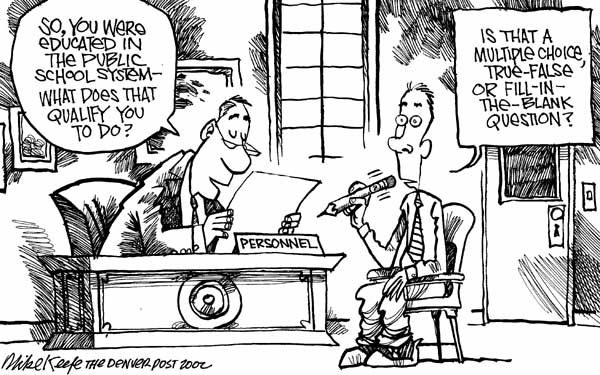
And despite our ever increasing demands of children to start school earlier, and complete larger piles of homework during their time away from school, our nation ranks at the bottom of nineteen industrial nations in reading, writing and arithmetic. KeefeM20020807


WEAPONS OF MASS INSTRUCTION

Octvio Paz from Mexico, the 1990 winner of the Nobel Prize for Literature, has this to say about our schools:

“In the North American system men and women are subjected from childhood to … principles contained in brief formulas [that are] endlessly repeated by the press, radio, television, churches and especially schools. A person imprisoned by these schemes is like a plant in a flowerpot too small for it. He or she cannot grow or mature. This sort of conspiracy cannot help but provoke violent individual rebellions.”

If schools are prisons then our children are undoubtedly the prisoners and they’re not happy about it. Our society treats children like prisoners and then has the audacity to act surprised when they exhibit some of the more violent behaviors we tend to associate with prisons. We lock them into regimented buildings, many of which are architecturally similar to prisons, segregate them by age, force them to engage in often meaningless busy work, break their spirit, force them to ask permission to use the bathroom and then act surprised when they bring a gun to school. John Gatto recognizes the psychopathic schizophrenia our children are subjected to by the school institution:

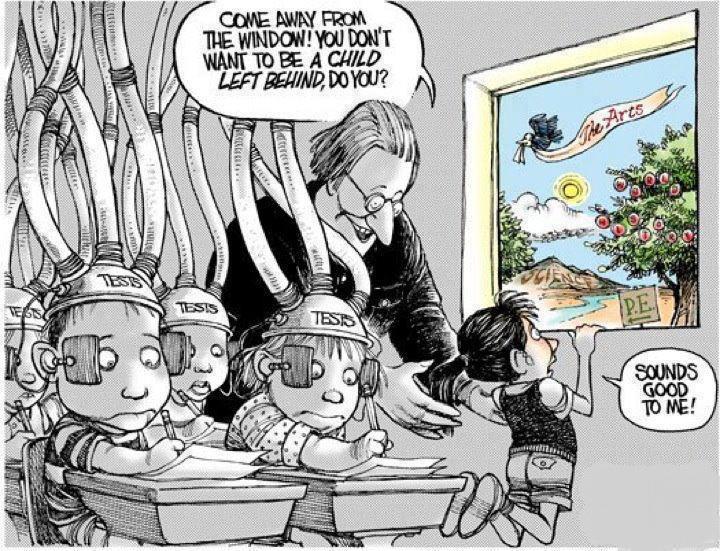
“Children learn what they live. Put kids in a class and they will live out their lives in an invisible cage, isolated from their chance at community; interrupt kids with bells and horns all the time and they will learn that nothing is important; force them to plead for the natural aright to the toilet and they will become liars and toadies; ridicule them and they will retreat from human association; shame them and they will find a hundred ways to get even. The habits taught in large-scale organizations are deadly.” comic_leftbehind


 RAISING AN INVISIBLE BAR

Gatto contends that “For 150 years institutional education has seen fit to offer as its main purpose the preparation for economic success.” But today’s kids dismiss the notion that if they do well at school they can get a degree and then get a good job and thus a good life, because the reality that this is not true has become all but impossible to ignore, not just because of the current state of technological unemployment and a failing monetary economy, but for the simple fact that Ellen DeGeneres, Mark Zuckerberg, Brad Pitt, Ted Turner, Steve Jobs, Bill Gates, F. Scott Fitzgerald, John Lennon, Jim Carrey, Al Pacino, Wolfgang Puck, Tom Hanks, Abraham Lincoln and thousands of fiercely successful human beings got that way by dropping out of school. We might offer the excuse that these individuals were special, but as the father of Capitalism Adam Smith himself asserted in Wealth of Nations, there is no difference between the Duke and the street sweeper except early training. The platitude that working hard in school will amount to an economically prosperous life is shoved down our throats because it makes both parents and students easier to regulate and intimidate as long as the association goes unchallenged. But even if it were true, money is a terribly substandard motivator.

learning.conformityTHE MATRIX HAS YOU

By and large, our institutions have come to replace communities in America. John Gatto repeatedly harps on the distinctions between communities and their inferior mimics that he refers to as networks:

“Large cities have great difficulty supporting healthy community life, partly because of the coming and going of strangers, partly because of space constrictions, partly because of poisoned environments, but mostly because of the constant competition of institutions and networks for the custody of children and old people, for monopolizing the time of everyone else in between.”

But in a monetary economy that has been stripped of all worth by the banking elite, today’s parents can seldom sustain a household on a single income and lack the time or money to homeschool their children. Today the income of working couples has the same purchasing power that the income of the average working man did a century ago. Thus the state has been charged with raising the children – an intentional consequence of the Rockefeller funded movement called Women’s Liberation, sold to society on the promise of empowering women with the actual aim of doubling the taxpayers while simultaneously granting access to the young minds of their progeny at an earlier age. The prospect of both couples working at full-time jobs wouldn’t have garnered much support as long as parents were worried about their children. The prevailing attitude of institutions like schools that masquerade as though they were communities is one of indifference. You are anonymous and happy for it because of imagined dangers others may present if they take notice of your existence. The problems of the society are considered always to be someone else’s responsibilities, and that someone should be paid to solve them. As a result,the most commonly shared dream is to go someplace better, constantly running after a carrot you will never catch by looking outside of yourself for the answers to your own misery. The fundamental difference between a community and a network is that one makes you feel included and the other makes you feel isolated. Networks like corporations, colleges, armies, hospitals and government agencies allow a limited sliver of expression as acceptable, and cultivate large groups of individuals who associate with each other out of habituated routine without any genuine empathy or warmth for one another but for a few limited exceptions that are sure to slip through the cracks. A community on the other hand, allows the full flowering of all varieties of human expression. Communities think of the homeless as real people – networks convene committees to calculate cold mathematical formulas to systematically address the nameless problem of the less fortunate. Networks divide. Communities unite. The extremely limited capability of networks means they instantly deliver all they ever will right at the very beginning, while communities become more beautiful the longer you’re a part of them. You have to buy your way into a network to be a part of it. A community’s love sticks with you through thick and thin. The love of a network is conditional and likely to disappear at any time if you fail to measure up to its expectations. Networks starve us of emotional nourishment hence creating the inherent loneliness that can so easily lead to suicide and substance dependency – problems that rarely inflict individuals who are part of communities with solid social cohesion.

dumb-kidsMANUFACTURING ADULT CHILDREN

It’s interesting to note that the modern institution of mandatory schooling survives largely by virtue of its employment of police power to enforce filling the hollow classrooms. Compulsory schooling posits hegemonic ideals – that there is only one right way to do anything. Bertrand Russell aptly observed that the inherently anti-democratic institution of mass schooling produces distinctly imperialistic students trained to become insecure anti-intellectuals who’s contempt for excellence is equaled only by their contempt for aesthetics. If we don’t feel secure with ourselves we’ll never be okay with our neighbors. Institutions like schools alienate us from our communities which in the long haul creates an entire generation with a fierce indifference to just about everything. Schooling is an artificial shortcut that creates the appearance of community while robbing us of it. Schools weaken families and communities, alienating parents from children and then blaming the family for its lack of togetherness. Age segregation has created a great disconnect between the generations, ensuring a society where the possibility of community is continuously inhibited. As a result we become addicted to dependency. In today’s national crisis of maturity, everyone seems to be waiting for a teacher to tell them what to do. Whether its feeling the need to obtain permission to perform the kind of work we’re interested in by obtaining a degree from so-called experts, or asking permission to build structures by filing permits, or expecting our global crisis to be solved by a superhero or a Rockstar Messiah or an intergalactic alien nation to come down into this chaos we’ve created for ourselves and save us from it, we’re all left feeling completely powerless to do anything. And it all starts with how we are molded as children. Schools are crippling our population’s potential by artificially extending childhood, first and foremost with the imposed myth that 12-year olds are children. History is riddled with evidence to the contrary, from Thomas Edison starting a printing business at the age of twelve, to Thomas Jefferson running a 250-employee operation at the age of twelve, nothing could be further from the truth. We artificially extend childhood all the way up to the age of eighteen, at which point our youth have been conditioned to believe that they may never have to grow up, and more often than not they never do. They end up sitting in front of the TV drinking beer and cheering on their favorite football team and scrutinizing celebrity gossip while remaining oblivious to world events directly impacting their lives. The creation of a docile surf population was the goal of standardized schooling all along, and is a fully realized nightmare today. Our learned helplessness empowers strong father figures at the heads of corporate-run government agencies to dictate the way forward for us, which of course includes sustaining the institution of mass schooling that disempowered the human spirit in the first place. The people who put the school system into place are getting what they paid for: an army of obedient workers.

00Schools don’t teach you anything but how to obey orders.

The goal of education is the realization of fully realized human beings.

The goal of schooling is the compulsory programming of habitual conformity.

Until we have the collective resolve to scrap the institution altogether, teachers like John Taylor Gatto show us how to sabotage it, and students like Logan LaPlante show us how to hack it. testingGabrielle Lafayette is a journalist, writer, and executive producer for the Outer Limits Radio Show.
Catch the cloudcast at mixcloud.com/outerlimitsradioshow
Check out the more frequently updated tumblr page at outerlimitsradioshow.tumblr.com
Contact the research team at outerlimitsradioshow@fastmail.fm