What transformed the formerly safe neighborhoods of the American west into the post-apocalyptic bazaars of meth, trafficking and murder they are today? Within less than a decade tent cities rapidly emerged from public parks and sidewalks and grew into shantytowns and Hoovervilles like the ghastly disgrace called “the Zone” in Phoenix, Arizona. Over the past five years, these symptoms of societal decay have grown visibly worse. In the face of this humanitarian crisis, many public officials have made an institutional commitment to ignoring the problem, claiming that their hands have been tied by a decision made by the Ninth Circuit Court of Appeals in 2018. This technocratic abdication of duty is not only legally inappropriate, it normalizes a sadistic indifference toward human suffering that dramatically accelerates the urban decay of the American west. After a five-year long headache, this colossal policy failure now lies before the US Supreme Court for reconsideration.
“Five years ago, the Ninth Circuit Court of Appeals decided a case called Martin v. City of Boise that radically transformed how local governments address the problem of homelessness and vastly worsened the nation’s homelessness crisis. Now, the Supreme Court is poised to consider whether to overrule that decision—and a subsequent decision called Johnson v. Grants Pass.”
Both Martin and Johnson proclaimed that it is unconstitutional to enforce anti-vagrancy laws unless there are adequate shelter beds available for homeless persons. These lawsuits rely on a ruling from the 1962 case, Robinson v. California, wherein the Supreme Court held that people cannot legitimately be punished for immutable characteristics; in this case, the immutable characteristic of being “involuntarily homeless” – a term that has yet to be defined.
That argument held sway in the case ofMartin v. Boise. This case began after a Boise man named Robert Martin fell asleep on an Idaho park bench and was cited by police for doing so. Martin and five other homeless Boiseans in turn sued the City after being cited for sleeping in public spaces. The decision climbed up the ladder to the Federal Appellate Court who eventually ruled against the City. In that case, a panel of judges from the U.S. Court of Appeals for the Ninth Circuit ruled that punishing homeless persons for sleeping in public violates the Eighth Amendment’s prohibition on “cruel and unusual punishment” if shelters are not available for them. As a result, this ruling conveyed to every western court that the City of Boise had violated the constitutional rights of homeless people by imposing criminal penalties for sleeping and camping outdoors.
The expansion of the Martin ruling began in 2018 when a homeless woman named Debra Blake (alongside fellow plaintiffs John Logan and Gloria Johnson) sued the city of Grants Pass, Oregon in federal court for similar reasons. “The city of Grants Pass is trying to run homeless people out of town,” the lawsuit stated. “On any given day or night, hundreds of individuals in Grants Pass, Oregon, are forced to live outside due to the lack of emergency shelter and affordable housing in their community.” The Ninth Circuit ruled in favor of the plaintiffs, citing Martin v Boise as precedent.
These rulings were meant to reiterate that people have an inherent right to exist in public spaces. Martin established that municipalities cannot criminalize people for sleeping in public and Grants Pass ultimately reiterated the human need for insulation against the elements.
Lazy bureaucrats have twisted these legal decisions into the end-all absolution from municipal responsibilities. Duly-unelected interim-mayor Jordan Hess demonstrated this point perfectly in his County Courthouse Address on 26 April 2023:
“We don’t have – the reality is that we do not have enough indoor shelter in our community for everybody. … Uh, cities across the west have, of course, seen a high increase to the cost of living and the cost of housing as, um, these – as our desirable communities have become destinations for, uh, for people moving into our communities. …
“Municipalities cannot criminalize homelessness, uh, nor can we ticket nor arrest or remove people who are camping in public places because there are no shelter beds, um, because there are no shelter beds for them. So since we don’t have, uh, shelter beds we cannot remove, uh, someone from an encampment, um, in a public space.”
Hess strategically actuates the predictable “criminalizing homelessness”strawman. Relying on public ignorance, lazy bureaucrats ladle out helpings of such logical fallacies frequently and generously. In this case, Jordan relies on the intentionally misrepresented proposition of “criminalizing homelessness” because such fallacies are easier to defeat than the real arguments concerning the actual issues like addiction, mental illness, and financial collapse. Hence “attacking a strawman”.
Arizona Judge Freddy Brown expounds on the folly of “criminalizing homelessness”:
“Martin’s presumption of helplessness is also manifested in such rhetorical tricks as the Respondents engage in when they accuse Petitioners of “criminalizing homelessness.” This is a semantic device intended to substitute intimidation and accusation in place of rational legal analysis. It’s safe to say that no party or amicus in this case seeks to criminalize homelessness. Rather, the laws in question are laws against sleeping in public parks, polluting public areas, and other acts which are voluntary, at least in the vast majority of cases, and that the exceptions can only be discerned on a case-by-case basis.”
Despite what lazy officials and mayoral liars may allege, City governments can still enforce anti-camping ordinances. But Martin’s bizarre application of the concept of “involuntary homelessness” has created a legally unworkable situation that combines a lack of shelter beds alongside a declaration of “involuntariness” that then entitles a person to reside indefinitely in public spaces—while completely exempt from law enforcement intervention as a matter of constitutional entitlement.
“At least that’s how many municipal officials interpret Martin. Notwithstanding the caveats in that case, such officials have taken Martin’s bizarre “involuntariness” theory as an opportunity to shrug off their responsibility to enforce laws that are wholesome and necessary for the public good. The result is a stark homelessness crisis in cities across the west.”
Since the Ninth Circuit enjoys jurisdiction over the entire American West from Arizona to Washington and even Alaska and Hawaii, their rulings set precedent for all lower courts of nine western States, including Montana.
With Grants Pass up for review before the US Supreme Court, the city attorneys from that case point out the obvious effects of this ludicrous policy in a separate brief:
“This Court can see the track record under Martin in the Ninth Circuit — sprawling encampments, rising deaths, and widespread harms to the community, as localities are forced to surrender their public spaces.”
Timothy Sandefur’s amicus brief elucidates on this observation:
“One need only look at the multitude of dangerous and dehumanizing homeless encampments and open-air drug markets in cities under the jurisdiction of the Ninth Circuit—such as the Zone in Phoenix—to see the profound impact that Martin and Grants Pass have had. … And the decisions also provide a convenient excuse for other city leaders that wish to do nothing while such encampments grow and fester.”
In January the Supremes agreed to hear an appeal from the City of Grants Pass of the 2022 ruling by the Ninth Circuit that expanded the 2018 Martin ruling. As Bob Egelko of the San Francisco Chronicle reported in January:
“The U.S. Supreme Court agreed Friday to hear a case that could dramatically reshape how cities across the West respond to the homelessness crisis. Gov. Gavin Newsom, governments in 20 other states and organizations of cities and counties had asked the court to review and overturn a September 2022 decision by the 9th U.S. Circuit Court of Appeals that prohibited local governments from sweeping homeless encampments unless shelter was available for the camp’s residents.” …
“Families can no longer walk the streets of Portland, San Francisco, and Seattle in safety,” said lawyers for the 20 states, led by Idaho and Montana.
Writing for Planetizen, Irvin Dawid clarifies that the appeal was filed under “Grants Pass” even though the case that originally created this monstrous precedent was Martin v. Boise:
“Now that the Supreme Court has agreed to hear the appeal, the case goes by title, City of Grants Pass v. Johnson. Note that the high court refused to hear an appeal of Martin v. Boise in December 2019. Since the Grants Pass ruling involved precedent set by Martin, consideration of appeal means that both are up for reconsideration.”
MISSOULA RESCUED BY THE STATE OF MONTANA, AGAIN
When Missoula drops the ball on enforcement, the State of Montana must often mop up the mess. Both the $250,000+ Reserve Street shantytown eviction as well as the $20,000 burrows rebuild came out of the State budget because both areas are owned by the Montana Department of Transportation. So while Jordan Hess and other pathetic bureaucrats whine about the State legislature hoarding budgets from Missoula, these overwhelmingly expensive mistakes—made by Missoula ideologues—were paid for by all Montanans.
Why was the State of Montana allowed to do what Hess said couldn’t be done?
Jordan Hess reflects on time in office
Jordan Hess demonstrates a profound misunderstanding of the law when he claims—falsely—that his government wasn’t allowed to protect innocent taxpayers against people who are unable to control their own actions. By this nincompoopery, if a shelter runs out of vacancies then the police and citizens must stand down and watch the town burn.
While the City of Missoula claimed its hands were tied regarding the Clark Fork Colonies proliferating around the Reserve Street Bridge, the State of Montana took legal action against Missoula County to enforce an eviction of 100+ John Does “from accessing, residing on, or otherwise occupying the Property.” The 2022 complaint from the State of Montana addresses factors like health, dangerous fires, improper disposal of waste, the building of permanent structures on land owned by MDT, and vandalism:
“The lawsuit includes five counts including forcible detainer, trespass, a claim for public and private nuisance, a request for injunction and a declaratory action.”
“One such health and safety risk involved the continual risk of contamination to the Clark Fork River due to the encampment’s improper waste disposal system and the encampment’s proximity to the river. …
“In Montana, a nuisance is defined as anything that is injurious to health, indecent or offensive to the senses, or an obstruction to the free use of property, so as to interfere with the comfortable enjoyment of life or property, or that unlawfully obstructs the free passage or use, in the customary manner, of any….public park, square, street, or highway.
An abandoned sliver of the 2022 Reserve Street Shantytown
A similar situation arose this past November when Chinese President Xi Jinping was due to arrive in San Francisco, whereupon California’s Governor Newsom cleaned up his city literally overnight. Presenting a kind of Potemkin Village, the entire downtown was barricaded by miles of black fencing while authorities purged the district of tents, garbage and homeless. Newsom didn’t hide behind the Ninth Circuit decision, admitting that the cleanup was only performed for Xi’s arrival.
By legal precedent, Federal law is supposed to supersede state andlocal laws, but with several caveats. Since individual states exist within the regional boundaries of the Ninth Federal Circuit District’s jurisdiction, the Martin and Grants Pass decisions are technically binding. But since Federal rulings are not supposed to infringe on states’ rights, decisions can be lawfully challenged and presumptions rebutted.
The State of Montana would seem well within its rights to file a complaint petition, as it did two years ago in the case of the Reserve Street Shantytown. Article IX of the Montana Constitution guarantees that “the state and each person shall maintain and improve a clean and healthful environment in Montana for present and future generations.”
Furthermore, the Ninth Circuit never declared the west was a free-for-all to make encampments wherever anyone desires, nor did it legalize public endangerment, the contamination of public waterways or the degradation of public spaces. Their ruling was narrowly defined. But that hasn’t stopped municipalities like Missoula from twisting the decision into a one-size-fits-all excuse to ignore a profitable catastrophe while redirecting public funds into private partnerships and blaming fallout on those dastardly Republicans at the State Legislature.
Sandefur elaborates:
“The Martin/Grants Pass rule has not only worsened the homelessness problem—by confusing and frustrating city officials who want to do something to clean up their communities and help the unsheltered—but it has also encouraged irresponsible and foolhardy policies that only exacerbate the homelessness crisis. Cities such as Phoenix and San Francisco responded to those precedents by adopting the failed policy known as “Housing First,” which has actually increased homeless populations. And some cities, including Phoenix, took Martin and GrantsPass as handy excuses to do nothing about the homelessness problem—ignoring the laws they’re supposed to enforce, and endangering the hardworking taxpayers who have the right to police protection. We saw the practical consequences of that in The Zone.”
“The idea behind “Housing First” is simple: there will be no more homelessness if everyone has a home. The fault with that logic is that there are many individuals who do not want housing—at least, not at the cost of giving up their addictions—and for that reason choose not to take advantage of available aid.”
Despite what their pushers may allege in the corporate media, so-called “Housing First” policies have overwhelmingly proven themselves a failed strategy in the west. From 2014 to 2020, the States of Oregon, California and Washington all initiated “Housing First” initiatives that resulted, quite ironically, in dramatic increases in homelessness on the streets of their cities.
Liberal mayors in both Missoula and San Francisco committed to ending homelessness within a decade. Missoula’s ten-year plan to end homelessness was called “Reaching Home” and ended in such utter failure that by its conclusion in 2022 none of its former proponents were enthusiastic about its mention.
In the meantime, Missoula burns while mayor Andrea Davis fiddles with her “urban camping” working group, which concluded earlier this month “without clear recommendations” for policymakers. This doesn’t seem particularly surprising given that Davis introduced her working group back in February on KGVO with murky statements like this:
“So, our plan here is in addition to obviously, long-term community planning that we’re doing, to come up with our next plan to address homelessness, is to make homelessness rare, brief and one time only.”
Andrea Davis discusses the unhoused in Missoula
It is already the case that most people who become homeless are only so for a day or two, according to Dennis Culhane’s Five Myths about America’s Homeless, which reveals that chronic homelessness is usually the result of addiction or mental illness. Once again, the reality on the ground doesn’t fit with the narrative being forced down from above.
The reality-averse bureaucrats pulling the purse-strings of local government will constantly assert that the solutions lie in constructing more affordable housing. They’ll never discuss whether it’s possible to make existing housing affordable because their developer donors want subsidies to build new apartment complexes. Whether the proposed solutions are effective at “eliminating homelessness” becomes completely irrelevant once the money changes hands.
CRUEL AND UNUSUAL
Prohibiting homeless persons from sleeping, camping, and lodging wherever they want, whenever they want, cannot be construed as torture. Nevertheless, that’s exactly what the lawyers in these cases argued, and the Ninth-Circuit-Numbskulls bought it. The arguments bolstering the Martin ruling (and by extension, Grants Pass) hinge entirely on the bastardization of the Eighth Amendment’s clause prohibiting “cruel and unusual punishment”. Timothy Sandefur expounds on this misinterpretation:
“The Martin and Grants Pass cases declared that it’s unconstitutional to arrest people for living in tents in public parks or other public property, any time there aren’t enough beds available in government-run homeless shelters to accommodate the city’s unsheltered population. Relying on a 1962 precedent calledRobinson v. California, which said that the Eighth Amendment’s prohibition on “cruel and unusual punishment” bars the government from punishing people for things that are outside their control, the Ninth Circuit reasoned that if the number of homeless people is greater than the number of shelter beds available, those who sleep on the streets must be doing so because they can’t help it. Everyone must sleep, after all, so a person who can’t find a place to stay, and falls asleep on a sidewalk, is doing so as part of what the judges called the “inevitable consequences of being human.”
It seems obviously dubious that anyone who chooses to live indefinitely outdoors can be said to be doing so only as an unavoidable “consequence of being human.” Nevertheless, this is where legislators and bureaucrats tend to get lost in the weeds.
“Dissenting, Judge Bumatay stated that nothing in the text, history, and tradition of the Eighth Amendment’s Cruel and Unusual Punishments Clause comes close to prohibiting enforcement of commonplace anti-vagrancy laws, like laws against sleeping on sidewalks and in parks.”
While homeless individuals are certainly entitled to the utmost respect and compassion, they are not therefore immune from the law. Breathing in public is quite different than building structures into the riverbank and polluting the waterway with dangerous chemicals and hazardous substances. Judge Bumatay describes how the Martin decision flipped the Eighth Amendment completely upside-down:
“Today, we let stand an injunction permitting homeless persons to sleep anywhere, anytime in public in the City of San Francisco unless adequate shelter is provided. The district court’s sweeping injunction represents yet another expansion of our court’s cruel and unusual Eighth Amendment jurisprudence. Our decision is cruel because it leaves the citizens of San Francisco powerless to enforce their own health and safety laws without the permission of a federal judge. And it’s unusual because no other court in the country has interpreted the Constitution in this way. …
Based on this innovative reading of the Clause, our court thought it was “compel[led]” to prohibit enforcement of Boise’s anti-camping and disorderly conduct ordinances whenever shelter is not offered. Id. Martin reasoned that sitting, lying, and sleeping are “universal and unavoidable consequences of being human” so that the “conduct . . . is involuntary and inseparable from status.” … So Martin felt that governments cannot criminalize the “state of being homeless in public places” if “there is no option of sleeping indoors.”
Sandefur illustrates the logical fallacy inherent in this reasoning:
“By the Ninth Circuit’s logic, if a person drives home intoxicated from a bar, and gets into a collision that kills someone, she cannot be held criminally responsible—because the government failed to provide her with a taxicab. That is illogical. Likewise, someone who chooses to start a fire that gets out of control and consumes a neighbor’s house has no “involuntariness” defense to an arson charge just because the government did not give him an electric heater. And a person who pours poisonous waste into a river is not “involuntarily polluting” simply because the government failed to provide her with a toxic waste disposal service.”
Among other “unintended consequences” of the Ninth Circuit’s dimwitted decision was the explicit validation of an extraordinarily vague term: “involuntarily homeless”. According to dissenting judge Patrick J. Bumatay, “The district court didn’t even define what it means to be “involuntarily homeless” and gave conflicting signals on the point.”
But comparing involuntary homelessness to voluntary substance abuse seems an inappropriate conflation on the verge of non sequitur. Voluntary intoxication is not a defense in criminal proceedings per Montana v. Egelhoff. Sandefur further explains the absurdity of associating human behavior under the auspices of “involuntary”:
“[…] both rulings embody an untenable assumption that people lack free will—and therefore cannot be held responsible for their actions—whenever the government fails to provide them with a free-of-charge alternative to breaking the Law. …
“A corollary mistake in both cases is the assumption that the government cannot penalize “involuntary” conduct—and is thus powerless to protect innocent citizens from harms inflicted by people who are unable to control their actions. … The law cannot punish people for who they are, but it certainly can arrest and incarcerate people for what they do.
“To regard the homeless as lacking free will—or, in today’s fashionable jargon, as lacking “agency”—not only paralyzes public officials and harms the hardworking taxpayers who expect their public employees to enforce the law for the protection of their neighborhoods; it’s also dehumanizing to the homeless themselves. To treat the destitute as choice-less underestimates their capacities and, by failing to regard them as ordinary people, risks denying them full humanity.”
Sandefur further describes why overly-simplistic declarations like “the answer to homelessness is housing” represent the flawed reasoning of low-effort thinkers and their antisocial shepherds who ignore the phenomenon of “shelter resistant” individuals:
“Take, for example, the plaintiffs in an ongoing federal lawsuit brought by the ACLU involving Phoenix’s infamous “Zone”—which until recently was occupied by as many as 1,000 people living in tents on downtown sidewalks. In that case, the plaintiffs are a man who admits he’s lived on the streets for nearly 25 years, and a woman who is not only physically and mentally competent, but even maintains a credit card account. These people are clearly not incapable of making decisions in their lives, and characterizing them as “involuntarily homeless” is ludicrous. So is giving them a constitutional right to reside indefinitely in tents on public property.
The infamous “Zone” of Phoenix, Arizona
SCOTUS REVIEW WILL LIKELY OVERTURN DISASTROUS NINTH CIRCUIT DECISION
The Supremes appear to be siding with the City of Grants Pass in this case, though they haven’t ruled yet and probably won’t until the very end of their session next month. According to the New York Times:
“A majority of the Supreme Court appeared inclined on Monday to uphold a series of local ordinances that allowed a small Oregon city to ban homeless people from sleeping or camping in public spaces.… The conservative majority appeared sympathetic to arguments by the city of Grants Pass, Ore., that homelessness is a complicated issue that is best handled by local lawmakers and communities, not judges.”
Another factor that makes a SCOTUS overturn of Martin very likely is the multilateral support the appeal has garnered from a wide variety of unlikely allies. The San Francisco Chronicle notes that, “The case has become a rare instance in which officials across the political spectrum, from Newsom to conservative state senators in Arizona, are seeking the same outcome.”
“Dozens of parties have submitted amicus curiae or “friend of the court” briefs, many of them backing Grants Pass in its bid to overturn the ruling. And the case has produced some strange bedfellows, including California Gov. Gavin Newsom and the conservative Goldwater Institute, not to mention the attorneys general of Idaho, Montana, Nevada and other western states. …
“What’s really striking is how many states, how many counties, how many cities here on the West Coast — governments run by liberal Democratic mayors and governors — have filed briefs with the court saying that ‘This is unworkable.’”
Beyond being unworkable, the Martin ruling results in policies that ironically mock the very compassion their authors purport to embody. Sandefur’s amicus brief concludes:
“Leaving people to remain living indefinitely on the streets, or in tents in a park—precisely on the grounds that they are unable to do otherwise!–is not a compassionate response. On the contrary, it simply reasserts, under the strangest of disguises, the cold attitude of a past era that viewed the poor as a mere “surplus population” beyond possibility of rescue. …
“A compassionate response would consist of providing people with the care they need—including taking them into custody against their will if they are unable or unwilling to manage themselves. … Finally, the law-abiding, taxpaying public deserves compassion, also. The victims of municipalities’ abdication of their law-enforcement duties aren’t just the homeless—who certainly deserve better than to be left to live on the streets—but also members of the community who must suffer threats, pollution, damage to their properties, and the ruin of their businesses as the consequence of a legal principle that is indefensible.”
Recently one of Missoula’s local newspapers used images of summer-squatters to give a face to the new boogie man we must all demonize, as part of a new jihad on panhandling. That’s right. There are homeless people downtown begging for your money, and now it is our duty to declare war on them – right?
Wrong.
As more individuals than ever struggle to get by, the war on the impoverished rages to new heights.
But before we get too deep into this topic, let’s not take my word for it. Perhaps we should take a look at this article directly…
The headline reads:
Panhandlers still press for money, transients still congregate in front of businesses, and the homeless with addiction issues still sleep on city sidewalks.
Some downtown business owners and shoppers have had enough, but there’s little the Missoula Police Department can do other that write offenders a ticket, and even that hasn’t helped.
“Our business community is feeling the frustration because they’re not getting the response they need,” said Linda McCarthy, executive director of the Missoula Downtown Association. “Our police officers are frustrated because they’re limited in what they can do.”
The City Council’s Public Health and Safety Committee met Wednesday to discuss implementation of Missoula’s Pedestrian Interference and Aggressive Solicitation Ordinance.
While the city ordinance was designed to address such issues as aggressive panhandling and sitting and sleeping on downtown sidewalks, some believe it has failed, and it may be making the problem worse.
“The ordinance really hasn’t helped, and I’m not so sure it didn’t re-educate these guys,” said Worden’s Market owner Tim France.
“They are more intractable, it seems. They’re clear about knowing where they can sit, and I’ve watched them sit for hours and hours and hours, even after multiple contacts by law enforcement.”
Instead of watching these people sit for hours and hours and hours, might I suggest perhaps, I don’t know, maybe talking to them? Why does their sitting enrage you so? I mean, what exactly are these people supposed to do? Sing and dance? No patron seems to have a problem with paying customers just sitting for hours and hours – so if someone isn’t putting money into your pocket they don’t deserve to exist? Is that it? Another thing here -they’re clear about knowing where they can sit because they have nowhere else to go without being harassed by law enforcement. But I digress; Kidston writes:
To deal with the problem, some have called for fines and possible jail time for repeat offenders.
Oh yes – jail time! That’s the answer, isn’t it? That’s the answer to everything! There ought to be a law, right? Yeah, because homeless people have money to pay fines, and putting them in jail is a perfectly plausible solution – how dare anyone be without money! Why don’t poor people just buy more money? I don’t get it. Here’s what we do – let’s punish the poor for being poor. Brilliant solution everybody – top class – I really hope you’re proud of yourselves. Good work. Fantastic. Now I’m on the edge of my seat – pray-tell, what other nuggets of wisdom does this article have in store for us?
France has adjusted his business by monitoring liquor sales and types. Other downtown establishments that sell packaged liquor may do the same in an effort to forge their own solution.
France said he recently observed two intoxicated transients engage in a fistfight in the middle of the day with families nearby. It was one of several examples given to highlight the problems business owners and downtown shoppers face.
“It’s just a very graphic example of what we see on a very regular basis,” said France. “Our inability to move people along is glaring, and they seem hardwired knowing they don’t have to move on.”
I love how the propensity is to treat the issue of panhandling like it is itself some kind of disease. I’ve got some news for the good people out there; there are more than 800,000 homeless Americans walking our streets, right now living already in a post-apocalyptic reality, and if it makes some affluent business owner uncomfortable to be confronted with the reality of where this country is headed, the answer is not to ignore that reality or deny its existence or treat those in poverty as though they are the problem. I think we would do well to understand that homelessness and panhandling are symptoms of a profoundly sick society rotting from the inside. If there are no opportunities for income, people won’t have homes, let alone food. But he’s right – they seem hardwired knowing they don’t have to move on – because they’re human beings – why on Earth would they have to move on? Where should they go? Where would the pretentious affluent prefer they relocate to? What would convenience the yuppies most? The article continues:
Ellen Buchanan, executive director of the Missoula Redevelopment Agency, met recently with developers eying a high-priced project in the Riverfront Triangle. After the meeting, one developer spent an evening downtown. Despite his worldly travels, he was less than pleased with the level of panhandling, aggressive behavior and inebriation he witnessed among Missoula’s transient population.
“He told me, ‘You’ve got some cleaning up to do in your downtown,’ ” Buchanan told the committee. “This is someone who’s looking at a multimillion-dollar investment downtown. His concerns certainly caught my attention.
Missoula Redevelopment Agency? I’ll listen to the outsider with some mysterious flippin multimillion $ plan rather than asking a person born and raised here living in a tent under a bridge because she likes living outside and she’s been through hell and high water trying to negotiate the privilege of living life with an insane society that only cares about their narrow window of …”doing my job, just doing my job, gotta do a good job so I’ll get that check… check into the bank… can’t see my life blood retained….”
Because there is no money in helping people, is there? If some multi-million dollar investor who isn’t even from Missoula, is uncomfortable by a glaring reality more difficult to ignore on a daily basis, then we need to criminalize the act of being poor, right? Its also very telling that they’re upset about inebriation – especially Mr. France. “God, these people are just drunk out there, sitting around.” Well what does Warden’s Market sell, anyway? Do they sell, groceries? Not really. Oh, but they do sell alcohol – lots and lots of alcohol, and little else. Oh right – Cigars. I suppose they’ve got some cigars down there too. And alright, to be fair there is a single aisle of condiments in there to make the place look a bit more respectable so they don’t just look like a liquor store. After all, Grizzly Liquor is right across the street. The article concludes:
Council members expressed varying levels of concern, including Bryan von Lossberg, who agreed that citations alone aren’t working, and Emily Bentley, who asked why jail time wasn’t already on the books.
To that question, attorney Dan Cederberg said the city in 2009 considered adding jail time to the original ordinance but shied away for two reasons, including a lack of political will and the costs involved in doing so.
“If you put somebody in jail on a city ordinance violation, then the city is liable for the jail time,” he said. “There are often other costs associated with that, like medical treatment.”
Cederberg expressed his support for a tiered penalty system that includes increasing fines for each offense and jail as a possibility for repeat offenders.
He said a Missoula Municipal Court judge supports jail as an option as well, and will likely testify before the committee lending support for jail as a penalty.
“To make the ordinance effective, she needs that tool (jail) in her belt to make it work,” Cederberg said. “She would like the ability to effect jail time, and she’d like it to be effective jail time.”
And that’s it – that’s the entire article. The Missoulian didn’t even bother to interview these so-called transients, did they? Was there even a mention of why these people are homeless in the first place? And I’m supposed to interpret this as journalism?
Somebody’s confusing the symptoms for the problem here. The problem is not that there are more homeless people, oh excuse me, let me use the Missoulian’s charming expression here – TRANSIENTS. The problem is not that there are more transients than ever begging for change. That is a symptom. A symptom of what our economic system produces, namely scarcity. This system is beneficial only to elites, and if you think it serves you, that’s because your number hasn’t come up yet -keyword here YET. This is a game of musical chairs, and here are local business owners getting upset at the people who lost the first few rounds of musical chairs. They don’t have a chair to sit in, so what are they supposed to do? Are they supposed to just go die somewhere so you don’t have to be confronted with reality on a daily basis?
So while the question of how to “end homelessness” is proposed, what seems to be the most obvious reason for homelessness? If people can’t pay rent, they’re going to be homeless. If people can’t find work they won’t be able to pay rent. If the banks have intentionally destroyed our economy to line their own pockets thereby undermining our entire manufacturing base, then people won’t be able to find work. Follow the money – it’s called basic journalism.
Many people in our society, especially the affluent, have the audacity to think of homeless people as freeloaders – as panhandlers – as transients. The homeless who walk our streets are living out their daily existence in a post-apocalyptic reality. It is no picnic to be in their shoes, and we would do well to walk a mile in their shoes before judging them. There is no freeloading to be had here – their life is one of daily suffering and constant misery, not just of the lack of means to survive, but from the corrosive outlook of those condescending enough to look down their noses at them, as though they’re not even human. Then newspapers go the extra step, attempting to make their demonization a commonplace mentality.
And yet, The harder it gets out there, the more numerous the homeless population will grow – that encompasses you and I. And why don’t these homeless folks have a better attitude? They’re only starving to death in a system that offers few safety nets and no economic opportunities. The illusion here is that there exists a difference between them and us. There is no them and there is no us – unless you’re into binary distinctions, drawing lines in the sand, or adhering to divide and conquer strategies employed by elites. You know, there are two kinds of people in the world – people who make binary distinctions about there being two kinds of people in the world, and everybody else.
There is only we in this game of musical chairs. Just because I didn’t lose the first round of musical chairs does not give me the right to demonize those who have been left out to dry. And when its my turn to lose one of the next rounds, a sense of urgency will suddenly well up inside of me as reality comes sinking in that I’m on my own. But so is everybody else – Musical Chairs does not meet a harmonious end, it ends with one privileged person and everyone else loses. That’s no model to build your society on unless you’re fond of Concentration Camps. Anybody want to be Nazi Germany? The POINT here is that today it is them, the unfortunates, who have lost the first few rounds of the real musical chairs game. But tomorrow its us, as the game of monopolization continues. This is far from over. It is delusional to think that we can avoid this; that if we’re smart we can stay afloat as everything becomes worse and worse. That we can just ignore these problems and keep right charging right on course with the dead shell of what used to be free-market capitalism. We don’t have capitalism anymore. We don’t even have a society – we have a collective of individuals, cooped up in their individual houses, hating on everybody else, watching television to better ignore what we’re collectively doing to the planet and each other. No person is an island. But our media outlets continue to perpetuate this ridiculous myth of a jobless recovery.
“But wait a minute – I heard on the nightly news that unemployment is getting better? So these homeless folks are just too lazy to get out there and find a job in the wage-slavery market.”
The only statistical data concerning unemployment RATES that is reported on the mainstream media has to do with the percentage of our population currently receiving unemployment insurance BENEFITS. It is does not include any other demographics. So if you hear that unemployment is currently 7.1%, that means that 7.1% of Americans are currently receiving unemployment insurance benefits. That means that 7.1% of our population receives a check from the Unemployment agency this month. Now, on the other hand, if you’re talking about the percentage of Americans without income, our actual “unemployment” rate in America is closer to 30%.
But how can this be?
92 million Americans are presently excluded from the labor force in a country with roughly 315 million people. Do the math, I’ll wait. That’s roughly a third of our population. We can’t see the depression for what it is because we’ve gotten a lot better at hiding it. There are no lines for soup kitchens in this day in age, because we’ve invented food stamps – its hard for a photographer in the journalism field to take a picture of a long line of people standing in a bread line if 47 million Americans are enrolled in the SNAP program because they can’t afford to eat on their low wages. And this is the crux of this entire issue – our system demands people have access to money – scratch that – currency, to survive. And not just any currency. We’ve institutionalized the Federal Reserve note as the only acceptable currency with which to trade for goods and services. So therefore if people have no access to Federal Reserve notes, they lack access to the necessities of life. And what do most of us believe is our only source for Federal Reserve Notes?
Jobs. We’ve got to get a job that pays a wage, but most jobs don’t pay a wage that we can survive on, do they? There are 92 million Americans without a source of income right now.
But some economists actually contend that there is no real “labor shortage,” only a shortage of people willing to work at the wages currently being offered. We may as well discuss a “Lamborghini Shortage” – which there is, you see, since there is a shortage of people willing to pay $300,000 for a car. Calling around to various economists and complaining about the inadequacy of wages available to entry-level workers, the first response is always the same: they say, “But wages are going up!” Obviously we have one of those debates over whether the glass is half empty or half full. While wages at the bottom might be going up, they’re not going up very briskly. The obvious reason why they’re not is that employers resist wage increases with every trick they can think of and every ounce of strength they can muster. I’ve had ample opportunities to query some my own former employers on this subject, some of whom have CONFIDED in me that they could easily double their business overnight, if only they could just find “enough reliable workers.” So, as politely as possible, I asked why they didn’t make their jobs more competitive and just raise the pay, thereby undermining the frequency of the turnover rate. But the question seems to slide right off of them. One employer actually told me, “We offer “mothers’ hours,” meaning that the work-day was over at three o’clock, – as if to say, “With a benefit like that, how could anybody complain about something as inconsequential as wages?” But this is a non sequitur because their employees continue leaving.
As Louis Uchitelle reported in the New York Times, many employers will offer almost anything, from free meals, to subsidized transportation, to store discounts – rather than raise wages. The reason for this, in the words of one employer, is that such extras “can be shed more easily” than wage increases when changes in the market seem to make them unnecessary. In the same spirit, automobile manufacturers would rather offer their customers cash rebates than reduced prices; the advantage of the rebate is that it seems like a gift, and can be withdrawn without explanation.
But the resistance of employers to increase wages only raises a second and ultimately more intractable question: Why isn’t this resistance met by more effective counter pressure from the workers themselves? I mean, don’t workers have unions to stave off exploitative slave-labor practices? In evading and warding off wage increases, employers are of course behaving in an economically rational fashion; their business isn’t to make their employees more comfortable and secure, but to maximize profits. So why don’t employees behave in an equally rational fashion, demanding higher wages of their employers or seeking out better-paying jobs? The assumption behind the law of supply and demand as it applies to labor, is that workers will sort themselves out as effectively as marbles on an inclined plane – gravitating to the better-paying jobs and either leaving the wayward employers behind or forcing them to up the pay. According to economic theory, we are all supposed to do whatever it takes to secure and maximize our own economic advantages. Well difficult though it may be for the economics professor to believe, human beings are not marbles, and tend to experience a lot more friction than marbles do, and the poorer we are, the more constrained our mobility is. Low-wage folks who don’t have cars are often dependent on a relative who is willing to drop them off and pick them up each day, sometimes on a route that includes the babysitter’s house or the child care center. In turn another obvious result is that working two jobs, folks cannot raise their own children, and the day care centers and public schools are charged with doing our jobs for us, locking us into further government dependency on external institutions. And if you change your place of work, you may be confronted with an impossible topographical problem to solve, or at least a reluctant driver that now must be persuaded into assisting you on a daily basis. Many of my previous co-workers have ridden bikes to work, and though this is cleaner and healthier, clearly limits one’s geographical range. For those who do possess cars, there are many more problems still with gas prices, oil changes and maintenance, registration, mandatory insurance and compulsory licensing, and of course the numerous court fees accumulated from police who are just trying to secure the city’s bottom line. And with the general hassle of getting around to fill out applications, drop off resumes, get interviewed and take drug tests, being without transportation all-too-often means being perpetually unemployed.
Its easy to judge others when you’re comfortable, but when its your butt in the sling, and you see for yourself from the eyes of the poor, the utter lack of compassion and so-called humanity our society has to offer those truly in need, reality begins to set in like a brick wall to the face and that sense of urgency begins to take hold in your stomach. Only when we experience poverty for ourselves do we realize what the phenomena of hunger really feels like. So while today its them, tomorrow its us – it’s you and me. We would do well to watch our language with regards to demonizing these so-called poor people. Because how long do we need to travel down that road before we see where it leads? Is our solution really to round them up and arrest them? So we cordon off this ambiguous sector of the population as undesirable and ship them off… where? To prisons? To labor camps? To a Gulag?
How about this new trend of anti-homeless floor studs – have you seen this? Metal spikes installed near doorways under awnings where a homeless person might sleep to avoid the weather. Businesses have decided to install metal spikes in those places to prevent the homeless from sleeping there, because God forbid we be presented with the consequences of what our economic system produces.
Or Pay to Sit Park Benches – park benches with retractable spikes which retract only when pocket change is fed into a slot. After a period of time an alarm sounds to let the sitter know their time is almost up, at which point the spikes jut back up again to prevent poor people from enjoying the luxury of sitting down on a bench.
To illustrate where this kind of thinking leads, let’s take a look at a little town called Columbia, South Carolina, whose city council has successfully outlawed homelessness – isn’t that great? It’s actually illegal to be homeless in Columbia!
Columbia’s city council voted unanimously to ban all homeless people from its downtown business area. Violators will be jailed, but those who wish to “comply” can stay at a shelter just outside of the city limits. The catch is that they must be among the first 240 to get there, and are not permitted to leave the grounds by any means, other than the official shuttle booked by appointment only.
The American dream turns into a nightmare when we succumb to the reality of getting stacked into giant, concrete, filing-cabinets we can barely pay for with the crappy service jobs available, lest we become homeless, which is rapidly becoming a crime in many places around Amerika.
Did you know that 25% of all homeless Americans are Veterans?
Did you know there are 24 EMPTY homes for every homeless person in America?
That is what the census says. Andrew Leonard in Salon notes that it is a bit misleading, that “4.7 million are for “seasonal use” only, the Census tells us — unoccupied vacation homes, in other words. 4.1 million are for rent, 2.3 million are for sale, and the remaining 7.5 million “were vacant for a variety of other reasons.”
The census also lists the total number of homeless in America as 759,101. Therefore, according to these numbers, there are 24 empty houses for every homeless person in America.
Let’s think about this last statistic for a moment, shall we? While the city of Missoula proposes building a new Poverello center, I find myself asking why we need to build more buildings if there are already so many empty buildings? Why are we building more structures? We have more houses than we have people, but they’re all empty because this is the banking industry’s idea of a good profit margin. Could we, I don’t know, stop building and make use of the buildings we already have? And by the way – nobody wants to live in a Ghetto. I know people think they should be grateful for it, but nobody wants to live there. Sickness and mites spreads like wildfire in places where people are crammed together like sardines. I’m sorry, it is a Ghetto – that’s what a Ghetto is. Cramming people with no options left into a relatively tiny facility. 24 empty homes for every homeless person in this country and we’re proposing building another Ghetto. We can do better than this, goddamit. This is a shameful outrage that for some reason, nobody wants to confront for what it is.
This situation is more commonplace today than I think most of us want to admit, and more Americans than ever are forced to make the ludicrous choice between a full stomach, or paying the rent. Why can’t our financial elite be introduced to this ever-so-elusive concept of ETHICS? Are the bankers familiar with that word? Or the concept of EMPATHY? The deadliest form of violence is poverty, like Mahatma Ghandi said, and he didn’t say it that long ago: Poverty – is the deadliest form of violence.
“When the United States is not invading some sovereign nation—or setting it on fire from the air, which is more fun for our simple- minded pilots—we’re usually busy “declaring war” on something here at home. Anything we don’t like about ourselves, we declare war on it. We don’t do anything about it, we just declare war. “Declaring war” is our only public metaphor for problem solving. We have a war on crime, a war on poverty, a war on hate, a war on litter, a war on cancer, a war on violence, and Ronald Reagan’s ultimate joke, the war on drugs. More accurately, the war on the Constitution.
“But there’s no war on homelessness. You notice that? It’s because there’s no money in it. If someone could end homelessness and in the process let the corporate swine steal a couple of billion dollars, you’d see the streets of America clear up pretty goddamn quickly. But if you think it’s going to be solved through human decency, relax. It’s not gonna happen. You know what I think they ought to do about homelessness? Change its name. It’s not homelessness, it’s houselessness. It’s houses these people need. Home is an abstract idea; it’s a setting, a state of mind. These people need houses. Physical, tangible structures. They need low-cost housing.
“But there’s no place to put it. People don’t want low-cost housing built anywhere near them. We have a thing in this country called NIMBY: “Not in my backyard!” People don’t want social assistance of any kind located anywhere near them. Just try to open a halfway house, a rehab center, a shelter for the homeless, or a home for retarded people who want to work their way into the community. Forget it. People won’t allow it. “Not in my backyard!” People don’t want anything near them, especially if there’s a chance it might help somebody. It’s part of that great, generous American spirit we hear so much about. You can ask the Indians about that. If you manage to find one. We’ve made Indians just a little hard to find. Should you need more current data, select any black family at random. Ask them how generous America has been to them.
“People don’t want anything near them, Even if it’s something they think society needs, like prisons. Everybody says, “Build more prisons! But don’t build them here.” Well, why not? What’s wrong with having a prison in your neighborhood? It seems to me it would make for a fairly crime-free area. You think a lot of crackheads and thieves and hookers are gonna be hangin’ around in front of a fuckin’ prison? Bullshit! They ain’t goin’ anywhere near it. What could be safer than a prison? All of the criminals are locked inside. And if a couple of them do manage to escape, what do you think. they’re gonna do? Hang around? Check real estate prices? Bullshit! They’re fuckin’ gone! That’s the whole idea of breakin’ out of prison: to get as far away as you possibly can. . “Not in my backyard.” People don’t want anything near them. Except military bases. They like that, don’t they? Give ’em an army or a navy base; that makes ’em happy. Why? Jobs. Self-interest. Even if the base is loaded with nuclear weapons, they don’t give a shit. They’ll say, “Well, I don’t mind a few mutations in the family if I can get a decent job.” Working people have been fucked over so long, those are the kind of decisions they make now.
“But getting back to low-cost housing, I think I might have solved this problem. I know just the place to build housing for the homeless: golf courses. It’s perfect. Plenty of good land in nice neighborhoods; land that is currently being squandered on a mindless activity engaged in by white, well-to-do business criminals who use the game to get together so they can make deals to carve this country up a little finer among themselves. I’m sick of these golfing cocksuckers in their green and yellow pants, precious little hats, and pussified golf carts. It’s time for real people to reclaim the golf courses from the wealthy and turn them over to the homeless. Golf is an arrogant, elitist game that takes up entirely too much space in this country.
“The arrogant nature of golf is evident in the design and scale of the game. Think of how big a golf course is. It’s huge; you can’t see one end of it from the other. But the ball is only an inch and a half in diameter. So will someone please explain to me what these pinheaded pricks need with all that land? America has over 17,000 golf courses. They average over 150 acres apiece. That’s three million-plus acres. Four thousand, eight hundred and twenty square miles. We could build two Rhode Islands and a Delaware’s worth of housing for the homeless on the land currently wasted on this meaningless, mindless, arrogant, racist game. That’s another thing: race. The only blacks you’ll find in country clubs are carrying trays. And don’t give me that Tiger Woods bullshit. Fuck Tiger Woods. He ain’t black. He acts, talks, and lives like a white boy. Skin alone doesn’t make you black.
“And let’s not forget how boring golf is. Have you ever watched it on television? It’s like watching flies fuck. A completely mindless game. I should think it takes a fairly low intellect to draw pleasure from the following activity: hitting a ball with a crooked stick …and then walking after it! And then …hitting it again! I say, “Pick it up, asshole, you’re lucky you found the fuckin’ thing in the first place. Put it in your pocket and go the fuck home!” But, no. Dorko, in the plaid knickers, is gonna hit the ball again. And then he’s gonna walk some more. I say let these rich cocksuckers play miniature golf. Let ’em fuck with a windmill for an hour and a half. I wanna see if there’s any real skill among these people. And yeah, yeah, I know there are plenty of golfers who don’t consider themselves rich; people who play on badly maintained public courses. Fuck ’em! Fuck them and shame on them! Shame! For engaging in an arrogant, elitist, racist activity.”
~George Carlin
WHAT ARE THE CAUSES OF HOMELESSNESS?
They’re everywhere; on the street, at the bus stop, even the corner of Circle K, and there being millions of them, it’s no surprise, You’ve guessed it – I’m talking about our homeless. We all have our opinions and have heard statements regarding the homeless be it, “keep walking,” “avoid eye contact,” and my personal favorite, “ignore them,” and they’ll all go away. But the truth of the matter is, this problem isn’t going away. Homelessness is a major problem for the United States, with a skewed view by the public regarding the causes and effects has lead to dehumanization and unfortunately, an overlooked need. Today I would like to enlighten you on the causes and the effects of homelessness, which have attributed none to the solution.
According to the National Coalition for the Homeless, Poverty is the leading cause of homelessness. But Poverty is multi-faceted, and the first of which is work related. Be it due to downsizing or inadequate work ethics, losing a job at the wrong time can have an indomitable effect on one’s social class.
Take for instance, Guy Trevor, a former Interior Designer prior to the foreclosure crisis. He says,
“I see myself as a casualty of a perfect storm. The people sleeping on the parking lot are very friendly. They’re just like me. They come from normal, everyday homes. I don’t think a lot of people in this country realize that they too are a couple of paychecks away from destitution.”
But believe it or not, he’s absolutely right. According to a recent survey performed by Careerbuilder.com, 4 in 10 workers say they’ve often or always lived paycheck-to-paycheck.
Healthcare is also another contributing factor to Poverty in the United States. According to the National Coalition for the Homeless for families and individuals struggling to pay the rent, a serious illness or disability can start a downward spiral into homelessness. And considering that one-third of all people living in Poverty has no health insurance whatsoever, one bad break, or one illness can send an entire family down the road to homelessness.
Personal problems is the second major contributing cause of homelessness in the United States, first of which being domestic violence. According to the National Coalition for the Homeless, nationally, approximately half of all women and children experiencing homelessness are fleeing domestic violence. And considering the extent of abuse, the choice is trivial.
Mental Illness and Addiction are also contributing causes of homelessness in the United States, surprisingly not to the extent that most of us realize. According the U.S. Conference of Mayors, Only 16% of the single, adult, homeless population suffers from some form of mental illness. and according to the National Coalition for the Homeless, the increase in homelessness over the past two decades cannot be explained by addiction alone – which leads me to the sad effects of homelessness.
“I think a lot of people think homeless people are nothing. They’re feeble; they’re not “all-there.” I think people take that opportunity to take what they have, or beat them.”
He’s absolutely right. Often times we find ourselves frowning upon the homeless, ignoring the homeless, and believing the worst – thinking they’re trying to “free-ride” their way through life, rather than getting a job like the rest of us. But sometimes that’s not the case, which leads to dehumanization.
Four years ago, Nathan Moore was a typical 15-year-old boy who liked typical 15-year-old things like playing video games, watching movies, and hanging out with friends. Until some of his friends decided to, “play a game,” of what they considered a game of taunting a 49-year-old homeless man, Rex Baum. It started innocently enough (or as innocently as this can get) with yelling and screaming, but eventually escalated to hitting and punching, and then throwing anything and everything that they saw in sight, from sticks and rocks, to bricks and even the homeless man’s barbecue grill. One of the boys picked up a baseball bat that homeless man had at the side of his camp for his own protection and began pounding him with it. Upon finding him unresponsive to their abuse, one of the boys took their own fecal matter and smeared it across his face before cutting him, simply to “see if he was alive.” He wasn’t. And upon finding this, the boys left the homeless man there with his face wedged in his own barbecue grill, and a plastic tarp over his body, hoping that the animals would eat him, before heading off to grab a bite to eat at McDonald’s.
Believe it or not, these stories of abuse are not far and few. According to the National Coalition for the Homeless, the number of attacks on the homeless has been at the highest level in almost a decade. It was reported 122 attacks and 20 murders in 2006. And as the years continue, so does the number of attacks on the homeless.
As we’ve seen, the causes of homelessness are typically due to unexpected and unpreventable circumstances. And the majority of people experiencing homelessness today are everyday folks such as ourselves who fell into one of these situations. It is also clear that these actions of abuse are unacceptable. But actions derive from attitude. And currently our attitude stinks. We give abuse rather than compassion, beatings rather than sympathy, and avoiding eye-contact rather than addressing the issue with more vigorous action. It is clear that change must start within ourselves. But the real question is, “Are we willing to change?”
WHAT DO YOU DO FOR A LIVING?
People so often ask, “What do you do,” as a conversation starter. The question annoyed me for years since I tended to see it as an attempt to label me in a particular category of a person’s mind. It reminded me of that famous scene in Taxi Driver where a fellow Cabby explains to Robert De Niro that what you do is who you are. So if you drive a taxi, you’re a cabby. If you spend your day in the kitchen, you are a cook. But Tyler Durden’s contention that you are not your job, sits a whole lot better with me, since I’ve engaged in a plethora of activities over the years to keep a roof over my head but did not identify personally with any of them.
Over the course of my life I’ve held down a lot of different jobs to make ends meet. It’s worth mentioning that I’ve never been fired from any job in my life. However, something happened in 2008 that changed the game for everyone; The banking collapse made everything worse for everybody, and tossed six-million families onto the streets in a matter of months as the subprime loan bubble burst. That was the first time I had ever experienced a layoff, and I like so many others was only able to prevent myself from becoming homeless during a long, tedious job-search by prematurely cashing in my 401K retirement plan, and registering to collect Unemployment Insurance Benefits. Do not confuse Unemployment with Welfare, because if you’re eligible for Unemployment Benefits its because you earned it by paying into it. But that safety-net doesn’t last long; when it runs out, if you haven’t found a job, you’re on your own, and the brick wall of reality hits hard.
But even if you are employed, most people I know have to work two jobs simultaneously to make it work, and I have myself often experienced periods where 70-hour work weeks were a normal phenomena.
When a single person in good health, who possesses a working car, can barely support themselves by the sweat of their brow, something is indeed very off track in our system.
It wasn’t that long ago that mothers could stay at home and rear their children while the family survived monetarily off of dad’s earnings. I’m all for empowering women but our system hasn’t done that at all – today’s family struggles despite the fact that both parents work two jobs; and since the child never gets to see their parents, they’re raised by the system – and we wonder why our kids are disturbed.
When the entirety of your earnings are exhausted on food and shelter, your labors are no longer viewed as an opportunity for economic advancement, but rather as an act of self preservation in the real world. That’s called SLAVERY, but most Americans don’t see the plantation. Why not? You don’t need a degree in economics to perceive that wages are too low and rents too high. Especially in a college town like Missoula, where predatory lending agencies siphon student loan refund checks, and Property Management Companies knowingly charge exorbitant rents since they’re after all banking on new waves of naïve freshmen who can be convinced that this is all very much “normal,” and that it has always been this way, to sign their exploitative contracts. During my third year in school I remember one rental agency actually increased our rent by 50 dollars every six weeks. I am not making this up.
When the rich and the poor compete for housing on the open market, the poor don’t stand a chance. The rich can always outbid them, buy up their tenements or trailer parks, and replace them with condos, McMansions, Golf Courses or whatever they wish. The poor of today have been forced into housing that is more expensive, more dilapidated, or more distant from their places of work. Insofar as the poor have to work near the dwellings of the rich – as is the case of so many service and retail jobs – they are stuck with lengthy commutes or dauntingly expensive housing.
When the market fails to distribute some vital commodity, such as housing, to all who require it, the usual liberal-to-moderate expectation is that the government will step in and help. We accept this principle, albeit halfheartedly, in the case of health care, but in the case of housing, the extreme upward skewing of the market has been accompanied by a cowardly public sector retreat from responsibility.
The deadliest form of violence is poverty. If this is true, then it cannot be disputed that today we are experiencing a level of violence unparalleled by anything in recorded history.
John Steinbeck likewise once observed that the poor of America see themselves NOT as an exploited proletariat, but as temporarily embarrassed millionaires. Thus none are more hopelessly enslaved than those who falsely believe they are free.
I’m amazed and simultaneously profoundly saddened by the pride some people take in jobs that reward them so meagerly, either in wages or in recognition. Often, in fact, these people have experienced management as an obstacle to getting the job done as it should be done – just like in the Mike Judge Film Office Space. There seems to be a vicious cycle at work here.
Ours is not just an economy of inequality, but a culture of inequality. Corporate suits occupy economic positions miles above that of the underpaid masses whose labor they depend upon; they tend to distrust the category of people from which they recruit their workforce, hence the perceived need for repressive management and intrusive measures like the whiz-quiz or the personality exam; exams and medical tests that cost a lot of money, resulting in ever more increased pressure to keep wages down. And indeed the society is caught up in a similar cycle of cutting public services for the poor and investing more heavily in prisons and cops; the microcosm displays once again that the cost of repression becomes another factor weighing against the expansion or restoration of needed services. Running on the hamster wheel, we’re condemned to even deeper inequality, and in the long run, almost no one benefits but the agents of repression.
Most civilized nations compensate for the inadequacy of wages by providing relatively generous public services such as health care, child care, subsidized housing, maternity leave, free education, or public transportation. But the US, for all its wealth, leaves its citizens to fend for themselves – facing market-based rents on non-competitive wages and nothing more. For millions of Americans, that laughable minimum wage is all that there is.
Physical slavery requires people be housed and fed.
Economic slavery requires people house and feed themselves.
AND SO WE ENTER INTO THE GREAT MINIMUM WAGE DEBATE
Many people attest that raising the minimum wage decreases the purchasing power of the dollars in their pocket, but what are we really talking about here? The first minimum wage was established in 1938, and it was 25 cents per hour… But the economy was different then, and hadn’t inflated to where it is now. Today’s minimum wage is $7.25 an hour or roughly $14,000 annually, and that’s before taxes, mind you. Fourteen-Thousand dollars in the year 2014 amounts to roughly $850 in 1938.So when we adjust for inflation today’s minimum wage should be at least double what it is just to match what it was in 1938 when the minimum was established. Still, as many people are against raising the minimum as those advocating for a maximum. So if raising the minimum wage cheapens your money, it certainly doesn’t cheapen your money to anywhere near the degree that inflation does. We know that this is exactly what happens with inflation in all of its forms, including the institutionalized counterfeiting operation known as Quantitative Easing that take place at Private Central Banks like our beloved FED. I still don’t see how resetting the game a little bit to include people who weren’t at the Monopoly board when the game got started could do any harm whatsoever, nor do I see any reason any person from any background to feel opposed to such a proposal – I mean, it shouldn’t be a novel idea that if your neighbors do well, you do well; that the success of those around you is your success. But we’ve got this whole competitive
edge in the Economic game, don’t we? Winner-take-all and nice guys finish last. Make an all out commitment to acquisition and accumulation and win the game by kicking in your opponent’s teeth.
But let’s not get ahead of ourselves here, I don’t know if raising the minimum wage constitutes a solution to the PROBLEM, or merely one of its symptoms. It very well may be simply delaying the inevitable, since the phenomena of technological unemployment has come into view in a society where most labor becomes obsolete due to technical automation of just about everything. Cars are made by machines. Clothes are made by machines. CDs, blue jeans, sneakers, computers, even guitars and houses, all can be made by technical automation now. In fact many low-wage jobs only exist now because those tasks have not been automated yet. As soon as a machine can do it, the market has no use for you. In the end this is a good thing, since it frees human beings from menial and meaningless tasks, but in a market system driven by dollars and cents that leaves the working class to fend for themselves, it’s absolutely catastrophic.
Worst of all, for the jobs that haven’t been affected by automation yet, workers are expected to act like machines, and we never care if our computer is sick, we just want it to work, and in the modern disposable economy, toss it the moment it fails. What is difficult for those who are not poor to see is the acute distresses: they don’t see how being unable to eat leads to lightheadedness and faintness on the job before the end of a long shift; they don’t see the “home” that is a car or a van; they don’t see the illness or injury that must be “worked through,” with gritted teeth, because after all there is no sick pay or health plan, and the loss of one day’s pay will mean no groceries for the next, if not losing the job altogether for inconveniencing the establishment. By this token, a good friend of mine was recently fired from a local Missoula restaurant for, believe it or not, undergoing an Emergency Surgery whereby his appendix had to be removed. He was fired from his job for this, and this treatment is shockingly routine among employers. I wish more people would see that these experiences are not part of a sustainable lifestyle, or even a lifestyle of chronic deprivation and relentless low-level punishment. They are, by almost any standard of subsistence, emergency situations. And that is how we should see the poverty of so many millions of low-wage Americans – as nothing short of a state of Emergency! The true consequence of learning these hard truths was possibly best articulated by Oliver Wendell Holmes Jr. who said that A mind that is stretched by a new experience can never go back to its previous dimensions. As a consequence it becomes more and more difficult to participate in the façade that everything is okay. Thereby anti-depressant medications have been peddled for this kind of thinking. Many would like us to believe that anti-depressants are the answer. Just give in and quit being so gosh darned negative all the time – you can perceive all of this to be good! So you lost your house, your job, your
car and your ability to feed yourself but you can feel good about all of this if you just take one of THESE every day. After all, depression is just a chemical imbalance, right? But no! – to be depressed is not a sign of a serious chemical imbalance; no one said it better than Huxley, that “It is no measure of good health to be well adjusted to a profoundly sick society.” After unplugging Neo from the Matrix, does Morpheus offer him an antidepressant to “make it all better?” Quite the opposite – the red pill opened his eyes, didn’t it? He was forced to see the world as it is, instead of as he may have wished it to be.
But some odd optical illusion within our highly polarized and unequal society makes the poor almost invisible to their economic supervisors. Journalist James Fallows reported in 2000 that, from the vantage point of the Internet’s nouveaux of riches, it is “hard to understand people for whom a million dollars would be a fortune…not to mention those for whom $246 is a full week’s earnings.” Among the reasons he and others have cited for the blindness of the affluent is the fact they are less and less likely to share spaces and services with the poor. As public schools and other public services deteriorate, those who can afford to do so send their children to private schools and spend their off-hours in private spaces like health clubs, instead of the local park. They don’t ride on public buses and subways. They withdraw from mixed neighborhoods into distant suburbs, gated communities, or guarded apartment towers; they shop in stores that, in line with the prevailing “market segmentation,” are designed to appeal to the affluent alone. Even the affluent young are increasingly unlikely to spend their summers learning how those lowly peasants live, as dishwashers, as waitresses, as housekeepers.
Then, too, the particular political movement favors what looks like a “conspiracy of silence” on the subject of poverty and the poor; since elected Democrats are not eager to find flaws in the period of “unprecedented prosperity” they take credit for, and elected Republicans have lost interest in the poor now that “welfare-as-we-know-it” has ended. Welfare reform itself is a factor weighing against any close investigation of the conditions of the poor. Both parties heartily endorsed it, and to acknowledge that low-wage work doesn’t lift people out of poverty would be to admit that it may have been, in human terms, a catastrophic mistake! One reason nobody has bothered to pull all this information together and announce a widespread state of emergency may be that Americans of the newspaper-reading professional middle class are used to thinking of poverty as a consequence of unemployment. When unemployment causes poverty, we know how to state the problem: we say, “Well, the economy just isn’t GROWING fast enough,” because our system is built on an infinite growth paradigm, and furthermore we know that the traditional liberal solution is something called “full employment.” But when we have full or nearly full employment, when jobs are available to any job seeker who can get to them, then the problem goes deeper and begins to cut into that web of expectations that make up the “social contract.” I grew up hearing over and over to the point of tedium that “hard work” was the secret to success: “Work hard and you’ll get ahead” or “It’s hard work that got us where we are today!” No one ever said that you could work hard – harder even than you ever though possible – and still find yourself sinking ever deeper into poverty and debt, as our system is of course designed to do. The only counter to this I can think of given to me by any superior came during my time in the Army, where a Lt. Colonel told me to work smarter – not harder. This man also told me that the fastest way to get anything done was to pick out the laziest guy and let him lead the project, because he would find a way to get through the task as quickly as possible, though I never understood what to him constituted a lazy individual.
ANYWAY
THE POINT IS that when poor single mothers had the option of remaining out of the labor force on welfare, the ZERO POINT ONE PERCENT quickly defaulted to their corporate media to convince everyone else to view them with a certain impatience on the edge of contempt, if not all out disgust. The welfare poor were condemned for their laziness, denounced for their persistence in reproducing in unfavorable circumstances, criticized for their presumed addictions, and above all castigated for their “dependency.”
“”TO THINK, here they were, the lazy bastards, content to live off “government handouts” instead of seeking “self-sufficiency,” like everyone else, through a job – the nerve. They need to get their act together, learn how to wind an alarm clock, get out there and work.””
But now that government has largely withdrawn its so-called “handouts” now that the overwhelming majority of the poor are out there toiling in Wal-Marts or Wendy’s, what are we to think of them now? Disapproval and condescension no longer apply, so what outlook makes sense? GUILT?, you may be thinking warily. Isn’t that what we’re supposed to feel? But guilt doesn’t go anywhere nearly far enough to solve the problem, does it? I would venture to say that the appropriate emotion is SHAME – shame at our own dependency, in this case, on the underpaid labor of others; SHAME on our consumption of low-cost goods that are low cost specifically because they’re SLAVE-MADE goods; SHAME on our complacency through entertainment; SHAME on our obsession with convenience; and SHAME on us, that with which we demand so crumbles the social foundation of our entire society. The “working poor,” as they are approvingly termed, are in fact the major philanthropists of our society. They neglect their own children so that the children of others will be cared for; they live in substandard housing so that other homes will be shiny and perfect; they endure privation so that inflation will be low and stock prices high. To be a member of the working poor is to be an anonymous donor, a nameless benefactor to everyone else, one of history’s many ghost writers. The late, great George Carlin once remarked, “You know how I define the economic and social classes in this country? The upper class keeps all of the money and pays none of the taxes. The middle class pays all of the taxes and does all of the work. The poor are there just to scare the crap out of the middle class and keep them showing up to those jobs.
A RATIONAL RESPONSE TO HOMELESSNESS
Ana Kasparian for The Young Turks reports:
“Utah is a very conservative state, but recently they decided to deal with their issue of homelessness by giving homeless people homes for free – and there are no strings attached whatsoever. So this program actually started back in 2005. Let me give you the details:
“Since 2005 Utah has reduced homelessness by 78% and it’s on track to end it completely by 2015. So what they do is offer extremely affordable housing for homeless people. So it starts off as free, and they also provide a social worker and a case worker to help them transition [back] into society; they’ll help them get a job, they’ll help them get any type of mental health care that they need, because a lot of people who are out on the streets, of course, need mental health care; some of the women that are homeless left their husbands because they’ve been battered by them, &c. So having a social worker is a key element of this. However, if they are unable to find work or make that transition, they can stay in that housing for free, for as long as they want. And its actually a cost-effective way of doing it. By the way – if they do earn an income, they pay 30% of that income for the housing.
“The annual cost for Emergency Room visits and Jail stays for each homeless person is $16,667 a year. Utah found out that if you provide them housing, it’s actually much cheaper. The annual cost of providing an apartment and social worker for each homeless person is $11,000 a year.”
Gabrielle Lafayette is a journalist, writer, and executive producer for the Outer Limits Radio Show.


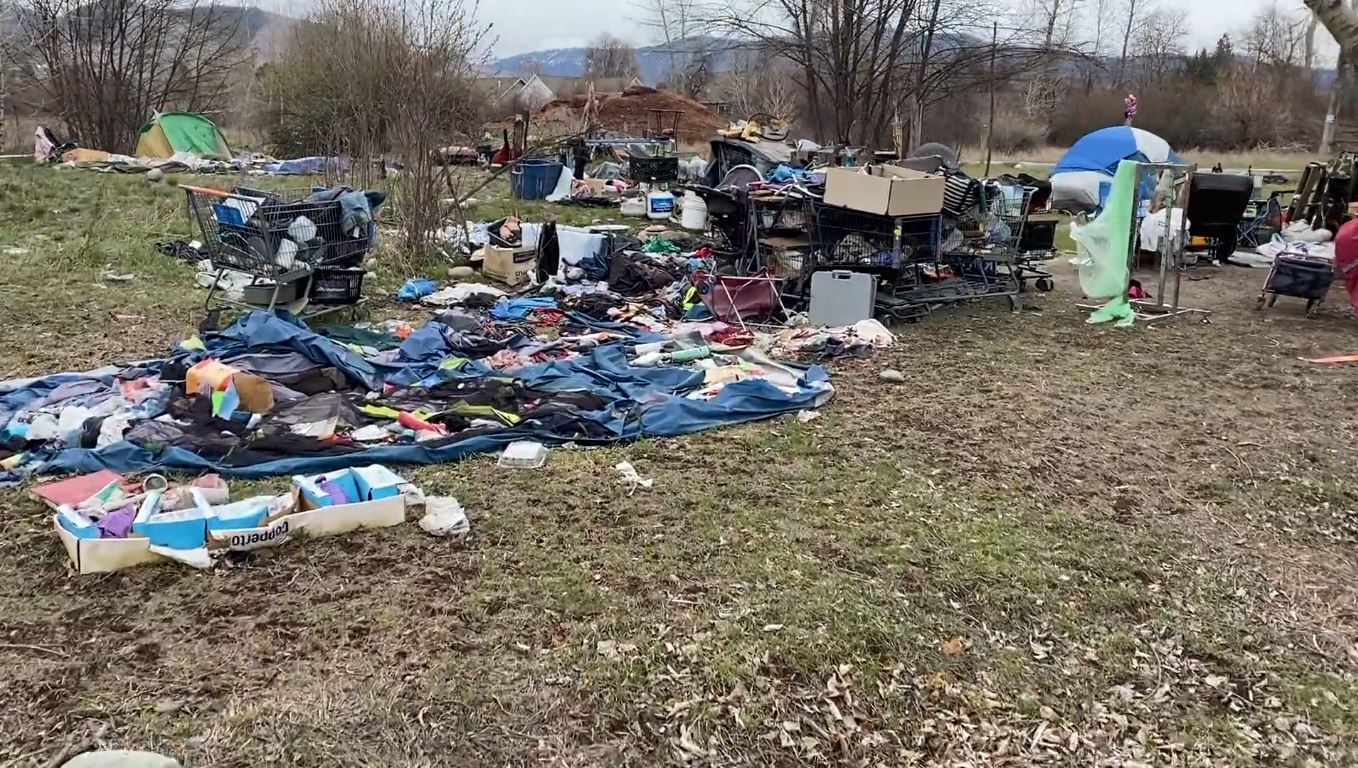


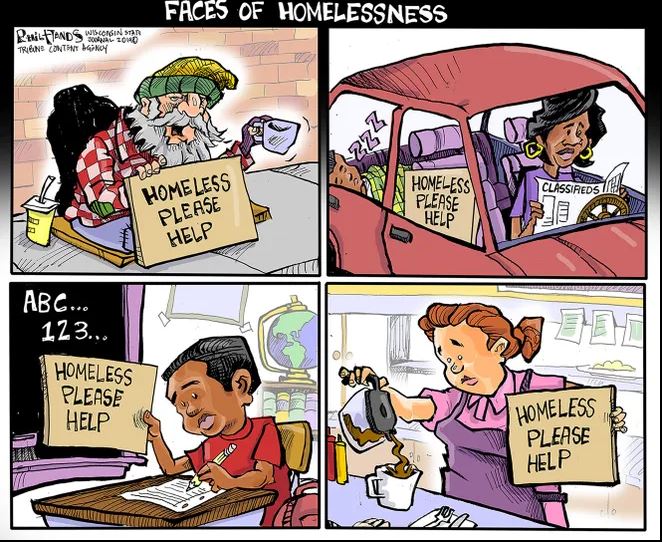
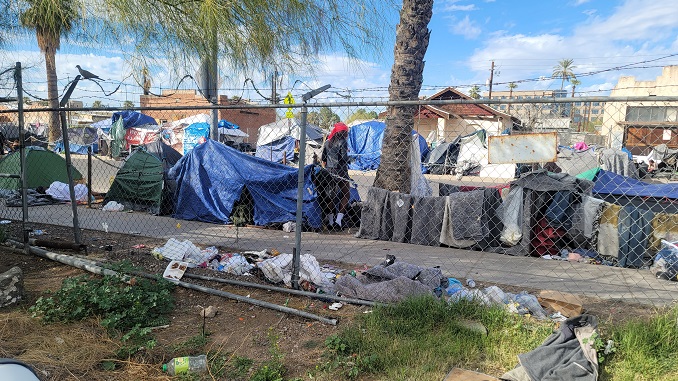

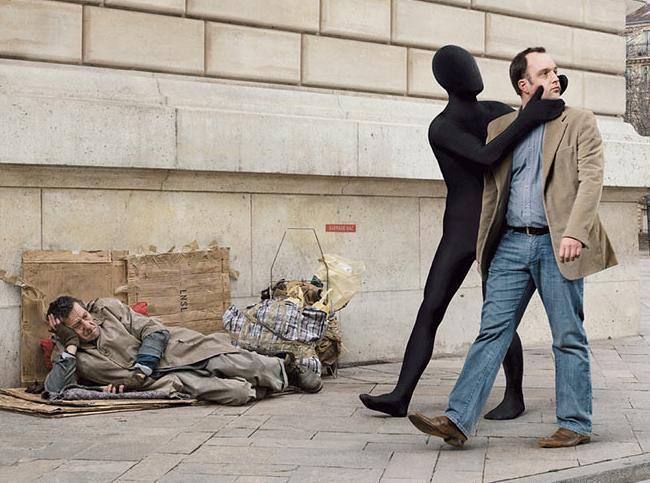
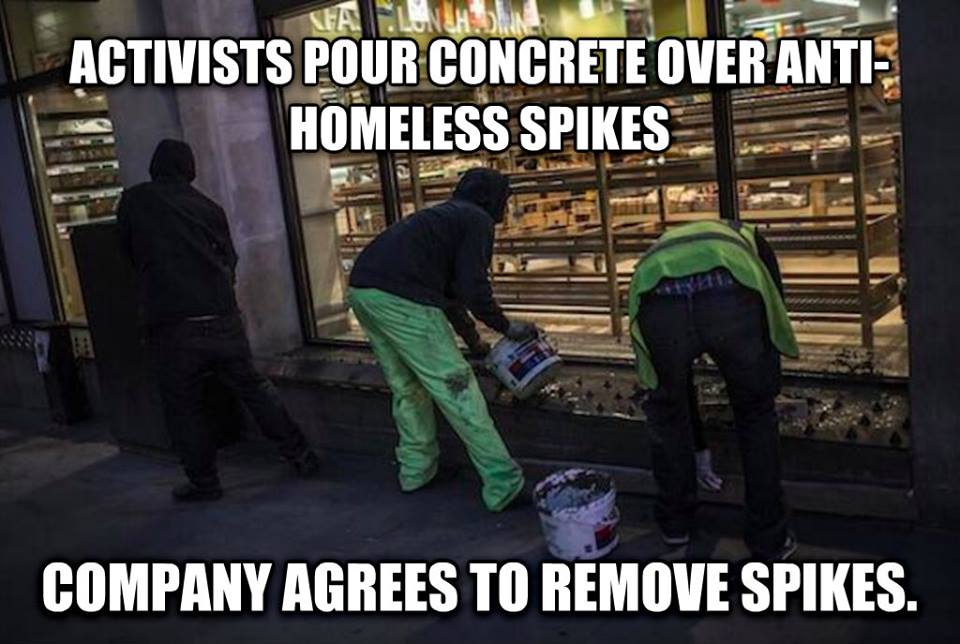


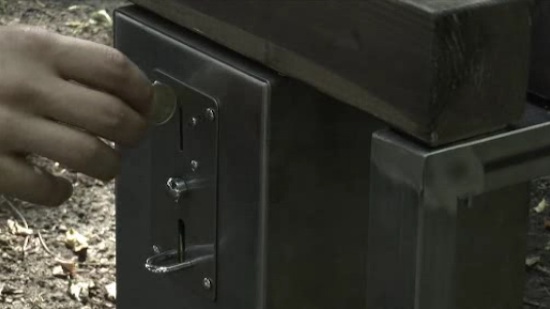


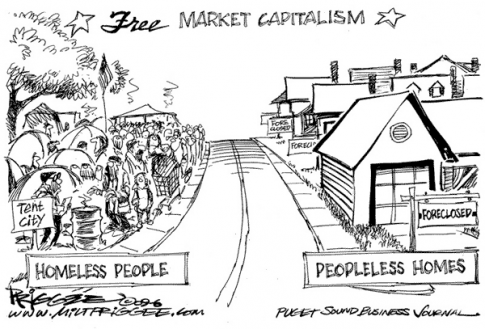




 Outer Limits Radio Show