Pathetic Mayors Ignore Catastrophe By Twisting The Law

What transformed the formerly safe neighborhoods of the American west into the post-apocalyptic bazaars of meth, trafficking and murder they are today? Within less than a decade tent cities rapidly emerged from public parks and sidewalks and grew into shantytowns and Hoovervilles like the ghastly disgrace called “the Zone” in Phoenix, Arizona. Over the past five years, these symptoms of societal decay have grown visibly worse. In the face of this humanitarian crisis, many public officials have made an institutional commitment to ignoring the problem, claiming that their hands have been tied by a decision made by the Ninth Circuit Court of Appeals in 2018. This technocratic abdication of duty is not only legally inappropriate, it normalizes a sadistic indifference toward human suffering that dramatically accelerates the urban decay of the American west. After a five-year long headache, this colossal policy failure now lies before the US Supreme Court for reconsideration.

Timothy Sandefur of the Goldwater Institute writes:

Five years ago, the Ninth Circuit Court of Appeals decided a case called Martin v. City of Boise that radically transformed how local governments address the problem of homelessness and vastly worsened the nation’s homelessness crisis. Now, the Supreme Court is poised to consider whether to overrule that decision—and a subsequent decision called Johnson v. Grants Pass.”

Both Martin and Johnson proclaimed that it is unconstitutional to enforce anti-vagrancy laws unless there are adequate shelter beds available for homeless persons. These lawsuits rely on a ruling from the 1962 case, Robinson v. California, wherein the Supreme Court held that people cannot legitimately be punished for immutable characteristics; in this case, the immutable characteristic of being “involuntarily homeless” – a term that has yet to be defined.

That argument held sway in the case of Martin v. Boise. This case began after a Boise man named Robert Martin fell asleep on an Idaho park bench and was cited by police for doing so. Martin and five other homeless Boiseans in turn sued the City after being cited for sleeping in public spaces. The decision climbed up the ladder to the Federal Appellate Court who eventually ruled against the City. In that case, a panel of judges from the U.S. Court of Appeals for the Ninth Circuit ruled that punishing homeless persons for sleeping in public violates the Eighth Amendment’s prohibition on “cruel and unusual punishment” if shelters are not available for them. As a result, this ruling conveyed to every western court that the City of Boise had violated the constitutional rights of homeless people by imposing criminal penalties for sleeping and camping outdoors.

The expansion of the Martin ruling began in 2018 when a homeless woman named Debra Blake (alongside fellow plaintiffs John Logan and Gloria Johnson) sued the city of Grants Pass, Oregon in federal court for similar reasons. “The city of Grants Pass is trying to run homeless people out of town,” the lawsuit stated. “On any given day or night, hundreds of individuals in Grants Pass, Oregon, are forced to live outside due to the lack of emergency shelter and affordable housing in their community.” The Ninth Circuit ruled in favor of the plaintiffs, citing Martin v Boise as precedent.

These rulings were meant to reiterate that people have an inherent right to exist in public spaces. Martin established that municipalities cannot criminalize people for sleeping in public and Grants Pass ultimately reiterated the human need for insulation against the elements.

Lazy bureaucrats have twisted these legal decisions into the end-all absolution from municipal responsibilities. Duly-unelected interim-mayor Jordan Hess demonstrated this point perfectly in his County Courthouse Address on 26 April 2023:

We don’t have – the reality is that we do not have enough indoor shelter in our community for everybody. … Uh, cities across the west have, of course, seen a high increase to the cost of living and the cost of housing as, um, these – as our desirable communities have become destinations for, uh, for people moving into our communities. …

Municipalities cannot criminalize homelessness, uh, nor can we ticket nor arrest or remove people who are camping in public places because there are no shelter beds, um, because there are no shelter beds for them. So since we don’t have, uh, shelter beds we cannot remove, uh, someone from an encampment, um, in a public space.”

Hess strategically actuates the predictable “criminalizing homelessness” strawman. Relying on public ignorance, lazy bureaucrats ladle out helpings of such logical fallacies frequently and generously. In this case, Jordan relies on the intentionally misrepresented proposition of “criminalizing homelessness” because such fallacies are easier to defeat than the real arguments concerning the actual issues like addiction, mental illness, and financial collapse. Hence “attacking a strawman”.

Arizona Judge Freddy Brown expounds on the folly of “criminalizing homelessness”:

“Martin’s presumption of helplessness is also manifested in such rhetorical tricks as the Respondents engage in when they accuse Petitioners of “criminalizing homelessness.” This is a semantic device intended to substitute intimidation and accusation in place of rational legal analysis. It’s safe to say that no party or amicus in this case seeks to criminalize homelessness. Rather, the laws in question are laws against sleeping in public parks, polluting public areas, and other acts which are voluntary, at least in the vast majority of cases, and that the exceptions can only be discerned on a case-by-case basis.”

Despite what lazy officials and mayoral liars may allege, City governments can still enforce anti-camping ordinances. But Martin’s bizarre application of the concept of “involuntary homelessness” has created a legally unworkable situation that combines a lack of shelter beds alongside a declaration of “involuntariness” that then entitles a person to reside indefinitely in public spaces—while completely exempt from law enforcement intervention as a matter of constitutional entitlement.

At least that’s how many municipal officials interpret Martin. Notwithstanding the caveats in that case, such officials have taken Martin’s bizarre “involuntariness” theory as an opportunity to shrug off their responsibility to enforce laws that are wholesome and necessary for the public good. The result is a stark homelessness crisis in cities across the west.”

Since the Ninth Circuit enjoys jurisdiction over the entire American West from Arizona to Washington and even Alaska and Hawaii, their rulings set precedent for all lower courts of nine western States, including Montana.

With Grants Pass up for review before the US Supreme Court, the city attorneys from that case point out the obvious effects of this ludicrous policy in a separate brief:

“This Court can see the track record under Martin in the Ninth Circuit — sprawling encampments, rising deaths, and widespread harms to the community, as localities are forced to surrender their public spaces.”

Timothy Sandefur’s amicus brief elucidates on this observation:

One need only look at the multitude of dangerous and dehumanizing homeless encampments and open-air drug markets in cities under the jurisdiction of the Ninth Circuit—such as the Zone in Phoenix—to see the profound impact that Martin and Grants Pass have had. … And the decisions also provide a convenient excuse for other city leaders that wish to do nothing while such encampments grow and fester.”

In January the Supremes agreed to hear an appeal from the City of Grants Pass of the 2022 ruling by the Ninth Circuit that expanded the 2018 Martin ruling. As Bob Egelko of the San Francisco Chronicle reported in January:

The U.S. Supreme Court agreed Friday to hear a case that could dramatically reshape how cities across the West respond to the homelessness crisis. Gov. Gavin Newsom, governments in 20 other states and organizations of cities and counties had asked the court to review and overturn a September 2022 decision by the 9th U.S. Circuit Court of Appeals that prohibited local governments from sweeping homeless encampments unless shelter was available for the camp’s residents.” …

Families can no longer walk the streets of Portland, San Francisco, and Seattle in safety,” said lawyers for the 20 states, led by Idaho and Montana.

Writing for Planetizen, Irvin Dawid clarifies that the appeal was filed under “Grants Pass” even though the case that originally created this monstrous precedent was Martin v. Boise:

Now that the Supreme Court has agreed to hear the appeal, the case goes by title, City of Grants Pass v. Johnson. Note that the high court refused to hear an appeal of Martin v. Boise in December 2019. Since the Grants Pass ruling involved precedent set by Martin, consideration of appeal means that both are up for reconsideration.”

MISSOULA RESCUED BY THE STATE OF MONTANA, AGAIN

When Missoula drops the ball on enforcement, the State of Montana must often mop up the mess. Both the $250,000+ Reserve Street shantytown eviction as well as the $20,000 burrows rebuild came out of the State budget because both areas are owned by the Montana Department of Transportation. So while Jordan Hess and other pathetic bureaucrats whine about the State legislature hoarding budgets from Missoula, these overwhelmingly expensive mistakes—made by Missoula ideologues—were paid for by all Montanans.

Why was the State of Montana allowed to do what Hess said couldn’t be done?

Jordan Hess reflects on time in office

Jordan Hess demonstrates a profound misunderstanding of the law when he claims—falsely—that his government wasn’t allowed to protect innocent taxpayers against people who are unable to control their own actions. By this nincompoopery, if a shelter runs out of vacancies then the police and citizens must stand down and watch the town burn.

While the City of Missoula claimed its hands were tied regarding the Clark Fork Colonies proliferating around the Reserve Street Bridge, the State of Montana took legal action against Missoula County to enforce an eviction of 100+ John Doesfrom accessing, residing on, or otherwise occupying the Property.” The 2022 complaint from the State of Montana addresses factors like health, dangerous fires, improper disposal of waste, the building of permanent structures on land owned by MDT, and vandalism:

The lawsuit includes five counts including forcible detainer, trespass, a claim for public and private nuisance, a request for injunction and a declaratory action.”

According to the complaint:

One such health and safety risk involved the continual risk of contamination to the Clark Fork River due to the encampment’s improper waste disposal system and the encampment’s proximity to the river. …

In Montana, a nuisance is defined as anything that is injurious to health, indecent or offensive to the senses, or an obstruction to the free use of property, so as to interfere with the comfortable enjoyment of life or property, or that unlawfully obstructs the free passage or use, in the customary manner, of any….public park, square, street, or highway.
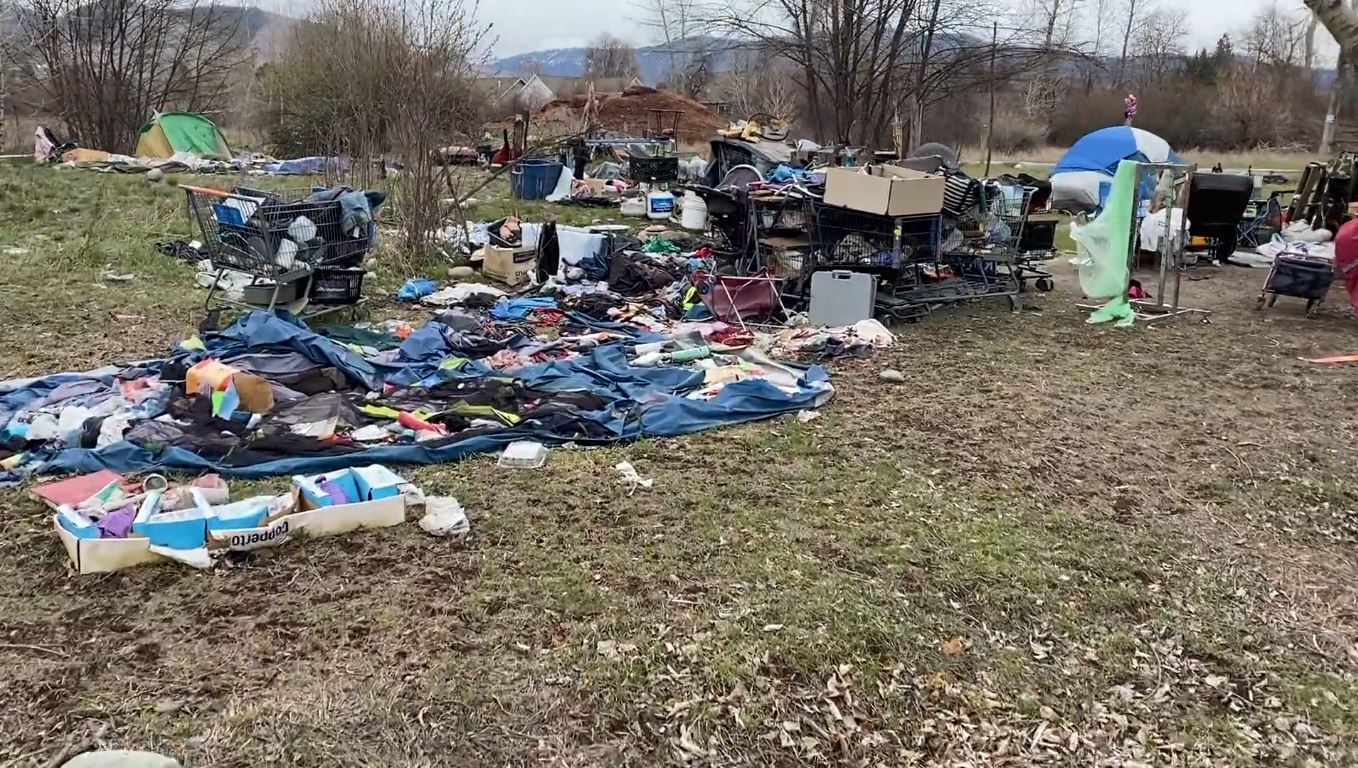
An abandoned sliver of the 2022 Reserve Street Shantytown

A similar situation arose this past November when Chinese President Xi Jinping was due to arrive in San Francisco, whereupon California’s Governor Newsom cleaned up his city literally overnight. Presenting a kind of Potemkin Village, the entire downtown was barricaded by miles of black fencing while authorities purged the district of tents, garbage and homeless. Newsom didn’t hide behind the Ninth Circuit decision, admitting that the cleanup was only performed for Xi’s arrival.

By legal precedent, Federal law is supposed to supersede state and local laws, but with several caveats. Since individual states exist within the regional boundaries of the Ninth Federal Circuit District’s jurisdiction, the Martin and Grants Pass decisions are technically binding. But since Federal rulings are not supposed to infringe on states’ rights, decisions can be lawfully challenged and presumptions rebutted.

The State of Montana would seem well within its rights to file a complaint petition, as it did two years ago in the case of the Reserve Street Shantytown. Article IX of the Montana Constitution guarantees that “the state and each person shall maintain and improve a clean and healthful environment in Montana for present and future generations.”

Furthermore, the Ninth Circuit never declared the west was a free-for-all to make encampments wherever anyone desires, nor did it legalize public endangerment, the contamination of public waterways or the degradation of public spaces. Their ruling was narrowly defined. But that hasn’t stopped municipalities like Missoula from twisting the decision into a one-size-fits-all excuse to ignore a profitable catastrophe while redirecting public funds into private partnerships and blaming fallout on those dastardly Republicans at the State Legislature.

Sandefur elaborates:

The Martin/Grants Pass rule has not only worsened the homelessness problem—by confusing and frustrating city officials who want to do something to clean up their communities and help the unsheltered—but it has also encouraged irresponsible and foolhardy policies that only exacerbate the homelessness crisis. Cities such as Phoenix and San Francisco responded to those precedents by adopting the failed policy known as “Housing First,” which has actually increased homeless populations. And some cities, including Phoenix, took Martin and Grants Pass as handy excuses to do nothing about the homelessness problem—ignoring the laws they’re supposed to enforce, and endangering the hardworking taxpayers who have the right to police protection. We saw the practical consequences of that in The Zone.

The idea behind “Housing First” is simple: there will be no more homelessness if everyone has a home. The fault with that logic is that there are many individuals who do not want housing—at least, not at the cost of giving up their addictions—and for that reason choose not to take advantage of available aid.”

Despite what their pushers may allege in the corporate media, so-called “Housing First” policies have overwhelmingly proven themselves a failed strategy in the west. From 2014 to 2020, the States of Oregon, California and Washington all initiated “Housing First” initiatives that resulted, quite ironically, in dramatic increases in homelessness on the streets of their cities.

Liberal mayors in both Missoula and San Francisco committed to ending homelessness within a decade. Missoula’s ten-year plan to end homelessness was called “Reaching Home” and ended in such utter failure that by its conclusion in 2022 none of its former proponents were enthusiastic about its mention.

In the meantime, Missoula burns while mayor Andrea Davis fiddles with her “urban camping” working group, which concluded earlier this month “without clear recommendations” for policymakers. This doesn’t seem particularly surprising given that Davis introduced her working group back in February on KGVO with murky statements like this:

So, our plan here is in addition to obviously, long-term community planning that we’re doing, to come up with our next plan to address homelessness, is to make homelessness rare, brief and one time only.”

Andrea Davis discusses the unhoused in Missoula

It is already the case that most people who become homeless are only so for a day or two, according to Dennis Culhane’s Five Myths about America’s Homeless, which reveals that chronic homelessness is usually the result of addiction or mental illness. Once again, the reality on the ground doesn’t fit with the narrative being forced down from above.

The reality-averse bureaucrats pulling the purse-strings of local government will constantly assert that the solutions lie in constructing more affordable housing. They’ll never discuss whether it’s possible to make existing housing affordable because their developer donors want subsidies to build new apartment complexes. Whether the proposed solutions are effective at “eliminating homelessness” becomes completely irrelevant once the money changes hands.
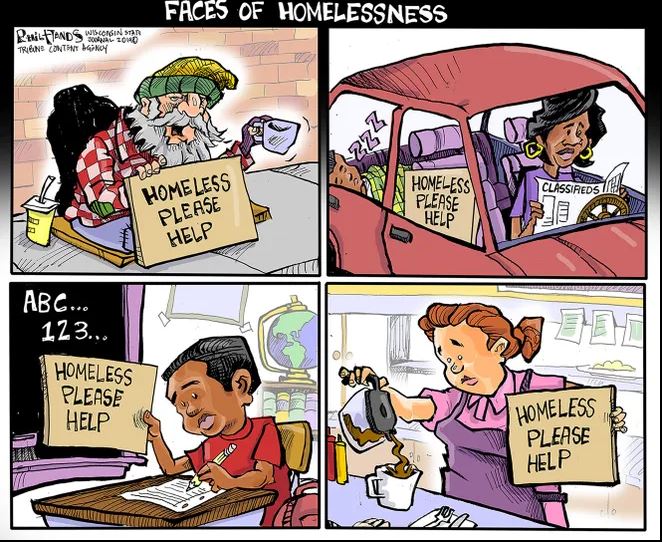
CRUEL AND UNUSUAL

Prohibiting homeless persons from sleeping, camping, and lodging wherever they want, whenever they want, cannot be construed as torture. Nevertheless, that’s exactly what the lawyers in these cases argued, and the Ninth-Circuit-Numbskulls bought it. The arguments bolstering the Martin ruling (and by extension, Grants Pass) hinge entirely on the bastardization of the Eighth Amendment’s clause prohibiting “cruel and unusual punishment”. Timothy Sandefur expounds on this misinterpretation:

The Martin and Grants Pass cases declared that it’s unconstitutional to arrest people for living in tents in public parks or other public property, any time there aren’t enough beds available in government-run homeless shelters to accommodate the city’s unsheltered population. Relying on a 1962 precedent called Robinson v. California, which said that the Eighth Amendment’s prohibition on “cruel and unusual punishment” bars the government from punishing people for things that are outside their control, the Ninth Circuit reasoned that if the number of homeless people is greater than the number of shelter beds available, those who sleep on the streets must be doing so because they can’t help it. Everyone must sleep, after all, so a person who can’t find a place to stay, and falls asleep on a sidewalk, is doing so as part of what the judges called the “inevitable consequences of being human.”

It seems obviously dubious that anyone who chooses to live indefinitely outdoors can be said to be doing so only as an unavoidable “consequence of being human.” Nevertheless, this is where legislators and bureaucrats tend to get lost in the weeds.

From the appeal:

Dissenting, Judge Bumatay stated that nothing in the text, history, and tradition of the Eighth Amendment’s Cruel and Unusual Punishments Clause comes close to prohibiting enforcement of commonplace anti-vagrancy laws, like laws against sleeping on sidewalks and in parks.”

While homeless individuals are certainly entitled to the utmost respect and compassion, they are not therefore immune from the law. Breathing in public is quite different than building structures into the riverbank and polluting the waterway with dangerous chemicals and hazardous substances. Judge Bumatay describes how the Martin decision flipped the Eighth Amendment completely upside-down:

Today, we let stand an injunction permitting homeless persons to sleep anywhere, anytime in public in the City of San Francisco unless adequate shelter is provided. The district court’s sweeping injunction represents yet another expansion of our court’s cruel and unusual Eighth Amendment jurisprudence. Our decision is cruel because it leaves the citizens of San Francisco powerless to enforce their own health and safety laws without the permission of a federal judge. And it’s unusual because no other court in the country has interpreted the Constitution in this way. …

Based on this innovative reading of the Clause, our court thought it was “compel[led]” to prohibit enforcement of Boise’s anti-camping and disorderly conduct ordinances whenever shelter is not offered. Id. Martin reasoned that sitting, lying, and sleeping are “universal and unavoidable consequences of being human” so that the “conduct . . . is involuntary and inseparable from status.” … So Martin felt that governments cannot criminalize the “state of being homeless in public places” if “there is no option of sleeping indoors.”

Sandefur illustrates the logical fallacy inherent in this reasoning:

By the Ninth Circuit’s logic, if a person drives home intoxicated from a bar, and gets into a collision that kills someone, she cannot be held criminally responsible—because the government failed to provide her with a taxicab. That is illogical. Likewise, someone who chooses to start a fire that gets out of control and consumes a neighbor’s house has no “involuntariness” defense to an arson charge just because the government did not give him an electric heater. And a person who pours poisonous waste into a river is not “involuntarily polluting” simply because the government failed to provide her with a toxic waste disposal service.”

Among other “unintended consequences” of the Ninth Circuit’s dimwitted decision was the explicit validation of an extraordinarily vague term: “involuntarily homeless”. According to dissenting judge Patrick J. Bumatay, “The district court didn’t even define what it means to be “involuntarily homeless” and gave conflicting signals on the point.

But comparing involuntary homelessness to voluntary substance abuse seems an inappropriate conflation on the verge of non sequitur. Voluntary intoxication is not a defense in criminal proceedings per Montana v. Egelhoff. Sandefur further explains the absurdity of associating human behavior under the auspices of “involuntary”:

[…] both rulings embody an untenable assumption that people lack free will—and therefore cannot be held responsible for their actions—whenever the government fails to provide them with a free-of-charge alternative to breaking the Law.

A corollary mistake in both cases is the assumption that the government cannot penalize “involuntary” conduct—and is thus powerless to protect innocent citizens from harms inflicted by people who are unable to control their actions. … The law cannot punish people for who they are, but it certainly can arrest and incarcerate people for what they do.

To regard the homeless as lacking free will—or, in today’s fashionable jargon, as lacking “agency”—not only paralyzes public officials and harms the hardworking taxpayers who expect their public employees to enforce the law for the protection of their neighborhoods; it’s also dehumanizing to the homeless themselves. To treat the destitute as choice-less underestimates their capacities and, by failing to regard them as ordinary people, risks denying them full humanity.”

Sandefur further describes why overly-simplistic declarations like “the answer to homelessness is housing” represent the flawed reasoning of low-effort thinkers and their antisocial shepherds who ignore the phenomenon of “shelter resistant” individuals:

Take, for example, the plaintiffs in an ongoing federal lawsuit brought by the ACLU involving Phoenix’s infamous “Zone”—which until recently was occupied by as many as 1,000 people living in tents on downtown sidewalks. In that case, the plaintiffs are a man who admits he’s lived on the streets for nearly 25 years, and a woman who is not only physically and mentally competent, but even maintains a credit card account. These people are clearly not incapable of making decisions in their lives, and characterizing them as “involuntarily homeless” is ludicrous. So is giving them a constitutional right to reside indefinitely in tents on public property.
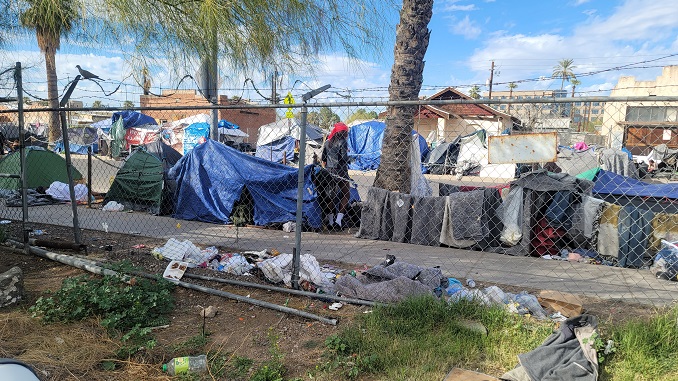
The infamous “Zone” of Phoenix, Arizona

SCOTUS REVIEW WILL LIKELY OVERTURN DISASTROUS NINTH CIRCUIT DECISION

The Supremes appear to be siding with the City of Grants Pass in this case, though they haven’t ruled yet and probably won’t until the very end of their session next month. According to the New York Times:

A majority of the Supreme Court appeared inclined on Monday to uphold a series of local ordinances that allowed a small Oregon city to ban homeless people from sleeping or camping in public spaces. … The conservative majority appeared sympathetic to arguments by the city of Grants Pass, Ore., that homelessness is a complicated issue that is best handled by local lawmakers and communities, not judges.”

Another factor that makes a SCOTUS overturn of Martin very likely is the multilateral support the appeal has garnered from a wide variety of unlikely allies. The San Francisco Chronicle notes that, “The case has become a rare instance in which officials across the political spectrum, from Newsom to conservative state senators in Arizona, are seeking the same outcome.”

Jamie Parfitt of KGW8 likewise notes that:

Dozens of parties have submitted amicus curiae or “friend of the court” briefs, many of them backing Grants Pass in its bid to overturn the ruling. And the case has produced some strange bedfellows, including California Gov. Gavin Newsom and the conservative Goldwater Institute, not to mention the attorneys general of Idaho, Montana, Nevada and other western states. …

“What’s really striking is how many states, how many counties, how many cities here on the West Coast — governments run by liberal Democratic mayors and governors — have filed briefs with the court saying that ‘This is unworkable.’

Beyond being unworkable, the Martin ruling results in policies that ironically mock the very compassion their authors purport to embody. Sandefur’s amicus brief concludes:

Leaving people to remain living indefinitely on the streets, or in tents in a park—precisely on the grounds that they are unable to do otherwise!–is not a compassionate response. On the contrary, it simply reasserts, under the strangest of disguises, the cold attitude of a past era that viewed the poor as a mere “surplus population” beyond possibility of rescue. …

A compassionate response would consist of providing people with the care they need—including taking them into custody against their will if they are unable or unwilling to manage themselves. … Finally, the law-abiding, taxpaying public deserves compassion, also. The victims of municipalities’ abdication of their law-enforcement duties aren’t just the homeless—who certainly deserve better than to be left to live on the streets—but also members of the community who must suffer threats, pollution, damage to their properties, and the ruin of their businesses as the consequence of a legal principle that is indefensible.”

FLUSHING CARLYLE: Privatization Is Drowning Missoulians in an Ocean of Leaks, Bills, and Propaganda

WATER YOU THINKING?

3 April 2015 concluded the third and final week of Missoula’s District Court Battle with the Carlyle Group and Mountain Water, anticipating closing statements from both sides on Monday, April 6th after which Judge Karen Townsend will determine whether it is necessary to condemn the Water System through eminent domain.

The final days of Missoula’s trial curiously coincided with a related event in California making national headlines this past Wednesday, as California Governor Jerry Brown ushered in unprecedented state-wide water restrictions. Standing in a patch of brown grass in the Sierra Nevada Mountains, the Governor called attention to the fact that there should be a minimum of 6 feet of snow where he stood, estimating California’s 2015 snow pack at 6% of normal.

“People should realize we are in a new era,” he said at press time on Wednesday. “The idea of your nice little green lawn getting watered every day, those days are past.”

California’s water restrictions will dramatically affect the citizens, and while I agree wholeheartedly that watering lawns is a waste of time, money and resources it is doubtful if water restriction enforcement will pertain to Nestle’s water bottling facilities, or even restrict the number of gallons Nestle are permitted to bottle from the millions they currently do.

The fact that our very own Mountain Water Company’s previous parent company Park Water is based in California establishes a very real connection between the healthy abundance of our water system, and the ongoing drought currently underway in California. The water deficit in California signals two possibilities for us here: a sudden influx of climate refugees from California inland toward places like Montana, and the export of Missoula’s water resources into increasingly thirsty regions such as California.

It appears that that California Gold Rush has given way to a new kind of rush away from California for the so-called Blue Gold of water resources seen by investors looking to capitalize on the worldwide drought situation by privatizing the resource and selling it to thirsty communities.

Beings as Missoula’s Water System has been privatized for nearly a hundred-fifty years, the implications of this past month’s eminent domain proceedings are so immense it’s difficult to appreciate the severity of this situation for what it really is. But I will nevertheless do my best to convey the seriousness of the circumstances.


THE LATEST ON THE MOUNTAIN WATER TRIAL

Mountain’s current owner Carlyle, has signed a proposal to sell Mountain to Liberty Utilities, a subsidiary of Canadian-based Algonquin Power and utilities Corp.

While Algonquin’s CEO Ian Robertson has refused to testify in Missoula County District Court, an executive representing Algonquin’s subsidiary Liberty Utilities took the stand on Wednesday, April 1st. This is the same firm that offered Mayor Engen $2.5 million to forget about this trial, as it stands directly in the way of their desired purchase.

Greg Sorenson, a division president of Liberty Utilities could not confirm that ownership by Liberty would result in faster fixes. Under cross-examination by lawyer Harry Schneider, Sorensen also could not promise the subsidiary of a Canadian conglomerate would even make an attempt to do “a little better than the current owner.” This isn’t promising considering the fact that even Mountain Water Co. admits it is not fixing pipes at a rate that is adequate to avoid main failures.

Sorenson also said Liberty has no plans to bottle tap water in Missoula, and has promised to state regulators that it will adhere to the conservation clauses in the same agreement signed by Carlyle, the city of Missoula, and the Clark Fork Coalition in 2011. However, Liberty never signed an agreement, so that statement by Liberty that it will adhere to the clause prohibiting the bottling of Missoula water is not legally binding, as the clause only applies to Carlyle’s use of the water. Liberty wouldn’t be legally liable if they decided to reverse their verbal pledge to adhere to the pledge not to bottle Missoula water. For the pledge to be anything more than empty promises, we’d need it in writing. And under cross-examination, Sorensen admitted Liberty itself has no written agreement with the city or the Clark Fork Coalition.

When Missoula’s utility was sold to the Carlyle group by Sam Wheeler’s Park Water in 2011, the agreement signed by Carlyle’s Bobby Dove prohibited Carlyle from setting up a bottling plant in Missoula. But now Carlyle wants to do exactly that, according to Clark Fork Coalition director Karen Knudsen who testified on 27 March, revealing that Mountain Water’s president John Kappes invited her out for coffee to explain Carlyle’s desire to bottle Missoula’s water for export and sale throughout the world.


INTO THE GARDEN A SERPENT DID CRAWL

Then on Thursday, April 2nd, Carlyle’s very own, Robert Dove took the stand, rebutting the claim that his firm failed to consider any offer made by the city of Missoula to purchase the Water System “in good faith.” He said that the City’s offer of $65 million in 2013 was unreasonable, estimating the appraised value of the system at nearly double that. From Carlyle’s corporate perspective, this probably seems reasonable.

The three water companies Carlyle own are together referred to as Western Water Holdings, the total estimated value of which floats around the vicinity of $220 million (considerably more than when they purchased them four years ago for $157 million). Algonquin’s offer to Carlyle for Western Water Holdings is $327 million, and is not contingent upon the result of Missoula’s condemnation hearing, meaning that Carlyle gets paid the same amount even if the sale does not include Mountain Water Company. Obviously, Carlyle stands to profit immensely regardless of what happens.

At Carlyle’s request following their 2011 purchase of Mountain Water, Mayor John Engen waited until 2013 to present an offer to purchase the system. But in an email to Dove early that same year, another Carlyle executive said the firm would lose $2.1 million in revenue every year if it sold the utility; that money is paid by Mountain to its new parent company Western Water Holdings, also based in California.

After agreeing to consider “in good faith” any offers by the city to buy Mountain Water Company, Carlyle refused both offers by the city, and declined to negotiate, offering no counter to Missoula’s proposed $65 million and $50 million deals. Dove stated that sale to the city would be “An optimal outcome” but that the offers had been much too low.

Dove also admitted Carlyle never estimated the value of Mountain as a standalone asset despite being aware of the city’s ongoing interest in its purchase. He also acknowledged Carlyle had earned $11 million in profit from those water companies since the firm took ownership in late 2011, turning eleven million dollars in four years.

Dove also agreed that his firm did not put any additional capital into infrastructure in Missoula, saying:

“There was not a need to do so.”


AN EXERCISE IN FUTILITY

 One of the City’s arguments in favor of municipal ownership of the water system this past week, pertained to the City operated Waste-water treatment plant the city referred to as “world class.” So in an attempt to challenge this assertion, Carlyle called an engineering expert Wednesday to testify that the city plant was not “world class,” pointing to photos of spilled grease, a “sludge island” in a basin and rust on equipment in an effort to illustrate the facility is “inadequate” in some areas. When asked how a world-class facility would stack up he said such facilities will go years without any violations.

However, upon cross examination he admitted that the city run plant is generally meeting its permit requirements, and doing so at customer rates that are well below average. He also admitted that his assessment of the facility found it “clean with minimal odors” and gave it an “excellent” rating in multiple areas.

Bill Mercer and Joe Connor have done an exemplary job of attempting to instil doubt in our minds through their efforts in court, and with the help of Mountain’s President John Kappes and Liberty Utilities, the private firms have done an excellent job of propagandizing condemnation for something it isn’t with exorbitant advertising campaigns designed to influence public perception away from its best interests.

But regardless of what we think “condemnation” means, this isn’t some kind of government takeover. Local government represents the constituency far better than Federal institutions ever can. The citizens have a voice in the chambers of their locally elected representatives, and a say in what happens to their community.

If people don’t trust the government, that’s perfectly understandable, but can they honestly say they have more trust in private equity firms like the infamous war profiteers at the Carlyle Group? Even if the city has to increase rates, it’s highly unlikely that they would do so at 13% annually, which has thus far been Carlyle’s modus operandi revealed in projected earnings documents they fought hard to keep out of the public eye in the initial days of this trial.

To really drive the point home is Bobby Dove’s assertion that Carlyle has not put any additional capital into Missoula’s infrastructure because “There was not a need to do so,” is an outright lie that in and of itself should be enough of a head turner to get some light bulbs flickering above our heads. They’re quick to raise rates and stuff their pockets from the sweat of our brows, but when it comes to our health and well-being, all we’ll ever get from them are excuses. How could we expect it to be otherwise – they’re not accountable to us because nowhere in the equation can elected representatives enforce responsibility or ethical practices. This is the true face of privatization.


SPEAKING OF RATE INCREASES

Yesterday was the final day of the trial, and City Attorney Jim Nugent took the stand. Nugent was questioned at length concerning the details of Mountain Water Company proceedings in municipal court over the last 11 years. Nugent said several times that “Mountain Water Company has petitioned to raise rates every single year, and that city officials have almost always intervened. So the accusation that city control will result in rate hikes is directly contradicted by countless instances to the contrary. Nevertheless, the corporate-sponsored rumor that city control is bad for Missoulians perpetuates, thanks to their concerted advertising campaigns.

Carlyle’s attorney Bill Mercer also asked several times if the city ever called witnesses to testify on rates/operations of Mountain Water Company. Nugent said that such witnesses had been called in District Court, and also in municipal court by the Public Service Commission.

On cross examination from the City Nugent was asked “do you agree that the sale of Mountain Water Company to yet another for-profit out-of-state enterprise would not be in the city’s interest?”

Carlyle’s Bill Mercer stood and shouted, “Objection!”

Judge Karen Townsend responded, “Overruled.”

The city asked again, “Do you agree that the sale of Mountain Water Company to yet another for-profit out-of-state enterprise would not be in the city’s interest?”

Nugent responded by saying, “Absolutely.”


 IS THIS THE END?

So where are we now? Our system leaks. It needs repaired. Private owners have proven repeatedly to the point of tedium that pocketing profits is more important to them than making necessary improvements. The repairs are estimated at nearly $100 million on the high end. But beings as the city has a AA credit rating, and beings as rate payers pay more than twelve-and-a-half million dollars annually, it doesn’t take a PhD in mathematics to figure out that we have options to purchase this thing, fix it, pay for it, and enjoy the fruits of our labor in under ten years.

Then again, I wish to express enthusiastic solidarity with Dan Brook’s article in Number 13 of the Missoula Independents’ 26th Volume. Brooks makes the case that Missoula should absolutely have control over its own water system (after all, 128 other cities and towns in the state already do), but that we shouldn’t buy it. It’s ours. Why can’t we tell these private firms to grow up and quit exploiting the people? Would they sue us as they did Bolivia? Probably they would. But this is Montana, and even personalities like Bobby Dove would do well to remember where they are. American Imperialism ends here, starting with the Corrupt Practices Act.

I fear that many Missoulian’s who either don’t have time to be informed about this or simply don’t care are in for a rude awakening when the world’s water woes come here to roost. It’s easy to care when its too late to matter; during rate spikes and amid bottling deals, sinkholes and catastrophic failures won’t matter to our owners as the drought spreads. If Missoula fails to take control now, no one will hear our protests when its too late to matter.

Missoula’s privatizations woes began shortly after Missoula became a colonized settlement a century and a half ago whereupon Higgins and Pattee constructed the Rattlesnake and Waterworks infrastructure. That system was bought by the Missoula Mercantile Company, who promptly thereafter named it the Missoula Water Company. Then copper baron William Clark bought it and changed the name to the Missoula Light and Water Company. Montana Power bought the system in 1930. Nearly four decades later in 1979 Sam Wheeler’s Park Water bought the system thus creating Mountain Water. Three decades after that, the Carlyle Group purchased multiple water systems from Sam Wheeler, including Mountain Water, and consolidated them together into what is now Western Water Holdings. Now Liberty Utilities, a subsidiary of Canadian-based Algonquin power, wishes to purchase Western Water Holdings from Carlyle.

Are Missoulian’s tired yet of this endless for-profit, out-of-state, corporate privatization of our most vital resource?

Are Missoulians jaded by decades of high rates and leaky pipes?

Have Missoulians had enough of this game of Hot-Potato constantly tossing our

Water System into the hands of a new owner every few years?

Aren’t Missoulians weary of the consequences of continued privatization amid the ongoing climate crisis currently drying up water resources worldwide?

To pull control of our water system away from corporations, the City has to prove that municipal ownership of the drinking water system is “more necessary” than private ownership. What defines what is “necessary” might be a subjective statement.

But given the fact that Missoula’s water system is among the leakiest in the nation, leaking more than 4 billion gallons of water per year; given that Mounain Water’s answer to leaky infrastructure has been to construct additional pumps to pump more water through increasingly leaky pipes; given that Missoulians are paying $600,000 a year to power those pumps; beings as Missoulian’s have what are among the highest rates in the region; given that there is no monetary incentive for a private firm to reinvest profits into repairing the leaky infrastructure; and beings as the city could likely run the utility for nearly $7 million less per year, I would say the case for condemnation couldn’t be more clear.

worldGabrielle Lafayette is a journalist, writer, and executive producer for the Outer Limits Radio Show.
Catch the cloudcast at mixcloud.com/outerlimitsradioshow
Check out the more frequently updated tumblr page at outerlimitsradioshow.tumblr.com
Contact the research team at outerlimitsradioshow@fastmail.fm

The Leakiest Pipes In America

What’s In The Water?

The City of Missoula Versus Mountain Water and the Carlyle Group raged through its seventh day this past week and is on course to conclude this coming week, after which Judge Karen Townsend will determine whether it is necessary to condemn the infrastructure through eminent domain. The case for condemnation gathered steam this week, notably on Monday with the revelation that Missoula’s water system is among the leakiest in the country, if not outright the single leakiest municipal water system in the nation.

Testifying on Monday, 23 March 2015, speaking on behalf of Henningson, Durham and Richardson, Inc. HDR’s Senior Vice President of engineering Craig Close displayed several images depicting rusty pipes, leaky pumps, and crumbling dams that he collected during his survey of Missoula’s water system. According to Close, the Mountain Water system is leaking more than 4 billion gallons of water a year, which amounts to 50 percent of total water pumped, putting Missoula well above the national average for leaky systems and far outside the acceptable range. But instead of addressing the cause of the leaks, Mountain Water has repeatedly decided to alleviate the symptoms of the problem by constructing more pumps, thereby exacerbating the problem while simultaneously raising rates to account for the additional flow charges. And guess who gets to pay for all of that excessive waste? The costs associated with pumping more water through increasingly leaky pipes costs Missoulians more than $600,000 annually, and that’s just the electrical costs to power the additional pumps to keep up with the increasing leakage.

Close mentioned that this volume of leak is unprecedented with regards to the modest size of Missoula’s water system, which is composed of a mere 319 miles of main. In terms of amount by volume, Missoula’s leak rate is the highest Close has ever seen.

Then on Wednesday, 25 March, Kees Corssmit of Geitner Environmental Management Group admitted not only that the leakage rate at Mountain Water reveals “significant” problems, but that he has only seen one other instance of a system that leaked anywhere near the rate of Mountain Water during more than 4 decades of studies.

But coming back to Close’s revelation that Mountain Water leakage totals more than four billion gallons of water lost annually, he went on to explain that not only does that leakage pour chlorine and other contaminates into our aquifer, but it creates a conduit between the surface and the aquifer through which surface level contaminates such as fertilizers, pesticides and automotive chemicals can seep into the aquifer more easily thus sullying our groundwater with a chemical cornucopia. In other words, contaminates are whisked into our aquifer directly by Mountain Water’s extraordinarily leaky infrastructure.

This problem would be less alarming if there weren’t so many surface-level contaminates leeching into the Earth already. Earlier this year Jessica Mayrer published a column in the Missoula Independent featuring Travis Ross from the Missoula City-County Health Department. Ross calculated that every single day, as much as 300 gallons of chemical waste are being released from a single, leaky underground storage tank owned by Montana Rail Link and operated by Emerald Services on Missoula’s North side at the Phillips Street Chemical Transfer Facility. The tank farm contains chemicals like petroleum, antifreeze and windshield wiper fluid, and could be leaking contaminants into the soil. More than 80 complaints circulated from residents in the vicinity of the Tank farm who reported feeling ill, citing symptoms such as nausea and sore throats, that seemed to be attributed to some kind of chemical contaminant in the area. Though the city has launched a formal inquiry, the task force assigned to the case is waiting for warmer spring temperatures before continuing with the investigation.

As bad as a chemical leak of 300-gallons per day is, that situation would be less severe if Mountain Water’s leaky infrastructure wasn’t providing a direct go-between for these surface level contaminants and the aquifer that we source our water from. The pipes wouldn’t be so leaky had money been spent on reinforcing and rebuilding sections of leaky and condemned infrastructure; that infrastructure wouldn’t have been so neglected had the money collected from Missoula rate-payers been reinvested into the system instead of getting shuffled into the stock portfolios of a few wealthy executives and shareholders. With more than a million-dollars a month collected from Missoulians who rely on Mountain Water, there is no excuse for this situation other than simple greed – a direct manifestation of private ownership of a public utility that is, for all intents and purposes, a natural monopoly, since it is literally impossible for a competing agency to offer the same service.

peak-generation-waterglass

Gabrielle Lafayette is a journalist, writer, and executive producer for the Outer Limits Radio Show.
Catch the cloudcast at mixcloud.com/outerlimitsradioshow
Check out the more frequently updated tumblr page at outerlimitsradioshow.tumblr.com
Contact the research team at outerlimitsradioshow@fastmail.fm

Water Is NOT The “New Oil”

????????????????????????????????????????THE BIG SQUEEZE

The great Mountain Water debate is on in Missoula County District Court as the City of Missoula takes its eminent domain case for public ownership against Mountain Water Company and its new owner, the infamous global equity firm, the Carlyle Group. The trial comes as a consequence of Carlyle reneging on its promise to sell Mountain Water to the City of Missoula after Carlyle acquired Mountain’s parent company, California based Park Water.

This trial also comes as another step in the age-old fight for Missoulians to gain control of their water system. Missoula is the only city in Montana that does not own its own water, and never has, dating back to 1905-06 when the Water Works diversion became privately owned.

In fact, this all goes back to the 1870’s When Frank Worden, C.P. Higgins and David Pattee constructed the reservoir and infrastructure from Rattlesnake Creek to Water Works Hill and the reservoir that was bought by Missoula Mercantile Company, naming it Missoula Water Company. Then a dam was constructed in 1901-02 to divert the waters. By 1905 Senator and copper-king William A. Clark plaid $900,000 for the system, and a year later changed the name to the Missoula Light and Water Company.

the Diversion dam on Water Works Hill was reconstructed with concrete in 1924, at which point Mayor William Beacom suggested that the public purchase the water, offering $600,000 for the system. But the roaring 20’s being what they were, Missoulians didn’t bite, and the utility remained under private ownership.

By 1930, Missoula’s population had grown to 14,657. The Montana Light and Water Company had also grown to provide a central heating system for the city as well as the trolley system, in addition to the utilities of water and electricity. It was at this point that the Montana Power Company bought the system. Established in 1912, Montana Power was a private firm founded by John Ryan, President of the Anaconda Copper Mining Company. Shortly thereafter it was determined that that Water Works Infrastructure was insufficient to provide water to the demands of an ever expanding population, inspiring the addition of five wells into the system.

Jump forward to 1979 when Montana Power sold our water system outright to a California based firm in the creation of Mountain Water as a subsidiary utility service to provide water to some 4,000 Missoulians residing outside of the city limits. Mountain Water was and still is owned by Park Water, a California based company owned by a man named Sam Wheeler. Following the Public Service Commission’s approval of the deal, the city missed its chance to buy the utility in 1979. The vice chairman of Montana Power, Jack Burke, was determined to confirm whether the city of Missoula was interested in purchasing the utility, and went out of his way to do so. Montana Power contacted Mayor Bill Cregg to inform him that the utility was available, but before the city council could even consider the proposal, Montana Power announced their sale to Sam Wheeler for $8 million. Wheeler claimed that the city missed its chance to purchase the system because the delays associated with municipal financing took too long, stating that the city didn’t have the money and lacked the time and resources to raise it, whereas Wheeler who had the cash in hand was able to bypass the bureaucracy of city decision making.

By 1983, 40,000 people called the Missoula valley their home, whereupon the Water Works system was abandoned completely for the utilization of Missoula’s Aquifer. Water Works was to remain an emergency back-up, but nothing more. Though Water Works was providing nearly half of the city’s water (45%) a giardia outbreak that infected the digestive systems of thousands of residents led to the realization that Water Works required millions of dollars of additional improvements for more sophisticated filtering and improvement costs. The following year the city again attempted to purchase Mountain Water, valued at $11million in 1984. The city proposed a bond, but Mountain Water’s general manager Lee Magone appraised the system’s worth at $16 million.

The city announced that the salaries of Mountain Water employees would be cut in the event of the sale, resulting in employees accusing the City of failing to account for the impact on their lives. Thus a handful successfully opposed the popular majority of Missoulians who wanted to see the water owned locally, obtaining a voter initiative to block the sale to the City. After the city’s failed litigation against those individuals, Mayor John H. Toole began eminent domain proceedings against Mountain Water with tremendous support from Missoula residents. That trial ensued in March of 1986, and ended dismally in August of that same year when the court determined that the city had, “failed to prove that the condemnation was necessary.” The battle created bad blood and hard feelings on both sides, turning the relationship between the City and Mountain Water from civil to hostile. The city had to pay for Mountain Water’s massive legal fees, and Sam Wheeler vowed that he would never allow the City that tried to wrestle his property away from him, any opportunity to purchase it.

Though attempts to bury the hatchet have been made, it appears as though Wheeler kept his word.

In 2011 Sam Wheeler sold Park Water (and in-turn Mountain Water) to the Carlyle Group. Carlyle knew Wheeler wouldn’t sell to Missoula, but also understood Missoula’s desire to gain control of the utility. So Carlyle had to assure Mayor Engen that while Wheeler wouldn’t sell to Missoula, they would, but they needed to buy it from Wheeler first. Enter the notorious Robert Dove who swooped in to convince Mayor Engen to back the transfer, promising to consider “in good faith” any offer Missoula made to purchase the system from Carlyle later on.

Carlyle has since rejected at least two offers that we know of (one of $50 million and one of $65 million) leading the city to accuse Carlyle of ‘bait and switch’ techniques, subsequently taking Carlyle to court. In April of 2014, filing eminent domain proceedings which remained on track for trial in the spring of 2015.

Carlyle is arguing that with regards to the wording of their written agreement with Mayor Engen, that all they actually promised was that they would consider selling Mountain Water to Missoula; not that they would actually do so.

1151571

SO WHERE ARE WE NOW?

Liberty Utilities, a subsidiary of Canadian Algonquin Power, desires to purchase the system from Carlyle, and it looks as though Missoula is getting left out of the loop once again. So Missoula is on course for another attempt at condemnation in yet another effort to place the utility in the hands of the people. But Algonquin really wants it. In fact, since the city has already racked up $1.9 million in legal fees as of March 2015, Algonquin officer and Liberty President David Pasieka actually offered $2.5 million to Mayor Engen, aiming to convince him to pass up the eminent domain proceedings.

Despite Pasieka’s efforts, the condemnation trial began on 18 March thus embarking a long list of witnesses and experts upon the arduous cross-examination voyage to shed light on this whole story. The trial continues every business day until 2 April whereupon Judge Karen Townsend will determine whether condemnation is necessary.

After the 2nd of April, it’s entirely Judge Townsend’s prerogative whether to condemn the system and give ownership to the City, or not, and she can take as long as she deems necessary to arrive at that final decision. If she decides condemnation is necessary, Carlyle will no doubt appeal the decision and Missoula’s eminent domain proceedings will move to the Montana Supreme Court, which is a very different place than it was the last time this happened in the 1980’s.

But the competition is fierce and insidious. Liberty has shoveled advertising dollars all over the city in such a fierce marketing campaign that Judge Townsend called for them to halt the ads because they were unfairly affecting public perception and influencing her own objectivity.

But the ads are merely a symptomatic accompaniment of the presence of the major corporate players.

Managing director of infrastructure Robert Dove is back in Missoula on behalf of Carlyle, and is certainly no stranger to the business of water rights. When he worked for Bechtel he was a member of the board of directors for International Waters on behalf of Bechtel, sealing the deal to gain control over the water systems in Bolivia. After monopolizing water resources, immediately hiking rates by 50%, and lobbying to create laws in Bolivia that actually made it illegal for residents to collect rain water, the Cochabamba Water Wars ensued. You might remember seeing footage of thousands of women marching in the streets clanging pots and pans to draw attention toward Bechtel’s inhuman policies. The Bolivian government cancelled its contract with Bechtel, and Bechtel actually sued Bolivia for lost earnings. Robert Dove was present for those hearings as well.

Representing Carlyle is Bill Mercer of Billings based Holland & Hart, and Mercer’s history is as interesting as Bobby Dove’s. He was asked to resign his post as U.S. Attorney by Montana Senator Jon Tester after a report accused Mercer of changing federal law so he could live outside his district and hold a separate post in Washington D.C. In 2006 Mercer got himself into hot water when U.S. District Judge Donald Molloy accused Mercer of acting overly zealous with regards to imposing federal charges in state matters, asking Mercer, “Do you ever concern yourself with justice?”

Also on the defense, representing Mountain Water is Joe Connor of Baker Donelson, who is apparently notorious for getting his clients a lot more money than they originally demanded. Responding to the City’s declaration that public ownership is in the best interest of Missoulians, Connor said: “This is our property, and you can’t prove we don’t deserve to keep it.”

On the opening day of the trial, Connor brandished a segment of bent, rusty pipe and dramatically declaring it to be the primary evidence that private ownership is necessary if our leaky infrastructure is to ever recover; that the entire leaky system is in such a state of disrepair, private ownership is the only way to restore the infrastructure.

Unfortunately his argument doesn’t hold water, since the condition of that pipe is the direct result of private ownership which seeks profits over structural reinvestment. We have to ask ourselves if the infrastructure would be in the state of decay that it is if it were under city management. If it were, the city council would be directly responsible for reinvesting funds garnered from ratepayers back into the system instead of hording them. Private owners have no incentive to reinvest into the system, instead providing profits to shareholders, CEO’s and other corporate beneficiaries with large financial dividends.

With more than 22,000 customers paying an average of $47.35 a month, rate payers are contributing to an enterprise that amounts to more than a million dollars a month ($1,041,700). Those rates are guaranteed to rise according to Carlyle’s own estimates of projected earnings. And given what previous private owners have allowed our infrastructure to become, we’re not only guaranteed rate hikes, but proliferating system failures as the system continues to crumble.

So if the system is making a million-dollars-a-month, where is that money going? We know that 42 employees at Mountain Water’s parent company rake in a cumulative $6.1 million annually, one third of which is provided for by Missoulians. And our rates, which are already among the highest in the region (that includes surrounding states) are guaranteed to skyrocket year after year if private ownership continues.

Bruce Bender helps to provide some context for this claim. On Thursday, 19 March 2015, Bender who serves as Missoula’s Chief Administrative Officer, explained the significance of a chart that showed plans for rapid rate increases that Carlyle’s lawyers insisted be kept out of the public record. Much to their chagrin, Judge Townsend allowed the documents to be submitted for public record as evidence, and as a result Missoulians have been made aware of Carlyle’s 6-year plan for a 50% increase in rates, from $39 million to $59 million.

The following day on 20 March, Missoula’s director of Central Services Dale Bickell, announced that Missoula could operate Mountain Water for nearly $7 million less annually than Carlyle, further demonstrating how absurd Missoula’s rates are already.

Perhaps most alarming of all, the Public Service Commission appears to have a rather cozy relationship with Mountain Water and Carlyle. According a brief filed by the City in August of 2014, “unlawful ex parte communications” took place between the agency and the private firms concerning whether the PSC planned to intervene in Missoula’s eminent domain proceedings, illustrating “evidence of the agency’s coordination against the public interest.”

Money talks, while everything else walks, and corporate money is talking very loudly is Missoula, Montana right now. They’ve bought airtime and newspaper space, they’ve offered millions to our elected representatives, and they’ve established relationships with all the major players. Though our owners are already fabulously wealthy, the speculation for more profits at the hands of Missoulians has blinded them from decency, and further transformed this entire Mountain Water situation into the circus of corruption that it is. This water deal represents a tremendous profit potential for private equity firms like Carlyle and Algonquin, and with unpolluted water resources dwindling world wide, multinationals are aggressively swooping in to gain control of systems like Mountain Water. Either Missoula gains control of the resource, or our rates go through the roof – or worse, Nestle will lobby to open a bottling plant here and begin shipping Missoula’s water around the world in plastic bottles. If history is any guide at all, we could then be subjected to laws prohibiting the collection of rainwater, and Robert Dove would gladly smile over those proceedings just as he has in the past over similar circumstances. Unless Missoula can somehow gain control of the system, we will be rendered utterly helpless in determining its future.

drought-water-scarcity-15Gabrielle Lafayette is a journalist, writer, and executive producer for the Outer Limits Radio Show.
Catch the cloudcast at mixcloud.com/outerlimitsradioshow
Check out the more frequently updated tumblr page at outerlimitsradioshow.tumblr.com
Contact the research team at outerlimitsradioshow@fastmail.fm