This Is Why Missoulians Can’t Have Nice Things

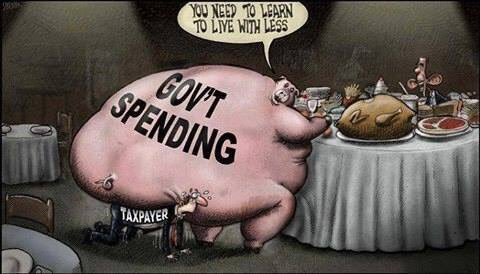
Who benefits from rising property taxes? Why does Missoula need another special tax levy to keep the firefighters in business when property taxes are already sky high as it is? And why are the lords of Missoula’s budget exempt from the election process?

As Missoulians reluctantly brace for the imminent effects of last year’s 37% property assessment increase (and subsequent 21% property tax increase) a major share of the fault lies with the unorthodox drain on municipal budgets that’s always justified through the ever-profitable concept of redevelopment. An unelected body of members loyal to the Missoula Redevelopment Agency (MRA) now ultimately decides where Missoula’s tax money goes and how it’s divvied out. More often than not large quantities of our tax money gets skimmed and funneled to crony donors instead of where it should be going: schools, roads and municipal services.

Missoula locals are constantly forced to accept special tax levies to sustain services we’re already paying for because the general fund never seems to have any money in it. Taxpayers cannot reverse this trend through voting because none of the bureaucrats responsible for these tax abuses were ever elected by voters. By dominating the management of Missoula’s tax dollars and what those dollars pay for, the MRA consistently proves that it has more power than any elected figurehead. Mayors come and go but the permanent bureaucracy of the MRA maintains a uniform continuity of governance, and they do it with something called Tax Increment Financing (TIF).

The stated and primary purpose of TIF is “to increase taxable value,” which is great for banks, developers and bureaucrats who profit from the plight of workers and retirees. For property owners, increasing the taxable value of their homes means paying higher property taxes, but without any kind of corresponding increase in government services. For renters that means increased rents. For the countless workers who cannot magically double their income overnight, such increases signal their imminent displacement. This game of musical chairs leaves someone without a place to live at the end of every round and only the biggest bank accounts can prevail.

Naturally, the intractable parasites who’ve grown addicted to tax money have a deep-seated fear of public awareness. Runaway redevelopment agencies all too often rely on public ignorance of the law to abuse it to the extent that they have, and make claims of public benefit that are demonstrably false to cover their tracks. After Missoula officials publicly mocked their constituents in 2020 for our alleged ignorance of TIF, Fortune 500 CFO Bob Moore publicly declared to the City Council:

I understand [TIF] very well. It’s nothing but taking taxpayer money and giving it to developers and builders and calling it investment.”

TIF bonds are so coveted and controversial that those who consistently profit from them expend great deals of energy and resources attempting to convince the public that our lives would collectively fall apart without them. But beyond the hypothetical promises of “free money” and healthier cities, TIF turns out to be just another insidious profiteering scheme that feeds off of public money. This mechanism remains shrouded by acronym and is cleverly designed to smokescreen reality behind complicated financial terminology that ensures most people will never bother figuring out what makes it tick, including legislators and policy makers.

Over the decades the TIF law has morphed from a pledge to eliminate urban blight into the duct-tape solution for every municipal pipe dream. Since their inception half a century ago, urban renewal agencies around the country have often abused their authority and consistently transformed TIF into a mechanism to rob struggling taxpayers in order to provide giant subsidies to large organizations and fund the pet projects of favored donors. Whatever its original intentions, TIF has proven as vulnerable to nefarious activity in the Treasure State as it has in many others.

The word “blight” as defined in the Montana State code allows for any and every possible interpretation, including wildly imaginative perversions like “future blight” and several shades of figurative blight. The law as currently written is rife with loophole opportunities, allowing TIF addicts to interpret whatever definition of blight they want while also technically operating within the letter of the law. As a result, local officials bend themselves into pretzels figuring out as many new ways as possible to spend taxpayer dollars on anything but what they’re intended for: schools, roads and municipal services!

To “improve” these so-called “blighted” areas, TIF-addicted governments accept debt from banks to catalyze solutions. That debt is supposedly paid off with revenue generated by new residents and businesses that benefit from the blight remediation. Since TIFs theoretically pay for themselves by raising the property values of surrounding areas, those adjacent properties are directly affected by the newly elevated values because they create higher tax burdens. Therefore, TIF is meant to increase taxable value of property, and this hurts local citizens and fixed-income taxpayers. Worse still, since many TIF subsidies are provided to out-of-state corporations, local businesses are forced to stand idly by as their tax dollars are literally weaponized against them, economically prioritizing the interests of outside competition. Short-term gains leave long-term residents holding the shit-end of the stick.

Officials who’ve grown dependent on TIF will insist it’s the only tool they have. They’ll say they need it to subsidize affordable housing, to provide incentives for business developments and real estate investment, for job creation, to assist nonprofits, and to grow the tax base. But former Montana Legislator (and former Missoula City Councilman) Adam Hertz asserts that TIF isn’t meant to pay for any of that:

Those are all great things. None of them are mentioned in state law when it comes to urban renewal districts.”

Despite what tax addicts may claim, the TIF statute says nothing about economic development, job creation or housing. It’s for blight remediation, not a blank check for vertical development.

If the only tool you have is a hammer, every problem tends to look like a nail. After years of increasingly misusing and abusing the TIF hammer, Missoula began attracting criticism from a former MRA director. Geoff Badenoch, who directed the Missoula Redevelopment Agency for the 18 years before the reign of Ellen Buchanan, had this to say about Missoula’s dependence on and addiction to TIF:

If you find there’s a temptation to use a tool too often, you’re not a good craftsman. … The thing about tax increment is, it’s so tempting to use it because you don’t have to go to the voters for it. There’s millions lying around.”

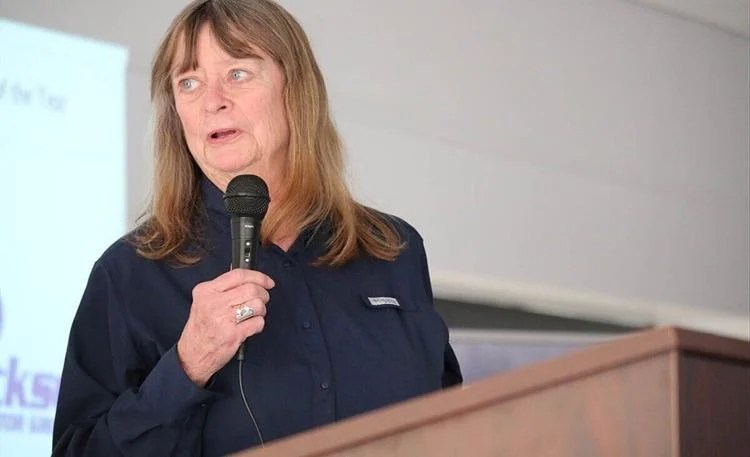
One of the core problems with TIF in modern Montana lies with the fact that public money is spent against popular will by an unelected body. The most powerful bureaucrats in our governments are never vetted by voters, but appointed to their positions, sometimes for decades. Ellen Buchanan is working on her third consecutive decade as chief meddler in Missoula’s piggy bank, and there’s nothing that voters can do about it.

Ellen Buchanan, Master of Deficit

Windbag politicians flap their jaws advocating for things like workforce housing, zoning reform, increased subsidies, housing-choice vouchers and trickle-down rent relief to address the symptom of rising homelessness because those “solutions” favor the status quo while ignoring the real problems. Those same windbags then help parasitic redevelopment agencies hollow out the city’s general fund on unnecessary and irrelevant “improvement” projects. As a result, firefighters must now beg taxpayers to approve special levies that further drive taxes up for people who can barely afford them, which pushes even more people toward displacement. As former Montana legislator Brad Tschida explicates in his recent Missoulian op-ed:

[…] if the liberal Dem mayor and city councilors were frugal stewards of the tax dollars we’ve already sent them, there would currently be plenty of money to adequately fund our firefighters.

The stuffed shirts calling the shots in Missoula’s secret government all too often treat their municipalities like a sadistic game of Sim City 2000 or CityState. Myopic officials relentlessly propound their failed solutions because they’ve run out of excuses to accrue more TIF debt. As the dumpster fire grows we’re told that dousing it with more gasoline will help extinguish the flames.

TIF was the mechanism through which Missoula’s unelected officials borrowed millions of dollars from banks to provide giant gifts to those same banks. Decades worth of taxpayer-funded interest payments were provided to First Interstate Bank and Stockman Bank by borrowing said gifts from the same banks and packaging those gifts in the wrapping paper of Tax Increment Financing. The taxpayers get stuck with decades of unwelcome interest payments instead of the municipal services they expect from government. In fact, those services steadily deteriorate to the point that extra taxes are proposed, euphemistically referred to as “levies”. Case in point, Missoula’s firefighter levy would not be a topic of conversation if the City’s handling of the budget weren’t so flagrantly corrupt.

Officials addicted to tax increment loans have cultivated relationships with the financial industry to the point that they don’t know how to operate their towns without the banks. In a rare case of pissing-on-our-leg-and-telling-us-it’s-raining, we’re told that without TIF there just aren’t any resources for governments to fix the roads. This irrational claim was actually made by MRA director Ellen Buchanan in 2023:

Without TIF investment in public facilities, roads, bridges, parks, other infrastructure, this puts more pressure on local governments to find ways to pay for these services.”

Buchanan strategically frames the argument from a brazenly dishonest perspective, presuming that scheduled maintenance cannot occur without accruing debt. But we don’t need a bank loan to fix the roads if our tax dollars are handled honestly. Property taxes are collected into the general fund but the account always seems to have insufficient funds to pay for services when the check comes due. Beyond that, municipal services now receive their funding directly from the redevelopment agency. The very idea of redevelopment seems to have become deliberately conflated with the concepts of maintenance and management to the point that many officials have forgotten how to fund services without the MRA.

Missoula County Public Schools admitted to an unconventional funding gift from the Missoula Redevelopment Agency in an Email last month. According to the employee newsletter, the MRA provided $2 million in funding to the school district in the form of a “remittance”. Because the MRA seems to enjoy exclusive control over the city budget, the only way to get a slice of that budget is to cozy up to MRA director Ellen Buchanan.

The fact that a redevelopment agency now funds schools through a nebulous “remittance” process seems outrageous. Why exactly is the school district receiving funding through the MRA instead of directly from the general fund? The MRA was supposed to only deal with issues pertaining to redevelopment, not the maintenance or staffing of every local government body.

Who benefits when scores of locals are displaced by skyrocketing rent increases? It is not possible to pull yourself up by your bootstraps when the free-money cult of tax addicts keeps taking your boots away. The inevitable corruption of the scheme itself demonstrates its irredeemable nature. We can explore the theoretical benefits of this economic voodoo until the cows come home, but the rhetoric that justifies TIF spending is simply never backed up by facts.

Public money addicts actively ignore the overwhelming impacts that their policies inflict on average citizens. They can be expected to further minimize the disproportionate burden placed on Montana taxpayers caused by their overindulgence on this financial instrument. To acknowledge such “side effects” would interrupt the rush of their high. Reality is a buzzkill for addicts forced to come to terms with the harm their actions cause. The MRA desperately needs an intervention before they sell Missoula’s proverbial kitchen sink to score another hit.

Thorough analysis of the literature generated by regulatory professionals who’ve attempted to curtail TIF abuse with amendments to existing law makes it clear that the abuse continues regardless of what kind of new regulations are put into place. The fanatics who feel they’re entitled to the subsidy don’t ever take “no” for an answer and never will. Whenever the will of the voters becomes bad for business, the industry’s lawyers weave a tapestry of new loopholes to continue spending public money without voter knowledge or consent.

The parasites who’ve turned the government budget into their own personal piggy bank will also predictably point their hypocritical little fingers at “the evil Republicans” at the State Capital as the reason for rising property taxes, no matter how obvious it is that more and more of the municipal tax base has been “captured” and re-routed to subsidize the private development delusions of transplants.

TIF addicts will often and loudly mention that TIF is practiced by a majority of the states, but probably won’t mention that it was killed in the very state in which it was created. TIF was born in California and died in California after bankrupting the Golden State. But California isn’t the only state with a robust record of abusing TIF, nor is California the only state to attempt to curtail TIF abuse.

Montana’s first real attempt to reign in the abuse during the 2023 legislative session revealed the primary tactic of the TIF addicts, who relied on scaring the legislators with fibs about how the sky will fall without these subsidies to hold it up. It’s a simplistic deception, but it has always been easier to fool a man than to convince him that he’s been fooled, and the lie succeeded in shutting down the regulations proposed by Senator Greg Hertz.

As this nightmare carousel of circular logic revolves into another election season, let’s consider how much longer we’re willing to passively accept the anti-human outcomes scripted for us by society’s ruling psychopaths.


Ellen Buchanan Mobilizes Big Business to Keep Her Secret Government Monolith Alive

An addict is a person with an uncontrolled compulsion to continue engaging in an activity despite the negative personal or professional consequences that result. Addiction can also be defined by the overreaction that occurs when the object of addiction is taken away from the user.

Tax Increment Financing began as a complex and convoluted financial scheme of using public money to repair blighted areas that has gradually morphed into a silver bullet solution for every municipal problem and often gives rise to rampant cronyism at the expense of the taxpayers.

Bureaucrats who become predictably overdependent on Tax Increment Financing constitute TIF addicts and their overuse of this legal financial tool signifies an obvious perversion of the original intentions set down by the state legislature that enacted it in 1974.

This spring Senator Greg Hertz championed a bill meant to reign in some of the abuse during Montana’s 2023 legislative session, prompting an army of lobbyists and business people to come out of the woodwork and assemble in defense of the status quo.

Anyone who earnestly studies TIF will eventually recognize that the law is loose, open to interpretation and riddled with loopholes. There are plenty of instances of Cities using this tool responsibly, but nobody can deny the fact that TIF has also consistently birthed a scourge of runaway redevelopment agencies staffed by unelected bureaucrats who enjoy uninterrupted control over municipal budget spending decisions.

Don’t take it from me. Take it from former MRA director Geoff Badenoch, who ran the agency for 18 years:

The history of Tax Increment around the country has been that it is a temptation that many cities have not been able to resist. And tax increment gets used in ways that go way out on the fringe of what I think legislatures intended. And as a result, in Minnesota, California, Illinois, other states, legislatures have felt the need to come in and restrict the use of tax increment or eliminate it altogether. And, yes. But that’s a political response to abuse. The danger with TIF is that there is a temptation to use it every which way, if you can square it in the law any way, to use it.”

Ellen Buchanan has run the MRA ever since Mr. Badenoch left over two decades ago, and today she makes $180,000 a year to dictate how our tax money is spent. Last month Ellen was quoted in the Missoulian piece titled, Missoula Officials Lash Out At Proposed Bill That Would Revise TIF Laws:

The one that absolutely just destroys Tax Increment Financing in the state of Montana is a Senate bill sponsored by Sen. Hertz and it just puts us out of business,” Buchanan said. “There’s no way to amend it that makes it functional or even just less efficient. It just destroys Tax Increment Financing.”

When SB 523 came before the Senate Committee in March, Ellen Buchanan showed up to defend her access to the municipal purse strings. After the Montana Senate passed it Buchanan went into overdrive, sending out a mass Email that included the business community, fellow MRA board members, former mayors, TIF dealers like Stockman Bank and major TIF recipients like Peter Lambros. The Email expressed grave concern about the bill and provided an eight-bullet list of talking points with which to appeal to the members of the Tax Committee that would be deciding the bill’s fate.

Many of Ellen’s bullet points are factually problematic, like the claims made in Bullet #7:

Elimination of TIF may result in higher property taxes, not lower property taxes. Without TIF investment in public facilities, roads, bridges, parks, other infrastructure, this puts more pressure on local governments to find ways to pay for these services.”

So without TIF there aren’t any resources for government to fix the roads? What about the taxes that were collected to begin with? Do we really need a bank loan to fix our roads?

But it doesn’t matter that many of the bullets are factually and demonstrably false because if you get enough people to repeat the lie everyone starts to believe that it’s true. And she definitely harnessed enough people to repeat her points.

In fact, Buchanan’s recruitment efforts were so successful that she didn’t even have to herself testify before the committee. Her newly unelected mayor, Jordan Hess (alongside his handler Council President Gwen Jones), also came to her bidding and helped hypnotically repeat the phrases “affordable housing” and “workforce housing” while she lingered in the background on her phone building the next wave of testimony. The real power remains behind the throne.

A cacophony of lobbyists and business owners stepped up to the microphone to read versions of Buchanan’s talking points at the tax committee. Among the hyperbolic allegations was the predictable claim that “TIF critics are just ignorant,” which seemed particularly offensive given the explosive history of TIF criticism in Missoula.

Speaking of offensive, Missoula City Council President Gwen Jones publicly projected the word “criminal onto Adam Hertz and Jesse Ramos – two former Missoula City Councilmen – for compiling a list of TIF abuses in their City. By The Missoulian’s account, Jones is “an experienced attorney in town” (ostensibly meaning her enunciation of the word “criminal” has extra authority). The article went on to illustrate how the MRA unanimously characterized professional criticism to their spending habits as a“lot of misinformation” being presented deliberately by elected officials:

Everyone in the room murmured in agreement. “By elected officials who know precisely what they’re doing,” Jones said.

One wonders if Ms. Jones has access to a mirror, as she too is an elected official who knows exactly what she’s doing. She is also well versed in the practice of abusing her power. As a board member of Missoula Aging Services, Gwen Jones threatened the job of another MAS employee who had written a poem critical of her policy as a City Councilwoman of placing crippling debts on local homeowners for unnecessary and unsolicited sidewalk updates. She also made a habit throughout 2019 and 2020 of performing background checks on all constituents who presented TIF information to the City Council that she personally disagreed with.

Ellen Buchanan likewise recently resorted to absurdist ad hominem attacks of the citizens critical of her agency’s shenanigans, comparing lawful populist opposition in Helena to the J6 “insurrection”:

You watch what’s going on in Helena and it’s just terrifying,” Buchanan said. “It’s just a microcosm for what went on in D.C. … It’s pretty scary,” Buchanan said. “It’s frightening for staff. It’s frightening for me and it’s frightening to city administration. So not to be a Debbie Downer, but it’s been a tough couple weeks around here.”

She also alleged that there’s been a “criminal” amount of disinformation spread about TIF. Former City Councilman Jesse Ramos responded, saying, “And citizens going to Helena to fight for what they think is right is ‘criminal’? That’s fantastic.”

Big Business opposed the bill with extreme prejudice, and many of the lobbyists who rose in opposition are paid by Montana tax dollars. Most of them parroted Chicken Little’s claim that “the sky is falling” and other apocalyptic predictions foreshadowing the end of the world as we know it should this bill ever become law.

They couldn’t debate obvious instances of TIF abuse so they instead try to divert attention elsewhere. And their buzzwords this session were “affordable housing” and “workforce housing.” But we don’t need to build affordable housing. We need to make existing housing affordable. Native Montanans are supposed to be represented by their legislature and their existing housing is under threat from the commonly occurring phenomenon of sudden property tax inflation. TIF districts disproportionately affect the working classes who pay for them because their property taxes balloon when the “taxable value” of their homes increases.

A stated purpose of TIF is the increase of taxable value, which thereby theoretically grows the tax base.

Theoretical benefits of TIF aside, the demonstrable abuses are as numerous as they are egregious but are all still technically “legal” since the legislature hasn’t really begun to regulate TIF in Montana yet. They include banks loaning their own TIF handouts to municipal governments at interest, unlawful claims of eliminating “future blight” and “blight down the trail,” designating newly constructed buildings as “blighted” to justify additional spending, weaponizing tax monies against local businesses who pay for their corporate competitors to out-compete them, and the cronyism inherent to a runaway board of unelected bureaucrats who have seized control of the City budget and decide economic winners and losers without regard to public will.

While snakes in suits kicked the legislative can down the road in the halls of Montana’s Capitol, many hardworking Montanans continue to be taxed out of their homes and businesses to make room for tourists with townhouses and second-home snowbirds. For the development regime who opposed Hertz’s bill last month that’s not a bug but a feature.

The problem in Missoula is not a lack of housing, it’s that people can’t afford it. One Army veteran we interviewed returning home to Montana in April of this year couldn’t find a one-bedroom studio apartment for less than $2,200 in his hometown of Missoula. But TIF addicts love to twist the reasons for our affordability problem around, which is why they talk a lot about their false solution to the problem: so-called “affordable housing.” TIF addicts like this subject because it technically allows them to administer many additional hits of industrial-grade TIF, even though the TIF statute says nothing whatsoever about building housing.

But Ellen Buchanan won’t let a petty thing like facts get in the way of her propaganda. And beyond quoting her inane blathering, the stenographers at the corporate-owned Missoulian won’t ask her any follow-up questions to statements she utters that make absolutely no sense:

“One of the arguments that is being made by some of the folks testifying for this bill is that we’ve got no business doing housing,” Buchanan said. “All we’re supposed to do is remove blight and housing is not something that’s permitted under TIF statutes, which is ridiculous. That’s been said over and over again, by one of our former city council members that’s really pushing this bill hard. So that’s a little bit ironic that there’s this dichotomy going on.”

I fail to see what Ellen Buchanan means by “ironic” since irony is an outcome opposite from and in mockery of the expected result. She doesn’t provide any evidence whatsoever that her critics are incorrect in their assertion, just that said assertions are “ridiculous”. Having said that, it does indeed seem ironic that a former elementary school principal and superintendent would oppose a bill supported by the School Administrators of Montana:

Rep. Ed Butcher, R-Winnifred, said he supported the bill because he believes “bad actors” are abusing the system. “Big corporations that don’t need these tax dollars for their construction projects. We have a person from Big Sky coming up here wanting his money, that really turned me off because those guys have more damn money than the U.S. government has.”

The bill was supported by the School Administrators of Montana, who argue that TIF diverts funds from school districts and instead into construction projects in Urban Renewal Districts.

But Rep. Mark Thane, D-Missoula, took issue with Butcher’s comments. Thane is the former superintendent of Missoula County Public Schools.

“We’ve heard essentially people say that there are abuses, that it’s corrupt, that it’s corporate welfare,” Thane said. “And I just want to go on record as saying that these funds are audited. There’s oversight by local government entities. There is no evidence that there’s been any kind of fraud or corruption or even abuse.” Thane went on to say, “I do take some offense at the allegations that it’s in some way corrupt or being abused when there’s been no evidence presented.

But plenty of evidence of abuse was presented before Thane and his peers by Senator Greg Hertz during the hearing. Thane’s definitely come a long way from his 1995 appointment as principal of the newly constructed Chief Charlo Elementary. Isn’t it interesting that he opposed a bill supported by the School Administrators of Montana, since TIF districts adversely affect school budgets?

TIF addicts won’t bother trying to defend the $1.5 million to Stockman at 4% interest or the $1.6 million to First Interstate at 6%.

They can’t deny the fact that Andy Holloran’s Home Base received over $3.6 million in TIF and used it to add an additional floor to the Marriott.

They can’t rebut the fact that “future blight” is not covered under state code, but was employed to justify $8.6 million in TIF subsidy to Peter Lambros to build a new road toward SouthGate Mall to incentivise Lucky’s Market to move in. But Lucky’s went out of business after only two years and Lambros sold Southgate to Washington Prime Group for $58 million. According to then Mayor Engen, the reason we helped Peter make a cool fifty million dollars of profit with over eight million in public money was to prevent “future blight,” since malls were going out of business all over the country.

Nevertheless, SB 523 died in committee on its way to the House after being tabled by a vote of 13-8. Former City Councilman Jesse Ramos said of the bill’s defeat, “Most unfortunately, SB 523 died in Committee today because of the Great Falls Caucus who believe it is their job to represent their local government. Not their constituents.”

It also didn’t help that certain committee members seemed hellbent on abdicating their responsibility to even consider regulating demonstrably irresponsible behavior. Committee member Dan Fern from Whitefish pigeonholed the debate as “the Missoula show” and even tried forcing a requirement on speakers to identify what town they were from. Chair Feilder overruled Fern’s requirement, but his minimization of the issue was duly noted.

All in all, Ellen Buchanan’s success was a manifest reality. Her persuasion machine succeeded, however narrowly, in convincing the legislature to leave her magic wand collection alone. With the legislative session finally over, she can breathe a sigh of relief knowing that her access to the tax coffers – and her ability to continue profiting from them – remains unimpeded.

At least for now.

Efforts to reign in TIF in Montana multiplied following this legislative session as more citizens began to familiarize themselves with the law, learning for themselves just how deep the rabbit hole goes. SB 523 awoke the multi-tentacled TIF Leviathan. And when the next round of TIF debates fill the halls of the Helena Capitol in 2025, Montana taxpayers can expect an even larger and more menacing beast to rear its ugly head.