The First Rule of BlackRock is You Do Not Talk About BlackRock

Last month a loose-lipped BlackRock recruiter confirmed what George Carlin said twenty years ago: that politicians are for sale; that war is good for Wall Street; that the captains of industry own everything, including all of the big media companies; that “they’ve got you by the balls!”

James O’Keefe’s latest hidden camera investigation pulls the curtain back on the singular company that leverages more control over the entire world than any other. The curt concessions came from a young BlackRock headhunter named Serge Varlay, who probably thought his date would be impressed with BlackRock’s absolute power when he so eagerly spilled the beans about their methods of manipulating the world to their will.

The shocking admissions caught on tape include Serge ominously leaning over the table toward his date and saying to her, “Let me tell you, it’s not who the president is. It’s who’s controlling the wallet of the president.

His date asks, “And who’s that?”

“The hedge funds, BlackRock, the banks,” Varlay says. “These guys run the world.

He goes on to admit that “You can buy your candidates,” through campaign financing.

His date asks, “How so?”

“All of these financial institutions, they buy politicians.

“How do they run the world?”

“You acquire stuff,” Serge explains. “You diversify. You acquire. You keep acquiring. You spend whatever you make in acquiring more.”

His date ponders this for a moment before asking, “And then once you just own a little bit of everything, is that where the control–”

“Yeah. You own a little bit of everything and that little bit of everything gives you so much money on a yearly basis that you can take this big fuck-ton of money and then you can start to buy people. Obviously we have this system in place. First, there’s the senators. These guys are fucking cheap. You got ten grand? You can buy a senator. It doesn’t matter who wins. They’re in my pocket at this point. … I could give you $500k right now, no questions asked. Are you gonna do what needs to be done? Yeah! Of course! Why not?”

“Yeah. You own a little bit of everything and that little bit of everything gives you so much money on a yearly basis that you can take this big fuck-ton of money and then you can start to buy people. Obviously we have this system in place. First, there’s the senators. These guys are fucking cheap. You got ten grand? You can buy a senator. It doesn’t matter who wins. They’re in my pocket at this point. … I could give you $500k right now, no questions asked. Are you gonna do what needs to be done? Yeah! Of course! Why not?”

“Does like, everybody do that? Does BlackRock do that?”

Varlay smiles, “Everyone does that.”

BlackRock CEO Larry Fink

BlackRock was founded in partnership with Blackstone Group in 1988. Within just five years, BlackRock’s founder, Larry Fink, grew the company from $5 million in value to over $8 Billion. The investment firm that today controls a massive number of shares in the largest companies in the world began by managing pensions and university endowments, as well as the portfolios of their super wealthy clients.

The lion’s share of BlackRock’s business model hinges on Exchange-Traded Funds (ETFs). Not unlike mutual funds, ETFs contain diversified investments that reduce investor risk. Rather than buying stock in a single company, this fund purchases and bundles a wide variety of stocks, commodities and securities together into a low-risk investment for clients to buy into.

In 1998 BlackRock created their highly lucrative Aladdin portfolio management system that can predict the possible outcome of every investment and collect information on all investors who contribute to their profits. The software ultimately predicts the likelihood of investment failures.

As the name indicates, the Aladdin technology proved to be a magical Genie that took Fink and BlackRock straight to the top of the market. Today BlackRock has over $9 trillion in Assets Under Management (AUM) and another $20 Trillion managed by Aladdin.

Keen to “never let a good crisis go to waste,” exploiting economic uncertainty has proven to be the key that unlocked BlackRock’s rise to absolute power. After promoting the very Mortgage-Backed Securities (MBS) that unleashed the housing bubble crisis in 2008, the subsequent financial crash allowed BlackRock to secure uncontested control of many failing banks and their assets. It also provided Larry Fink with a direct line to the American Federal Government.

The same thing happened in 2020 during the early days of the Plandemic when the American government asked BlackRock to funnel Federal Reserve money into “special purpose vehicles” to acquire risky debt under the CARES Act with a $4.5 trillion leveraged buyout. The following year BlackRock began gobbling up entire neighborhoods, buying up houses and properties as investments that no one will ever live in. This lowered the total supply of housing which contributed to higher demand and in turn skyrocketing housing prices. It also forced would-be home buyers to compete with the giant multinational investment firm for housing. Real estate consultant John Burns estimated at the time that “roughly 20% of homes sold are bought by someone who never moves in.

BlackRock has consolidated so much power that it essentially controls the world, as their total global assets amount to a sum greater than America’s total GDP. They enjoy so much power that they’ve even been referred to as “the Fourth Branch of Government” by Bloomberg. With all of those resources controlled by a single monolith, one might wonder how this gargantuan monopoly monstrosity is allowed to exist. But BlackRock doesn’t technically own these companies, nor does it even own shares of them. It’s their clients who own the shares. BlackRock just manages them. And many of BlackRock’s investors don’t even know they’re investors because they’re simply part of a pension fund or an endowment that BlackRock manages.

Through these mechanisms, a single company now controls such large ratios of stock that many large corporations cannot make significant moves without BlackRock’s approval.

Today BlackRock manages approximately 10% of the entire world economy through its constituent assets. Because BlackRock is one of the biggest investors in global giants like Amazon, Microsoft, Anheuser-Busch, Meta, Target, Proctor & Gamble, Comcast, CNN, Disney, Fox and Pfizer, these companies must consult with BlackRock before doing anything of consequence. By owning huge pieces of all competing corporations they’ve created a global monopoly spiderweb.

To maintain their ever-growing dominance, it’s important for the giant to avoid making headlines as a matter of corporate policy.

As Serge Varlay told his date, They [Blackrock] don’t want to be in the news. They don’t want people to talk about them. They don’t want to be anywhere on the radar.”

She asked, “Why not?”

Varlay pondered for a moment before responding, “I don’t know, but I suspect it’s probably because it’s easier to do things when people aren’t thinking about it.”

BlackRock would definitely prefer you never think about them at all, and if you must, they want you to think they’re socially and environmentally responsible. So in the wake of the 2020 George Floyd protests BlackRock publicly stated that companies must serve a social purpose, pledging that they would now score businesses on an ESG (Environmental, Social and Governance) score to “force behaviors” on individuals and companies.

The ESG concept was formed in 2004 but didn’t achieve critical mass until BlackRock began sporting it in 2020, when the timing was right. ESG essentially ranks how “woke” a company is like a dystopian social credit score for businesses. The Consumers’ Research nonprofit asserts that, “political activists use ESG as a way to drive a progressive agenda” to “help push this agenda through economic coercion and ignoring democratic processes.”

Companies are not just competing with each other for best credit score or highest quarterly earnings statement anymore, but now for the highest ESG score. This feat is ostensibly earned through the promise of increased diversity hires and embrace of environmentally friendly policies. But this pursuit has only resulted in a massive resurgence of corporate greenwashing; advertising campaigns designed to fool consumers into believing that dirty companies are cleaner than they actually are.

While BlackRock claims to champion ESG investing, BlackRock itself remains the largest investor in fossil fuels and war profiteering, maintaining friendly relationships with human rights violators the world over. Moreover, the company admitted to the business community that it’s only pretending to be woke. In his 2022 letter to CEO’s, Larry Fink writes,

It is not a social or ideological agenda. It is not “woke”. It is capitalism, driven by mutually beneficial relationships between you and the employees, customers, suppliers, and communities your company relies on to prosper. This is the power of capitalism.”

Corporate advertisements have always embraced whatever flavor-of-the-week suited them to earn consumer confidence and score a short-term profit. They don’t actually believe in anything, and the exploitation of your beliefs is just routine business to them.

BlackRock claims that climate risk equates to investment risk. So in 2021 BlackRock reshaped Exxon Mobile’s board of directors to “help combat climate change”. But the fact that BlackRock remained the world’s single biggest investor in fossil fuels confirms the rhetoric was just more focus-grouped virtue signaling.

Similarly, while BlackRock whines publicly about the atrocities of gun violence, they’re simultaneously the single-largest investor in gun manufacturing. This seems especially difficult to fathom when BlackRock engages in the deliberate irony of blaming gun manufacturers for not doing more to protect the lives of the American people.

Meanwhile BlackRock’s U.S. Aerospace and Defense Fund invests billions in major weapons contractors like Raytheon, Lockheed Martin, General Dynamics, and other merchants of death. These companies receive billions in Pentagon contracts to literally weaponize taxpayer money to fund unprovoked bombings and illegal wars around the globe that produce lots of civilian casualties. Often these weapons are supplied to foreign governments like Saudi Arabia, which received weapons from the U.S. government before using them to indiscriminately commit genocide against civilians in Yemen.

Serge Varlay confirms that war is damn good for BlackRock’s bottom line, jovially telling his date that, “Ukraine is good for business. You know that, right?”

He went to admit that, “We [BlackRock] don’t want the conflict to end.”

“Why?”

“We don’t want the conflict to end as a country. The longer this goes on, the weaker Russia is. … I’ll give an example: Russia blows up Ukraine’s grain silos. Price of wheat’s gonna go mad up. So what are you gonna do if you’re a trading firm? The moment that news hits–within a millisecond–you’re going to pump trades into whoever the wheat suppliers are; into their stocks. Within an hour or two, that stock goes fucking up. And then you sell and you just made, I don’t know, however many mil.”

Next she asks him, “Why would a news channel promote a side in war?”

“Because it’s also good for business too. I mean, what’s news? News right? What does news feed on? They feed on tragedy. They feed on fucked up events. That’s what people like to watch. So when it happens, it’s good business. More viewers. When nothing’s happening, who the fuck watches news? I don’t watch the news.”

“They’re all pushing like, the same talking point. Like generally, when you look at news, like–”

It’s propaganda,” Varlay tells her. “The Ukrainian economy is very largely tied to the wheat market; global wheat market. This is fantastic if you’re trading. Volatility creates opportunity to make profit. … War is real fucking good for business.”

Then Serge reveals the true sociopath mentality that lives within firms like BlackRock, gleefully confiding in his new friend that, “It’s exciting when shit goes wrong. Right?

BlackRock has poised itself to be a chief benefactor in the effort to fund Ukraine’s push to Build Back Better. The investment giant recently teamed up with JP Morgan to set up a “reconstruction bank” to fund the half-trillion dollar investment to rebuild war torn Ukraine:

The Ukraine Development Fund is still in the early stages of setting up the reconstruction bank, but potential investors will get an inside preview of how things will look during a London conference that is set to take place this week. With the steep cost to rebuild, the Ukrainian government reached out to BlackRock in November to see if there was a conceivable way of attracting investments. JP Morgan was soon added in February.

Despite it’s emphasis on ESG investing, BlackRock consistently and predictably overlooks human rights in favor of monetary gain.
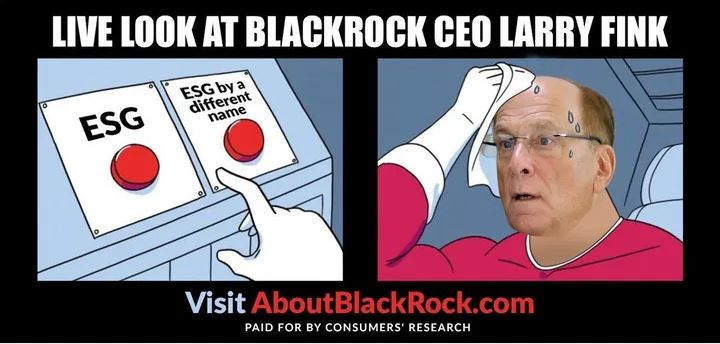
Putting all of this into perspective, we can better understand the following warning about BlackRock from Consumers’ Research:

U.S. Consumers should be wary of investments managed by BlackRock Investment Management Company. Led by Chairman and CEO Larry Fink, the company uses its clout to push a radical agenda in coordination with other financiers through a network of international organizations. This Consumer Warning highlights the commitments BlackRock has made with their investors’ money—commitments that adversely impact the U.S. economy and likely violate their fiduciary duty to seek the best return, putting your retirement at risk in the name of progressive politics.”

Investing in Chinese military companies and praising totalitarian governments are chilling indications of the management empire that BlackRock is working to finalize. BlackRock is also officially the first global asset manager to have access to the Chinese Communist Party’s mutual fund. When we consider that Larry Fink also serves on the Council on Foreign Relations and the World Economic Forum, we can better understand why the BlackRock monolith now attempts to foist violent changes upon existing social and political systems of the world, in lockstep with Davos’ other true believers of the “Great Reset” agenda. This is why the sudden and overwhelming prevalence of bewildering woke ideology in every facet of the business world. It’s part of a coordinated effort to socially engineer the populace into such a hypnosis that we’ll accept their New World Order nightmare as a dream. In short, the plan is for us to own nothing and “be happy.”
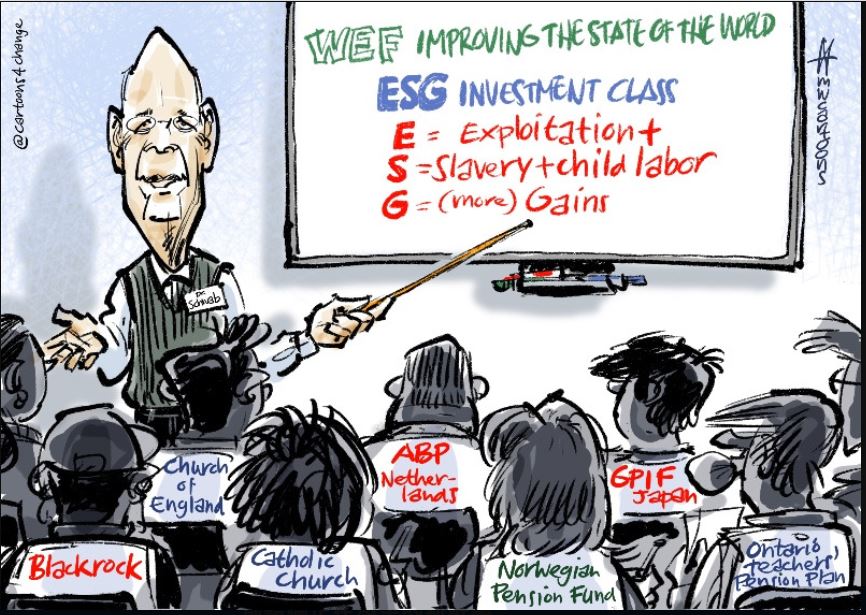
Through a stalwart commitment to acquisition, investment firms like BlackRock wield more power than the executives at the companies they own shares in. Laws could ostensibly be passed limiting how much influence an investment firm can have over companies it’s invested in, but since they own the politicians who pass the laws it seems highly unlikely that such an outcome would ever be allowed to occur.

BlackRock isn’t the only mechanism for worldwide institutional control. The second and third largest investment firms in the world, Vanguard and State Street, respectively, are guilty of the exact same behavior. Together, these three investment giants became the largest shareholders in 90% of S&P 500 firms. And the list of worthy runners-up who would each kill for a chance at a promotion to King Asshole looks endless.

And while it may be true that businesses that go woke do, in fact, go broke, the money doesn’t seem to matter as much to the multinational corporations as their ESG score. As companies like Anheuser-Busch hemorrhage profits in the wake of a woke Bud Light scandal, they’re quietly assured behind the scenes that they’ll be allowed to exist in “the new economy” regardless of how much money they lose, as long as their score remains high.

In the weeks after James O’Keefe’s hidden camera viral video put BlackRock into the spotlight, Larry Fink publicly back-peddled on ESG, insisting that it was always an apolitical term that has since become “weaponized”. Fink comically insisted that “ESG issues were never meant to be political statements,” and stated that he’s “ashamed” to be part of the debate. Fink now pledges his allegiance to something called “conscientious capitalism” announcing that the semantic re-branding will displace ESG in the future.

The truth seems obvious enough. Fink is trying to get out in front of the blowback because he knows it’s only a matter of time before the mass of people figure out how much influence this one man enjoys. And with his name in the media this much, it seems like that time is about up.

Why Are Businesses Forcing American Employees To File Immigration Form “I-9”?

How surprising is it to find out that some employers in the United States have actually been intimidated through misinformation peddled by extrajudicial government powers into behaving against their own interests? After more than three years of medical misinformation “brought to you by Pfizer” the sleeping giant of America has stirred from its slumber and begun rubbing the midnight propaganda from its weary eyes. And as the nation wakes up and takes a look around, it’s noticing that liars and psychopaths seem to have their hands in just about every pie. While some of the corruption has been extra brazen, many of the most insidious lies have gained traction under the quiet cover of boring.

An especially pernicious threat to the liberty of ordinary Americans has come unexpectedly from the Department of Homeland Security in recent years. Under the auspices of Immigration and Naturalization Services, DHS have successfully fooled some private employers and nonprofits into believing they are somehow required to force applicants to fill out immigration forms in order to legally work within the United States. But how could lifelong American citizens living within the United States possibly be required to file paperwork with federal immigration authorities? The short answer is, “They’re not!”

While the Department of Homeland Security falsely claims that everyone has been required to fill out an I-9 form since 06 November 1986, the organization known as Homeland Security did not even exist until the second Bush Administration created it in November of 2002 under the unconstitutional authority of the USA PATRIOT Act. It might be true that migrant workers have been required to file the I-9 form since 1986, but not so for the general population of Citizens residing lawfully in the States, and definitely not under the “authority” of a three-letter agency that didn’t even come into being for another 16 years.

This is the same agency that now actively seeks to target and silence Christians and conservatives as a “top priority” of its anti-terror capabilities. Funded by the Targeted Violence & Terrorism Prevention Grant Program (TVTP), Homeland Security has been weaponized against the American people, resulting in joint operations like the armed raid by dozens of federal agents against a commercial gun store in Great Falls, Montana this month.

On Wednesday, 14 June 2023, Highwood Creek Outfitters was hit by 20 heavily armed federal agents from the IRS and ATF. The store has purportedly been the victim of surveillance and harassment by several federal agencies, including the Department of Homeland Security and the FBI.

Owner Tom Von Hoose indicated how this raid transpired in spite of the fact that he’s never missed a tax return and has maintained a good relationship with the ATF:

Van Hoose says his shop has a good relationship with the Bureau of Alcohol, Tobacco and Fiearms, which was also present. He says because his shop carries “fun guns” like AR-15’s and AK-47’s, their level of licensing draws more scrutiny. “We have a reputation of dotting all the i’s and crossing all the t’s because there’s so much legal fun to be had,” said Van Hoose. “It’s just not worth doing things that are going to get you in trouble.”

Any decent attorney knows that, “The Devil is in the details!” It’s common knowledge that you’ve got to read the fine print if you want to get at the heart of anything legal. So laws are referred to as “code” for good reason. As computer code programs operating systems, legal code literally programs society. But it’s also “code” in the sense that its meanings are often deliberately obfuscated so as to be misunderstood by the general public. The writers of legal code do not use the common English that is spoken by the common people but a language that is deceptively similar to English called Legalese which is used to achieve specific goals based on legal definitions of words. Today’s legal “code breakers” are the attorneys with knowledge of the Constitution that this country was founded upon who also possess the fortitude to stand up for the inherent rights of their clients.

Most Americans have never been told that capitulating to the unlawful dictates of an increasingly tyrannical federal government might be the force responsible for laying the groundwork for our subjugation. Most remain unaware of the fact that the signing of government documents – not the avoidance of them – is what affirms the power of the state over us. You don’t have to be a criminal to get raided by the feds, you just have to have signed their documents verifying your status as a subject of their despotism.

Since no one reads what they sign anymore, few have any grasp of what their signature allows for, be it the terms and conditions for iTunes or the law behind the I-9 immigration form. We would do well to remember how to examine the fine print because the act of penning a signature is legally binding whether the signer knows what they’re agreeing to or not.

While most American employers have never heard of INS form I-9, many have been fooled into the false belief that they’re required to subject their recruits to it in order to legally perform work for their companies. Nothing could be further from the truth because the I-9 form is explicitly intended for migrant workers. Camouflaged within the fine print of the law are its hidden intents, among them, the subtle attempt to shift responsibility for immigration enforcement onto private employers. This not only spells an egregious violation of Americans’ rights, but a profoundly frightening future for this country.

The following legal breakdown comes courtesy of the brilliant minds at Original Intent, an organization dedicated to helping Americans remember their inalienable rights and empowering Citizens to stand up “boldly and decisively when government threatens those rights.” Their breakdown of the I-9 lunacy opens by spilling the beans on the hidden purpose of the statute straightaway:

“While the United States government may lie to us or twist the facts on a myriad of issues, the purported “requirement” of the INS Form I-9 for general private sector employment is a particularly abrasive and loathsome case. The INS Form I-9 (if it were enforceable here in the states of the Union) would create a de facto system of mandatory federal ID in order to get a job. That is not to be tolerated.”

It’s also worth nothing that, while the federal government has attempted many times to coerce Montanans into their de jure system of mandatory federal identification known as the REAL ID, the State of Montana has repeatedly tabled this “requirement”. It was set to become mandatory by 2023 until Montana petitioned for yet another extension into the year 2025. This might seem like a small victory for the Treasure State until we consider that the people running the federal government never take “no” for an answer. While the REAL-ID program was an explicit form of mandatory federal identification, the I-9 “requirement” snuck in as one that was more implicit.

Unfortunately, most Americans coerced into filling out this form never consider the fact that their signature on something that is explicitly intended for migrant workers might come back to bite them in the ass someday. But why would Americans be required to do this in the first place?

“How is it that the government claims to have created a law that requires an American to fill out federal paperwork, and sign it under penalty of perjury, in order to work? Please note that we said the government claims to have created such a law. This is because the government frequently misrepresents its authorities and powers to the American public. As we get further into the issue, you will decide for yourself whether the law that deals with the Form I-9 has anything to do with you.”

The fact that the vast majority of Americans have never heard of this malarkey stands in stark contrast to the insistence within a tiny cadre of frightened employers who earnestly believe that if they fail to comply with this law that they’ll be on the hook for fines and incarceration. But many savvy lawyers have asserted with confidence that this form remains exclusive to migrant workers, and only migrant workers. After all, the “I” in “I-9” stands for “Immigration.”

Nevertheless, several payroll companies alongside law firms and insurance agencies have become the peddlers of misinformation upon the small businesses they serve as clients, convincing them of their obligation to this form when none exists. Similar to the “no jab, no job” ultimatum, some employers have been convinced that acting against their own interests is not only the right thing to do, but also legally “required”. Thorough examination of the law proves otherwise.

Most executors who have become convinced of the I-9 requirement will probably be unable to explain to their employees why they’re required to fill it out beyond vague and spurious notions of proving citizenship. Additionally, the top of the form reads in bold print:

Employers are liable for errors in the completion of this form.”

Since only employers can be held liable for “errors” on the I-9, they are the ones who feel the fear associated with this ultimatum making them more likely to force this on their employees. If the liability were conversely declared to be on the employee, it seems likely that fewer people would sign it because there would be no enforcement middle man. The government is exploiting a fear tactic in order to deputize individual businesses to do the government’s work for them.

Thankfully, the folks at Original Intent have already translated the important details of the code into plain English so that the average American can see the devils behind them. What follows does not constitute legal advice, and readers should contact their attorney to obtain advice with respect to any particular legal matter, as only your individual attorney can provide assurances that the information that follows (and your interpretation of it) is applicable or appropriate to your particular situation. Having said that, it behooves anyone who has been subject to this nonsense to familiarize themselves with the following analysis.

By What Authority?

The law concerning “work eligibility” (which is what the I-9 is used for) is contained in Title 8 of the United States Code. Title 8 is named “Aliens and Nationality”. The regulations that address the I-9 issue are found in Title 8 of the Code of Federal Regulations, which is also named “Aliens and Nationality”.

The interesting thing about Title 8 of the Code, and its associated regulations, is that they deal exclusively with aliens, border controls, and issues of naturalization. The only authority that Title 8 possesses in reference to a native-born American Citizen would be if a Citizen were to violate a federal immigration law. In other words, in big broad terms, if a Citizen does not assist an alien in illegally entering this country, or does not unlawfully interfere with an INS officer or employee in the commission of his official duties, then nothing in Title 8 has any affect upon such a Citizen.

So where does the authority for “work eligibility” forms come from? When the United States grants an alien entrance to this country, the alien is either permitted to work, or not. [What goes into that decision does not concern us here.] In other words, conditions are placed on an alien’s entry; conditions to which he agrees in writing, or he is not allowed to enter the country.

However, let’s be frank, the government can pass no law that makes you legally accountable for enforcing immigration law, which includes checking the status of people who apply to you for a job. The enforcement of immigration laws is the sole responsibility of the government. It is not your responsibility, nor can they make it yours by passing a statute. The government can no more compel you to enforce immigration law than it can pass a law requiring you to come to the local federal building and sweep their floors! So what gives?

There are several factors that come into play when unwinding the sophistry of 8 USC 1324a, and its regulations at 8 CFR 274a.

To Whom It Properly Applies

The first and most notable fact that leaps off the page is the odd phraseology that is used to express who is doing an unlawful act by hiring aliens unauthorized for employment.

8 USC 1324a(a)(1) – It is unlawful for a person or other entity

Note that it says, “…a person or other entity”. Why does it not simply say, “…a person or entity”? Why include the word “other”?

Lest you think we’re just being silly nitpickers, here’s one of the fundamental canons [rules] of statutory construction:

Effect must be given to every word of a statute and that no part of a provision will be read as superfluous.

According to the canons of statutory construction, we would be in error not to investigate the significance of the word “other”, as used in the statute.

As a first step in this process, let us determine what “entity” means.

8 USC 1324a(a)(7) – For purposes of this section, the term ”entity” includes an entity in any branch of the Federal Government.

Of course only the government uses the same word to describe the term being defined! Nevertheless, what the government is referring to in the definition above is every element of the federal government, down to an individual federal officer or employee. We will remind you that “includes”, when used in federal statutes is generally a term of “limited expansion”. “Limited expansion” means that things that are reasonably within the boundaries of the definition that Congress is attempting to establish (by the words of the definition) can be added, even if not specifically enumerated. In other words, in the definition above, a corporation created by Congress can be “included” because it fits within the theme of the definition, but a private business cannot because there is no similarity whatsoever between a “branch of the Federal Government” and a private firm.

So now we know that the definition should read something like this:

It is unlawful for a person or other element of the federal government…

In this grammatical application, “other” is analogous to “further”, “additional”, or “similar”. In a legal sense it means “other such like”, which refers back to “person”. Phrased another way, it means the elements that come after the word “other” are in the same or similar class as what is being generally described by the word(s) that comes before “other”. Stated another way, the terms “person” and “entities”, as used here, have a similar or synonymous meaning.

Having established this much, it is still our duty to determine the statutory meaning of “person” applicable to the provision we’re addressing (if such statutory definition exists). At 8 USC 1101 we find:

(b) As used in subchapters I and II of this chapter… (3) The term ”person” means an individual or an organization.

So we now know that §1324a must use the definition of “person” shown above. The definition pivots on 2 words – “individual” and “organization”.

It is important to understand that in mala prohibita [regulatory] law, legal terms such as “person”, “natural person” and “individual” all have an underlying connotation of “the man (or class of man) under a duty…” In other words, “person”, “natural person” and “individual” do not mean “everyone”, but specific people who are under a duty to perform, or not perform a particular act concerning a specific area of law. Accordingly, in this instance, the “individual” who is a component of “person” must be someone who is inherently subject to the authority of Congress in immigration matters. Guess what? That’s not you!

[Ed. Note – The term “person or other entity” in §1324a does embrace an agricultural association, agricultural employer, or farm labor contractor (as defined in section 1802 of Title 29 of the United States Code) due to a nexus with the federal government. Original Intent has chosen not to present that information because that provision does not address the vast majority of the American work force.]

Let’s take a look at “organization” (another component of “person” in 1324a).

Organization – As a term used in commercial law, includes a corporation, government, or government subdivision or agency…”
Black’s Law Dictionary, 6th Ed

Now, given the phrase, “…or other entity” [remembering that “entity” means the U.S. government], which part of the above definition do you think the legislative draftsmen meant when they chose the word “organization”?

So let’s review for a moment. The opening phrase of §1324a states:

It is unlawful for a person or other entity…

If we take all that we have learned about “person” and the “other entity”, how might we expand the phrase so that the average man wouldn’t have to jump through all the hoops you’ve just jumped through to understand what is really being said? We think it would look something like this:

It is unlawful for any government corporation, government officer or employee, or any other governmental entity in any branch of government, to…

Knowing what you now know about definitions, as well as the fact that Congress cannot legislate you or me into the immigration law enforcement business, doesn’t this suddenly make the whole scheme of §1324a fall into place? We think so.

“Hire” Means “Knowingly”

As we’ve established, 8 USC 1324a does not apply to private firms in the states of the Union. However, it doesn’t hurt to understand that there are additional layers of protection from having to be involved in the I-9 nonsense.

One fact of which most American firms are unaware is that it is not illegal to hire a person who may turn out to be an alien unauthorized to work. Even if one were to believe that §1324a applies to his firm, the prohibition is only against hiring someone whom you know is an alien unauthorized to work!

8 USC 1324a – (1) In general – It is unlawful for a person or other entity – (A) to hire, or to recruit or refer for a fee, for employment in the United States an alien knowing the alien is an unauthorized alien…

At this juncture one might reasonably ask why one would ever ask a worker to fill out an I-9. It would certainly appear to result in more trouble than it’s worth. The answer to why large corporations use the I-9 is this:

8 USC 1324a(a)(3) Defense – A person or entity that establishes that it has complied in good faith with the requirements of subsection (b) of this section [by which they mean completing an I-9] with respect to the hiring, recruiting, or referral for employment of an alien in the United States has established an affirmative defense that the person or entity has not violated paragraph (1)(A) with respect to such hiring, recruiting, or referral.

So what is an “affirmative defense” you ask?

Affirmative defense – In pleading, matter asserted by defendant which, assuming the complaint to be true, constitutes a defense to it.
Black’s Law Dictionary, 6th Ed.

Did you get that? If a “person or other entity” demands that its employees complete a Form I-9, but an unauthorized alien is discovered working there, the statute says that the employer can use the I-9 as a legal defense against the allegation, while essentially admitting that they did knowingly hire an unauthorized alien! Only the government could concoct this type of smarmy legal trickery – and only lawyers would suggest their clients buy into it.

It should be noted that with or without an I-9, the government still has the burden of proof to show that the accused knowingly hired an alien unauthorized for employment. That’s a pretty tough burden to meet in the vast majority of cases.

The Double Edged Sword

So far we’ve been talking about §1324a and the hiring of aliens unauthorized for employment. It is appropriate at this time to take a look at some of the language in the regulations which really frosts the cake:

8 CFR 274a.1(k)(2) – Knowledge that an employee is unauthorized may not be inferred from an employee’s foreign appearance or accent. [italic emphasis in original]

Let’s see if we understand the lay of the land here. The government doesn’t want folks to hire aliens who aren’t authorized by the INS to work in this country. However, (leaving aside upon whom the law properly operates) the alleged illegal act isn’t hiring an alien who’s unauthorized to work, but only hiring an alien who you know at the time you hire him (or continue to employ him) is unauthorized to work. BUT, the regulations specifically say that an employer may not infer that the potential worker is an alien unauthorized to work because of his foreign appearance or accent. Lovely! Do you see why this type of legislation could only be binding upon the government’s hiring and employment practices?

Hearings For Violations

If there was any question that this law operates exclusively upon officers and employees of the government, this next item should end all doubt.

8 USC 1324a(e)(3) Hearing –

  1. Before imposing an order described in paragraph (4), (5), or (6) against a person or entity under this subsection for a violation of subsection (a) or (g)(1) of this section, the Attorney General shall provide the person or entity with notice and, upon request made within a reasonable time (of not less than 30 days, as established by the Attorney General) of the date of the notice, a hearing respecting the violation.
  2. Conduct of hearing any hearing so requested shall be conducted before an administrative law judge. The hearing shall be conducted in accordance with the requirements of section 554 of title 5.

What this section tells us is that the US Attorney General, without any authority other than Congress creating this statute, can impose an “order” upon an employer who violates this statute. Paragraphs 4, 5, and 6 tell us that such orders can restrict our future behavior and may even include monetary punishment.

Can the US Attorney (all by his lonesome) impose a fine upon an American citizen who’s running his own business in a state of the Union without taking that citizen to court and having a jury find him guilty of a crime? Not a chance in hell! One might reasonably ask, “To whom can the Attorney General do that”? The Attorney General can unilaterally impose fines on the following persons:

  • Government officers and employees
  • Government departments or agencies
  • Government owned corporations
  • Corporations contracting with the United States government
  • All businesses in U.S. possessions or territories [not states of the Union]

Evidence that this is merely an “internal administrative” procedure can be seen on subsection (B), which states, “Conduct of hearing any hearing…shall be conducted before an administrative law judge.”

An interesting facet of being heard by an administrative law judge is that such a hearing presumes you are subject to federal regulatory control! Is the average private firm, operating within a state of the Union, subject to the regulatory control of the INS? Absolutely not – but the “persons and other entities” shown above are!

Penalties

If a “person or other entity” is properly within the regulatory reach of the INS, certain actions can give rise to criminal prosecutions. It should be noted that criminal prosecutions under an Act of Congress can only be sustained in limited circumstances:

  • The business is located on federal land
  • The business is located within a U.S. possession or territory
  • The violator is an officer or employee of the U.S. government
  • The violator is a corporation wholly or partially owned by the U.S. government.
  • The violator is a corporation created by Congress.
  • The violator was using the Form I-9 in a fraudulent manner.

Please note that a private sector firm in a state of the Union is not within the government’s reach in this matter if they steer clear of using the Form I-9.

Some people may make the observation that private firms within a state of the Union have been prosecuted for an offense under §1324a. That is true, but it is the responsibility of the private firm to assert their Constitutional exclusion and to challenge the Department of Justice’s jurisdiction. Acquiescence to an authority not actually possessed by a government agent creates the presumption of legitimate authority.

Even if a person was affected by the statute, the criminal element is very narrow and specific.

1324a(f)(1) – Criminal penalty – Any person or entity which engages in a pattern or practice of violations of subsection (a)(1)(A) or (a)(2) of this section shall be fined…

And I bet you thought “pattern or practice” was just a couple of plain old words! To the contrary, “pattern or practice” is a “legal term” that means exactly what the definition provided for us in the regulations says it means!

8 CFR 274a.1(k) – The term pattern or practice means regular, repeated, and intentional activities, but does not include isolated, sporadic, or accidental acts.

Can a person be prosecuted criminally for failing to use I-9 forms? Nope; the criminal provision has nothing to do with the use or non-use of a Form I-9. The criminal elements are engaging in actions that are regular (as in “common place”), repeated, and intentional.

Summary

Let’s review what we’ve discovered.

  1. The DOJ and the INS only have Title 8 authority over;
    1. entry into the country by aliens
    2. status of the alien once in this country
    3. the naturalization process
    4. the actions of the U.S. government in carrying out each of the aforementioned duties.
  2. Congress has no authority to make any person in the private sector, within a state of the Union, responsible for the enforcement of U.S. immigration law.
  3. Congress is free to create laws that govern how the U.S. government will handle the employment of aliens in the federal work force.
  4. Congress is free to create laws that govern how the governments of federal possessions or territories will handle the employment of aliens in their government work force.
  5. Congressional Acts that address how the U.S. and its possessions and territories handle government employment may include requirements for the production of documents by anyone applying for governmental employment, whether aliens or citizens.
  6. The Form I-9 is the form that the Department of Justice has designated for use by the U.S. government and the governments of the possessions and territories to verify that applicants for government jobs are eligible for governmental employment.
  7. Even when §1324a is operative, the standard for wrongdoing is knowingly hiring an alien unauthorized for employment.
  8. If accused of wrongdoing, the Form I-9 can be used to “get off the hook” while essentially admitting that the accused did knowingly hire an alien unauthorized for employment. This is called an “affirmative defense”.
  9. All accusations of wrongdoing must be made against those persons who are subject to the regulatory control of the Department of Justice in reference to immigration matters. By 8 USC §1324a (and its regulations) Congress has brought all three branches of the U.S. government under DOJ regulatory control in reference to hiring alien employees.
  10. Criminal actions for violation of §1324a apply to the same persons as the I-9 requirement, but the government must prove that the accused engaged in hiring unauthorized alien on a regular, repeated, and intentional basis.
  11. No presumption of an applicant or employee being an alien unauthorized for employment can be inferred by a foreign appearance or accent.
  12. No private firm, in a state of the Union, which is not obligated to follow §1324a by the terms of a contract with the state of federal government, is required to use any federal forms when hiring workers.

Lobbyists Paid By Your Tax Dollars Lie to Montana Lawmakers to Continue Stealing Your Tax Dollars

When Montana Senator Greg Hertz introduced Senate Bill 523 into the legislature earlier this year, he never imagined it would catalyze the gathering of more people than any other piece of legislation introduced during the entire 2023 session. His bill sought to rein in the addictive potential of the municipal tool known as Tax Increment Financing and allow TIF to finally receive some much needed public scrutiny. It also brought its primary beneficiaries into the light, many of whom revealed exactly how low they’re willing to sink in defense of their “free money” fountain.

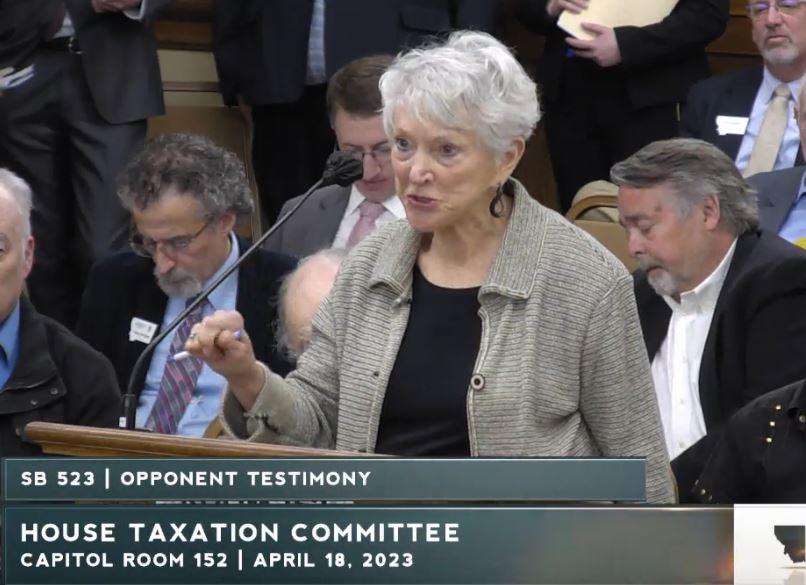
After passing through the Senate Committee, SB 523 entered into the House Taxation Committee for review, where it was met by an army of lobbyists. Former City Councilman and longtime TIF critic Jesse Ramos commented on the irony of voters facing off against opponents whose salaries they’re helping to pay for:

“Unfortunately, constituents have to work,” he said. “When you’re taking on these big giants, the League of Montana Cities and Towns, a lot of these folks are paid with taxpayer dollars to fight against the interest of the taxpayers. It’s frustrating.”

Montana taxpayers were up against a crowd of suit-and-tie representatives from the Big Sky Resort, the Montana Building Industry Association, the Montana Economic Developers Association, the American Council of Engineering Companies of Montana, the Montana Contractors Association, the Great Falls Development Alliance, the Montana Banking Association, Montana Architects, the Montana Travel Association, the Hospitality and Development Association of Montana, Montana Chamber of Commerce, Montana Infrastructure Coalition, Kalispell Chamber of Commerce, Montana Association of Realtors and the Missoula Economic Partnership. Every one of these lobbyists arrived in the state Capitol to help protect their favorite public investment subsidy from succumbing to additional regulation.

Without unregulated TIF dollars, developers would be on the hook to pay for the demolition costs associated with redeveloping existing property, which is the normal course of events and always has been. It’s always nice to receive a subsidy but the screaming high demand for real estate in Montana guarantees that said developments would have happened anyway and therefore did not require an extra incentive from the taxpayers. Nevertheless, one of the classic arguments made by TIF addicts is that these developments would not have happened “but for the TIF”, hence all the corporate hysteria hurled in Helena.

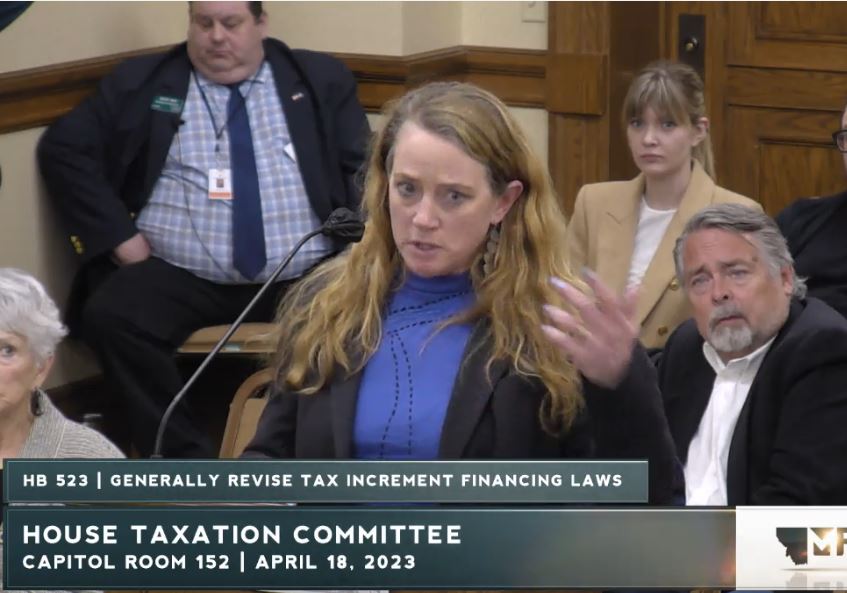
Charles Robison of the Montana Chamber of Commerce alleged that, “TIF builds infrastructure that won’t get built otherwise.” WGM engineer Brent Campbell echoed with, “My developer clients will not invest in that kind of risk, where some neighborhood folks dislike a project. Frankly TIF is the great equalizer.” Brent Campbell also earned the award for Most Distracting Facial Expressions Made During a Legislative Hearing.

There were many runners up for Most Offensive Show of Entitlement for Taxpayer Money, including the unelected Mayor of Missoula Jordan Hess’ breathless claims about so-called “affordable housing” or WGM’s executive officer Jeff Smith’s contention that “TIF is too important to the health of Montana’s economy and in solving our affordable housing crisis.” The public are meant to believe that our communities would fall apart without public subsidies for developers, which is exactly what Julie Foster of Ravalli County claimed when she said, “If this bill goes forward it is the knock-out blow for our community.”

But the award for Most Emphatic Distortions may go to May Nan Ellingson from Missoula, who alleged:

Every tax increment district, every tax increment project, every tax increment bond that has ever been issued in this state has been approved by a duly elected City Council or a board of county commissioners. … Tax increment bonds are truly revenue bonds. If the tax increment revenue is not adequate, the tax payers are not on the hook. It’s a risk that the purchasers of tax increment bonds make. Tax increment bond proceeds cannot be used to fund private buildings.”

According to constitutional attorney J. Kevin Hunt, these revenue bonds are really “junk bonds” secured only by unrealistic predictions of guaranteed prosperity. General Obligation Bonds are more secure, but must be approved by a vote of the people. Many cities issue “junk” revenue bonds explicitly to eschew that responsibility, especially when it comes to projects they know the public won’t support.

Dan Brooks of the Billings Chamber of Commerce seemed to corroborate this fact when he mentioned that, “While some cities may not require council approval, ours does, and those elected officials get to answer to their constituents.”

As for whether TIF bonds can be used to fund private buildings, that seems to be exactly what MRA proposed in 2019 when they pushed forward a $16.5 million TIF bond aimed at helping entertainment magnate Nick Checota build a community center that only he could enjoy exclusive access to, and for a lease duration of 75 years to be paid for by his property taxes. Stockman Bank likewise spent millions of dollars of public money to build private bank towers throughout the Missoula valley.

Next, the award for Most Obvious Contradiction goes to Craig Rickert and his misguided declaration that,

People outside my TIF district are not paying taxes into the TIF district. There seems to be a lot of miscommunication about that. People outside my TED district are not paying taxes into the TED district.”

Actually, people outside your TIF district are, in fact, paying taxes into the TIF district. And that isn’t a typo – Craig conflated TIF and TED so many times the chair had to ask him which one he meant. If you own property in an Urban Renewal District (URD), part of your property taxes go into a special fund used for other projects in that area. And this a isn’t “miscommunication”. It’s the reason why neighboring taxpayers grow increasingly irate about the things that their dollars are funding in districts that redirect captured tax revenue. In 2021 Craig Rickert’s developments became the target of lawsuits from citizens who called his deal with the Department of Transportation “unconstitutional”:

The lawsuit, filed in district court in Broadwater County, takes aim at MDT’s decision to work with Montana Rest Area JV Partners to build a rest area in Three Forks near U.S. Highway 287 and Wheatland Road. In exchange for the new rest area building, MDT would hand over the 19th Avenue rest area in Bozeman to developer Craig Rickert.

Next up, the award for Biggest Facepalm goes to Sara Hudson of Snowy Mountain Development, who claimed that anyone who criticizes the use of TIF must have a “fundamentally flawed” understanding of it, which in this case included Fortune 500 CFO Bob Moore and other veteran finance professionals. Officials reliant on TIF dollars predictably employ this old-hat response whenever the voters begin to get wise about where their taxes are going. Regardless of how many facts and figures are presented, critics are unanimously and contemptuously told that they “just don’t understand” how TIF works.

Finally, the award for Most Offensive Show of Entitlement for Taxpayer Money goes to developer Matt Sullivan who foolishly alleged that his ideological opponents were wasting everyone’s time and merely for the purposes of personal grandstanding:

Programs like TIF should always be improved but please be careful, objective and data-driven to make this decision. Do not be swayed by exaggeration and misinformation! Today no proponent has presented actual studies proving this bill will lower taxes! They’ve just presented their opportunities for themselves to speak!

First of all, neither Mr. Sullivan nor any of his peers ever satisfactorily rebutted any of the specific criticisms or concerns presented. They can’t debate the merits of a bank buying it’s own TIF bonds because they don’t seem to understand what that sentence even means. And they certainly can’t tell us it’s ethical for local businesses to be forced to subsidize outside competition.

Secondly, it’s technically true that tax burdens wouldn’t necessarily drop immediately, but they could stop skyrocketing as steeply for those affected by the so-called “special assessment” taxes of URDs.

Does anyone really think Missoula’s constant tax levy proposals are a normal consequence of fiscally responsible policy decisions? Every approved levy constitutes a tax increase. Missoula County Public Schools have repeatedly asked the voters for special general fund levies because their budgets got hollowed out by TIF. The same thing happened in California where it was discovered that TIF districts had stripped over $40 billion from public education, contributing to then Governor Brown’s decision to shutter over 400 URDs.

In 2017 only 4% of Missoula’s tax base was captured by TIF increment.

By 2020 it had ballooned to 14%.

And when the City of Missoula took in $36 million in property taxes during fiscal 2020, the MRA acquired $35 million of that.

Other cities are following suit and the percentages tend to grow larger. It’s a common pattern that seems to repeat ad infinitum. When municipal officials become addicted to this one-size-fits-all approach to development there is nothing but the state legislature to stop them from stretching the limits ever further.

But while Sullivan got downright irate about the very notion that his precious subsidy might need to be regulated, he also explicitly admitted that TIF does, in fact, represent a form of corporate welfare:

We’ve never received TIF funding or any other form of corporate welfare for our past projects, but due to high construction costs currently, we are asking for TIF funding for the project in front of you today. TIF provides developers with an incentive to improve our communities and increases the housing supply.”

I thought the love of the community was the incentive to improve it, but apparently some people need TIF money to feel that way about where they live. And increased construction costs duly noted, putting the burden on your neighbors isn’t the answer. We don’t need to build so-called “affordable housing”. Our priority should be to make existing housing affordable for people who already live here.

The main problem with funding so-called “affordable housing” developments with TIF dollars is simply that nothing in state code allows for TIF dollars to be spent that way. Tax Increment dollars were only intended to fund the elimination of physical blight, not to subsidize housing projects.

Yes, there’s high demand for housing out here but locals are well aware that the problem isn’t a shortage of places to live. The problem is that locals can no longer afford to live in the communities they grew up in. Building more buildings isn’t going to help because that doesn’t address the core problem that these policies are displacing the locals.

Matt Sullivan alleged that the loss of TIF subsidies would ultimately result in fewer apartments for Missoula, but existing Missoulians need breaks, not additional buildings funded with public money. The Missoulians who already live in Missoula but haven’t been displaced yet grow daily annoyed by the attempts all around to take their housing away, and that includes every mechanism that negatively impacts their property tax bills.

Developers are receiving TIF subsidies to build stack-and-pack apartments under the banner of so-called “affordable housing” and in doing so exacerbate the very reason housing has become so unaffordable for locals: the burgeoning effect that TIF overuse has on property taxes.

Harping on the “affordable housing” buzzword with extra gusto was former City Councilwoman and executive director for Habitat For Humanity of Missoula, Heather Harp:

And while on council I heard from constituents about the lack of affordable housing every week, and I have to say that remains very true today in my current job. This bill unravels the work of last session to include workforce housing – which was genius by the way – which is exactly what we build at habitat. … This bill affects every developer’s lending costs. To make home ownership affordable we rely on a variety of funding sources and grants from local and federal governments are an essential part of our lending strategy. … And for 30 years our affiliate financed 2 homes a year with bake sales and raffles. But with skyrocketing home sales and a statewide housing shortage of 30,000 homes, we opted to innovate to find financing alternatives to supply the demand. That solution requires large scale investment. The problem needs cash flow now. Government grants that can direct tax increment dollars to workforce housing are a much needed tool. This bill and others focused on reducing TIF’s strengths or leverage capabilities will effectively water down those local government funding sources to be meaningless. And without those local government dollars then we will not have the necessary local match to be awarded federal grants.”

Heather Harp fails to mention the voluminous TIF opposition she witnessed during her time on council including several of the longest council meetings in Missoula’s entire history. Nor does she seem to remember the woman who lost her Habitat home to rising property taxes in Missoula. On 27 August 2018 Councilwoman Harp was present at the Missoula City Council’s marathon budget meeting where one woman provided testimony that she could no longer afford the property taxes on her Habitat home. TIFs had significantly affected her property tax assessments.

When the national branch of Habitat For Humanity found out there were lobbying efforts in Montana this year to finance their housing program with public subsidies, they hit the ceiling. Habitat For Humanity homes are explicitly not supposed to be built with funding models that involve taxpayer dollars, and Heather knows it. It’s likely she knew it during her time on City Council too.

Heather’s development director, Nevin Graves, took the microphone next on behalf of Habitat to say:

Every part of our state is facing a housing affordability crisis. And just as my previous opponent said, we build workforce housing. We have an incredible tool in Tax Increment Financing to build workforce housing. And usually when people steal tools from my tool chest I call the cops. In this case I have to come to you. … But if anyone feels like they’ve got an adequate understanding of how this works in every community in Montana, then by all means, take your action tomorrow.”

After speaking, Nevin Graves publicly accosted Jesse Ramos in a heated outburst that had to be broken up by Capitol security, earning himself the prize for Most Unprofessional Behavior At A Legislative Event.

Jesse Ramos was standing in the committee room when Nevin marched up to him and shouted, “What the fuck do you think you’re doing? This is irresponsible!”

Jesse replied, “Don’t you think it’s irresponsible that we’re subsidizing this level of corporate welfare?”

Nevin again shouted over Jesse, “You just don’t understand the time value of money. You’re supposed to be a financial advisor.”

Nevin continued cursing his adversary out until he was told to leave by capitol security.

“Sure enough!” Nevin declared as he turned and walked out the door.

As we’ve repeatedly observed for years, there just doesn’t seem to be any limit to the behavior of people desperate to defend their parasitic choke hold on public money. Not all municipalities are corrupt but someone has to clean up the ones that are. SB 523 was a gallant effort to that end.

Jesse Ramos and Greg Hertz really hit a nerve in Helena this spring. So much so that big business had to flood the legislature with a toxic cloud of “smugnorance” emitted by a shrieking chorus of angry lobbyists. It doesn’t seem particularly surprising that organizations that have grown accustomed to TIF subsidies would rather not restructure their revenue model. Big business tends to be against major changes, unless those changes make them money. Developers will happily destroy historic housing that locals can afford with patronizing insults to injury like, “Change is hard.” But look how offended they become when the shoe is on the other foot. Hence the corrupt seldom see themselves as liable for the problems their corruption creates, as though no drop of water could ever be responsible for the flood.

Ellen Buchanan Mobilizes Big Business to Keep Her Secret Government Monolith Alive

An addict is a person with an uncontrolled compulsion to continue engaging in an activity despite the negative personal or professional consequences that result. Addiction can also be defined by the overreaction that occurs when the object of addiction is taken away from the user.

Tax Increment Financing began as a complex and convoluted financial scheme of using public money to repair blighted areas that has gradually morphed into a silver bullet solution for every municipal problem and often gives rise to rampant cronyism at the expense of the taxpayers.

Bureaucrats who become predictably overdependent on Tax Increment Financing constitute TIF addicts and their overuse of this legal financial tool signifies an obvious perversion of the original intentions set down by the state legislature that enacted it in 1974.

This spring Senator Greg Hertz championed a bill meant to reign in some of the abuse during Montana’s 2023 legislative session, prompting an army of lobbyists and business people to come out of the woodwork and assemble in defense of the status quo.

Anyone who earnestly studies TIF will eventually recognize that the law is loose, open to interpretation and riddled with loopholes. There are plenty of instances of Cities using this tool responsibly, but nobody can deny the fact that TIF has also consistently birthed a scourge of runaway redevelopment agencies staffed by unelected bureaucrats who enjoy uninterrupted control over municipal budget spending decisions.

Don’t take it from me. Take it from former MRA director Geoff Badenoch, who ran the agency for 18 years:

The history of Tax Increment around the country has been that it is a temptation that many cities have not been able to resist. And tax increment gets used in ways that go way out on the fringe of what I think legislatures intended. And as a result, in Minnesota, California, Illinois, other states, legislatures have felt the need to come in and restrict the use of tax increment or eliminate it altogether. And, yes. But that’s a political response to abuse. The danger with TIF is that there is a temptation to use it every which way, if you can square it in the law any way, to use it.”

Ellen Buchanan has run the MRA ever since Mr. Badenoch left over two decades ago, and today she makes $180,000 a year to dictate how our tax money is spent. Last month Ellen was quoted in the Missoulian piece titled, Missoula Officials Lash Out At Proposed Bill That Would Revise TIF Laws:

The one that absolutely just destroys Tax Increment Financing in the state of Montana is a Senate bill sponsored by Sen. Hertz and it just puts us out of business,” Buchanan said. “There’s no way to amend it that makes it functional or even just less efficient. It just destroys Tax Increment Financing.”

When SB 523 came before the Senate Committee in March, Ellen Buchanan showed up to defend her access to the municipal purse strings. After the Montana Senate passed it Buchanan went into overdrive, sending out a mass Email that included the business community, fellow MRA board members, former mayors, TIF dealers like Stockman Bank and major TIF recipients like Peter Lambros. The Email expressed grave concern about the bill and provided an eight-bullet list of talking points with which to appeal to the members of the Tax Committee that would be deciding the bill’s fate.

Many of Ellen’s bullet points are factually problematic, like the claims made in Bullet #7:

Elimination of TIF may result in higher property taxes, not lower property taxes. Without TIF investment in public facilities, roads, bridges, parks, other infrastructure, this puts more pressure on local governments to find ways to pay for these services.”

So without TIF there aren’t any resources for government to fix the roads? What about the taxes that were collected to begin with? Do we really need a bank loan to fix our roads?

But it doesn’t matter that many of the bullets are factually and demonstrably false because if you get enough people to repeat the lie everyone starts to believe that it’s true. And she definitely harnessed enough people to repeat her points.

In fact, Buchanan’s recruitment efforts were so successful that she didn’t even have to herself testify before the committee. Her newly unelected mayor, Jordan Hess (alongside his handler Council President Gwen Jones), also came to her bidding and helped hypnotically repeat the phrases “affordable housing” and “workforce housing” while she lingered in the background on her phone building the next wave of testimony. The real power remains behind the throne.

A cacophony of lobbyists and business owners stepped up to the microphone to read versions of Buchanan’s talking points at the tax committee. Among the hyperbolic allegations was the predictable claim that “TIF critics are just ignorant,” which seemed particularly offensive given the explosive history of TIF criticism in Missoula.

Speaking of offensive, Missoula City Council President Gwen Jones publicly projected the word “criminal onto Adam Hertz and Jesse Ramos – two former Missoula City Councilmen – for compiling a list of TIF abuses in their City. By The Missoulian’s account, Jones is “an experienced attorney in town” (ostensibly meaning her enunciation of the word “criminal” has extra authority). The article went on to illustrate how the MRA unanimously characterized professional criticism to their spending habits as a“lot of misinformation” being presented deliberately by elected officials:

Everyone in the room murmured in agreement. “By elected officials who know precisely what they’re doing,” Jones said.

One wonders if Ms. Jones has access to a mirror, as she too is an elected official who knows exactly what she’s doing. She is also well versed in the practice of abusing her power. As a board member of Missoula Aging Services, Gwen Jones threatened the job of another MAS employee who had written a poem critical of her policy as a City Councilwoman of placing crippling debts on local homeowners for unnecessary and unsolicited sidewalk updates. She also made a habit throughout 2019 and 2020 of performing background checks on all constituents who presented TIF information to the City Council that she personally disagreed with.

Ellen Buchanan likewise recently resorted to absurdist ad hominem attacks of the citizens critical of her agency’s shenanigans, comparing lawful populist opposition in Helena to the J6 “insurrection”:

You watch what’s going on in Helena and it’s just terrifying,” Buchanan said. “It’s just a microcosm for what went on in D.C. … It’s pretty scary,” Buchanan said. “It’s frightening for staff. It’s frightening for me and it’s frightening to city administration. So not to be a Debbie Downer, but it’s been a tough couple weeks around here.”

She also alleged that there’s been a “criminal” amount of disinformation spread about TIF. Former City Councilman Jesse Ramos responded, saying, “And citizens going to Helena to fight for what they think is right is ‘criminal’? That’s fantastic.”

Big Business opposed the bill with extreme prejudice, and many of the lobbyists who rose in opposition are paid by Montana tax dollars. Most of them parroted Chicken Little’s claim that “the sky is falling” and other apocalyptic predictions foreshadowing the end of the world as we know it should this bill ever become law.

They couldn’t debate obvious instances of TIF abuse so they instead try to divert attention elsewhere. And their buzzwords this session were “affordable housing” and “workforce housing.” But we don’t need to build affordable housing. We need to make existing housing affordable. Native Montanans are supposed to be represented by their legislature and their existing housing is under threat from the commonly occurring phenomenon of sudden property tax inflation. TIF districts disproportionately affect the working classes who pay for them because their property taxes balloon when the “taxable value” of their homes increases.

A stated purpose of TIF is the increase of taxable value, which thereby theoretically grows the tax base.

Theoretical benefits of TIF aside, the demonstrable abuses are as numerous as they are egregious but are all still technically “legal” since the legislature hasn’t really begun to regulate TIF in Montana yet. They include banks loaning their own TIF handouts to municipal governments at interest, unlawful claims of eliminating “future blight” and “blight down the trail,” designating newly constructed buildings as “blighted” to justify additional spending, weaponizing tax monies against local businesses who pay for their corporate competitors to out-compete them, and the cronyism inherent to a runaway board of unelected bureaucrats who have seized control of the City budget and decide economic winners and losers without regard to public will.

While snakes in suits kicked the legislative can down the road in the halls of Montana’s Capitol, many hardworking Montanans continue to be taxed out of their homes and businesses to make room for tourists with townhouses and second-home snowbirds. For the development regime who opposed Hertz’s bill last month that’s not a bug but a feature.

The problem in Missoula is not a lack of housing, it’s that people can’t afford it. One Army veteran we interviewed returning home to Montana in April of this year couldn’t find a one-bedroom studio apartment for less than $2,200 in his hometown of Missoula. But TIF addicts love to twist the reasons for our affordability problem around, which is why they talk a lot about their false solution to the problem: so-called “affordable housing.” TIF addicts like this subject because it technically allows them to administer many additional hits of industrial-grade TIF, even though the TIF statute says nothing whatsoever about building housing.

But Ellen Buchanan won’t let a petty thing like facts get in the way of her propaganda. And beyond quoting her inane blathering, the stenographers at the corporate-owned Missoulian won’t ask her any follow-up questions to statements she utters that make absolutely no sense:

“One of the arguments that is being made by some of the folks testifying for this bill is that we’ve got no business doing housing,” Buchanan said. “All we’re supposed to do is remove blight and housing is not something that’s permitted under TIF statutes, which is ridiculous. That’s been said over and over again, by one of our former city council members that’s really pushing this bill hard. So that’s a little bit ironic that there’s this dichotomy going on.”

I fail to see what Ellen Buchanan means by “ironic” since irony is an outcome opposite from and in mockery of the expected result. She doesn’t provide any evidence whatsoever that her critics are incorrect in their assertion, just that said assertions are “ridiculous”. Having said that, it does indeed seem ironic that a former elementary school principal and superintendent would oppose a bill supported by the School Administrators of Montana:

Rep. Ed Butcher, R-Winnifred, said he supported the bill because he believes “bad actors” are abusing the system. “Big corporations that don’t need these tax dollars for their construction projects. We have a person from Big Sky coming up here wanting his money, that really turned me off because those guys have more damn money than the U.S. government has.”

The bill was supported by the School Administrators of Montana, who argue that TIF diverts funds from school districts and instead into construction projects in Urban Renewal Districts.

But Rep. Mark Thane, D-Missoula, took issue with Butcher’s comments. Thane is the former superintendent of Missoula County Public Schools.

“We’ve heard essentially people say that there are abuses, that it’s corrupt, that it’s corporate welfare,” Thane said. “And I just want to go on record as saying that these funds are audited. There’s oversight by local government entities. There is no evidence that there’s been any kind of fraud or corruption or even abuse.” Thane went on to say, “I do take some offense at the allegations that it’s in some way corrupt or being abused when there’s been no evidence presented.

But plenty of evidence of abuse was presented before Thane and his peers by Senator Greg Hertz during the hearing. Thane’s definitely come a long way from his 1995 appointment as principal of the newly constructed Chief Charlo Elementary. Isn’t it interesting that he opposed a bill supported by the School Administrators of Montana, since TIF districts adversely affect school budgets?

TIF addicts won’t bother trying to defend the $1.5 million to Stockman at 4% interest or the $1.6 million to First Interstate at 6%.

They can’t deny the fact that Andy Holloran’s Home Base received over $3.6 million in TIF and used it to add an additional floor to the Marriott.

They can’t rebut the fact that “future blight” is not covered under state code, but was employed to justify $8.6 million in TIF subsidy to Peter Lambros to build a new road toward SouthGate Mall to incentivise Lucky’s Market to move in. But Lucky’s went out of business after only two years and Lambros sold Southgate to Washington Prime Group for $58 million. According to then Mayor Engen, the reason we helped Peter make a cool fifty million dollars of profit with over eight million in public money was to prevent “future blight,” since malls were going out of business all over the country.

Nevertheless, SB 523 died in committee on its way to the House after being tabled by a vote of 13-8. Former City Councilman Jesse Ramos said of the bill’s defeat, “Most unfortunately, SB 523 died in Committee today because of the Great Falls Caucus who believe it is their job to represent their local government. Not their constituents.”

It also didn’t help that certain committee members seemed hellbent on abdicating their responsibility to even consider regulating demonstrably irresponsible behavior. Committee member Dan Fern from Whitefish pigeonholed the debate as “the Missoula show” and even tried forcing a requirement on speakers to identify what town they were from. Chair Feilder overruled Fern’s requirement, but his minimization of the issue was duly noted.

All in all, Ellen Buchanan’s success was a manifest reality. Her persuasion machine succeeded, however narrowly, in convincing the legislature to leave her magic wand collection alone. With the legislative session finally over, she can breathe a sigh of relief knowing that her access to the tax coffers – and her ability to continue profiting from them – remains unimpeded.

At least for now.

Efforts to reign in TIF in Montana multiplied following this legislative session as more citizens began to familiarize themselves with the law, learning for themselves just how deep the rabbit hole goes. SB 523 awoke the multi-tentacled TIF Leviathan. And when the next round of TIF debates fill the halls of the Helena Capitol in 2025, Montana taxpayers can expect an even larger and more menacing beast to rear its ugly head.

Americans Are Not Required To Pay Income Taxes, But Many File Anyway

When three IRS whistle blowers stepped forward with the We The People Foundation to inform Americans that the income tax represents an institutionalized fraud of the highest order, the predictable response from those in power involved labeling the dissidents as conspiracy theorists, tax cheats, and other pejoratives. Those who benefit from the status quo know that anyone exposed to the authentic history of the IRS and the 16th Amendment becomes more likely to join the 90 million Americans who refuse to file income taxes. So the owners wheel out old red herrings to get the unwashed masses to fight among themselves. The corporate media run stories meant to turn a shackled population against anyone trying to help free them. We hear that “tax dodgers” are inherently selfish people who “refuse to pay their fair share”. Such ridicule has thus far prevented the working classes from banding together and going after the powerful who benefit from the situation remaining unchanged.

Because common literacy of the legal fiction threatens the scam, those in charge have a vested interest in perpetuating the lie. In the words of former IRS Criminal Investigator John Turner, “The IRS fears the public gaining a knowledge of how their scam works.”

Many activists and journalists have attempted to negotiate with the IRS directly about these problems, including many prominent employees of the IRS itself. But the agency stonewalls just about every inquiry that comes their way. In the words of another former IRS agent, Sherry Peel Jackson, “[the authorities] can’t answer because if they did, the American people will know the whole thing is a fraud.

And in the words of IRS Special Agent Joseph Banister, “Rather than pulling up a chair they pull out a club.”

These whistleblowers have helped many Americans understand that an unapportioned tax on labor is completely unconstitutional. They have exposed the fact that there is no law requiring Americans to file with the IRS. They’ve also illustrated that there is no way to file an income tax without testifying against yourself.

Income tax can’t be treated like a game

INCOME TAXES DO NOT CONTRIBUTE TO GOVERNMENT SERVICES

Remember when actress Emma Thompson and her husband Greg publicly declared their refusal to pay another penny in income tax until justice is served to the thousands of HSBC bankers who were caught laundering billions of dollars in Mexican drug cartel money?

If we’re supposed to get angry with anyone refusing to “pay their fair share” of the overall tax burden, where is the outrage for corporations that pay zero income taxes? The average American pays more income taxes than Exxon-Mobile, and plenty of other multi-billion dollar operations such as General Electric, Verizon and Boeing likewise avoid the income tax completely. So how can huge corporations avoid income taxes while simultaneously dodging scrutiny about paying their fair share? Wouldn’t such an arrangement place an obviously disproportionate burden on the working class?

Most Americans continue under the false impression that everything in society from the roads to the schools to the military must be funded by income taxes. But roads and schools and military services existed prior to the formation of the 1933 income tax. America has funded government services since the Declaration of Independence officiated its existence in 1776. For over 150 years America somehow financed government without income taxes, without the social security system, and without the IRS.

In 1982 Joseph Peter Grace was appointed by President Ronald Regan to identify waste and inefficiency in the US Federal government, in turn creating the now infamous Grace Commission. Grace requested that members of his commission “be bold” and “work like tireless bloodhounds” leaving no stone unturned in their search to root out inefficiency. Their conclusions were so shocking that the report was ultimately buried, and most students of history have never even heard of the Grace Commission.

The Grace Commission’s final report submitted on 15 January 1984 concluded:

“… all individual income tax revenues are gone before one nickel is spent on the services taxpayers expect from government… 100% of what is collected is absorbed solely by interest on the Federal Debt.”

Exactly zero percent of income taxes collected go towards funding government. The Grace Commission concluded that income taxes only fulfill the interest payments on the debt our government owes to the banks. Every cent of America’s finances are loaned to it at interest by the private Federal Reserve. According to John Whitehead, America’s government borrows $6 billion a day. This fact exists in spite of a stubborn unwillingness from countless Americans to acknowledge the evidence that the FED is privately owned. Said evidence includes the unnamed shareholders the official website admits to – shareholders who earn dividends based on interest payments collected through income taxes. The FED has historically collected $36 million an hour in interest from the American people this way. Income taxes are not really taxes per se. They are interest payments and America’s owners have grown fat from them.

We’ve only had an income tax since the 16th Amendment’s fraudulent passage in 1913, which just happens to have been the same year that the Federal Reserve came into existence. Prior to that, Americans kept 100% of their earnings, going all the way back to 1776. No IRS, no tax on labor, and no April 15th filing deadline. Yet somehow America financed schools, colleges, libraries, roads, railroads, subways, the Army, Navy and Marine Corps, and many other services and institutions that exist today. So how could America fund all of those programs without an income tax?

Countless taxes are levied against American workers every day, including property taxes, automobile registrations, building permits, court fines, gas taxes, traffic fines, marriage licenses, medicare and social security, parking meter fees, hunting and fishing licenses, toll booth levies, inventory taxes, real estate taxes, road usage taxes, septic taxes, estate taxes, capital gains taxes, CDL fees, tobacco and liquor taxes (i.e. “sin taxes”), and in most states there is also a sales tax.

When we include the Federal Income Tax into the ever-growing list of compulsory fees, fines and surcharges, today’s average American pays more than 64% of their total earnings into various tax collection schemes. That’s more than four times the relative tax rate that triggered the American Revolution.

WHY IS OUR GOVERNMENT PAYING INTEREST TO BANKS?

The rubber meets the road in the margins and in the fine print and in the loopholes when it comes to America’s legal and political processes. If the people don’t want something that benefits big business, the industry doesn’t take it as a learning experience to become more ethical, but as a cue to conjure the next loophole. They never take no for an answer, and no low is too low when it comes to their methods for infecting systems of governance with corruption that benefits them.

Such it was when the Federal Reserve Act was first pushed through Congress during the holidays. On Christmas Eve of 1912, when very few lawmakers were present in Washington, a tiny handful of legislators were on the floor and knew they could pass legislation without the rest of the Congress. An administrative technicality required only a majority of those physically present to pass legislation. So if only three showed up, and there were only three in the building, they only needed two for successful passage. The only potential hurdle after that was executive veto, but President Wilson had already agreed to sign the Federal Reserve Act into law in exchange for campaign financing. Wilson could be expected to fall in line because he took those campaign contributions from the very bankers pushing the bill through the legislature vicariously through their political puppets.

In 1913 the Federal Reserve came into existence and began loaning money to America at interest, placing the country immediately into debt. America entered the Great Depression as a direct result of the bankruptcy that inevitably occurred following the adoption of usury onto the national Treasury.

Through this elaborate system, which does a brilliant job of keeping us ignorant of the fact that we’re anything but free, our central banking system extracts wealth from the workers through the parasitism of interest. The intended effect of usury has always produced greater ownership possibilities for those who already have all the money. Banks profit from loans because borrowers must pay back a larger sum than was provided by the lender. So how can a country ever repay the debt in full, if the entire existing money supply is less than the money owed? It can’t. Eventually entire nations are forced to provide additional resources in “collateral” to satisfy the banks they’re indebted to.

John Perkins wrote extensively about this in his book, Confessions of an Economic Hit Man, describing this very process with regards to how the World Bank and International Monetary Fund put entire countries into debt through similar schemes.

So by 1933, after twenty years of loaning the country money at interest, America owed more than it had to the private Federal Reserve Bank. It only took two decades the render the country broke, at which point the bankers proposed another “solution” to the disaster they had created.

THE 16TH AMENDMENT

Ardent supporters of the status quo alongside fawning economics professors and government authorities continue to insist that the 16th Amendment grants the power to levy an income tax on the private labor of American citizens.

It does not.

In 1894 the US Supreme Court ruled that an unapportioned tax on labor is unconstitutional. As John W. Whitehead explains:

Determined to claim some of the citizenry’s wealth for its own uses, the government reinstituted the income tax in 1894. Charles Pollock challenged the tax as unconstitutional, and the U.S. Supreme Court ruled in his favor. Pollock’s victory was relatively short-lived. Members of Congress—united in their determination to tax the American people’s income—worked together to adopt a constitutional amendment to overrule the Pollock decision.

On the eve of World War I, in 1913, Congress instituted a permanent income tax by way of the 16th Amendment to the Constitution and the Revenue Act of 1913. Under the Revenue Act, individuals with income exceeding $3,000 could be taxed starting at 1% up to 7% for incomes exceeding $500,000.

The 16th Amendment never legally passed the ratification process because the number of states required to do so was never met. Despite this fact, the 16th Amendment to the Constitution was enacted.

But the fraudulent passage of the 16th Amendment was so problematic that another series of lawsuits prompted yet another Supreme Court ruling. And the Supremes once again determined that the average American is not required to pay the tax because the 16th Amendment’s powers only extend to gains earned as a result of corporate activity. Thus the Supreme Court ruled that the 16thAmendment granted “no new powers of taxation”.

BIRTH CERTIFICATES AND SOCIAL SECURITY

America is supposed to have a National Treasury, but the treasury has operated under emergency powers since 1933 following the nationwide bank collapse that brought about the Great Depression. In 1933 the country enacted the Social Security system as a way to collateralize the debt through birth certificates. Despite what most of us might think about them, birth certificates weren’t always part of the economic system. Birth certificates are bank notes and labeled as such on the edges which are designed with a webbing similar to that on the dollar bill. Before 1933 there were no such things as birth certificates. Prior to that, obstetricians recorded a Live Record of Birth as the common standard slip filled out upon a newborn’s arrival. It was not a “certificate” because certificates are defined as warehouse receipts on human resources.

This note’s worth is based on the estimated taxable value throughout a person’s life, which on average accounts for roughly $750,000. Birth certificates differ little from the deeds that 18th century plantation owners kept on their slaves. We the people are their collateral to keep this financial farce floating forward. One of the effects birth certificates have on society is the formation of a new corporation every time someone is born. And once a corporation comes into existence its financial profits can be treated as corporate gains, making it eligible for levy by the income tax.

Diligent study of the code reveals that there simply is no clear law requiring the average American to pay income taxes. The exception involves any corporate entity that records gains from corporate activity. This dirty little secret explains why refusing to file with the IRS is completely within your legal rights. Legitimate authorities wouldn’t have to rely on intimidation and scare tactics to enforce the tax if it were an authentic means of funding government services.

ON 15 APRIL USS AMERICA BECAME A ROGUE PIRATE SHIP

If you’ve ever wondered where the April 15th filing deadline came from, the answer has something to do with Abraham Lincoln, the Lieber Code and George Washington.

After George took office in 1789 a currency was developed for the country on a standard 70 year contract. That contract came to an end during the Lincoln Administration’s tenure in the 1860’s. Lincoln presided over 34 states at the time, but 21 of them were free from banking rule because only 13 colonies were included in the original contract. The additional states had come into existence as sovereign territories since Washington’s original establishment negotiations. So when Lincoln started his own financial renegotiation to extend the currency another 70 years, the banks demanded additional collateral. The Lincoln Administration agreed to all 34 states, but without the consent of the individual states themselves. When word of this got out, the states enacted their 10th Amendment powers and seceded from the union and on 27 March 1861 the Lawful Congress of this country disappeared forever.

The country formerly known as America was effectively disintegrated at this point and replaced with a military government. Abraham Lincoln continued to preside over the emergency executive branch but could no longer be called “the President” as there wasn’t a country to rule over following the secession of the constituent states.

On 15 April 1861, the Lincoln Administration issued executive order #1 establishing martial rule over all Federal territories. The spring of 1861 effectively voided the contract known as “the Constitution” and the United States as it had been known to that moment ceased to exist.

Since a new way of governing the Federal Territories would be required, Lincoln issued the General Orders 100 on 24 April 1863. General Orders 100, also known as the Lieber Code, has come to replace the old government with the military government we’re living under today. It instituted a martial rule and established a text-book dictatorship without a Congress or President accountable to the citizens. 1863 was also the year the Supreme Court was abolished. Without a lawful Constitution to guide the bureaucracy, the Article 3 Judiciary no longer existed and a new Supreme Court was established in the District of Columbia. But this De Facto court is very different than the one originally put in place by the founders.

In 1870 the Department of Justice was created to provide some semblance of law, but it was placed under the direct authority of the Executive branch. So the President now controlled the legal system. The top Law Enforcement Officer under this new system is ultimately the Attorney General, who is appointed by the executive.

In 1871 a new private municipal Corporation was created under the Organic Act, complete with a corporate charter called The Constitution of the United States of America. This is not the Article 6 Constitution published in 1789 since it was never intended to be a living document, as it explicitly stated. With no Constitutional authority to do so whatsoever, Congress created a separate form of government for the District of Columbia in 1871, replacing the organic Constitution and with a corporate one. America is not even a country anymore. It is a Corporation.

CONCLUSIONS

The IRS will never send SWAT teams into the headquarters of HSBC or Exxon-Mobil, or General Electric. Those corporations own the politicians who direct policy for the IRS. The irrational authorities in power selectively enforce laws to operate against the interests of the people. The facade of legitimacy around all things “government” clouds our ability to identify unfair exploitation, but the tide is turning, and faith in this system of taxation is waning.

If the present owners are to remain in power, their self preservation demands a divide-and-conquer approach against any attempt to upend their hegemonic apple cart. The authoritarian system that built their mechanisms of tyrannical bureaucracy would instantly collapse beneath the weight of the common people if we ever came to understand the extent of our collective enslavement.

What prevents Americans today from the kind of outrage that inspired a Revolution two centuries ago? It was much easier to stage a revolt when an ocean physically separated one side from the other. When the British imposed taxes, Americans recognized the exploitation for what it was. Today many Americans honestly believe in the unquestionable authenticity of our tax system here at home, although the veneer of legitimacy wears thinner every day.

The Key Difference Between Montana Rail Link and Norfolk Southern: LUCK

Following a plethora of toxic derailments nationwide, Montana Rail Link lucked out after one of their trains careened off the rails and onto the banks of the Clark Fork River last week. It was initially reported that an unknown substance was leaking into the river following a derailment near Paradise, Montana on the morning of Sunday, 02 April 2023. Sanders County authorities were alerted at 9:20 a.m. on Sunday morning that an incident had occurred near mile marker 19 of Montana Highway 135.

At least 18 rail cars stacked up against a tunnel entrance directly across the river from Quinn’s Hot Springs Resort. Guests of the resort staying in the waterfront cabins were temporarily evacuated as a precautionary measure. At least 2 chemical tanker cars derailed with one tipped over on the tracks and one stuck in the mouth of the tunnel. Workers struggled through the week to free the cars that went off track within the confines of the tunnel. Images show steam rising from the derailment site where heavy machinery works on the cliffs above and a crew dressed in orange floating along the river in an inflatable boat. Surveillance footage from Quinn’s Resort shows the cars piling up and falling down the steep banks toward the river at around 9 am.

While the train had been transporting hazardous materials in chemical tanker cars, only a tanker of butane came off the rails and it did not emit any of its contents into the environment. The spill was limited to powdered bentonite clay and cases of beer, in both bottles and cans. While a small amount of diesel fuel spilled onto the soil near the tracks, it wasn’t from a tanker car but from refrigerator cars with diesel-powered generators that became damaged in the pile up.

Amid a plague of toxic derailments all over the country that daily worsen an ongoing contamination nightmare, Montana Rail Link lucked out big time. The Clark Fork isn’t a small creek, and the location of this derailment happens to exist just a few miles upriver from its intersection with the Flathead River on its way to Lake Pend Oreille, the Columbia River, Portland and finally the Pacific.

History doesn’t repeat, but it does rhyme. As reported by The Missoulian, an eerily similar scenario played out along the same segment of river over two decades ago:

Amid sweltering temperatures on July 11, 1999, a heat-warped rail derailed an MRL freight train between Paradise and Plains, only a couple miles downstream of Sunday’s derailment. As happened Sunday, the 1999 derailment also sent thousands of Coors Light beers floating down the very same river, until a boom was deployed to contain them. The 1999 derailment also involved a tank car of liquefied petroleum gas — in that instance propane — that derailed but did not rupture. … However, unlike Sunday’s derailment, the 1999 incident sent about 20,000 gallons of scorching hot liquid asphalt into the Clark Fork. And that derailment caused a two-acre grass fire that took more than 30 firefighters to extinguish.

Considering the liquid asphalt spill and subsequent fire that resulted from the 1999 derailment, Montana Rail Link didn’t just luck out last Sunday. They hit the proverbial jackpot, sustaining minimal damage to their reputation by inflicting zero demonstrable harm to the environment. But how long are we just going to run on luck? It seems rather pathetic that a culture with our technology doesn’t regard derailments as a rare or easily correctable phenomenon. To the contrary, the news of the day wants us all to believe that they’re not only normal, but also innocuous. The incident almost feels like a kind of sponsored content piece for beer companies to enjoy free advertising.

If that train had come off the tracks just a few cars earlier than it did, the butane tankers would likely have been damaged and begun leaking into the river. What kind of behavior could we expect from the industry at that point?

For starters, if anything toxic were ever released into the environment at this location, Quinn’s Hot Springs Resort would be forced to close their doors because nobody wants their trip to the spa to leave them feeling sick from chemical exposure. While it’s true that the Clark Fork River might already be polluted with hexavalent Chromium and other contaminants from the Butte superfund site upriver, that doesn’t justify minimizing the further poisoning of our watersheds. It should be a top priority to keep them from becoming further polluted, because it takes a lot longer to clean them up than it does to contaminate them.

Because Earth’s river systems have settled into mountains with gradual and winding curves, the modern rail system could not exist without the ancient river networks due to the navigational limitations of locomotives. Since freight trains are designed to haul gargantuan proportions of tonnage, they cannot safely climb or descend steep grades. But in this era of chemical carelessness, most of the country’s rail now directly threatens local watersheds because chemical spills are tragically becoming more and more commonplace.

How do the owners of Quinn’s Resort feel knowing that a chemical smell emanating from the river could cripple their business? How anyone feels after realizing a monopoly industry can poison entire communities and ecosystems with impunity.

Rail Link got lucky this time, but how long can they maintain their streak? It seems obvious that it’s only a matter of time before we can all expect another derailment. Since America sustains three derailments a day and a major chemical spill every other day, more chemical disasters seem like an inevitability. Even after the catastrophe in Ohio permanently contaminated a large area with forever chemicals, nobody in the industry is sincerely considering updating America’s crumbling, Civil War era rail system. We’re left asking when the next derailment will happen, where the next chemical spill might occur, and what kind of chemicals we can expect to be released next time. Because there will definitely be a next time. It’s just a matter of how long we have to wait.