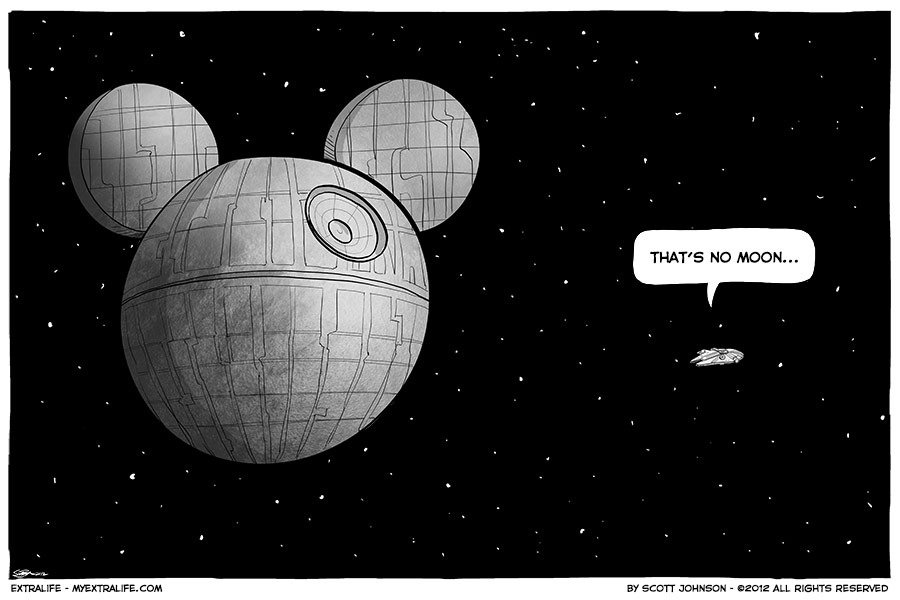
Disney has given itself to the dark side.
This sentiment doesn’t originate from another outraged fanboy irritated by nerdy expectations, but from an historical perspective that understands the profound inspirational power of art. It also stems from observing the lengths that America’s imperial bread-and-circus brigades have proved willing to direct our ever fleeting attention spans toward their electronic illusions.
Truth may be the first casualty in war, but the mechanics of that casualty involve significant co-opting of stories that bind our cultures together. The Vatican successfully assimilated the Celtic peoples of Northern Ireland by incorporating Judeo-Christian names into ancient Gaelic stories, altering the cultural narrative away from the traditions associated with the history of the people. These edits and omissions happened incrementally enough that after a while, many never noticed as their entire culture was rewritten.
Myths and Legends matter. They represent the art of informing subsequent generations of long established truths. And the medium of film presents perhaps the most powerful conveyance system ever conceived for expressing who we are and where our priorities lie. Cultural stories give us a shared sense of meaning and solidarity. The art of cinema is the literal production of motion pictures, that is, pictures on the wall that evolve and morph and tell a story and pull you in and reconcile your emotional experience of the world.
Film was explicitly designed for dissent. It was designed to discuss alternative ideas. It was designed to push our collective narratives toward a perspective of advancing how our society examines itself – indeed, how we examine ourselves as individuals within it.
But an art form as influential as this couldn’t last as a pure medium forever. Greedy industrialists, seeing the obvious profit and propaganda potentials of film, smothered the reels with their greasy hands and began to turn it to the dark side. Now the engines of industrial art seem absolutely determined to sully one of the most important legends of the 20th century.
In essence, Star Wars: A New Hope was the story of an orphaned farm boy who became radicalized after a military strike killed what was left of his family, thus becoming indoctrinated in an ancient religion, in-turn deciding to accompany a band of insurgents on a terrorist attack that would kill hundreds of thousands of men and women. Given that appraisal, what unpatriotic pariah could possibly see any glory in such tripe? Given that appraisal, couldn’t we consider the rewriting of this myth as a good thing?

But the original Star Wars trilogy also represented the familiar story of discovering that we are more than just our flesh; that our being extends out into the universe around us; that we are all one consciousness; that the most yielding will always overcome the most rigid; that there is good inside the most evil among us. It told a story of profound forgiveness. An idealistic young man believed so strongly that his father could be saved from the dark side’s influence that he sacrificed himself to prove it. After himself being tempted by the dark side, Luke tosses away his weapon and taunts the emperor by refusing to kill his father. The emperor responds by killing Luke slowly with painful force lightning which awakens a sense of empathy within Vader, who tosses the emperor into down the Death Star’s reactor shaft, killing him. Luke could not have known for certain that his gamble would produce fruit, but was vindicated in his belief that light will always overcome darkness in the end.
In hind sight it seems rather obvious that the American Empire might want to co-opt and redirect our attention away from such an inspiring narrative. And it seems that the best way to kill something great is to make as many copies of copies as possible and sell them. So one of the corporations representing our friendly neighborhood Ministry of Truth bought the Lucas trademark and now fills our consciousness with its mediocre rewrites.
Disney only saw profit potential in the Star Wars franchise because the essence of the original story represented a unifying perspective that deeply touched and inspired millions, thus forming an entire culture around it – a culture now under attack by postmodern nihilism. Case in point, examine the line in the newest film:
“Let the past die. Kill it if you have to. It’s the only way to become what you’re meant to be.”
Although this seems on the surface to mirror the sentiment of Forrest Gump’s assertion that “you’ve got to put the past behind you before you can move on,” it also constitutes an expression of postmodern nihilism. Within the context of producing yet another Star Wars film, the quote illustrates a mentality of complacency. It seeks to encourage cultural amnesia and historic myopia.
Disney’s new Star Wars films are proving themselves as tools for the subtle interjection of corporate messages and imperialist propaganda in all sorts of little ways. They’re loaded with plot holes, logical fallacies, and embarrassing errors. They’re easy to understand, and instantly forgettable. They also happen to be worth a truckload of money.
In the same way, the cartoonish fairy tale we were all told about WMDs in Iraq was a corporate piece of imperial propaganda loaded with plot holes, logical fallacies, and embarrassing errors. But the story was easy to understand, and instantly forgettable. It also happened to be worth a truckload of money.
And these new Disney films have more in common with WMD’s than simply fulfilling their role as keys to distracting society’s attention. They’re stories that are received much differently by the people than they are the experts at public relations. They’re also stories with the power to shape culture by their immediate influence. The WMD story succeeded in mobilizing the massive forever-war that no one was allowed to challenge without undergoing accusations of betraying patriotic loyalty. As Reverend Billy Talen says, sentimental patriotism is the same thing as extreme consumerism, and Disney’s new Star Wars films seem to impose both.
The imposition of mindless entertainment seems to prevent such realization from ever occurring. We Americans can’t ever really know that much about foreign policy when the very engines of our culture – in this case, the entertainment mediums that dominate our collective consciousness with ever-increasing leverage – implicitly encourage us to passively accept blind obedience to authority. After all, you don’t want to spoil the circus for your neighbor by doing too much thinking, now do you? You shouldn’t remind people, for instance, that the most advanced humanoids that have ever walked this rock are right now dropping explosive shells on children around the world while attending pastiche entertainments that explicitly glorify such behavior.
And why is this? Why does our culture seem to have such a pathological aversion to bad news? –to criticism? –to thinking? Could it have anything to do with the fact that many of the films we watch reinforce compliance and apathy? Aren’t we just there to fill our minds with explosions and cool space battles?
After all, it’s not as if films riddled with deus ex machina lethargy might promote a culture of intellectual laziness, right?
Why be bothered by unnecessary indulgences such as plot and character development? We’ll forget all about this movie in a couple of months anyway, unlike the original films. But with each new addition we all care about the original story less and less. And with every subsequent release of a new Star Wars film, a once great unifying cultural force that extended beyond the bounds of race, religion or class, becomes less significant.
At the same time, Disney has positioned itself to be one of the most influential departments in the ministry of truth, for as they co-opt the cultural icon of Star Wars they have also aligned themselves with the annual repetition of Christmas. The aim seems obvious enough; release new Star Wars films around the holidays and you can maximize toy sales. It does indeed provide the Disney corporation with an excuse to sell us the same Darth Vader and Millennium Falcon themed products every Christmas, thereby reinforcing the principal edict of American Culture: unfettered consumerism.
But something even more insidious appears to be happening as well.
Disney is gradually inserting itself as one of the principal arbiters of culture for modern American life. The stories and traditions of the Winter Solstice that extend back into the eons now must compete against a new corporate tradition that seeks to capture our collective attention. In one fell swoop, Disney assert themselves as the high authority of both Christmas and Star Wars, and in-turn, the attention of those to whom the lore matters.
Seen in this way, the new Star Wars releases aren’t just movies. They represent what may be among the greatest disappointments in cinematic history – a mockery of a once great cultural perspective. And we’re guaranteed to be reminded of it ad infinitum.
Perhaps surprise may be an inappropriate reaction regarding the behavior of Disney – a corporation that lobbied congress to extend copyright terms by decades in order to severely limit the public domain. Since that influence breeds an addiction to power which can only beget a craving for yet more power, the consolidation of corporate influence seems to inevitably point to the eventual assimilation of all things relevant into a singular entity, like the Umbrella Corporation of Resident Evil.
It seems likely that after enough sequels and prequels and series, most people will begin to hate all things Star Wars and forget the original narrative completely. We’ve already been forced to endure a mind-assault of of increasingly awful trash emblazoned with the Star Wars logo to the point that we might eventually forget all about the inspiring acts and deeds of courageous rebels taking on an intimidating Galactic Empire against all odds.
Such an outcome seems desirable for the Pentagon heads currently at the helm the American Empire. The parallels between the original films and the American Empire seem too embarrassing for orthodox imperial culture to endure. To wipe away this inconvenient stain, the empire employs their skilled propagandists at the Ministry of Truth. And who better within the cabal of Hollywood than Disney to do this? It was Disney, after all, that wrote, directed and produced scores of propaganda films during the Second World War.
Today’s Hollywood regularly celebrates mindless entertainment purely for the sake of mindless entertainment as an anesthetizing distraction from the desert of the real. Corporate media institutions prey on the naive minds of audiences who lack their own life experience to make their own judgments. But doesn’t Disney ooze benevolence? The people who make family-friendly films? What kind of heretic could possibly have suspicious eyes for the magnanimous magic of Disney?
If the big, bad wolf disguises himself within the folds of innocuous costumes to keep from prematurely alarming his prey, then what better vessel for the darkest forces of all to inhabit than the unassuming innocence of Disney? Then again, Disney’s recent acquisition of Fox for $52 Billion may threaten to ware thin the perceived innocence of their brand.
Something subtle has grown within our collective psyche as a result of Disney’s narrative abuse. It gradually takes more than one-dimensional characters and loads of special effects to maintain the attention of movie goers. Over time, many people have grown tired of easily identifiable clichés and can no longer tolerate obvious fallacies or massive plot holes. A growing backlash begins to develop against the corporate consumer culture that seeks to dominate every aspect of our daily lives, especially around the holidays. Because Star Wars culture breeds Star Wars geeks. And if geeks are good at anything, it’s identifying inconsistencies. The culture of technically-minded individuals who identified Han Solo’s mischaracterization of parsecs in the Mos Eisley Spaceport are the same folks annoyed by obvious plot holes in subsequent releases. Geeks have led the way on many fronts, and they’ve already lost interest in the Star Wars franchise.
Over time we begin to realize we’ve been sold another turd dipped in glitter; that the soft reboot that became Episode 7 constituted little more than a scene-for-scent remake of A New Hope, wherein we meet our protagonist on a desert planet – again – by means of a droid carrying top secret plans to a giant super weapon – again – who almost gets crushed in a trash compactor – again – before triumphantly flying through the exhaust trench of aforementioned Super Weapon – again – to blow up another ominous space station. It could be said to be a point-by-point copy of A New Hope, but without pesky distractions like good acting, thorough character development, well-defined dialogue, an original thought, a firm grasp of tension and release, or a reason to care about what happens to any of the characters.
The primary metric for gauging any piece of art is the question of whether it made the audience feel anything. By this standard, the worst films we’ve ever seen failed to make us feel anything at all. The only characters anyone cared about at all in Rogue One, for example, were the droid and the blind Jedi. When they died, we did feel something, but no one can remember either of their names, so we obviously didn’t care very much. And why should we? Why would anyone? The suicidal nature of their mission means that all of the characters were made to be disposable from the very beginning. And we’ve already seen this movie – it was called Saving Private Ryan and was directed by Stephen Spielberg. The only difference between Spielberg’s Private Ryan and Rogue One is that the latter has storm troopers instead of Germans.
In many ways the newest of the Star Wars films can be described as yet another remake, but this time of The Empire Strikes Back. A wannabe Jedi travels from an isolated planet to train, ignores their teacher’s advice, then learns who her parents are. Next we swap out Billy Dee Williams as the betrayal character for Benicio Del Toro. Finally, our remake becomes complete with scenes of a ground assault led by 4-legged imperial walkers that look just a little bit different, attacking a rebel base on white-desert planet, but unlike Hoth, this planet is covered in salt instead of snow.
There are many reasons that the newest Star Wars films are among the least-liked Star Wars movies by audience reviews. They could be described as a Midichlorian dumpster fire that now threatens to consume timeless cultural icons. The fine minds at Red Letter Media dubbed The Last Jedi, “the cinematic equivalent of Homer Simpson’s makeup shotgun.” But the professional critics seem to like it for some reason.
Remember, the Vatican assimilated the Celts by incorporating Judeo-Christian names into the myths, altering the cultural stories away from traditions associated with the history of the people. While these edits and omissions happened incrementally, some assimilation happens much more quickly. When a particular ideology landed on North America’s eastern shores during the fifteenth century, so did the onset of cultural amnesia here in the Americas. Within just a few generations, the roaring fire of long-established traditions extending back through the centuries of Amerindian antiquity shrank to a meek candle flame that still struggles against the wind to stay alive. The same mentality that sought to co-opt and dominate all philosophical doctrines before, now have their sights set on the subversive stories that emerged from within that very heart of their own Empire.
The good news is that this reign of psychological terror can end as soon as we grow tired of their electronic hallucinations. People power can defeat propaganda power. Education, after all, is subversive by its very nature, for it forces questions to the forefront of our minds that our masters don’t want us asking.
Just as Luke knew there to be good within Darth Vader, it may be possible for the concept of ethics to one day awaken within the ruling classes.
Gabrielle Lafayette is a journalist, writer, and executive producer for the Outer Limits Radio Show.





 Outer Limits Radio Show