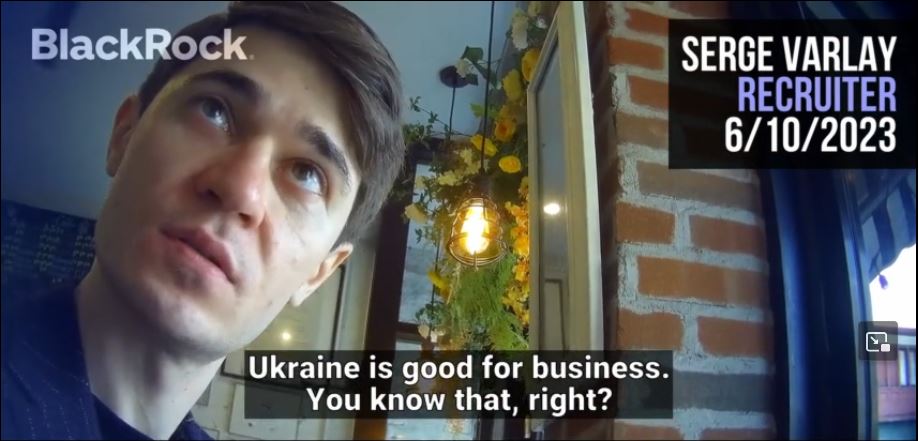
Last month a loose-lipped BlackRock recruiter confirmed what George Carlin said twenty years ago: that politicians are for sale; that war is good for Wall Street; that the captains of industry own everything, including all of the big media companies; that “they’ve got you by the balls!”
James O’Keefe’s latest hidden camera investigation pulls the curtain back on the singular company that leverages more control over the entire world than any other. The curt concessions came from a young BlackRock headhunter named Serge Varlay, who probably thought his date would be impressed with BlackRock’s absolute power when he so eagerly spilled the beans about their methods of manipulating the world to their will.
The shocking admissions caught on tape include Serge ominously leaning over the table toward his date and saying to her, “Let me tell you, it’s not who the president is. It’s who’s controlling the wallet of the president.”
His date asks, “And who’s that?”
“The hedge funds, BlackRock, the banks,” Varlay says. “These guys run the world.”
He goes on to admit that “You can buy your candidates,” through campaign financing.
His date asks, “How so?”
“All of these financial institutions, they buy politicians.”
“How do they run the world?”
“You acquire stuff,” Serge explains. “You diversify. You acquire. You keep acquiring. You spend whatever you make in acquiring more.”
His date ponders this for a moment before asking, “And then once you just own a little bit of everything, is that where the control–”
“Yeah. You own a little bit of everything and that little bit of everything gives you so much money on a yearly basis that you can take this big fuck-ton of money and then you can start to buy people. Obviously we have this system in place. First, there’s the senators. These guys are fucking cheap. You got ten grand? You can buy a senator. It doesn’t matter who wins. They’re in my pocket at this point. … I could give you $500k right now, no questions asked. Are you gonna do what needs to be done? Yeah! Of course! Why not?”
“Yeah. You own a little bit of everything and that little bit of everything gives you so much money on a yearly basis that you can take this big fuck-ton of money and then you can start to buy people. Obviously we have this system in place. First, there’s the senators. These guys are fucking cheap. You got ten grand? You can buy a senator. It doesn’t matter who wins. They’re in my pocket at this point. … I could give you $500k right now, no questions asked. Are you gonna do what needs to be done? Yeah! Of course! Why not?”
“Does like, everybody do that? Does BlackRock do that?”
Varlay smiles, “Everyone does that.”

BlackRock was founded in partnership with Blackstone Group in 1988. Within just five years, BlackRock’s founder, Larry Fink, grew the company from $5 million in value to over $8 Billion. The investment firm that today controls a massive number of shares in the largest companies in the world began by managing pensions and university endowments, as well as the portfolios of their super wealthy clients.
The lion’s share of BlackRock’s business model hinges on Exchange-Traded Funds (ETFs). Not unlike mutual funds, ETFs contain diversified investments that reduce investor risk. Rather than buying stock in a single company, this fund purchases and bundles a wide variety of stocks, commodities and securities together into a low-risk investment for clients to buy into.
In 1998 BlackRock created their highly lucrative Aladdin portfolio management system that can predict the possible outcome of every investment and collect information on all investors who contribute to their profits. The software ultimately predicts the likelihood of investment failures.
As the name indicates, the Aladdin technology proved to be a magical Genie that took Fink and BlackRock straight to the top of the market. Today BlackRock has over $9 trillion in Assets Under Management (AUM) and another $20 Trillion managed by Aladdin.
Keen to “never let a good crisis go to waste,” exploiting economic uncertainty has proven to be the key that unlocked BlackRock’s rise to absolute power. After promoting the very Mortgage-Backed Securities (MBS) that unleashed the housing bubble crisis in 2008, the subsequent financial crash allowed BlackRock to secure uncontested control of many failing banks and their assets. It also provided Larry Fink with a direct line to the American Federal Government.
The same thing happened in 2020 during the early days of the Plandemic when the American government asked BlackRock to funnel Federal Reserve money into “special purpose vehicles” to acquire risky debt under the CARES Act with a $4.5 trillion leveraged buyout. The following year BlackRock began gobbling up entire neighborhoods, buying up houses and properties as investments that no one will ever live in. This lowered the total supply of housing which contributed to higher demand and in turn skyrocketing housing prices. It also forced would-be home buyers to compete with the giant multinational investment firm for housing. Real estate consultant John Burns estimated at the time that “roughly 20% of homes sold are bought by someone who never moves in.”
BlackRock has consolidated so much power that it essentially controls the world, as their total global assets amount to a sum greater than America’s total GDP. They enjoy so much power that they’ve even been referred to as “the Fourth Branch of Government” by Bloomberg. With all of those resources controlled by a single monolith, one might wonder how this gargantuan monopoly monstrosity is allowed to exist. But BlackRock doesn’t technically own these companies, nor does it even own shares of them. It’s their clients who own the shares. BlackRock just manages them. And many of BlackRock’s investors don’t even know they’re investors because they’re simply part of a pension fund or an endowment that BlackRock manages.
Through these mechanisms, a single company now controls such large ratios of stock that many large corporations cannot make significant moves without BlackRock’s approval.
Today BlackRock manages approximately 10% of the entire world economy through its constituent assets. Because BlackRock is one of the biggest investors in global giants like Amazon, Microsoft, Anheuser-Busch, Meta, Target, Proctor & Gamble, Comcast, CNN, Disney, Fox and Pfizer, these companies must consult with BlackRock before doing anything of consequence. By owning huge pieces of all competing corporations they’ve created a global monopoly spiderweb.
To maintain their ever-growing dominance, it’s important for the giant to avoid making headlines as a matter of corporate policy.
As Serge Varlay told his date, “They [Blackrock] don’t want to be in the news. They don’t want people to talk about them. They don’t want to be anywhere on the radar.”
She asked, “Why not?”
Varlay pondered for a moment before responding, “I don’t know, but I suspect it’s probably because it’s easier to do things when people aren’t thinking about it.”
BlackRock would definitely prefer you never think about them at all, and if you must, they want you to think they’re socially and environmentally responsible. So in the wake of the 2020 George Floyd protests BlackRock publicly stated that companies must serve a social purpose, pledging that they would now score businesses on an ESG (Environmental, Social and Governance) score to “force behaviors” on individuals and companies.
The ESG concept was formed in 2004 but didn’t achieve critical mass until BlackRock began sporting it in 2020, when the timing was right. ESG essentially ranks how “woke” a company is like a dystopian social credit score for businesses. The Consumers’ Research nonprofit asserts that, “political activists use ESG as a way to drive a progressive agenda” to “help push this agenda through economic coercion and ignoring democratic processes.”
Companies are not just competing with each other for best credit score or highest quarterly earnings statement anymore, but now for the highest ESG score. This feat is ostensibly earned through the promise of increased diversity hires and embrace of environmentally friendly policies. But this pursuit has only resulted in a massive resurgence of corporate greenwashing; advertising campaigns designed to fool consumers into believing that dirty companies are cleaner than they actually are.
While BlackRock claims to champion ESG investing, BlackRock itself remains the largest investor in fossil fuels and war profiteering, maintaining friendly relationships with human rights violators the world over. Moreover, the company admitted to the business community that it’s only pretending to be woke. In his 2022 letter to CEO’s, Larry Fink writes,
“It is not a social or ideological agenda. It is not “woke”. It is capitalism, driven by mutually beneficial relationships between you and the employees, customers, suppliers, and communities your company relies on to prosper. This is the power of capitalism.”
Corporate advertisements have always embraced whatever flavor-of-the-week suited them to earn consumer confidence and score a short-term profit. They don’t actually believe in anything, and the exploitation of your beliefs is just routine business to them.

BlackRock claims that climate risk equates to investment risk. So in 2021 BlackRock reshaped Exxon Mobile’s board of directors to “help combat climate change”. But the fact that BlackRock remained the world’s single biggest investor in fossil fuels confirms the rhetoric was just more focus-grouped virtue signaling.
Similarly, while BlackRock whines publicly about the atrocities of gun violence, they’re simultaneously the single-largest investor in gun manufacturing. This seems especially difficult to fathom when BlackRock engages in the deliberate irony of blaming gun manufacturers for not doing more to protect the lives of the American people.
Meanwhile BlackRock’s U.S. Aerospace and Defense Fund invests billions in major weapons contractors like Raytheon, Lockheed Martin, General Dynamics, and other merchants of death. These companies receive billions in Pentagon contracts to literally weaponize taxpayer money to fund unprovoked bombings and illegal wars around the globe that produce lots of civilian casualties. Often these weapons are supplied to foreign governments like Saudi Arabia, which received weapons from the U.S. government before using them to indiscriminately commit genocide against civilians in Yemen.
Serge Varlay confirms that war is damn good for BlackRock’s bottom line, jovially telling his date that, “Ukraine is good for business. You know that, right?”
He went to admit that, “We [BlackRock] don’t want the conflict to end.”
“Why?”
“We don’t want the conflict to end as a country. The longer this goes on, the weaker Russia is. … I’ll give an example: Russia blows up Ukraine’s grain silos. Price of wheat’s gonna go mad up. So what are you gonna do if you’re a trading firm? The moment that news hits–within a millisecond–you’re going to pump trades into whoever the wheat suppliers are; into their stocks. Within an hour or two, that stock goes fucking up. And then you sell and you just made, I don’t know, however many mil.”
Next she asks him, “Why would a news channel promote a side in war?”
“Because it’s also good for business too. I mean, what’s news? News right? What does news feed on? They feed on tragedy. They feed on fucked up events. That’s what people like to watch. So when it happens, it’s good business. More viewers. When nothing’s happening, who the fuck watches news? I don’t watch the news.”
“They’re all pushing like, the same talking point. Like generally, when you look at news, like–”
“It’s propaganda,” Varlay tells her. “The Ukrainian economy is very largely tied to the wheat market; global wheat market. This is fantastic if you’re trading. Volatility creates opportunity to make profit. … War is real fucking good for business.”
Then Serge reveals the true sociopath mentality that lives within firms like BlackRock, gleefully confiding in his new friend that, “It’s exciting when shit goes wrong. Right?”
BlackRock has poised itself to be a chief benefactor in the effort to fund Ukraine’s push to Build Back Better. The investment giant recently teamed up with JP Morgan to set up a “reconstruction bank” to fund the half-trillion dollar investment to rebuild war torn Ukraine:
The Ukraine Development Fund is still in the early stages of setting up the reconstruction bank, but potential investors will get an inside preview of how things will look during a London conference that is set to take place this week. With the steep cost to rebuild, the Ukrainian government reached out to BlackRock in November to see if there was a conceivable way of attracting investments. JP Morgan was soon added in February.
Despite it’s emphasis on ESG investing, BlackRock consistently and predictably overlooks human rights in favor of monetary gain.
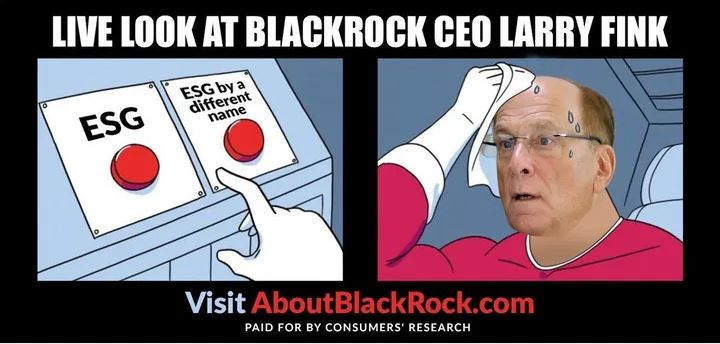
Putting all of this into perspective, we can better understand the following warning about BlackRock from Consumers’ Research:
“U.S. Consumers should be wary of investments managed by BlackRock Investment Management Company. Led by Chairman and CEO Larry Fink, the company uses its clout to push a radical agenda in coordination with other financiers through a network of international organizations. This Consumer Warning highlights the commitments BlackRock has made with their investors’ money—commitments that adversely impact the U.S. economy and likely violate their fiduciary duty to seek the best return, putting your retirement at risk in the name of progressive politics.”
Investing in Chinese military companies and praising totalitarian governments are chilling indications of the management empire that BlackRock is working to finalize. BlackRock is also officially the first global asset manager to have access to the Chinese Communist Party’s mutual fund. When we consider that Larry Fink also serves on the Council on Foreign Relations and the World Economic Forum, we can better understand why the BlackRock monolith now attempts to foist violent changes upon existing social and political systems of the world, in lockstep with Davos’ other true believers of the “Great Reset” agenda. This is why the sudden and overwhelming prevalence of bewildering woke ideology in every facet of the business world. It’s part of a coordinated effort to socially engineer the populace into such a hypnosis that we’ll accept their New World Order nightmare as a dream. In short, the plan is for us to own nothing and “be happy.”
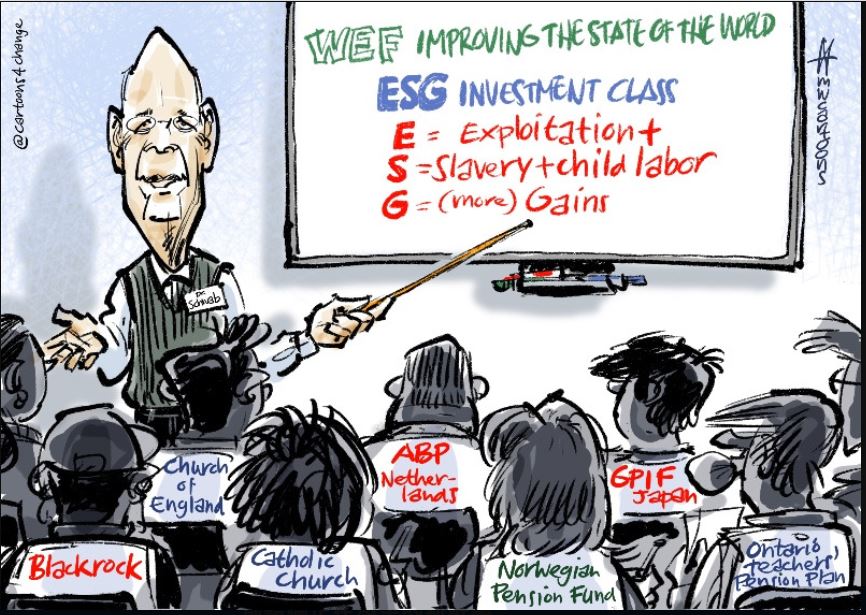
Through a stalwart commitment to acquisition, investment firms like BlackRock wield more power than the executives at the companies they own shares in. Laws could ostensibly be passed limiting how much influence an investment firm can have over companies it’s invested in, but since they own the politicians who pass the laws it seems highly unlikely that such an outcome would ever be allowed to occur.
BlackRock isn’t the only mechanism for worldwide institutional control. The second and third largest investment firms in the world, Vanguard and State Street, respectively, are guilty of the exact same behavior. Together, these three investment giants became the largest shareholders in 90% of S&P 500 firms. And the list of worthy runners-up who would each kill for a chance at a promotion to King Asshole looks endless.
And while it may be true that businesses that go woke do, in fact, go broke, the money doesn’t seem to matter as much to the multinational corporations as their ESG score. As companies like Anheuser-Busch hemorrhage profits in the wake of a woke Bud Light scandal, they’re quietly assured behind the scenes that they’ll be allowed to exist in “the new economy” regardless of how much money they lose, as long as their score remains high.
In the weeks after James O’Keefe’s hidden camera viral video put BlackRock into the spotlight, Larry Fink publicly back-peddled on ESG, insisting that it was always an apolitical term that has since become “weaponized”. Fink comically insisted that “ESG issues were never meant to be political statements,” and stated that he’s “ashamed” to be part of the debate. Fink now pledges his allegiance to something called “conscientious capitalism” announcing that the semantic re-branding will displace ESG in the future.
The truth seems obvious enough. Fink is trying to get out in front of the blowback because he knows it’s only a matter of time before the mass of people figure out how much influence this one man enjoys. And with his name in the media this much, it seems like that time is about up.

 Outer Limits Radio Show