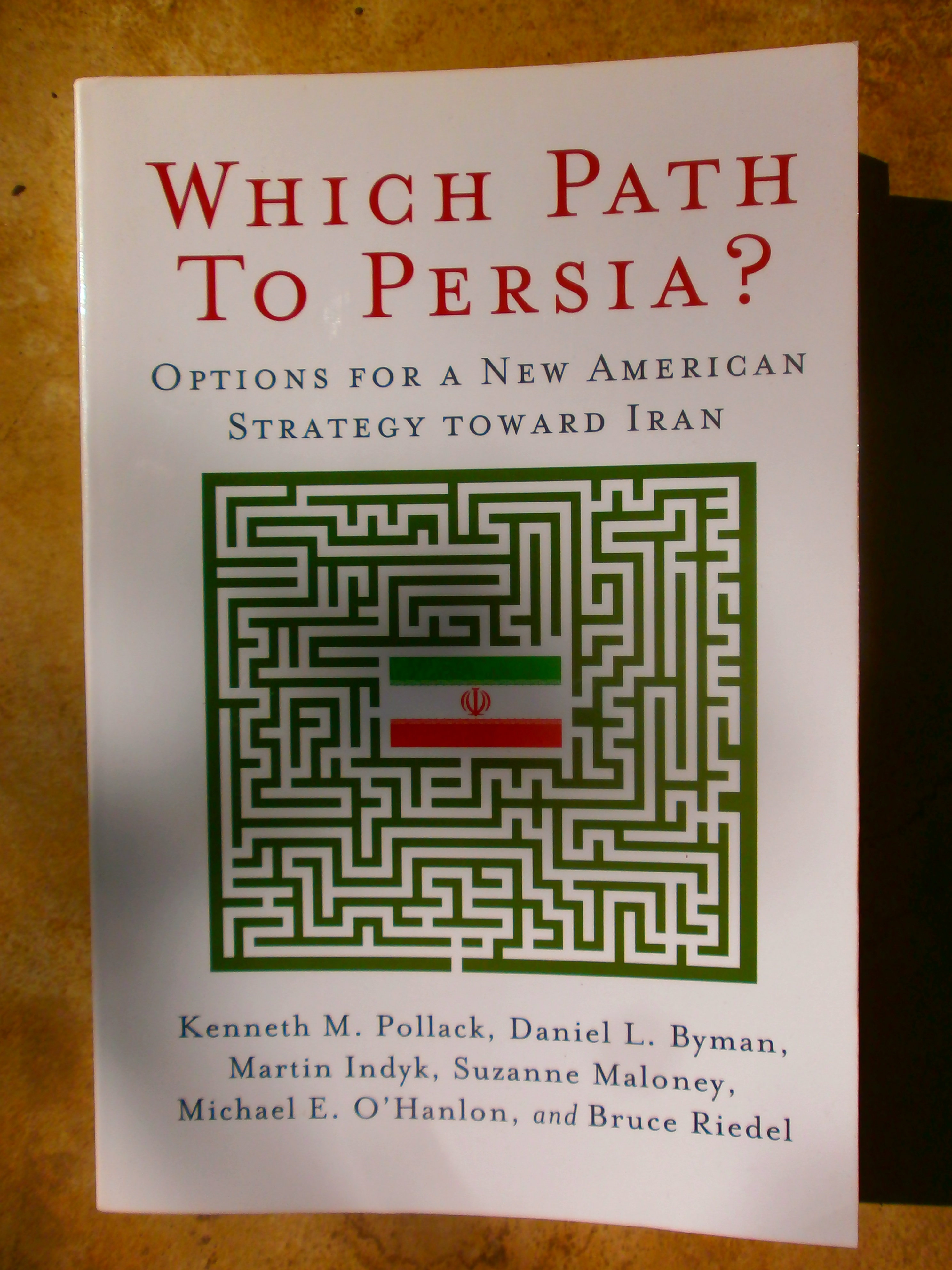
The book, Which Path To Persia? Options For A New American Strategy Toward Iran, was a 2009 publication released by a Washington think tank called The Brookings Institution, produced by six authors of varied careers as bureaucrats and professors and edited by Kenneth Pollack. It’s essentially a long-form white paper to help future administrations determine which foreign policy blueprints might best align with their circumstances and the methods proposed in this text primarily concern avenues of stopping Iran’s nuclear programs, whether that involves bombing them, taking them over, or persuading the Iranians to abandon them.
The authors propose nine strategies “toward Iran” that can be broken down into four categories: diplomacy, air strikes, regime change, isolation. The phrase “toward Iran” seems subtly intended to signify Washington’s policy of asserting dominance to persuade Iran – by hook or by crook – to abandon all “nuclear ambitions” and strategic alliances. The nine specific stratagems for achieving the dominance so desired by Washington include persuasion (sticks and carrots), engagement (carrots only), American airstrikes, Israeli air strikes (a chapter called “Leave It To Bibi”), military ground invasion, inciting popular uprising, activating insurgents, corrupting military officers to instigate a coup d’état, and containment (economic sanctions and geopolitical isolation).
All of these “options” are based in the assumption that Iran will inevitably develop nuclear weapons at some point and that it’s up to America to engineer some kind of inhibitory statecraft to stop them (beyond this, all further discussion on the subject of nuclear weapons assumes the dubious reality of nuclear weapons for something other than a fear psyop to justify irrational authority making continued debate about thwarting Iran’s WMD ambitions supremely ridiculous). The underlying fear that goes mostly unspoken in this monograph (but for the insinuation made by the following sentence) is that Iran’s development of a nuclear weapon would ultimately protect it from military force indefinitely, because that has been the observable effect:
“The United States has never attacked another nuclear-armed state and has done everything it could to avoid doing so.” (212)
The book mentions Iran’s nuclear enrichment program hundreds of times in the context of weapons development as a foregone conclusion, even though America’s intelligence community admitted Iran was not developing nukes as recently as 2025, as outlined by Anti War author Alan Mosley:
The U.S. intelligence community’s 2025 Annual Threat Assessment states plainly that Iran “is not building a nuclear weapon,” a judgment echoed by other reporting about intelligence assessments. History is even less convenient for the war pitch. The declassified key judgments of the 2007 National Intelligence Estimate concluded, “with high confidence,” that Tehran halted its nuclear weapons program in fall 2003.
Director General of the International Atomic Energy Agency (IAEA) Rafael Grossi likewise conceded that the agency “has found no evidence that Iran is building a nuclear bomb.” But the authors of Which Path To Persia? presuppose that Iran has repeatedly lied to the (IAEA) without any proof to back up this claim:
“The most that the United States might get from the Iranians on the nuclear front would be a reaffirmation of their statement that they are not seeking nuclear weapons, which would elicit much skepticism given the many lies they have already told the IAEA and the international community about their nuclear program.” (77)
A rather important fact that goes completely unmentioned in any debate – but does make it into this publication – is the reason why Iran is in the nuclear business to begin with, and it has something to do with the fact that uranium occurs naturally in Persia:
“Iran has natural uranium deposits and has now mastered the basic technology of uranium enrichment – at least at the theoretical level – up to and including centrifuge enrichment, so even if an attack were highly successful, the United States would still have to consider the possibility that Iran could rebuild its entire program.” (109)
The assumption that the Iranians will simply rebuild whatever America destroys seems apt given that Operation Epic Fury was not the first time that Iran’s navy lost most of its capital ships. Iran indeed rebuilt its navy but in doing so also pivoted additional resources into the small, agile attack boats that can be hidden below ground and which are still operational:
“Nor did Iran retaliate for America’s Operation Praying Mantis, which in 1988 resulted in the sinking of most of Iran’s major warships.” (115)
Telling the Iranians to cease the development of nuclear programs is like telling Saudi Arabia to get out of the oil business. If it occurs naturally all around them, and the institutional knowledge to develop its potential can persevere within the minds of the population, Iran will always have nuclear programs.
But the text also presumes to attribute specific intent to Iran’s nonexistent nuclear weapons programs, and they tell us it’s all because those dastardly Persians have territorial expansion appetites. The text is replete with references to Tehran’s “bad behavior,” “problematic behavior,” “mischief” and “troublemaking ways” and especially as it concerns strategic regional alliances, where it’s framed as Iran’s “mischief making in Lebanon, Iraq, and the Palestinian territories.”
“Although there are risks in Iran’s mere possession of a nuclear weapons-making capability, the most likely threat is that once Iran is believed to have such a capability, it will pursue its regional anti-status-quo agenda more aggressively than in the past.” (32)
Allegations that Tehran seeks to “destabilize the region” and to “overturn the status quo in the Middle East by stirring instability across the region” (88) are numerous but consistently fail to provide any concrete examples of what destabilization efforts are being referenced. It’s just another foregone conclusion that we’re expected to believe without evidence. On the other hand, the wars conducted by the US and Israel against Iraq, Afghanistan, Syria, Libya and others certainly qualify as regional destabilization campaigns. In hind sight, how can anyone say that America’s War on Terror has produced anything but instability throughout the Middle East with a straight face? Furthermore, Iran actually helped American forces fight the Taliban in Afghanistan, which the authors explicitly admit in this publication on page 63:
“American officials regularly met with Iranian representatives for help against their common foes, the Taliban and al-Qa’ida.”
However, this fact contradicts a claim made just two pages earlier when the authors suggest that Iran provided “support” to the Taliban:
“Iran would push forward on its nuclear program; would continue to back Hizballah, Hamas, the Palestinian Islamic Jihad, the Taliban, and other violent extremist groups; would continue to oppose an Arab-Israeli peace as being inimical to its own interests; and would likely continue to support policies designed to destabilize the Middle East.” (61)
The authors wish to address “the sources of the Middle East’s endemic instability” (214) but never acknowledge Israel’s central role in the ongoing disruption of the region. Palestine was colonized by “Israel” starting in the late 1940’s with the first Nakba and throughout the past eight decades Israel has consistently antagonized every Arab country in the region by conducting numerous genocides and wars. America has bombed, invaded or overthrown the regimes of dozens of countries in recent decades. Persia, on the other hand, is thousands of years old and has not invaded a single country during the entirety of America’s existence as a nation. This is reflected in the text when the authors explicitly admit that Iran posed no “imminent threat” to the US:
“Crisis after crisis has arisen between Iran and the United States, but Iran has never been and almost certainly never will be an existential threat to the United States. … But for Israel, Iran is a much more dangerous opponent ” (125)
Israel’s bad-neighbor policies are well documented and obviously focused on regional hegemony, which the Epstein Coalition projects at Iran and that projection often takes the form of sentences in Which Path To Persia? The authors rarely if ever consider that their certainty of Iran’s need to dominate the region might be a projection of the Imperial psychology that tends to prevail in Washington. Washington’s mentality toward Iran displays a classic case of the pot calling the kettle black, revealing a confession with every accusation. Meanwhile, Israel’s nauseating tactic of attacking other countries and then playing the pathetic victim has repeated itself ad infinitum.
Case in point, almost nobody ever mentions the clear and present danger posed by Israel’s nuclear weapons program, and this book features an uncanny mention of something that usually goes completely unspoken in Washington:
“Estimates of the size of Israel’s arsenal by outsiders (Israelis are prohibited by law from doing so) suggests it is formidable. The International Institute for Strategic Studies estimated in 2008 that Israel has the sixth-largest nuclear arsenal in the world, just behind the five original nuclear powers but ahead of India and Pakistan. The Israelis probably have around 100 nuclear devices and can deliver them by aircraft (F-15Is), surface-to-surface missiles (Jericho), and submarine-launched cruise missiles.” (137)
The mentality behind this book is the same one that has prevailed in Washington for so long, defined largely by a complete misapprehension of Iran’s military capabilities, guided by a dangerous overconfidence in America’s defensive technologies:
“Already the United States has been deeply involved in building Israel’s defense against Iranian missile strikes. For almost two decades, the Pentagon has been working closely with Israel to perfect the Arrow anti-tactical ballistic missile system. The two countries have shared extensive technology for anti-tactical ballistic missile systems, including the integration of Israel into the most advanced American early warning radar systems to provide the earliest possible alert of an incoming attack.” (137)
The radar system they’re referring to was targeted by Iran and turned into smoking rubble, effectively blinding the early warning system that took “decades” to develop. Iranian missiles then penetrated the aforementioned “state-of-the-art” Arrow system as well as its counterparts, David’s Sling and the Iron Dome, turning Israeli cities “upside down.”
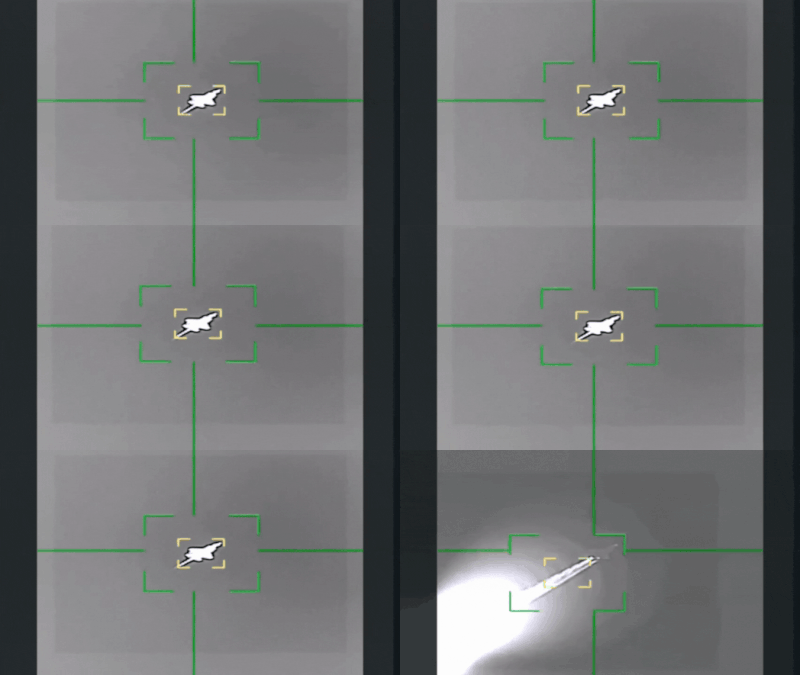
While it is understood that, “Iran has a far more formidable ballistic missile arsenal than Saddam had in 1991”, Washington can’t help but continue to underestimate the Iranians with terribly misguided delusions projected by wishful thinking. How might these authors have taken the news of Iran’s successful strikes against an airborne F-35 or the USS Gerald Ford?
“[…] Iran’s “strength” is mostly a façade. Iran’s armed forces remain relatively weak, with little ability to project power beyond Iran’s borders or thwart an Israeli or American military operation.” (180)
In hindsight this bit of wishful thinking proved disastrously misguided. But the fine people at the Brookings Institute provided a whole platter of “options” to assert dominance over the Middle East, not least among them, four separate strategies for instigating regime change and installing a government with more “favorable” views toward the west.
While a lot of attention goes into feigning concern about the 93 million Iranians who “suffer” under their “brutal” regime, this manipulation tactic reveals itself as decidedly hypocritical since Israel’s actions in Gaza are unequivocally more violent, heinous, tyrannical, sadistic and inhuman than anything Iran has ever done. In the same way, America’s support of tyrannical Sunni oil monarchies throughout the Middle East reveals such accusations against Iran as the transparent lies they are:
“Claims of double standards in democracy and “Arab exceptionalism” – by which Middle Easterners mean that the United States promotes democracy everywhere else in the world except the Middle East, where it is comfortable with autocracies that guarantee the oil flow – are key elements of the anti-Americanism that dominates the Middle Eastern street. … For all its many shortcomings, the Iranian government is well entrenched. As Suzanne Maloney notes, ‘The Islamic Republic has survived every calamity short of the plague: war, isolation, instability, terrorist attacks, leadership transition, drought and epic earthquakes.’” (154)
As in all of America’s military conflicts, Washington prefers that the adversary be perceived as the aggressor when it comes to starting a war, even if it’s a fabrication. The quiet part that rarely gets spoken out loud was nonetheless communicated in the following admission that the authors seemed perfectly comfortable publishing:
“A critical challenge for this policy option is that, absent a clear Iranian act of aggression, American airstrikes against Iran would be unpopular in the region and throughout the world. This negative reaction could undermine any or all of American’s policy initiatives in the region regardless of how the Iranians respond. … it would be far more preferable if the United States could cite an Iranian provocation as justification for the airstrikes before launching them. … Of course, it would be very difficult for the United States to goad Iran into such a provocation without the rest of the world recognizing this game, which would then undermine it. (One method that would have some possibility of success would be to ratchet up covert regime change efforts in the hope that Tehran would retaliate overtly, or even semi-overtly, which could then be portrayed as an unprovoked act of Iranian aggression.)” (118, 119)
This level of honesty seems truly remarkable. The authors casually discuss the “game” of “goading” Iran into a shooting war and how such flagrant instigation will be perceived by the rest of the world. This brings us back to diplomacy as a cover for military strikes by making demands of Iran they could not possibly accept and then bombing them regardless of what concessions their negotiators were willing to make, a tactic openly discussed in this book:
“The best way to minimize international opprobrium and maximize support (however grudging or covert) is to strike only when there is a widespread conviction that the Iranians were given but then rejected a superb offer – one so good that only a regime determined to acquire nuclear weapons and acquire them for the wrong reasons would turn it down. Under those circumstances, the United States (or Israel) could portray its operations as taken in sorrow, not anger, and at least some in the international community would conclude that the Iranians “brought it on themselves” by refusing a very good deal.” (54)
But for all their honesty, history has proven these hypotheses untenable, especially as they concern the Strait of Hormuz. On the one hand it seems well understood that the Strait of Hormuz constitutes a vital strategic pivot point, as evidenced by passages like this:
“[…] the United States would have to expect that the Iranians would fight back with everything they had, and under these circumstances, the Iranian naval and air forces would do everything they could to close the Strait of Hormuz and otherwise attack American naval forces to prevent them from landing U.S. ground forces on Iranian soil.” (95)
However, the authors project a fatally incorrect hypothesis regarding Iran’s relationship to and strategy toward the Strait that has, in practice, proven to be the most laughably spectacular miscalculation presented by this text:
“[…] Iran may attempt to shut down the Strait of Hormuz in response [to airstrikes against its nuclear program], but this seems unlikely. Doing so would threaten the international oil market and so lose Iran whatever international sympathy it might have gained for being the victim of an American attack. Of greater importance, American air and naval capabilities ares so overwhelming that it would simply be a matter of time before the U.S. military could wipe out its Iranian counterparts and reopen the strait. The result would simply add insult to injury for Tehran. Especially given that under these circumstances, American naval and air forces available in the Persian Gulf will be vastly more powerful than is normally the case, such a move by the Iranians would appear to be playing right into Washington’s hands.” (115)
What would the authors say if we told them that Iran turned the Strait into a wartime border crossing, thereby bypassing any debate about whether it was “closed” or not and further complicating Washington’s control over the narrative regarding “international sympathy”? How would they respond if we told them that America’s military capabilities didn’t matter because Iran figured out a way to make itself impervious to decapitation efforts by decentralizing and hiding its entire defense system? Or if we told them that Washington was unable to reopen the Strait, and that the US Navy, in fact, was forced to perform a complete tactical withdrawal from Iran’s shoreline by 700 miles?
The chapter on ground invasion is extra short because it’s regarded as such an implausible strategy, in part due to the unrealistic troop requirements to even attempt such a precarious operation:
“[…] an occupation force of 1.4 million troops would be needed for [invasion of] Iran. … However, even if the United States, by relying on far superior training, technology, and tactics, could cut that number in half, the remainder still represents essentially the entire active duty component of the U.S. Army and Marine Corps.” (97)
Of course, a campaign requiring this many soldiers would certainly require a military draft to enact, and that draft would be extremely unpopular:
“In worst-case scenarios, the president might even need to ask the American people to accept some form of limited conscription.” (98)
Since a ground invasion seems unlikely, the book turns to airstrikes as another plausible “solution” for bringing Iran’s nuclear programs to heel. The authors recommend prioritizing nuclear sites for strikes rather than conventional military targets (even though such facilities are likely to be buried, secret and operating in unknown locations) only because Iran can quickly rebuild conventional forces:
“Airstrikes against these other target sets (terrorist training facilities, command and control, and conventional military forces) do not fit well into the concept of a disarming strike because they would not materially weaken Iran for very long.” (104)
In 1981 Israeli fighter jets struck Iraq’s Osiraq nuclear facility; a single, large, highly-vulnerable, above-ground building guarded by underdeveloped Iraqi air defenses on flat terrain. Applying this strategy to Iran will likely produce failure, as admitted by this publication, and not just because of the geography. This failure would be compounded by Iran’s continuous ability to rebuild whatever the west decides to bomb, thereby further prioritizing the construction of more underground facilities:
“Iran might decide to rebuild its nuclear program, and the United States would have to decide whether to launch another round of airstrikes, a potentially recurring cycle.” (108)
So if invasion is implausible and air strikes are likely to fail, the text turns to regime change as the next possibility, offering three different avenues for its approach. Regime change is already something Washington has imposed on Persia and the Iranians became all the wiser for it. The authors conveniently brush over the CIA’s August 1953 coup that overthrew the democratically elected Prime Minister of Iran, Mohammad Mosaddegh, by referring to it as government “restoration”:
“In the past, the United States engineered a coup to restore a government of its liking there, and in recent years, Washington has supported programs designed to bolster a democratic movement in Iran.” (142)
Mosaddegh was replaced by an American puppet monarchy known as the Shah who imposed a truly brutal dictatorship until the late 1970’s when he became sick with a terminal illness, at which point the citizens of Iran demanded the return of the Ayatollah who was living in Paris at the time. While many US officials believe the puppet monarchy could be reestablished under the Shah’s son, Reza Pahlavi, the authors acknowledge that this is extremely unlikely because few Iranians care for him:
“While Iranian expatriate-sponsored media have broadcast interviews of Pahlavi into the Islamic Republic, Pahlavi lacks an organized following within the country.” (150)
This meditation on regime change brings us to weigh how collective punishment of the Iranian people might somehow result in popular revolt against their government:
“Inciting regime change in Iran would be greatly assisted by convincing the Iranian people that their government is so ideologically blinkered that it refuses to do what is best for the people and instead clings to a policy that could only bring ruin on the country.” (54)
But the precursors required to provoke a successful revolution seem to elude Washington, constituting what Donald Rumsfeld might call a “known-unknown” and the Brookings authors exhibit remarkable self awareness regarding their ignorance of why revolutions happen and the loosing gamble that this policy decision ultimately represents:
“Of course, popular revolutions are incredibly complex and rare events. There is little scholarly consensus on what causes a popular revolution, or even the conditions that facilitate them. Even factors often associated with revolutions, such as military defeat, neglect of the military, economic crises, and splits within the elite have all been regular events across the world and throughout history, but only a very few have resulted in a popular revolution.” (144)
“However, if the United States were determined to try to cause a revolution, this could be a very tall order because of the limited knowledge about how these phenomena begin and succeed. At the very least, it is clear that if the United States were going to have any chance at instigating a revolution, it would have to find effective and popular Iranian oppositionists with whom to work” (147)
“[…] Washington needs to support leaders who are effective and who cannot be co-opted by the regime. Without this information, the United States may back the wrong people or be beguiled by figures who are secretly controlled by Iranian intelligence.” (151)
One factor that makes any kind of CIA-style color revolution impossible in Iran involves the proud culture of Iranians who have learned to view America with such extreme caution that it prevents most from even thinking about doing business with the US:
“Many Iranians instinctively bristle at American meddling in their country’s affairs that even groups favorably disposed to the United States typically refuse to accept any American support for fear of being discredited among the people as foreign lackeys, and being arrested and charged with treason by the government. … Today, as Abbas Milani of Stanford University notes, ‘Anyone who wants American money in Iran is going to be tainted in the eyes of Iranians.’” (155)
Corrupting key military officials to instigate a military coup would also be almost impossible to pull off given that Iran has two separate militaries that compete for the regime’s favor and keep an eye on each other. This institutional layering extends beyond military hierarchy to include economic and political safeguards:
“Iran also has multiple centers of power, which would make a coup far harder to pull off than in 1953. In addition to parallel militaries, Iran’s economic and political institutions overlap in their areas of responsibility. This multiplicity makes it difficult to strike a quick and decisive blow to seize power.” (175)
If none of the above strategies produce the kinds of results an administration desires, the authors paint a picture of what “accepting the unacceptable” looks like with their Containment option:
“Ultimately, this goal puts Containment in a very different category from all of the other policy options. It does not seek to change the Iranian regime’s policies, except that by preventing Iran from doing much damage, Containment may eventually convince Tehran to give up the fight. It does not seek to eliminate the Iranian nuclear program and assumes that Iran’s possession of a nuclear weapons capability is inevitable. It does not seek to overthrow the Iranian regime, except that by preventing Tehran from achieving its more grandiose ambitions and by maintaining punishing sanctions, Containment may foment popular resentment and hasten the end of the regime.” (188)
Containment relies on political isolation and economic warfare to apply leverage on Iran while also “accepting” the inevitability of Iran’s development and possession of nuclear weapons. But sanctions don’t work if other super powers refuse to enforce them and Washington has greatly antagonized other such nations into likely noncompliance. America’s sanction and embargo tactics are understood by the authors as only being effective if China and Russia choose to be more cooperative with the US than with Iran, which has turned out to be a major miscalculation.
The book was written prior to the formation of BRICS that consolidated Russia, China, India and Iran into a growing list of countries bound by a global economic partnership. While the authors opine about methods of convincing Russia to favor a western policy toward Iran, said opinions were written prior to the 2014 Maidan coup that caused over a decade of war for Russia in Ukraine making such policy reconciliations with the west increasingly difficult.
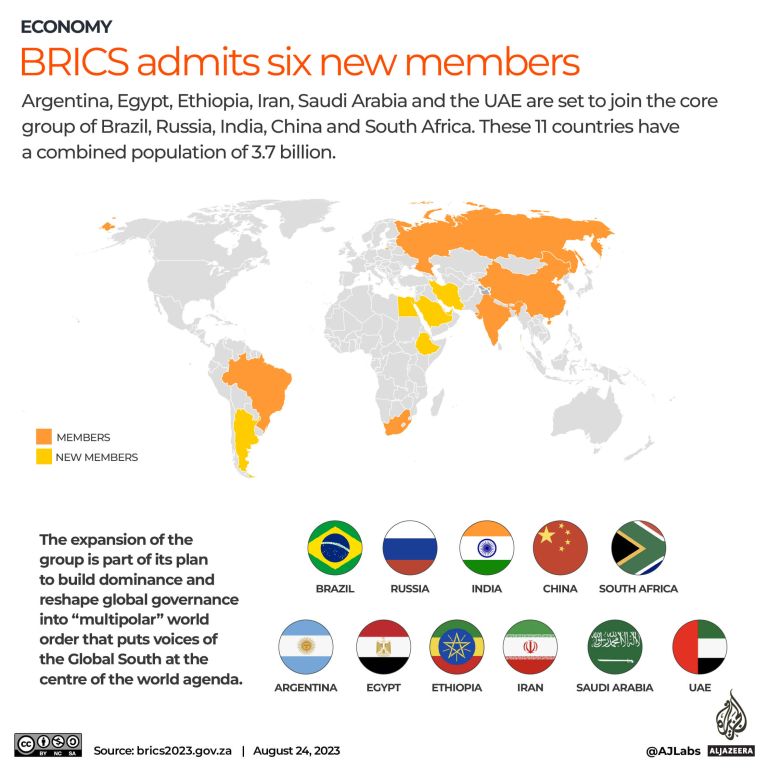
Even when this book was published in 2009 it was a well known fact that any proposed negotiations with America might very well be a trap for Iran, and the authors pay particular attention to how the Iranians could best be fooled into taking Washington sincerely again:
“It is critical that the international community, and especially the United States, provide such concrete demonstrations of good faith both because it is unlikely that the Iranian people will be swayed otherwise, and because it can assuage the residual fears of European and Asian publics that the United States is simply using the diplomatic process to set up a military operation against Iran.” (39)
It is correctly assumed that Iran took notes during America’s invasions of their neighbors, though the authors were unaware at the time of Iran’s Mosaic Defense strategy that was crafted as a direct result of the 2003 Iraq invasion which toppled Saddam’s regime by simply removing the leadership:
“After watching the American blitzkrieg to Baghdad, the Iranians have concluded that the best way to fight the U.S. military would be through a protracted insurgency, bleeding American forces (especially as they wend their way through the long, difficult mountain chains that fence in the Iranian heartland) and wearing them down.” (94-95)
The authors also foresaw how unlikely another Bush-style “coalition of the willing” was to form around war with Iran and that America would likely “go it alone” in a conflict of this nature:
“In this situation [invasion of Iran], Washington would be effectively deciding to “go it alone” because it will be too difficult to create the circumstances that would result in any meaningful aid from other countries.” (93) :
The authors suggest combining several of these approaches together given the “potential for events to occur that would make any of the options infeasible”. Indeed, the Epstein Coalition has thrown just about everything but the kitchen sink at Iran, employing most of the above options and their counterparts including airstrikes, economic sanctions, financial warfare, political isolation, military threats, lofty promises, covert operations, assassinations and the Mossad’s ham-handed attempt to instigate an insurgent uprising. Even when all of these tactics were combined they still failed to achieve any of the stated goals of toppling the regime, weakening popular loyalty or denuclearizing Iran.
We could see evidence of the failure of these policy opinions following the Twelve Day War of June 2025 when Russian bureaucrats floated the idea of providing ready-to-go nuclear arms to Iran as a deterrence mechanism. Iran refused because of the Ayatollah’s fatwa, but that didn’t stop the Trump Administration from carrying on the same, old, tired establishment tune that the clock is ticking because Iran is only “days away” from developing a nuclear weapon and must be stopped at all costs – a claim that Netanyahu has breathlessly made before the international community for over 30 years.
Because they had the eyes to acknowledge Iran’s intimidating complexity and ineffable mystery, the authors at least had the wisdom to admit the potential fallibility of a “core assumption of this option” regarding their proposed strategies:
“However, if it turns out that political freedom, not economic prosperity, is the Iranian people’s highest desire, then the United States not only might be selling them out but also might discover that a core assumption of this opinion is wrong.” (56)
All of these approaches assume some kind of larger strategic coherence which may be a mistake to attribute to policymakers. The stated objectives of the Brookings authors regard merely how they think Iran’s nuclear programs might be targeted by the United States and Israel given the tactical understandings of the time. A nuclear jus ad bellum appears like music to the ears of war profiteers because they just need to get a war started to get their gravy train rolling, irrespective of strategies, goals or justifications. As impossible as the stated goal of denuclearization already appears, there are no sections in Which Path To Persia? outlining how to kill the Iranian civilization and permanently destabilize its provinces. If Israel desires complete Balkanization of Iran, that strategy goes far beyond the stated purpose outlined by the Brookings authors. But their seminal text was no doubt instrumental in shaping Washington’s declared mentality toward the Islamic Republic of Iran.