Missoula Officials Distort Facts To Suppress TIF Activism

Tax Increment Financing has become a household phrase in Missoula, Montana. So much so that it seems local authorities will do whatever is necessary to protect the financial bottom line over the good of the people. Now that locals are mobilizing against cronyism, waste and shady taxpayer giveaways, a few local bureaucrats have sunk to a new low to defend their piggy bank, smearing a local activist as a threat to the community. And our local media are doing their job to exacerbate the fear mongering, suggesting that maybe all activists are dangerous, oversimplifying this  extraordinarily complex tale of greed, lies and betrayal. Our team dove head-first into the cesspool this week, not because we’re thrilled about telling this difficult story, but because it needs to be told and our local “journalists” don’t feel comfortable doing anything other than corporate PR. There is an elephant in the living room, but his name is not Brandon Bryant.

    Jesse

On February 4th, the Missoula Current published a smear piece against Air Force veteran and award-winning drone whistleblower, Staff Sergeant Brandon Bryant. Not only does the piece’s author, Martin Kidston, allude to Bryant as a case of Stolen Valor, he goes so far as to paint him as a violent lunatic:

One man’s threat to “hunt down and eliminate” members of the Missoula City Council has gained the attention of local law enforcement, which for now has banned the man from city property … Brandon Bryant, who claims to be an Air Force veteran, posted the video to YouTube in mid-December, where he railed against Missoula’s development community, the city’s elected officials, his past girlfriend and military commanders.

If Kidston were really a reporter it would be easy to confirm that Bryant is not only a veteran, but extremely high-profile and highly decorated to boot, with 36 Aerial Achievement Medals and Squadron with Valor. Propaganda is just part and parcel of the Missoula Current.

scapegoat-a-good-scapegoat-is-nearly-as-welcome-as-a-2419009

What Missoula’s fib factory doesn’t know, however, is that several months ago, someone claiming to be embedded within Missoula Mayor John Engen’s camp contacted Missoula local Brandon Bryant, providing a mysterious dossier of information purportedly verifying systemic corruption by the Mayor and his associates. The anonymous contact alleged that this evidence would be enough to entirely destroy Mayor Engen’s political career, as well as the careers of complicit parties, while simultaneously undermining the highly controversial development regime Engen has spent his career spearheading.

mtp_09jrad_snow_140126.focal-760x428
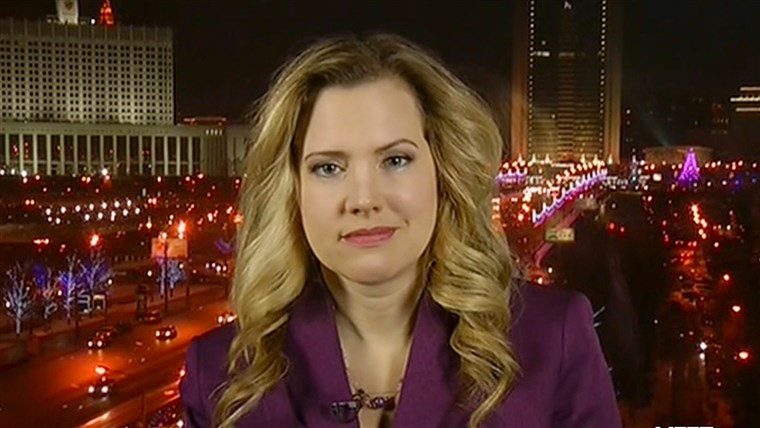
National Security and Human Rights Attorney Jesselyn Radack

Bryant was once represented by Jesselyn Radack, an American national security and human rights attorney known for her defense of whistleblowers, journalists, and hacktivists, including NSA whistleblowers Edward Snowden and Thomas Drake. This latest batch of small-town drama began when Radack was contacted at her DC office by Adam West – Missoula City Councilwoman Heidi West’s husband – about a terrifying death threat made against his wife. And the video, when viewed out of context, indeed looks very scary.

But Heidi West recently sat down for coffee with the man accused of making these so-called death threats. In fact, Councilwoman West met with Brandon Bryant on at least 2 occasions this winter to discuss Missoula’s complex problems.

So how did Mrs. West become so convinced that Bryant meant her harm as to prompt action by law enforcement? It certainly wasn’t because she’s made a habit of viewing Brandon Bryant’s youtube page. She’s raising kids and who has the time.

So how was all this brought to our attention? What youtube channel was it that created so much upset in Missoula this week? That youtube channel, ladies and gentlemen, belongs to dedicated youtube troll Rick Rynearson.
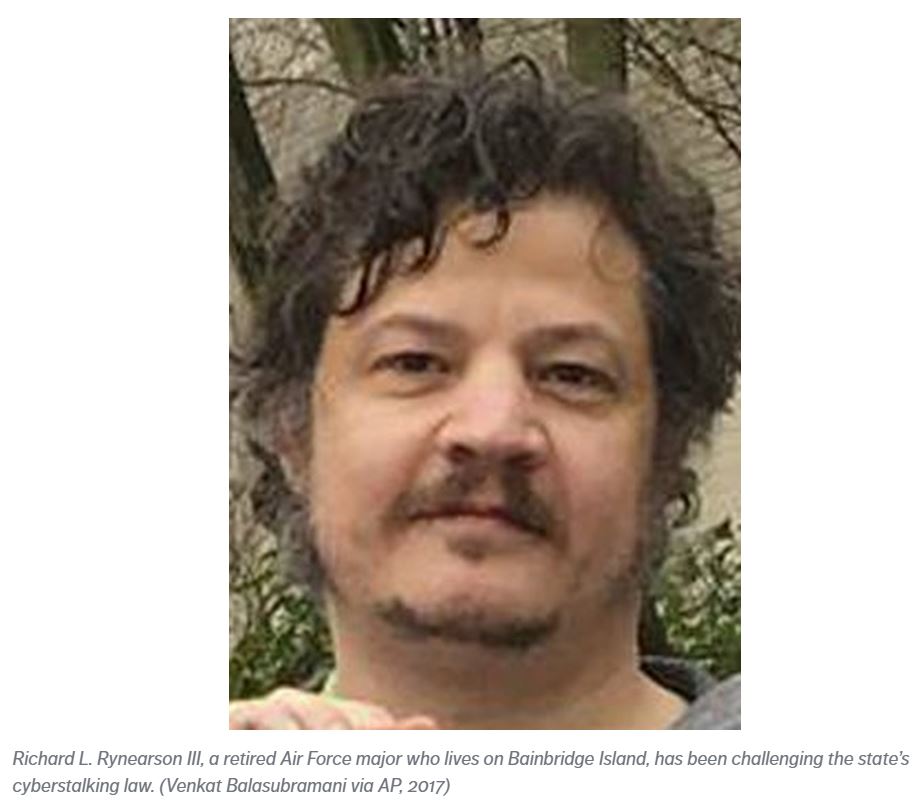
Rynearson

Rynearson reposed a short segment of one of Bryant’s longer videos before directing Heidi’s husband Adam to embrace the fear. And the video has a hypnotically scary caption, again compliments of Rynearson:

Brandon Bryant identifies people for “extermination” including the entire Missoula City Council and people in the military that he worked with, saying that he is “preparing” his soul to make those people “submit” and “die.”

Rynearson was himself an Air Force fly-boy for over 20 years, retiring as a Major. Now residing outside Seattle, has been accused of stalking and cyberbullyng against anti-war activists and public officials alike.

As reported by the Seattle Times:

“Richard L. Rynearson III, a retired Air Force major, sued to overturn the law in 2017, saying he had been threatened with prosecution by Kitsap County for writing posts that criticized a local activist… The Bainbridge island Police Department referred a police report to the Kitsap County Prosecutor’s Office finding probably cause for a cyberstalking charge, but the prosecutor did not file charges, instead saying the office would wait to see how Rynearson behaved in the future. And while the activist obtained a restraining order against him in a city court, a Kitsap County judge dismissed it, saying Rynearson’s posts were protected by the First Amendment.”

CONTEXT, CONTEXT, CONTEXT

OLYMPUS DIGITAL CAMERA
Bryant with his dossier on 6 FEB 2020. He says he keeps it where “no one could ever think to find it.”

As mentioned, someone claiming to be in the Mayor’s camp contacted Sgt. Bryant several months ago, providing a mysterious dossier of information purportedly verifying systemic corruption by the Mayor and his associates. The anonymous contact alleged that this evidence would be enough to entirely destroy Mayor Engen’s political career, as well as the careers of complicit parties, while simultaneously undermining the development regime Engen has spent his career spearheading.

Bryant’s family and Mayor Engen’s family aren’t exactly strangers to each other. The Mayor even attended high school with one of Bryant’s uncles. In fact, when the two men recently encountered each other on the street, they had a friendly exchange, inquiring about each other’s families. Mayor Engen asked Bryant how his Grandparents were. Bryant admitted that they had to move away because they couldn’t afford their property taxes anymore. And that’s the crux of the controversy generated by TIF.

Bryant has no criminal record whatsoever and was discharged from the military honorably. Furthermore, the police report to the Council indicates that law enforcement “
Don’t believe he’s an immediate threat to any council safety”.

The Mayor and members of the Council are perhaps justified in their concern. Their response may be proportional and appropriate, but as we’ve all seen over the last decades, the fear of violence dominates the narrative and distracts from the issues. The onus for such terror can be traced to powerful people in our culture who wage war against distant societies and against their own increasingly medicated and impoverished population, creating victims and trauma at home and abroad.

Bryant isn’t the only one who feels angry. He’s surrounded by folks who don’t know how to express their anger and also avoid confrontation. This lack of engagement is further exacerbated by the City Council’s belief that since there aren’t angry mobs of people showing up to decry taxpayer giveaways, “nobody has any problems with any of this”.

When thoughtful public comment is delivered on the subject of — not even stopping TIFs but merely slowing them down — those citizens are, at best, patted on the head and assured they “just don’t understand what’s going on,” and at worst, apparently, smeared for all they’re worth by Martin Kidston’s impotent rag.

If only Kidston understood that so much of the anger felt by this community has stemmed from a universal feeling of being ignored. Call it learned helplessness if you like, but people in Missoula – especially contractors – are terrified of upsetting Herr Engen’s apple cart, for “fear of political retribution.”

Given his willingness to accuse a veteran of stolen valor, it seem interesting that Martin Kidston also claims to have served with the Marine Corps, according to his biography page from the Missoula Current, wherein he alleges that he deployed to Iraq during the Bush Dynasty’s first attempt to overthrow Saddam.

Kidston Bio

Perhaps Martin has been reading a little fiction lately, maybe from forums like Valor Guardians:

this is still up

Bryant served in one of America’s most elite military units. The Joint Special Operations Command (JSOC) is an organization that didn’t officially “exist” when Jeremy Scahill published his expose/documentary on JSOC: Dirty Wars. At the time of Scahill’s reporting, the White House dismissed his reporting as a “conspiracy theory”. It wouldn’t be until JSOC officially took credit for the death of terrorist kingpin Osama Bin Laden that US officials ever publicly admited to the organization’s existence.

91GcXw+sTML._SL1500_


The so-called dossier didn’t appear until after tempers “boiled over” at City Council on the 18th of November 2019 (Bryant’s birthday). As reported by Shannon MacNeil of NBC Montana:

Tempers boiled over at Monday night’s City Council meeting. One resident accused the city of taking from the poor to gild their own pockets.

“You are that rich man,” resident Brandon Bryant said. Mayor John Engen responded, “We are not going to yell in this chamber, sir.”

Then Bryant said, “You need to understand, Mister, what you have done. You have sold out this community — you have wrecked the trust in this community.”

Engen ended the exchange with, “We’re off until you can calm down; let’s take a five-minute breather.”

Bryant and members of the group walked out during the break, although one stayed to urge the Council to continue the conversation.

Martin Kidston didn’t have to throw shade over the other citizens who spoke out against TIF alongside Bryant at City Council meetings, but he did anyway:

“…Bryant is among a handful of recent attendees who address the council at nearly every meeting, mostly with disdain over development and their inability to find meaningful work. Along the way, they’ve referred to “ivory towers of ideology” and the “dark underbelly of Missoula’s slave ship” while making other questionable statements used in their arguments….”

The citizen activists that showed up to Council chambers on Monday nights did not typically comment about “their inability to find meaningful work,” but rather, the wrongs endured by Missoula’s working class residents; wrongs which are spun as prosperity and growth by the media whores and PRESStitutes serving the town’s oligarchs.

As William Skink observed:

The author of this piece, Martin Kidston, seems to be casting doubt on whether or not Brandon Bryant is an Air Force Veteran. I find this odd, considering the power of Google mentioned above produces articles from media outlets like the Rolling Stone. In this Rolling Stone piece there doesn’t seem to be any doubt as to the “claims” Brandon Bryant is making about his experiences in the military killing the enemy for Uncle Sam.

It appears to me that the intent of the Missoula Current piece is to maximize the gift of these alleged threats toward City Council to character assassinate Bryant and to cast the guilt-by-association net over the other critics of Council policies…

How convenient for City Council. They get to look like the victims here, AND they get to increase the police presence for themselves while those in this community without protection–like homeless individuals living and dying in our shelters and on our streets–are left to fend for themselves.

While I don’t condone threats or acts of violence, I do understand how frustration for many is reaching a boiling point here in Missoula. This one video made by someone who let their frustration get the better of him is now going to be used to depict all critics of Council as jobless losers who pose a threat to the safety of Councilors. Just watch.

The Missoulian followed Kidston’s lead, further inflaming the city with lies and even suggesting that Bryant is a Trump supporter who  hates democrats.

At another committee meeting in January, Bryant brought a large stick to the podium that he identified as a weapon, which led councilors and city staff to express concerns for safety, von Lossberg said.

Von Lossberg added that he thinks the incident points to “the polarized environment that we’re living in” and the rhetoric that elected officials use at every level of government.

Von Lossberg’s claim that Bryant identified his antique bokken as a “weapon” is completely untrue. Anyone who bothers to analyze the video feed from that meeting (start @ 8:30) will quickly observe what a liar von Lossberg is, and how unbelievably complicit local media are in perpetrating this obvious distortion.

Bryant speaks in metaphors to illustrate how using an “imperfect tool” can lead to disastrous consequences. Since Council repeatedly refer to TIF as an “imperfect tool”, Bryant attempted to demonstrate how a warrior would never enter combat with the wrong tool, like a wooden sword. Bryant clearly states the bokken resembles a weapon because of its SHAPE, and went on to say  that looking at it reminds him to him priority number one is always doing the right thing, and that he swore an oath after his military service never to visit violence upon another human being ever again. If you need additional context, America’s drone assassination of an Iranian general took place the weekend prior to this January meeting involving the wooden bokken, illustrating a parallel to another “imperfect tool”: drones.

“You cannot use an imperfect tool to do a correct job. Just like if a sword is made incorrectly, it doesn’t protect the people who depend on it. And this tool of Tax Increment Financing, if you do not use it correctly, it will end people’s lives in ways that are worse than death.”

von Lossberg

Nobody in the audience seemed to think anything one way or the other about it at the time. Committee members can even be seen joking around and laughing. Is that how people who feel threatened act? The demeanor in that room at time was one of boredom. Not terror.  It’s a show-and-tell segment, not a death threat.

Perhaps the Perception Managers at The Missoulian missed all that critical context somehow. But they nevertheless succeed in evoking a similar tone to Kidston’s smear, albeit with slightly toned down wording; this time Bryant is “identifying himself as an Air Force veteran”. I suppose that’s a step-up from saying he “claims to be an Air Force veteran” but it still leaves unnecessary doubt about his service where none need exist. Why even make such a suggestion?

Like Kidston, The Missoulian reporters appear to be deprived of Google search, because Bryant is easily the most high-profile Air Force veteran in the state who was just featured in yet another explosive expose on America’s murderous drone program:
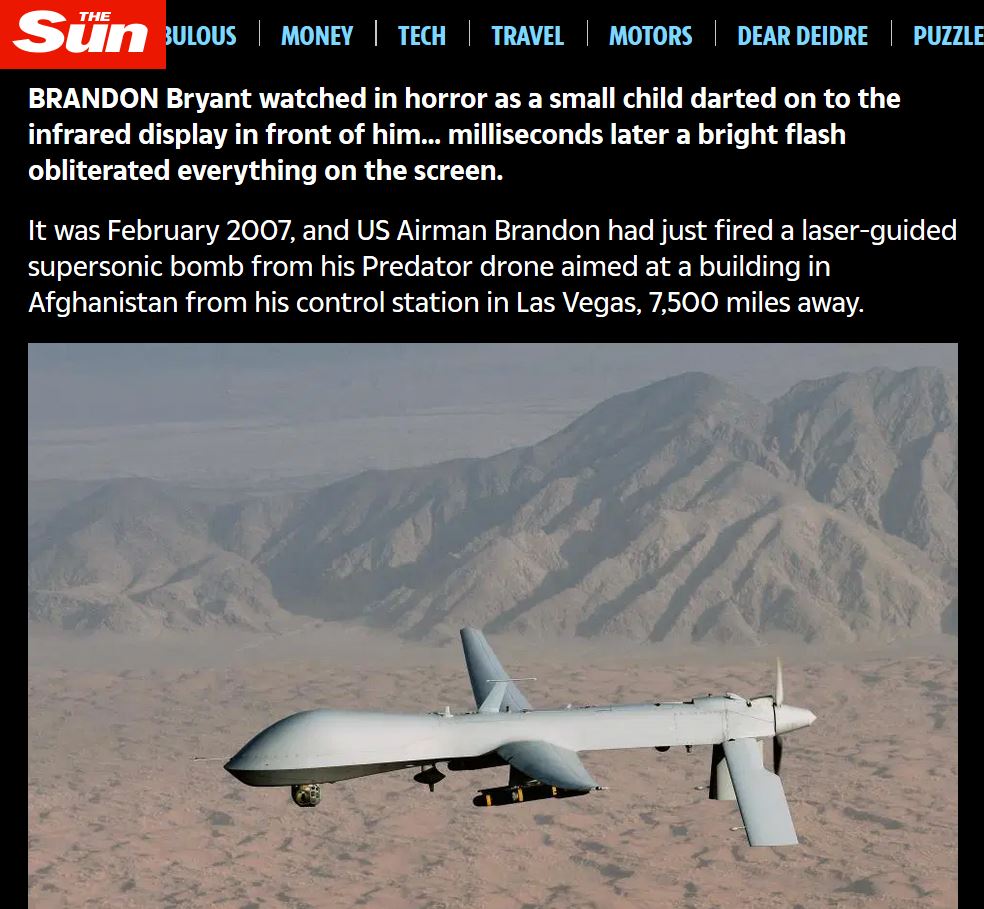
 

SUN
ptsd
Article in The Sun

England’s Independent picked up the story the following day:

Independent
7 Feb 2020 Article in The Independent

This all highlights something we’ve been asserting for months: that Missoula’s “leaders” can’t debate TIF because they know they’ll lose public support if people find out about its correlations with gentrification. So instead they continue silencing the noise around TIF.


So just what was in the mysterious dossier?

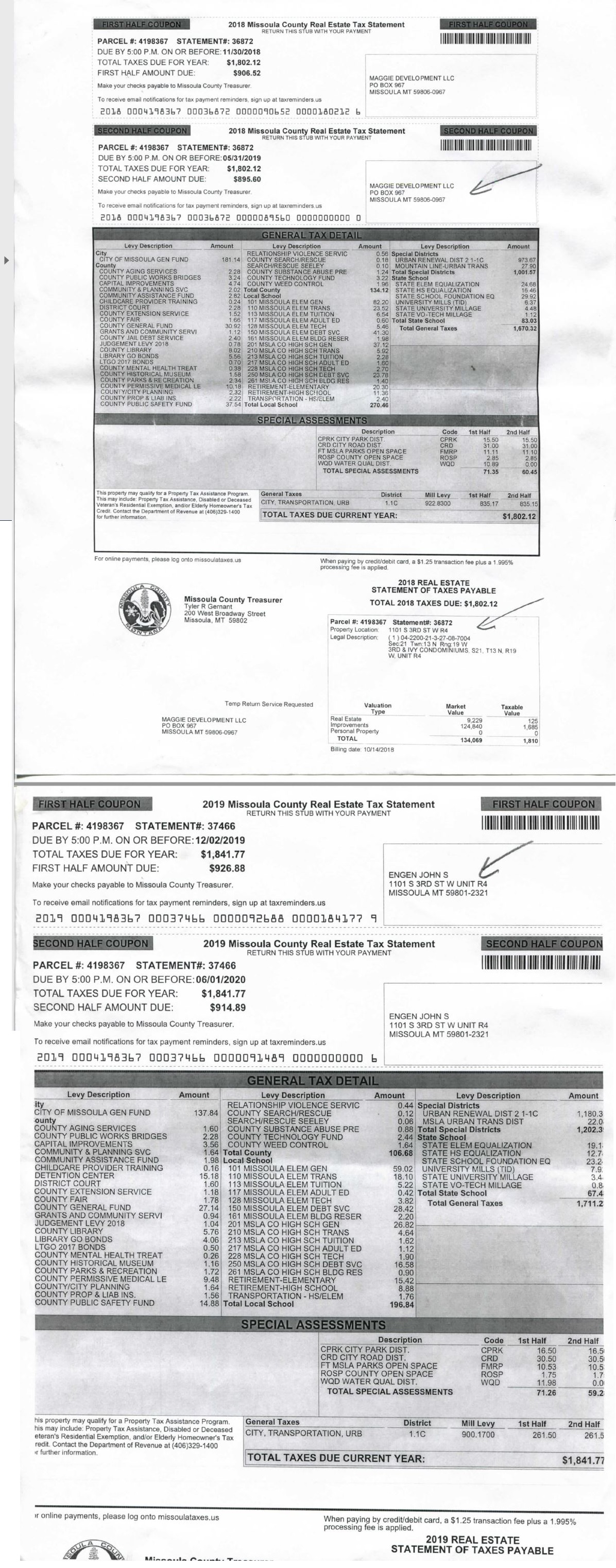
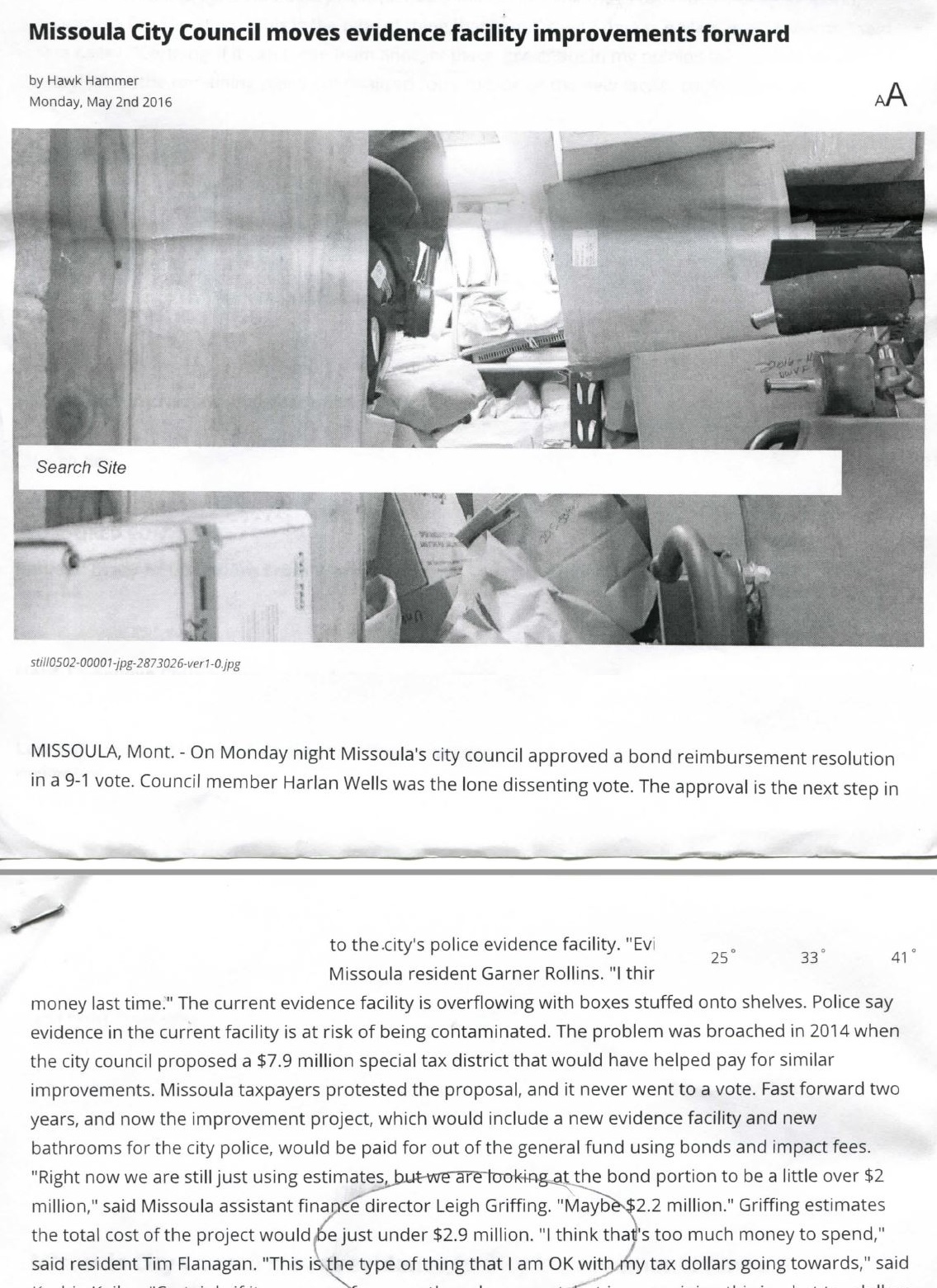
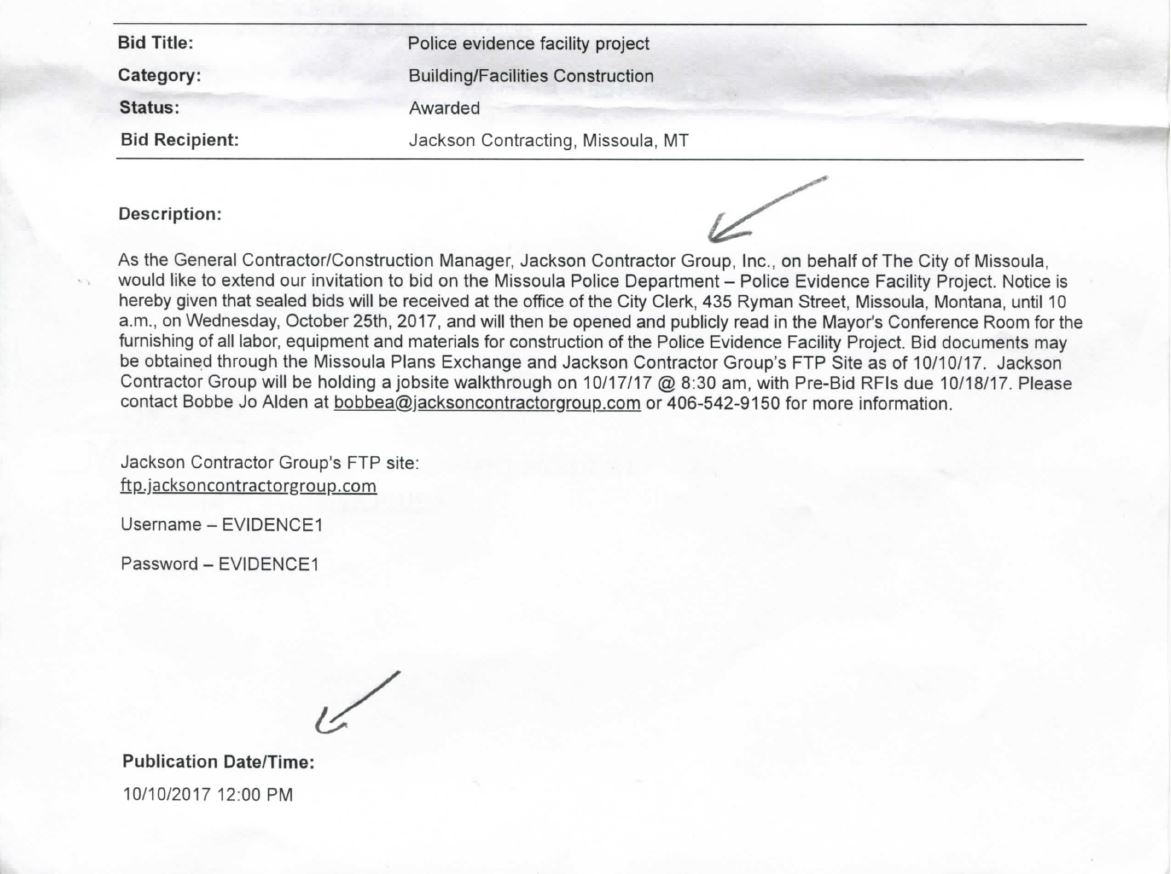
The pages seem to suggest (among other things) that Mayor John Engen may have received some kind of kickback for awarding Jackson Contractor Group a $3 million job to build a new evidence facility for the City, and that kickback may have come to him in the form of property, perhaps at less than market rate, or as they say in the Real Estate business, “with money left on the table”.
CURVE NUMBA TWO


010


001


006


007


CURVE NUMBA ONE

OLYMPUS DIGITAL CAMERA

Gabrielle Lafayette is the executive producer for the Outer Limits Radio Show.
This cache of thought is presented free of charge as a service and gift to you.
May our eternal vigilance help liberate all beings from the smoke-and-mirrors deceptions of the Samsaric Panopticon.


The (G)Reed at Missoula’s Hip Strip

IMG_3745

This is what the death of Missoula looks like. A Borg Death Cube called “The Reed

If Missoula’s affordable housing woes and homelessness crises weren’t already ridiculous, the approaching avalanche of luxury condos cascading into the Garden City now places this once-quiet mountain town firmly within the theater of the absurd.

WGM’s Nick Kaufman appeared again before the Missoula City Council this Monday on behalf of Cole Bergquist, Cade LLC and Pupaw LLC, to make the case for their 4th Street gentrification project: The Reed.

The plan involves displacing Missoula locals,  tearing down several  century-old structures and uprooting a native plant garden to construct towering eyesores of glass and steel erected for the enjoyment of anyone who can afford a $500,000 condominium.

Since there was no way to play within existing rules to make this elaborate plan work, Kaufman has asked the Council to simply alter the rules. And he’s pulled out all the stops: WGM have asked the City to throw out the University historic character overlay, they asked to vacate city Right-of-Way at 4th and Ronald to the developers, and they’ve asked for a unique “spot rezone” to include commercial applications.

And on top of it all, Missoula’s locals are told we should celebrate because this development that’s being crammed down our throat will help us “go green” — because tower blocks can be deemed “environmentally friendly” somehow.

Kaufman’s presentations insult the Missoula community’s intelligence with hopelessly optimistic projections, half-truths and outright lies. But the most egregious misstep was attempting to sneak commercial “spot zoning” past the Missoula community, hoping nobody would notice this metaphorical elephant in the living room that is poised to shit on all of our faces.

Let’s start with their traffic projections.

WGM’s engineers told us with a straight face that this 40+ condo development that features 75 underground parking spaces will only contribute 13 vehicles leaving in the morning and 13 at night. It seems bewildering they expected us to believe this nonsense. But what’s even more flabbergasting is how so many of our public officials are drinking WGM’s Kool-AId.

Moving on to the Council’s condition that the existing historical structures be moved at the developer’s expense.

WGM generously offered to provide up to $12,500 per building to be moved, however the language of the condition repeatedly states that they’ll provide these funds for moving the buildings only if “designated feasible for relocation“. Given that these are century-old structures, said feasibility is decidedly ludicrous. The cost of moving such structures would be several times the amount proposed.

Next, the outright lies that WGM presented to the council.

Kaufman stood before the City claiming that his group had offered financial compensation to the residents his development threatens to displace. This claim was already suspect, as one such resident, Jeff Gardner, appeared in The Missoulian the week prior, revealing that he’d received no such offer of compensation.

In response to this glaring inconsistency, Nick Kaufman claimed, “We had outreach to our tenants and we notified the tenants and offered relocation assistance. Apparently we missed one of those tenants. We apologize for that.”

Kaufman told us that “apparently we missed one of those tenants” and promised to rectify that oversight. However, over the course of the evening, no less than four of the current residents appeared before the Council and revealed that none of them had received the relocation funds WGM promised.

As of this writing, none of that has changed. Though that hasn’t stopped the Bergquist fib factory from manufacturing the next obvious excuse, that he offered to assist them in locating a new place, if needed, but that “no FINANCIAL assistance was ever offered or discussed with any of the tenants.” But what other meaningful assistance could there possibly be, Cole, if not financial? Selling them one of the other luxurious properties you’ve been tasked to represent by your lofty real estate firm?

But the lies didn’t end there. After Councilwoman Stacie Anderson proposed an amendment prohibiting commercial applications as part of this controversial rezone, the Mayor asked Kaufman directly if the developer was “intending to do commercial” with this project. Nick Kaufman said, before God and everybody, “No. The developer is not intending to do commercial.”

But when the prospect of losing the commercial aspect to this rezone began taking shape and the Council started discussing the feasibility of Anderson’s amendment, Kaufman doubled back, saying they had indeed planned to use commercial, but only as a “fallback”, further stating that without such a fallback, perhaps they would need to reconsider the 20% affordable housing requirement, which he alleged had already severely undermined their profit margin. 

It was further suggested that the commercial implications may be interrelated with the so-called affordability threshold, thus weaponizing the buzzword of “affordable housing” to justify commercial “spot zoning”and unapologetic gentrification.

Heather Harp opposed Anderson’s amendment, saying, “ I worry that based upon the document that was uploaded today … that if the developer can’t get to 20% and is going to lose money, that we will get zero affordable housing, and that they will walk away from the project. it’s a possibility. Which is something none of us in this room want. So I just caution that.”

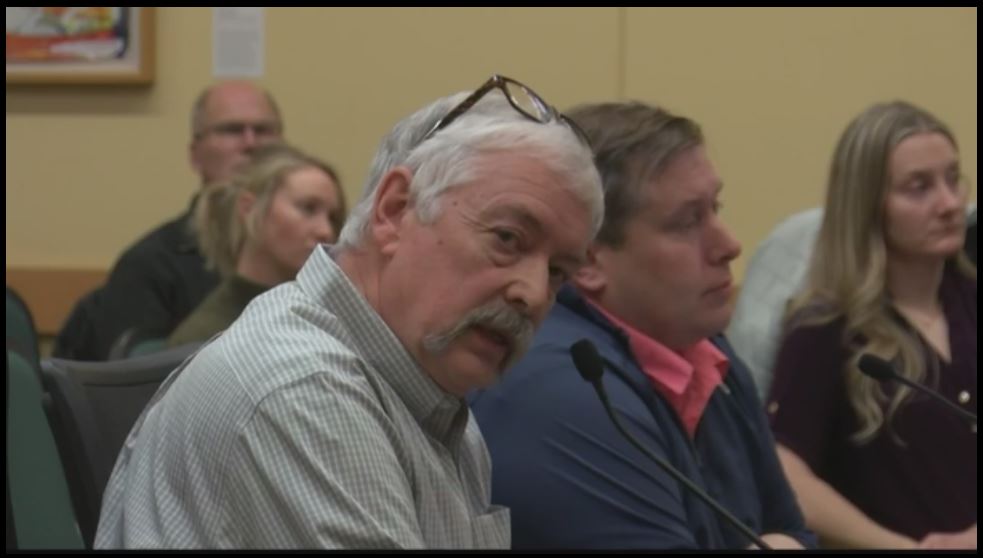
Mrs. Harp’s bias for WGM may stem from her husband’s role as Principal Engineer for WGM until two years ago, when he became part of Missoula’s highly lucrative revolving-door economics. Today he’s Missoula’s interim director of Development Services which he stepped up to from his post as director of Missoula’s public works.

kaufmannnm

Nick Kaufman of WGM Group

Nick Kaufman lied to our faces.

If anyone on the Missoula City Council should choose to take something personally, let it be that inconvenient fact.

But they shouldn’t get angry when half the chamber laughs at them for claiming “4 units of affordable housing is better than zero” when seven currently exist.

They shouldn’t throw up their hands claiming “the plan is far from perfect” without making any attempt to secure a better deal for the people of Missoula.

They shouldn’t cry crocodile tears about isolated statements regarding parallels between poverty and crime — statements couched within hours of thoughtful public comment that covered a much wider scope of issues.

And whatever they do, they definitely shouldn’t then decry such statements as “classist”. Punching down is bad enough, but punching down on your own kind just makes you look stupid.

There may be a problem with classism in Missoula’s City Council chambers, but that problem doesn’t originate with the working-class residents of the city who attend council meetings to try to defend their way of life.

No.

It comes from the developer-class who attempt to weaponize the City Council as their instrument in the class war they wage against working people. A class war worsened by the brazen cronyism of revolving-door politics; the infiltration of public offices by organizations who stand to benefit from deregulation.

The Council were elected by said working people to represent their interests; not to be sold out to developers, or railroaded in defense of developers, or patronized about their apparent lack of understanding of economic theories. Our representatives can either become public servants operating the levers of power or acquiesce as tools of the developer class. But they cannot do both.


WHAT IS SPOT ZONING AND IS IT LEGAL?

One defense of this controversial and potentially illegal commercial spot zone hinged on convincing average Missoulians that this neighborhood is part of the Hip Strip’s commercial throughway. But, as revealed by vociferous public comment, that area is not cherished by locals as a potential shopping district, but as part of the Kim Williams River Trail.

The commercial implications of Kaufman’s rezone request suggests that The Reed was likely imagined as another monument to gentrification like that exemplified by South Park’s SoDoSoPa. Indeed, such developments have become increasingly unpopular as their negative side effects have been duly noted. Severe gentrification begins as a wave starting with an unprecedented developments that promise to “re-imagine” a small section of the city. These developments are presented as innocuous, but bring about detrimental and irreversible effects.

This is why the Missoula community responded to this development the way they did. For should the “spot zone” for The Reed be determined legal, Missoula henceforth opens a giant Pandora’s Box of increasingly controversial developments all over town based on that precedent.

The Reed‘s new zoning covers exactly one building, granting that single building the right to be twice as tall as the maximum allowed height for any of its neighbors. And that height discrepancy will be locked-in forever, unless and until zoning for neighboring properties is likewise altered.

This begs the question: What’s the point of zoning then? If such discrete exceptions are allowed, why do it at all?

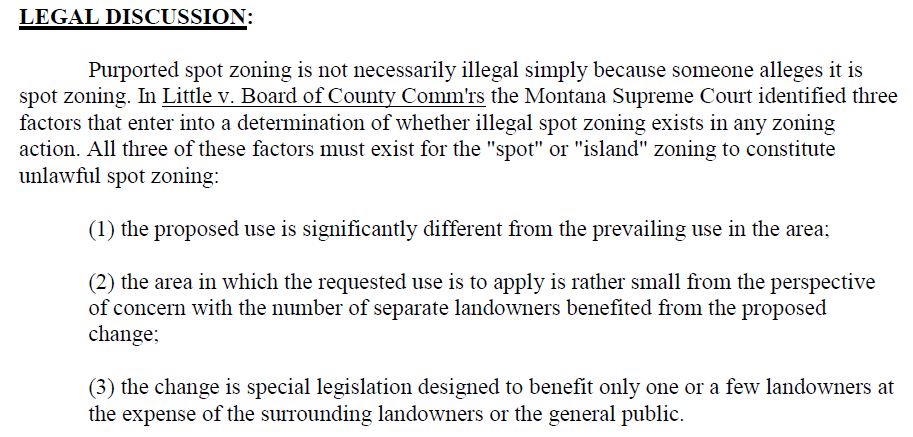
Such occurrences are known as “spot zoning“; a controversial practice which is illegal in some circumstances. According to the Montana Supreme Court, there is a 3-pronged legality test, including public good, to determine illegal spot zoning:

legal discussion

From Missoula City Attorney Jim Nugent’s 2011 dissertation regarding the legality of “spot zoning”

Three conditions are cited that, if violated, make the “spot zoning” illegal. And all three seem applicable to The Reed:

  1.  the proposed use is significantly different from the prevailing use in the area;

  2.  the area in which the requested use is to apply is rather small from the perspective of concern with the number of separate landowners benefited from the proposed change;

  3.  the change is special legislation designed to benefit only one or a few landowners at the expense of the surrounding landowners or the general public

And from the MSU Extension office’s, How To Spot a Spotzone:

One illegal form of rezoning is spot zoning…To be considered a spot zone, the property, in most cases, must meet the following four criteria:

  • The area is small compared to districts surrounding the parcel in question.

  • The new district allows land uses inconsistent with those allowed in the vicinity.

  • The spot zone would confer a special benefit on the individual property owner not commonly enjoyed by the owners of similar property.

  • The existence of the spot zone conflicts with the policies in the text of the master plan and the future land use map.

From where most average citizens stand, those three out of the four of those conditions all seem to establish a slam dunk for this case. But then again we’re citizens, not lawyers. Lawyers possess that special-bullshit-barrister magic that enables them look at those words and see a completely different meaning from the common English speaker.

For example, in the four legal precedents cited by Nugent, all four cases appear to be situations where the court determined spot zoning could be legal. The following reasoning seems particularly egregious:

“Boland v. City of Great Falls, 275 Mont. 128; 910 P.2d 890; 1996 Mont. LEXIS 17; (1996), the Supreme Court held that no illegal spot zoning occurred and indicated that the zoning change would benefit the adjacent property owners whose property values would tend to increase from the project development; and that there would be benefit to more landowners than the individuals whose property was being zoned and therefore the zoning was not in the nature of special legislation designed to benefit only one landowner”

This brings us to the City Council’s requirement that their development include at least 20% affordable housing units. Because of the implications of “spot zoning” it was essential that WGM be able to prove some kind of “public good” to cover the potentiality for legal problems moving forward. Ironically, the linchpin for the entire proposal to build luxury condominiums, ended up being “affordable housing”.

As previously observed, this constitutes a net loss of affordable housing units, since the existing buildings already provide seven units of affordable housing. The council’s position has been to allege those seven units are under threat, maintaining that four permanent units is better than zero.

The absurd icing on this turd cake is that ZERO units of affordable housing could be exactly what they get. The language of the proposal states that the developers include an affordable housing condition in EITHER the for sale condo units OR the rental apartment units. At one point the City Council changed that language in the proposal to make the “OR” an “AND”, meaning that both the for sale units AND the rental units would have to include a certain percentage of affordable housing. But at the request of the developer who complained of the effect on profit margins, the Council removed that change, returning to the original “OR”.

Why is this important?

The mechanisms available to the City to enforce affordable housing are very different for the For Sale units versus the rentals. For Sale units are “deed restricted“; the term the Council uses repeatedly in avowing their support for the proposal. “Deed restricted” units would, in fact, be permanent affordable housing. They would be sold to qualified residents at a rate much lower than the other condo units, and the lower price would be maintained as these units were sold and resold in the housing market.

The rental units, however, are “voucher preferenced“, which means that qualified residents could receive a housing voucher every month, which is good for $800 dollars of their rent. They give that voucher to the property owner and pay the difference. The property owner  makes the same amount of money off each unit as they would renting to someone paying full price, but a person of modest means can get in. The property owner is just partially being paid by the government, who pays for it by collecting our tax dollars.

Essentially, we are subsidizing these apartments.

Now this doesn’t sound altogether unacceptable. The “deed restricted” option is clearly preferable, but the “voucher preference” doesn’t sound too bad. That is until you realize that the “voucher preference” only lasts for 60 days before the property owner can abandon it and rent to anyone.

This means that if the property owner decides for any reason that they don’t want to rent to the voucher holding citizens, all they have to do is let the apartment sit empty for 60 days. And those units of affordable housing the Council fought so hard to secure are gone forever. So much for “permanent, structural affordable housing”.

WGM is attempting to hold the City to ransom, promising to mitigate the damage to public good if the Council gives them massive concessions in the form of a drastic and unpopular rezone, as well as surrendering City Right-of-Way.

But when it comes to bullying locals who speak out against gentrification, these developers really pulled out all the stops. As reported by Cameron Evans this week:

“Members of the public reiterated concerns that the project would disrupt the historic nature of the neighborhood and obstruct their view of the river. Last week, those concerns manifested in an image created by an anonymous resident that circulated Facebook. It featured a large black box purportedly representing the proposed structure to illustrate the scale of the project.

“Bergquist, however, said the image was inaccurate and responded with another rendering that he commissioned from an architectural firm.”

IMG_3745

Missoulian WGM Condo picture

Original (above) posted to facebook. Bergquist’s response (below) as printed by The Missoulian

The keen observer will notice by Mount Sentinel’s relative size in the background of each image, that Bergquist’s rebuttal image is zoomed way out, thus severely minimizing what essentially amounts to validation of the original image; more boxy modernist architecture blighting Missoula’s otherwise pristine skyline.

Cameron Evans continues, illustrating the sleazy lengths these developers will go to bully anyone who threatens their precious profits:

At Monday’s City Council meeting, Mary LaPorte shared a letter that she said her friend, Shirley Juhl, received from Datsopoulos MacDonald & Lind on January 24, saying they represent developers Cade, LLC and Pupaw, LLC.

LaPorte read the letter to the council:

It has recently come to our attention that you have posted on Facebook a rendering of what the Fourth Street condominium project would look like from the Higgins Bridge … I’m writing for the purposes of placing you on formal legal notice that this rendering presents false and misleading information apparently designed to wrongly influence the public’s perception of the project.

LaPorte further commented that, “This is a letter from a lawyer threatening a citizen for speaking out against a project. That is so against the values of our community. This is not who we are as Missoula.”

Millionaires and billionaire are constantly crowing that any marginal impact on their profit due to regulation will ruin them; that any concession to public good or common decency will destroy their profit margin and cripple their ability to contribute to a thriving economy. We’re made to believe that those who have the most in our society are constantly teetering on the edge of total financial disaster should the society they’ve thrived upon ask for them to give anything back, however minuscule. We’re told to believe that property rights are sacrosanct above public good or community responsibility.

Even if it were indeed true that WGM’s profit margins are razor thin and that any concession of public good will somehow deem their project untenable, what does that really mean?

It means they’re not entrepreneurs at all.

If the only way they can turn a reasonable profit on this project is on the backs of massive public giveaways, then they’re not the drivers of progress and innovation so lauded by wide-eyed acolytes of trickle-down economics like the Mayor and his hand-picked successor.

If poverty is the deadliest form of violence, then all contributors to poverty are accomplices. And if these economic amateurs can only get their way by resorting to threats to sue little old ladies and further worsen the City’s housing crisis if their demands are not met, then they are no less than economic terrorists. And it should not be the policy of the City of Missoula to negotiate with such swine.

genty

Gabrielle Lafayette is the executive producer for the Outer Limits Radio Show. This cache of thought is presented free of charge as a service and gift to you. May our eternal vigilance help liberate all beings from the smoke-and-mirrors deceptions of the Samsaric Panopticon.

Montana’s Jackson Hole

If you’ve been having trouble keeping up with business closures in Missoula lately, you’re not alone. Just when it seems the situation in here couldn’t possibly grow more absurd, even more iconic local businesses and longtime Missoula institutions forever closed their doors this month, including Pita Pit, Green Light, Lucky’s Market and JCPenny. The dust has barely settled from the last round of closures, claiming the Old Post American Legion Hall, Iza and Zoo Brew, among many others, all within the space of three months

Many displaced shopkeepers say they were forced to close down because their landlords increased rents. Others were obliged to vacate after property taxes suddenly multiplied. Both reasons highlight the effects of Missoula’s ongoing gentrification disaster.

The Green Light’s shop owner Sabrina Smith corroborates this fact. She says that after 11 and-a-half years working retail in downtown Missoula, she is retiring because her rent increased last January by about 30%, then increased again due to property taxes.

And the same vice squeezing locals out of their business is likewise pinching residents from what affordable homes remain that haven’t yet been bulldozed to install giant monuments of gentrification; projects that permanently contaminate entire neighborhoods with construction blight, ugly architecture, and fly-by-night tourists who only spend their summers in Missoula and consider the locals their compliant servants.

26% of Missoula’s work force must now commute from outside of Missoula largely because they cannot afford to live in town anymore. A chilling parallel to the housing crisis currently playing out in California’s Bay Area, where housing prices have ballooned to such an absurd degree that an annual salary of $120,000 is now considered “low income.”

Additionally, as many as 40% of Missoula residents are what is referred to as “income independent”, meaning they do not have to rely on income from local wages to pay for their costs of living here. Some of these residents are remote workers who draw silicone-valley level incomes from out of state businesses, while still others are simply independently wealthy people who do not need to work at all.

But Missoula’s income disparity insinuates an even more chilling reality. It’s the case today that 24% of people living in Missoula are one-percenters. Considering that Missoula’s income disparity is now the 33rd highest in the nation, it would seem Missoula isn’t so much becoming the “Austin of the Northwest” as it is to becoming Montana’s Jackson Hole.

Locals aren’t happy about this deadly trend, and they’re starting to become savvy to its causes. And one cause increasingly stands out above the rest: the misuse and abuse of Tax Increment Financing (TIF).

TIF constitutes an elaborate taxpayer-giveaway scheme that bankrupts cities through a morbid process of death-by-a-thousand-cuts. This kind of Voodoo economics directly causes property taxes to spike, in-turn causing rents to skyrocket, thus displacing locals and gentrifying entire communities.

But some TIFs are more egregious than others. The Missoula Redevelopment Agency (MRA) is all-too happy to cough up TIF money, even to organizations who don’t ask for it. But when developers hold the blight gun to the city’s head, they coerce our public officials to ensnare us all in highly regrettable quagmires that accelerate the decay of our fragile community.

Five years ago Peter Lambros threatened the MRA with “mall blight” if it didn’t cough up millions in public financing for a road, namely the Mary’s Avenue extension. Lambros said millions had already been invested and claimed that without public TIF dollars the whole deal would collapse.

plPeter Lambros presented a cartoonishly-dismal picture, threatening “future blight” if the city didn’t grant the Lambros Cartel millions in taxpayer subsidies to build that unnecessary road. The Lambros Cartel and Southgate Mall Associates got their $7.6 dollars of public money, plus several more millions in additional TIF money, then turned around and flipped the entire property to Ohio-based Washington Prime for $58 million.

mary's tif

More than $8.6 million in taxpayer money was spent on the Mary’s extension

But it gets even better!

Not only did MRA director Ellen Buchanan assure us that it’s fine for Peter Lambros to screw over the taxpayers of Missoula so brazenly because apparently Missoula requires a better road to the mall, when asked whether Lambros would have to repay the millions of taxpayer dollars granted to them through TIF, Buchanan dug in even further. As reported by Sarah Gravlee last week:

Ellen Buchanan Director of the Missoula Redevelopment Agency, the group that manages TIF funding, said the city has been trying to identify an east-west connection between Reserve Street and Brooks Street for decades. This project gave them that opportunity.

So, that’s what the money’s for,” Buchanan concluded. “It’s for a city street.”

The only problem with that story is that this so-called “public” street was requested by Peter Lambros specifically to get Lucky’s Market into Southgate.

Buchanan knows that, and she knows it looks bad.

According to Councilman Jesse Ramos, that road was explicitly requested by Peter Lambros to get more customers into his mall. “It’s in the minutes for that meeting,” he says. “It’s public record.”

So is Buchanan lying?

It seems obvious that the road would naturally be desired by Lambros for the purposes of attracting customers into the parking lot, but Buchanan continues to spin it as nothing more than a benefit for the community. Unfortunately, locals are well aware that these millions in TIF subsidies did little more than complete a road that nobody uses except to access Southgate Mall. Indeed, the very shape of the road itself indicates to whom its fruits would benefit, and it wasn’t the Missoula community. What a great deal for Lambros, and yet another cold shoulder for Missoula taxpayers.

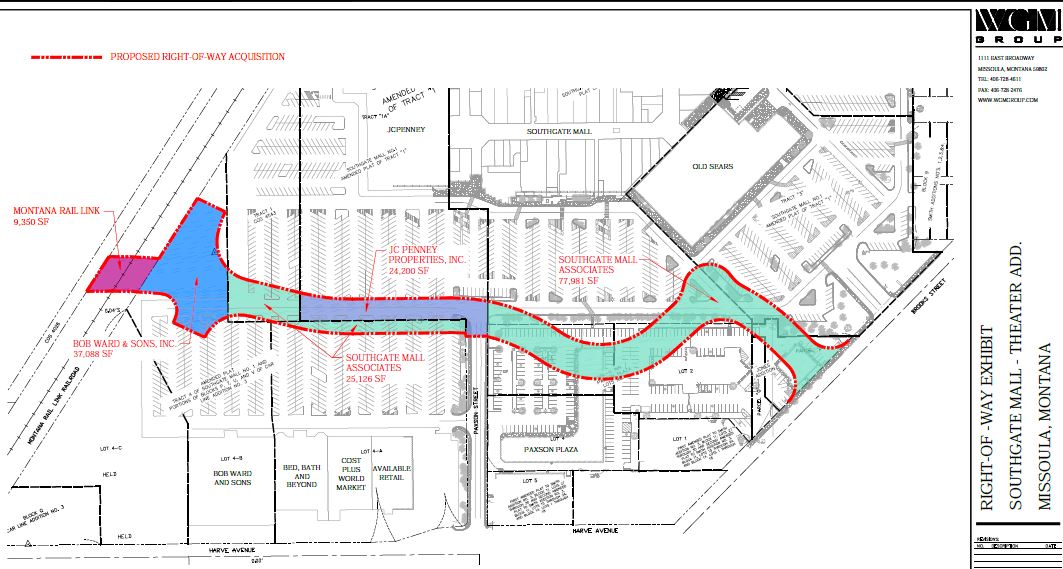
extension

From WGM’s 2015 TIF proposal for Southgate

The above map featuring “SOUTHGATE MALL” indicates “JCPENNY” on the western corner and “OLD SEARS” on the eastern. That “old Sears” would become Lucky’s Market. Both businesses are directly contiguous with this road which was meant to give life to them. A superb example of the fact that no speculator, no matter how well spoken, has a crystal ball for what the future will bring.

And even as the ideology of the MRA’s master-plan narrative crumbles, Ellen Buchanan doubles down on the vapid claim that the City desired this unnecessary road through that part of town since the 1990’s. But the only reason anybody would ever use that road is to go to the mall or the shops around the mall. Trying to navigate that area is a nightmare, new road notwithstanding.

With malls across the country closing down and boarding up, Lambros was clever enough to realize that “future blight” might become a self-fulfilling prophecy. Even though Southgate wasn’t a “mall” anymore, choosing instead to identify as a “Mixed-Use Town Center,” it remained just as susceptible to the same economic forces currently driving all brick and mortars out of business nationwide as it was before.

Lambros clearly knew this. So he flipped the mall while it was still profitable to do so, but not before taxpayers built him this unnecessary road to make the sale more appealing. And Washington Prime Group did indeed bite for $58 million.

You’re welcome Peter.

Mary-Avenue

From the developer’s standpoint at the time, the sole purpose of the Mary’s Avenue extension was to direct more traffic into the mall so that the owners could entice Lucky’s to move in. Because of this poor decision from the Council, tens of millions of dollars will be diverted from roads, from police, from fires, from schools, to benefit wealthy business owners.

But Southgate is just the tip of the iceberg!

South-Reserve-Pedestrian-Crossing-1-1024x576

Millions more in TIF was extracted from taxpayers to build the South Reserve Bridge. Mayor Engen and other TIF addicts claimed at the time that connecting the trails would relieve blight all along the bike trail; yet another excellent example of inappropriate abuse of the TIF statute through creative interpretation of the law.

When it comes to abusing the TIF statute, Urban Renewal District III really takes the cake. The Reserve Street pedestrian bridge that stands just a few short blocks away from the Southgate Mall, added an additional $5 million burden onto Missoula taxpayers, in an area of town that doesn’t seem “blighted” by any logical metric to thus justify TIF funding.

When asked how Larchmont Golf Course and a thriving industrial zone could possibly be considered “blighted”, MRA director Ellen Buchanan said at the time that the bridge “completed the trail, and people love to build on riverfront properties.” So even though the bridge didn’t eliminate blight in that specific area (URDIII), it apparently eliminated blight down the path, illustrating once again the desperate lengths these TIF addicts will go to justify their addiction.

This week, Councilman Jesse Ramos appeared on KGVO to elaborate:

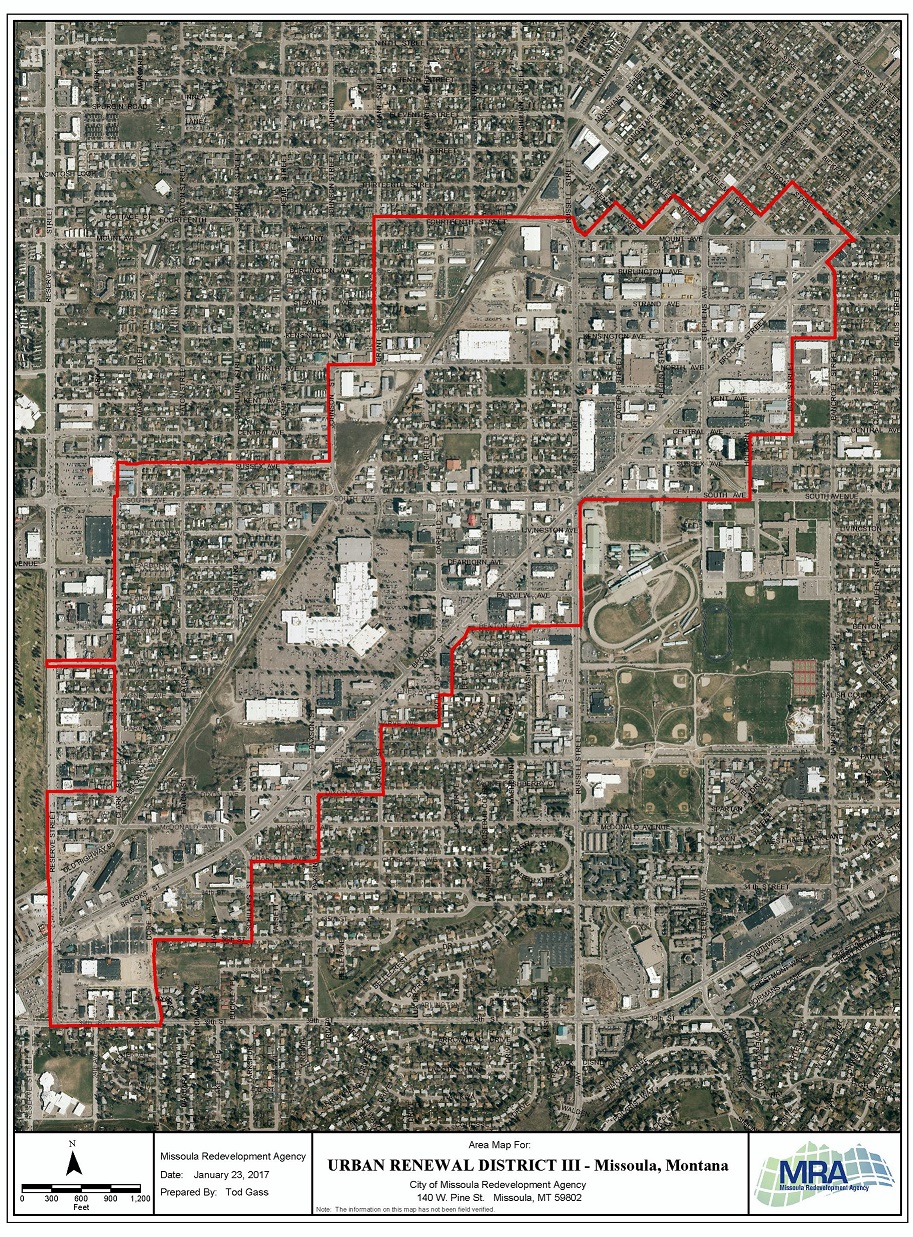
“Urban Renewal District III, that’s the one the bridge is in … goes from the walking bridge, wraps all the way around Cabela’s, wraps back around 39th, wraps around the fairgrounds, wraps down through Bancroft, hits Mount, wraps all the way back around Reserve, and then comes around. It’s one square mile, so it’s a massive, massive district. It was created in the year 2000 because it was blighted, according to Montana Code Annotated.

urd3

Ramos continues:

As defined by Montana Code Annotated, “blighted property” is “an area that is conducive to ill health, transmission of disease, infant mortality, juvenile delinquency, and crime.”

Ramos explains that the district had a $10 million tax base in 2000. When the tax revenue was divided roughly equally, a third went to the city, a third went to the county, and a third went to the schools. In the year 2000 TIF funding froze the process. The only tax revenue going to the City, County and Missoula schools was a part of the original $10 million tax base. Property taxes still increased, but any increase in the tax base was skimmed off of the top and went to the Missoula Redevelopment Agency. TIF funding must be reinvested back in the same district. Along with the pedestrian bridge construction, some of that TIF funding went towards the Missoula Mercantile, [to] construction at Southgate Mall, and [to] Stockman Bank.

“That TIF money is only supposed to be used for 15 years, so that district was created in 2000 and was supposed to sunset after 15 years,” Ramos explained. “But there’s a small provision within Montana Code Annotated which states that if you settle debt within the district, it extends the district out the length of the bond for a maximum of 40 years total. In September of 2015, the city council sold $5 million worth of bonds for that walking bridge built with TIF funds, and extended that district out until the year 2040. So, all the growth in that tax base is going to be skimmed off the top until the year 2040.”

And what company was it that helped “reimagine” Missoula’s Southgate Mall? The now notorious WGM Group, an organization with players working inside the Missoula City Council and other local government posts. The same organization now proposing the ludicrous commercial rezone that would bulldoze several historic buildings and displace Missoula locals to build luxury condos, blighting the skyline of Missoula and uprooting the fragile foundations of our community for all time. For once this spot zone is deemed legal, we open a Pandora’s Box of developments just like this all over Missoula in the form of precedent.

IMG_3745

And on top of it all, the MRA, headed by Ellen Buchanan, awarded $50,000 in TIF subsidies to Lucky’s Market itself. That’s $50,000 that Missoula taxpayers are told would come back to us as a “return on investment” through property taxes generated by Lucky’s. But it’s awful hard to collect property taxes from the business we’re subsidizing when those businesses go belly-up in their first 24 months.

lucky50

On top of it all, there’s the interest to think about, since TIF projects are bonded out, putting the city, and thus the taxpayers at its base, in astronomical debt. From a $7 million TIF we can expect at least an additional $5 million in interest to accrue, putting Missoula Taxpayers out by at least $12 million for a road to benefit a mall that is closing down like every other mall in America. And the trend indicates that’s exactly what’s happening. Because it isn’t just Lucky’s closing down shop.

Friday, Southgate Mall owners announced JCPenney’s would also close their doors, though the mall has indicated that it will announce plans for “redevelopment” of the JCPenney location soon; “redevelopment” that will likely involve even more TIF subsidies, awarded in vein to delay the inevitable sinking of Southgate.

Astonishingly, the city’s justification for these monies was to prevent “future blight” – a term that does not exist under state law, further illustrating the blatant misuse and abuses of the TIF statute.

It is not the job of the taxpayer to bail out private business, and if the mall is going to close we’re not going to stop it no matter how many tens of millions of taxpayer dollars we decide to throw at it.

When will Mayor Engen, the Missoula City Council, and the unelected TIF addicts working for the MRA, realize that they cannot take on Jeff Bezos and Amazon with taxpayer handouts?

We can’t reverse a nationwide economic trend with TIF subsidies!

0001

Gabrielle Lafayette is the executive producer for the Outer Limits Radio Show. 

Heather Harp Claims Average Citizens Too Ignorant To Understand TIF Law

Every time the City Council vote “yes” on inappropriate TIF subsidies, they confirm that short-term gains are more important than long-term sustainability.

This slideshow requires JavaScript.

The death of iconic local businesses like the Old Post American Legion Hall, Iza Asian Restaurant and now Pita Pit and The Green Light, all within the space of three months, confirms that the heart and soul of Missoula is disappearing before our very eyes; the latest examples of a terrifying trend. Countless other Missoula staples have been forced to close in recent years, including institutions like Uptown Diner, the Red Bird, and Stage 112, just to name a few. Many displaced shopkeepers say they were forced to close down because their new landlords increased their rents by astronomical amounts, while others were obliged to vacate after property taxes suddenly multiplied. And the very same vice squeezing locals out of their business spaces is likewise pinching residents from affordable homes.

26% of Missoula’s work force must commute from outside of Missoula largely because they can’t afford to live in town anymore. A chilling parallel to the housing crisis currently playing out in California’s Bay Area, where housing prices have ballooned to such an absurd degree that an annual salary of $120,000 is now considered “low income.”

Considering that Missoula’s income disparity is now the 33rd highest in the nation, it would seem we’re not that far from experiencing Frisco’s affordable housing woes.

part zoo

Locals aren’t happy about this deadly trend, and they’re starting to become savvy to its causes. One cause increasingly stands out above the rest: the misuse and abuse of Tax Increment Financing (TIF). An elaborate taxpayer-giveaway scheme that causes property taxes to spike, in-turn causing rents to skyrocket, and in-turn displacing locals and gentrifying entire communities.

For those who say “correlation is not necessarily causation,” former defense attorney Kevin Hunt corroborates our worst suspicions:

“Although it was said that ‘general taxes in the community won’t be affected,’ we know that these TIF projects have, in fact, already drastically increased property taxes for some people in this city. The Missoulian has already written articles about what’s happened to people like Office Supply; people who are downtown. When we start bookending these projects around these locally owned businesses – icons – familiy businesses, who were presented with property tax bills that had suddenly tripled, and because of that, their landlords now are jacking up their rents and they don’t know if they’re going to remain in business. …

“What happens is a lot of times these people do go out of business, and then the buildings are snapped up. And they’re snapped up by people like Nick Checota. Not that he would do it. But others with the funds to do it, they snap them up at a discount. Often they then end up demolished because they’re declared “blighted” and then we use more TIF. And what do we do with the more TIF? We demolish these buildings. We maybe save a facade or two. And pretty soon Missoula doesn’t look like a western town anymore.”

Jesse

Countless subversive “lost cat” posters appearing all over town seem to signal a mobilization within the community, many of whom consider the current state of Missoula nothing short of an emergency situation. An emergency that officials are now attempting to ameliorate with its very causes: inappropriate TIF subsidies that set dangerous precedents for the further abuse of the TIF law.

Councilman Jesse Ramos posted the “lost cat” on facebook, adding:

These were found all over Missoula this weekend. It is time the council has a serious discussion about TIF.

Our streets are in disrepair, our police are understaffed, our citizens are being taxed out of their homes and now the city wants a sales tax to cover these basic services. Yet oftentimes when a wealthy developer comes to the city with their hand out they walk away with millions.

Not only does TIF cause the city tax rate to go up but it also puts upward pressure on the county and school district taxes.

The latest case in point is unfortunately the Missoula Food Bank – an organization about which I have nothing but positive things to say. It’s an indispensable lifeline that’s helped me and many of the people I know navigate difficult times. I’ve even volunteered there. But this TIF is blatantly inappropriate, highlighting the creative misuse of the law.

First and foremost TIFs are only supposed to be used for the “elimination of blight,” and the Missoula Food Bank currently resides in a brand new building. Can anyone really tell us with a straight face that a brand new building can be considered blighted?

Far from it.

The present director of the Missoula Redevelopment Agency (MRA) Ellen Buchanan showed up in the flesh on Monday night not only to double down on the misuse of TIF funding, but also to tell us that she’s not required to follow the common understanding of the law, leaning instead on its many possible interpretations:

“I think one thing that comes into play here is the fact that in order to create an urban renewal district, you have to make findings of blight. And the definition of blight is laid out in State Law and it includes, you know, a dozen or better different conditions and you have to meet so many of those in order to declare an area blighted. And I think what that’s translated into for a lot of people is that Tax Increment Financing dollars can only be used to address those specific things that are laid out in that definition of blight.”

MT definition of BLIGHT

Current standards for defining “blight” in the State of Montana. As the law is written, proposed projects that hope to make use of TIF funds are required to honor this provision. Unfortunately, it’s still an extremely low standard that allows for the abuse of TIF because virtually anything can be considered “blight” under such loose conditions.

Buchanan continues:

“But if you read the statute in its entirety, there are references all through the statute to things that really speak to this type of project. In the preliminary statement of policy it says that, it’s declared that blighted areas which constitute a serious and growing menace, injurious to the public health and safety and morale, that the existence of such areas constitutes an economic and social liability. There is reference to health and safety throughout the statutes. And there also is authorization in the statute to use TIF funds for the acquisition of real property, to provide land for public facilities. I would argue this is a public facility. By virtue of the relationship with the county and the nonprofit status and the community that it serves. And I’m not going to bore you with all of the references in the statute. But I was aware of the issues that Geoff Badenoch raised back in October. He raised those. The city attorney responded in almost exactly the same way that I have addressed this tonight.

“We’re going to buy that property. We’re going to buy a portion of that building. And it will be for a public use. That’s no different than using TIF funds to buy a piece of land, and building a public park for public use. So I don’t know how you make the argument that this is an inappropriate use of TIF funding. It’s throughout the statute. I think that State Law enables us to do this. This serves a public purpose, like almost all of the dollars that we spend do. So I’m happy to try to answer questions, but I would encourage you to read through the statute and find those references that are to something besides water and sewer and streets and sidewalks.”

Bryan von Lossberg: “Thanks for clarifying. So Mr. Badenoch’s comments were back in October?”

Ellen Buchanan: “They were.”

Actually, they weren’t.

At least not if they’re referring to Badenoch’s comments quoted earlier at that same meeting. Said comment does not come from October of 2019 at all, but appears rather in response to last week’s hit-piece by the Missoula Current: Despite Conservative Opposition, Missoula City Council Approves Funding for Health Clinic at Food Bank.

The article’s author, Martin Kidston, gaslights his readers by dishonestly characterizing Jesse Ramos and other TIF skeptics as “conservative” in order to portray all critics of TIF as classist snobs who hate poor people. After all, why else would anyone vote against this Food Bank/Partnership Health Center deal?

Geoff Badenoch explains exactly why:

“Let me say first off, I am all for helping public health clinics and food banks with public funds. Second, on most issues, I would not agree with Jesse Ramos. [But] on this issue of TIF funds, I think there is less daylight between our views. One does not have to be “conservative” or “liberal” to examine the purposes for which the Montana State Legislature empowered local governments to use TIF as a tool for redevelopment. It is essentially a tool meant to correct physical deficiencies that create social problems. Assemble and/or Clear land. Expand or relocate utilities. Plan. Build curbs, gutters, sidewalks and streets. Build parks. Missoula has used it to build other government or public facilities.

“I am concerned about this particular use because it has been the case all over the country that municipalities cannot resist the temptation to use TIF in ever more expansive ways and state legislatures have almost always responded by removing that tool from local governments.

“Anyone can go to mt.gov and look up the urban renewal statutes in the Montana Codes Annotated. Simply look in Title 7-15, Parts 42 and 43. Read it yourself and see if this issue as not as clear cut as it appears. I think we need to be terribly circumspective about these expansive uses of TIF. This particular use might even be worth referring to the State Attorney General for an opinion as to its legality.

“TIF is too important a tool to be used without serious and deep consideration, regardless of the good outcome that may come for the clients of the Partnership Health Center, a brilliant institution that itself does wonderful work.”

Geoff Tiger Prawn Badenoch

Fun fact about Geoff Badenoch: he worked Ellen Buchanan’s job as MRA director for 18 years, from 1985 to 2003. I’m betting he probably knows what he’s talking about.

This is not to suggest that Ellen Buchanan doesn’t know what she’s talking about. The above quote is a concise illustration of how the evolution of the TIF law since the 1970’s consistently results in wider and wider interpretations of the law, lending itself to misuse and abuse over time.

When TIF addicts hit the TIF pipe too much, they force legislators at the state level to take this “imperfect tool” away from municipalities. Historically this is invariably what occurs in every state where dependent municipalities inevitably fall victim to TIF addiction. Tax Increment Financing in California has driven several cities to declare bankruptcy, compelling California legislators to take away the TIF toys forever.

Buchanan declared that blighted areas constitute a serious and growing menace. But for many Missoulians, the only serious and growing menace that directly threatens the health and safety of their families is the prospect of raised rents that price them out of Missoula. Property owners are worried about the serious and growing menace of exploding property tax bills that force them to sell their property to speculators. And our fragile community is terrified about the serious and growing menace of gentrification.

As of this writing, Missoula housing prices have soared to a record high of $315k. As reported by David Erickson last week:

“Housing prices continue to behave like a runaway helium balloon in the Garden City, while wages behave like a child on the ground with hands toward the sky, watching as the gap gets larger. Missoula’s median home sales price soared to a record high of $315,000 in 2019, a jump of 8.62% from the 2018 price of $290,000. … Andrea Davis, the executive director of the nonprofit Homeword in Missoula… noted that a person or a family would need an income of around $100,000 a year to afford a median-priced home in Missoula.”

The constant abuse of taxpayer money through endless TIF results in runaway housing prices that in-turn cause property taxes to explode, thereby displacing entire generations out of the neighborhoods they grew up in but can no longer afford. Then those newly abandoned areas are declared “blighted” enabling subsequent waves of gentrification to violently uproot the last vestiges of formerly-strong communities.

As Ryan McMaken further authenticates:

“Tax Increment Financing (TIF) legislation is geared not toward low-cost housing, but toward new commercial development. Often, that development is built where “unsightly” (but affordable) housing once existed. Its destruction is encouraged by government policy.”

Missoula-born local Lily Elison identifies how everybody loses when communities become gentrified:

“It is the inner-woven lives of individuals which creates a community … If we do not hold space for our local people and historic places, we will lose what makes this city worth living in. We will see a serious loss of security in our streets as life-long neighbors and childhood friends are replaced with strangers who have no community ties or responsibility to this place.

“I don’t want to see our history bulldozed. I don’t want to see skyscrapers instead of mountains. And I definitely don’t want to see my people in tent villages, because that’s what’s happening in Portland right now, because of their gentrification, because they’re pushing people out.

“And just think. What if it was your home that they were asking you to leave? What if it was your home?”


YOU JUST DON’T LIKE IT BECAUSE YOU DON’T UNDERSTAND IT

A persistent myth elected officials use to justify these taxpayer giveaway schemes is that ordinary folks are just “too dumb” to understand TIF. Indeed, any TIF addict relies on this myth as their primary rebuttal to the concerns of locals. Earlier at Monday’s meeting, Missoula local and longtime TIF critic Robert Moore — a man who spent the bulk of his career as the Chief Financial Officer for Fortune 500 Companies — approached the lectern to dispel an awful myth:

“Here’s an article where some of the members of the City Council are saying that the reason we don’t agree with TIF is that we don’t understand it. Well let me tell you – I do understand it. And I think all of you all understand it. You’ve just got a different purpose in mind. You want to give ten-million-dollars to the shopping center; four-million-dollars to Stockman Bank, that’s got a balance sheet of 2 or 3 billion dollars, and a surplus of 300-million-dollars.

“Tax Increment Financing is something we all need to learn more about, but at the same time Mrs. Harp [deflects] question[s] about it by saying, ‘You just don’t like it because you don’t understand it.’

“I understand it very well. It’s nothing but taking taxpayer money and giving it to developers and builders, and calling it ‘investment’.

“I think TIF oughta be disbanded.”

HH

Councilwoman Heather Harp

When it was Heather Harp’s turn to speak to Mr. Moore’s comments, she reiterated the very myth he sought to dispel, suggesting once again that people just don’t understand the law:

“I think one of the things that has often eluded a lot of folks, and frankly I don’t blame you, is because you don’t necessarily have all the facts. And I think we have a long ways to go in this community in terms of being able to tell a compelling story about why TIF is good. We know it has been good for us for 40 years. But going forward how how can we reshape that, so that folks understand?

“We also face the fact that we only have one tool in our toolbox in terms of being able to actually remedy our economic decline in these certain neighborhoods.

“Jesse, from time to time we’ve gotten into conversations about the merits and the demerits of our one and only tool. And I come down to this point of view that you can’t throw the baby out with the bathwater. This is the only thing we have. And at this point in time we have 600 people that need services of all types.”

I’m sure that Mrs. Harp, like everyone supporting this project, thinks she’s doing the right thing. After all, how can you go wrong endorsing either the Food Bank or Partnership? There is no questioning the good these organizations do on a daily basis for the many people who depend on their services.

But that isn’t the issue at all.

Critics don’t dispute the merits of TIF, but the negative side effects that occur later as a direct result. Negative side effects that we can’t afford to ignore for much longer.


ENTER PRINZING JONES

Councilwoman Harp is not the only one gas-lighting citizens about TIF. She has a lot of help from her fellow ideologues – like Natasha Prinzing Jones.

As William Skink noted this January, “The Missoulian is launching a new quarterly publication focusing on doing PR for businesses called Missoula Business. This vapidly titled quarterly will feature a notable business person and other things … The first notable business person is a lawyer for the Missoula Redevelopment Agency and the topic will be PR spin for Tax Increment Financing.”

Prinzing

Natasha Prinzing Jones is an un-elected MRA board member, married to a banker who works for a bank that benefited from TIF the same way Stockman Bank did, loaning us their own corporate handout and stiffing taxpayers with the interest payments. What’s more, Prinzing Jones happens to work in an office that itself benefited from TIF subsidies.

Natasha Prinzing Jones is also the attorney who underestimated Missoula’s Mountain Water legal fees by over $12 million!

So what does this “competitive spirit” have to say about citizen criticism regarding TIF?

“My observation is that many of the individuals who voice either concerns or opposition of TIF funding misunderstand its role and application,” she said. “Many individuals who are critics, I’ve never seen at a single (MRA board) meeting. Big picture, I think folks just don’t understand what’s going on. Their objections to the agency and the concept of TIF would benefit from a deeper review of what’s actually happening at those meetings.”

There you have it folks.

Once again, with painful predictability, there are NO specific responses whatsoever to either criticisms or concerns about TIF. The Missoulian had a whole cover story to do so. An entire centerfold’s worth of material, and only a few short paragraphs dedicated to beating Missoulians

Instead of responding to specific concerns, Prinzing Jones defaults to the same politically expedient tactic as all the other TIF addicts, claiming that Missoula’s citizens are just too brainless, too ignorant, and too stupid to understand how TIF works.

The reason that TIF addicts don’t debate the specific concerns is because they know they’ll lose if they argue the points before them. Critics don’t question the merits of TIF, but focus instead on it’s many unintended consequences.

TIF addicts seem to prefer employing STRAWMAN arguments: they substitute their opponent’s actual position with a distorted version that’s easy to dismiss. The debate is NOT about what TIF can do, but what it’s effects are. It’s about multi-million dollar taxpayer giveaways to banks, shopping centers and entertainment monopolies that unnecessarily and inappropriately increase everyone else’s property taxes to the point that locals are displaced completely by wealthy out-of-staters.

The Missoulian recently featured such a Strawman, quoting Linda McCarthy, executive director of the Missoula Downtown Association. Not only does McCarthy claim that, despite all the businesses closing all around us, “Downtown Missoula is without question a thriving commercial and community hub today.” The strawman comes in the form of trying to show all the good that TIF has done for local businesses – something critics don’t usually dispute.

McCarthy

Linda McCarthy, executive director of the Missoula Downtown Association


What TIF addicts don’t seem to realize is that by constantly using TIF to finance everything in the city from Lord Checota’s Ego-Dome to Stockman Bank’s Crony-Tower to Peter Lambros’ Shopping Maul to Andy Holloran’s Hotel Holocaust, what they’re actually doing is dooming Missoula to a fiscal death-by-a-thousand-cuts. And just like any addiction, the more they do it, the more they must continue doing it.

It doesn’t take that much time for these policies to produce negative side effects of increasing relative tax burdens for everyone, by artificially raising property values across the board.

TIF addicts claim that they’re trying to alleviate poverty, while actually helping to worsen the very conditions that exacerbate poverty in the first place: rising housing costs!

Mrs. Harp’s comment seems especially perplexing within the context of its timing. The previous week, on the 8th of January, she was stripped of her chairmanship on the Finance Committee, apparently because of her willingness to sincerely listen to citizen anxieties about TIF, and its constant overuse.

Her replacement, Gwen Jones, consistently displays an unapologetic contempt for citizens concerned about the effects of TIF, and was therefore the logical choice to Chair Missoula’s Finance Committee, at least from the point of view of wealthy developers, their cronies, and the useful idiots who go along to get along. Gwen’s cold, calculating indifference is further revealed by her recent declaration that “battle lines have been drawn.” Because apparently our community is nothing but a battlefield.

Those on the Council who helped unseat Mrs. Harp have sent a chilling message both to the people of Missoula as well as the rest of our elected representatives: don’t ever work with the people of your community, or you’ll lose what little authority we allow you to have.

I concede that at least this Food Bank/Partnership TIF is aimed at doing some good. Unlike the proposed $16.5 million TIF for Nick Checota’s LogJam Monopoly to further dominate Missoula’s entertainment scene with a giant monstrosity that they alone will have rights to operate for the next 75 years, all on the taxpayer dime.

As Missoula’s debt engines speed toward the cliff of bankruptcy, the TIF addicts are hitting the nitrous boosters while screaming, “Can’t this thing go any faster?” And the only operator who even discussed tapping the brakes was just pulled from the driver’s seat.

Jones isn’t merely a TIF addict; she’s a TIF dealer.

Under these circumstances, what possible benefit exists in continuing to patronize taxpayers with the same condescending claim that Tax Increment Financing is just too complicated a subject for ordinary folks to wrap their heads around?

john-holcroft-5-5d073d80139f9__700

Gabrielle Lafayette is the executive producer for the Outer Limits Radio Show.
This cache of thought is presented free of charge as a service and gift to you.
May our eternal vigilance help liberate all beings from the smoke-and-mirrors deceptions of the Samsaric Panopticon.


We Can’t Prevent War By Starting War

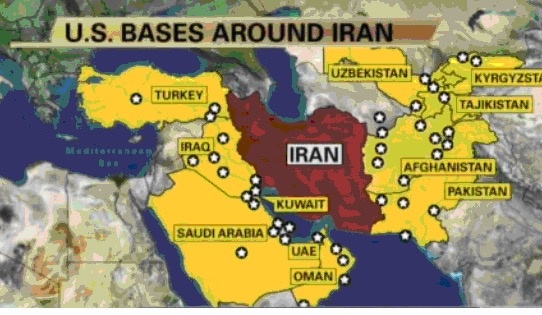
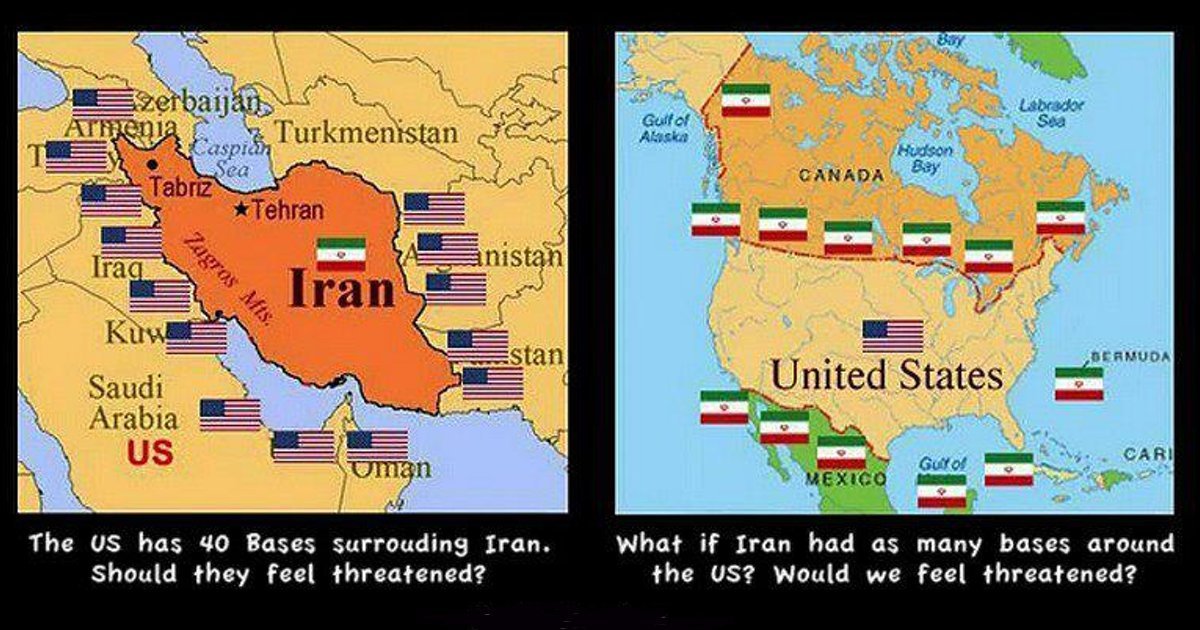
Trump has united Iran against America. The Pentagon’s unprovoked drone assassination of the Iranian general responsible for the defeat of ISIS should confuse most Americans. But the fact that General Soleimani was murdered while negotiating a peace deal signals that America’s oligarchs are finally ready to ignite World War III. The attack corroborates General Wesley Clark’s revelation that the “War on Terror” involved invading and overthrowing seven Middle-Eastern countries in five years – finishing with Iran. Since the War on Terror began, America has surrounded Iran with over 40 military bases, mirroring the intentions set by the Brookings Institution’s 2009 regime change strategy guide: “Which Path to Persia? Options for a New American Strategy Toward Iran.” And ever since the Mossad’s ill-advised deployment of the STUXNET virus and the resulting cyber war that followed, Iran has proven capable of defending itself with a deterrent far more effective than nuclear arms.

main-qimg-4d67205db3b8a9d820ca77d77364f94a

bases.jpg

Your Luxury Is Our Displacement

Missoula’s battle against gentrification rages into 2020. WGM Group is pushing for a development of unaffordable condos on 4th Street near Missoula’s Hip Strip. The plan involves destroying several century-old houses to construct in their place, a glassy eyesore for the enjoyment of the very rich. The proposed development is on property currently owned by former Griz and Roughrider Quarterback Cole Bergquist. Mr. Bergquist happens to be the realtor put on probation “for unprofessional conduct” after selling the University’s Salmon Lake Lodge to Paws Up in 2017. Since he owns these historic 4th street buildings, Bergquist now wants to displace Missoula’s neighbors from these historic homes to erect multi-million-dollar condominiums that no locals will ever be able to afford. To maximize profits, Bergquist is asking City Council to rezone the property and surrender public right of way around it, in-turn displacing locals, leveling history, and uprooting neighborhood foundations.

bear