Montana’s Jackson Hole

If you’ve been having trouble keeping up with business closures in Missoula lately, you’re not alone. Just when it seems the situation in here couldn’t possibly grow more absurd, even more iconic local businesses and longtime Missoula institutions forever closed their doors this month, including Pita Pit, Green Light, Lucky’s Market and JCPenny. The dust has barely settled from the last round of closures, claiming the Old Post American Legion Hall, Iza and Zoo Brew, among many others, all within the space of three months

Many displaced shopkeepers say they were forced to close down because their landlords increased rents. Others were obliged to vacate after property taxes suddenly multiplied. Both reasons highlight the effects of Missoula’s ongoing gentrification disaster.

The Green Light’s shop owner Sabrina Smith corroborates this fact. She says that after 11 and-a-half years working retail in downtown Missoula, she is retiring because her rent increased last January by about 30%, then increased again due to property taxes.

And the same vice squeezing locals out of their business is likewise pinching residents from what affordable homes remain that haven’t yet been bulldozed to install giant monuments of gentrification; projects that permanently contaminate entire neighborhoods with construction blight, ugly architecture, and fly-by-night tourists who only spend their summers in Missoula and consider the locals their compliant servants.

26% of Missoula’s work force must now commute from outside of Missoula largely because they cannot afford to live in town anymore. A chilling parallel to the housing crisis currently playing out in California’s Bay Area, where housing prices have ballooned to such an absurd degree that an annual salary of $120,000 is now considered “low income.”

Additionally, as many as 40% of Missoula residents are what is referred to as “income independent”, meaning they do not have to rely on income from local wages to pay for their costs of living here. Some of these residents are remote workers who draw silicone-valley level incomes from out of state businesses, while still others are simply independently wealthy people who do not need to work at all.

But Missoula’s income disparity insinuates an even more chilling reality. It’s the case today that 24% of people living in Missoula are one-percenters. Considering that Missoula’s income disparity is now the 33rd highest in the nation, it would seem Missoula isn’t so much becoming the “Austin of the Northwest” as it is to becoming Montana’s Jackson Hole.

Locals aren’t happy about this deadly trend, and they’re starting to become savvy to its causes. And one cause increasingly stands out above the rest: the misuse and abuse of Tax Increment Financing (TIF).

TIF constitutes an elaborate taxpayer-giveaway scheme that bankrupts cities through a morbid process of death-by-a-thousand-cuts. This kind of Voodoo economics directly causes property taxes to spike, in-turn causing rents to skyrocket, thus displacing locals and gentrifying entire communities.

But some TIFs are more egregious than others. The Missoula Redevelopment Agency (MRA) are all-too happy to cough up TIF money, even to organizations who don’t ask for it. But when developers hold the blight gun to the city’s head, they coerce our public officials to ensnare us all in highly regrettable quagmires that accelerate the decay of our fragile community.

Five years ago Peter Lambros threatened the MRA with “mall blight” if it didn’t cough up millions in public financing for a road, namely the Mary’s Avenue extension. Lambros said millions had already been invested, claiming that without public TIF the whole deal would collapse.

plPeter Lambros presented a cartoonishly-dismal picture, threatening “future blight” if the city didn’t grant the Lambros Cartel millions in taxpayer subsidies to build that unnecessary road. The Lambros Cartel and Southgate Mall Associates got their $7.6 dollars of public money, plus several more millions in additional TIF money, then turned around and flipped the entire property to Ohio-based Washington Prime for $58 million.

mary's tif

More than $8.6 million in taxpayer money was spent on the Mary’s extension

But it gets even better!

Not only did MRA director Ellen Buchanan assure us that it’s fine for Peter Lambros to screw over the taxpayers of Missoula so brazenly because apparently Missoula requires a better road to the mall, when asked whether Lambros would have to repay the millions of taxpayer dollars granted to them through TIF, Buchanan dug in even further:

As reported by Sarah Gravlee last week:

Ellen Buchanan Director of the Missoula Redevelopment Agency, the group that manages TIF funding, said the city has been trying to identify an east-west connection between Reserve Street and Brooks Street for decades. This project gave them that opportunity.

So, that’s what the money’s for,” Buchanan concluded. “It’s for a city street.”

The only problem with that story is that this so-called “public” street was requested by Peter Lambros specifically to get Lucky’s Market into Southgate.

Buchanan knows that, and she knows it looks bad.

According to Councilman Jesse Ramos, that road was explicitly requested by Peter Lambros to get more customers into his mall. “It’s in the minutes for that meeting,” he says. “It’s public record.”

So is Buchanan lying?

It seems obvious that the road would naturally be desired by Lambros for the purposes of attracting customers into the parking lot, but Buchanan continues to spin it as nothing more than a benefit for the community. Unfortunately, locals are well aware that these millions in TIF subsidies did little more than complete a road that nobody uses except to access Southgate Mall. Indeed, the very shape of the road itself indicates to whom its fruits would benefit, and it wasn’t the Missoula community. What a great deal for Lambros, and yet another cold shoulder for Missoula taxpayers.

extension

From WGM’s 2015 TIF proposal for Southgate

The above map featuring “SOUTHGATE MALL” indicates “JCPENNY” on the western corner and “OLD SEARS” on the eastern. That “old Sears” would become Lucky’s Market. Both businesses are directly contiguous with this road which was meant to give life to them. A superb example of the fact that no speculator, no matter how well spoken, has a crystal ball for what the future will bring.

And even as the ideology of the MRA’s master-plan narrative crumbles, Ellen Buchanan doubles down on the vapid claim that the City desired this unnecessary road through that part of town since the 1990’s. But the only reason anybody would ever use that road is to go to the mall or the shops around the mall. Trying to navigate that area is a nightmare, new road notwithstanding.

With malls across the country closing down and boarding up, Lambros was clever enough to realize that “future blight” might become a self-fulfilling prophecy. Even though Southgate wasn’t a “mall” anymore, choosing instead to identify as a “Mixed-Use Town Center,” it remained just as susceptible to the same economic forces currently driving all brick and mortars out of business nationwide as it was before.

Lambros clearly knew this. So he flipped the mall while it was still profitable to do so, but not before taxpayers built him this unnecessary road to make the sale more appealing. And Washington Prime Group did indeed bite for $58 million.

You’re welcome Peter.

Mary-Avenue

From the developer’s standpoint at the time, the sole purpose of the Mary’s Avenue extension was to direct more traffic into the mall so that the owners could entice Lucky’s to move in. Because of this poor decision from the Council, tens of millions of dollars will be diverted from roads, from police, from fires, from schools, to benefit wealthy business owners.

But Southgate is just the tip of the iceberg!
South-Reserve-Pedestrian-Crossing-1-1024x576

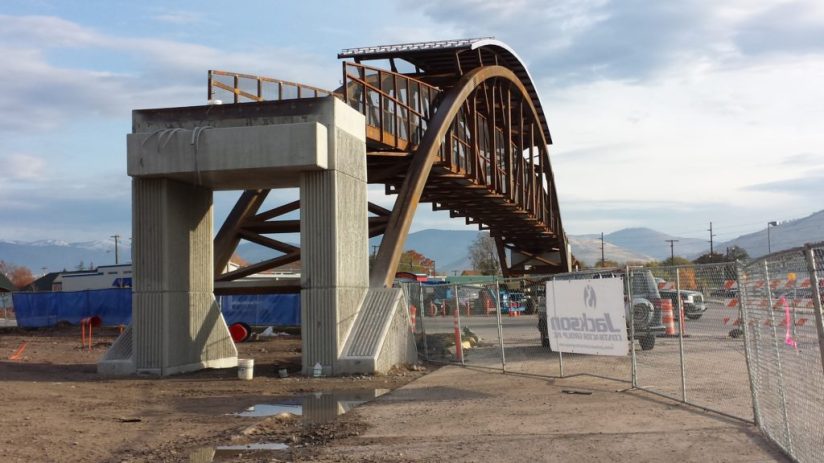
Millions more in TIF was extracted from taxpayers to build the South Reserve Bridge. Mayor Engen and other TIF addicts claimed at the time that connecting the trails would relieve blight all along the bike trail; yet another excellent example of inappropriate abuse of the TIF statute through creative interpretation of the law.

When it comes to abusing the TIF statute, Urban Renewal District III really takes the cake. The Reserve Street pedestrian bridge that stands just a few short blocks away from the Southgate Mall, added an additional $5 million burden onto Missoula taxpayers, in an area of town that doesn’t seem “blighted” by any logical metric to thus justify TIF funding.

When asked how Larchmont Golf Course and a thriving industrial zone could possibly be considered “blighted”, MRA director Ellen Buchanan said at the time that the bridge “completed the trail, and people love to build on riverfront properties.” So even though the bridge didn’t eliminate blight in that specific area (URDIII), it apparently eliminated blight down the path, illustrating once again the desperate lengths these TIF addicts will go to justify their addiction.

This week, Councilman Jesse Ramos appeared on KGVO to elaborate:

“Urban Renewal District III, that’s the one the bridge is in … goes from the walking bridge, wraps all the way around Cabela’s, wraps back around 39th, wraps around the fairgrounds, wraps down through Bancroft, hits Mount, wraps all the way back around Reserve, and then comes around. It’s one square mile, so it’s a massive, massive district. It was created in the year 2000 because it was blighted, according to Montana Code Annotated.

urd3

Ramos continues:

As defined by Montana Code Annotated, “blighted property” is “an area that is conducive to ill health, transmission of disease, infant mortality, juvenile deliquency, and crime.”

Ramos explains that the district had a $10 million tax base in 2000. When the tax revenue was divided roughly equally, a third went to the city, a third went to the county, and a third went to the schools. In 2000, TIF funding froze the process. The only tax revenue going to the city, county and Missoula schools was a part of the original $10 million tax base. Property taxes still increased, but any increase in the tax base was skimmed off of the top and went to the Missoula Redevelopment Agency. TIF funding must be reinvested back in the same district; along with the pedestrian bridge construction, some of that TIF funding went towards the Missoula Mercantile, [to] construction at Southgate Mall, and [to] Stockman Bank.

“That TIF money is only supposed to be used for 15 years, so that district was created in 2000 and was supposed to sunset after 15 years,” Ramos explained. “But there’s a small provision within Montana Code Annotated which states that if you settle debt within the district, it extends the district out the length of the bond for a maximum of 40 years total. In September of 2015, the city council sold $5 million worth of bonds for that walking bridge built with TIF funds, and extended that district out until the year 2040. So, all the growth in that tax base is going to be skimmed off the top until the year 2040.”

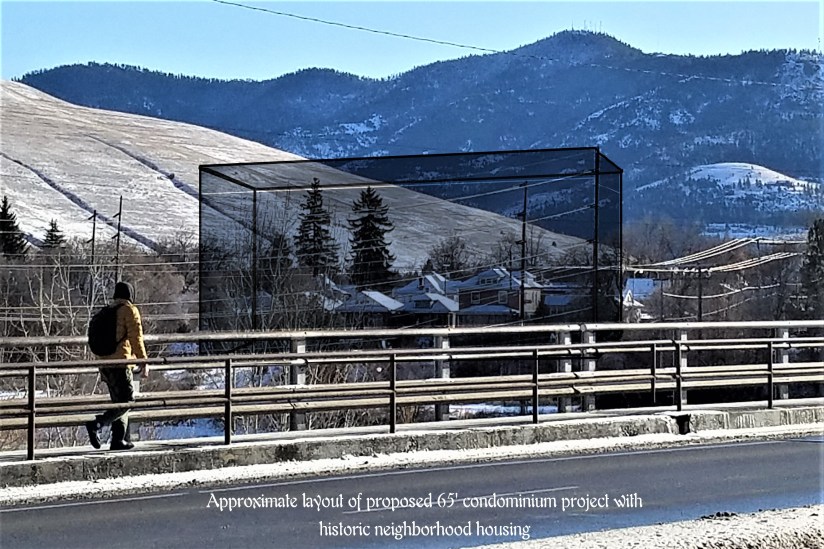
And what company was it that helped “reimagine” Missoula’s Southgate Mall? The now notorious WGM Group; an organization with players working inside the Missoula City Council and other local government posts. The same organization now proposing the ludicrous commercial rezone that would bulldoze several historic buildings and displace Missoula locals to build luxury condos, blighting the skyline of Missoula and uprooting the fragile foundations of our community for all time. For once this spot zone is deemed legal, we open a Pandora’s Box of developments just like this all over Missoula in the form of precedent.
IMG_3745

And on top of it all, the MRA, headed by Ellen Buchanan, awarded $50,000 in TIF subsidies to Lucky’s Market itself. That’s $50,000 that Missoula taxpayers are told would come back to us as a “return on investment” through property taxes generated by Lucky’s. But it’s awful hard to collect property taxes from the business we’re subsidizing when those businesses go belly-up in their first 24 months.

lucky50

On top of it all, there’s the interest to think about, since TIF projects are bonded out, putting the city, and thus the taxpayers at its base, in astronomical debt. From a $7 million TIF we can expect at least an additional $5 million in interest to accrue, putting Missoula Taxpayers out by at least $12 million for a road to benefit a mall that is closing down like every other mall in America. And the trend indicates that’s exactly what’s happening. Because it isn’t just Lucky’s closing down shop.

Friday, Southgate Mall owners announced JCPenney’s would also close their doors, though the mall has indicated that it will announce plans for “redevelopment” of the JCPenney location soon; “redevelopment” that will likely involve even more TIF subsidies, awarded in vein to delay the inevitable sinking of Southgate.

Astonishingly, the city’s justification for these monies was to prevent “future blight” – a term that does not exist under state law, further illustrating the blatant misuse and abuses of the TIF statute.

It is not the job of the taxpayer to bail out private business, and if the mall is going to close we’re not going to stop it no matter how many tens of millions of taxpayer dollars we decide to throw at it.

When will Mayor Engen, the Missoula City Council, and the unelected TIF addicts working for the MRA, realize that they cannot take on Jeff Bezos and Amazon with taxpayer handouts?

We can’t reverse a nationwide economic trend with TIF subsidies!

0001

Gabrielle Lafayette is the executive producer for the Outer Limits Radio Show. This cache of thought is presented free of charge as a service and gift to you. May our eternal vigilance help liberate all beings from the smoke-and-mirrors deceptions of the Samsaric Panopticon.

Heather Harp Claims Average Citizens Too Ignorant To Understand TIF Law

Every time the City Council vote “yes” on inappropriate TIF subsidies, they confirm that short-term gains are more important than long-term sustainability.

This slideshow requires JavaScript.

The death of iconic local businesses like the Old Post American Legion Hall, Iza Asian Restaurant and now Pita Pit and The Green Light, all within the space of three months, confirms that the heart and soul of Missoula is disappearing before our very eyes; the latest examples of a terrifying trend. Countless other Missoula staples have been forced to close in recent years, including institutions like Uptown Diner, the Red Bird, and Stage 112, just to name a few. Many displaced shopkeepers say they were forced to close down because their new landlords increased their rents by astronomical amounts, while others were obliged to vacate after property taxes suddenly multiplied. And the very same vice squeezing locals out of their business spaces is likewise pinching residents from affordable homes.

26% of Missoula’s work force must commute from outside of Missoula largely because they can’t afford to live in town anymore. A chilling parallel to the housing crisis currently playing out in California’s Bay Area, where housing prices have ballooned to such an absurd degree that an annual salary of $120,000 is now considered “low income.”

Considering that Missoula’s income disparity is now the 33rd highest in the nation, it would seem we’re not that far from experiencing Frisco’s affordable housing woes.

part zoo

Locals aren’t happy about this deadly trend, and they’re starting to become savvy to its causes. One cause increasingly stands out above the rest: the misuse and abuse of Tax Increment Financing (TIF). An elaborate taxpayer-giveaway scheme that causes property taxes to spike, in-turn causing rents to skyrocket, and in-turn displacing locals and gentrifying entire communities.

For those who say “correlation is not necessarily causation,” former defense attorney Kevin Hunt corroborates our worst suspicions:

“Although it was said that ‘general taxes in the community won’t be affected,’ we know that these TIF projects have, in fact, already drastically increased property taxes for some people in this city. The Missoulian has already written articles about what’s happened to people like Office Supply; people who are downtown. When we start bookending these projects around these locally owned businesses – icons – familiy businesses, who were presented with property tax bills that had suddenly tripled, and because of that, their landlords now are jacking up their rents and they don’t know if they’re going to remain in business. …

“What happens is a lot of times these people do go out of business, and then the buildings are snapped up. And they’re snapped up by people like Nick Checota. Not that he would do it. But others with the funds to do it, they snap them up at a discount. Often they then end up demolished because they’re declared “blighted” and then we use more TIF. And what do we do with the more TIF? We demolish these buildings. We maybe save a facade or two. And pretty soon Missoula doesn’t look like a western town anymore.”

Jesse

Countless subversive “lost cat” posters appearing all over town seem to signal a mobilization within the community, many of whom consider the current state of Missoula nothing short of an emergency situation. An emergency that officials are now attempting to ameliorate with its very causes: inappropriate TIF subsidies that set dangerous precedents for the further abuse of the TIF law.

Councilman Jesse Ramos posted the “lost cat” on facebook, adding:

These were found all over Missoula this weekend. It is time the council has a serious discussion about TIF.

Our streets are in disrepair, our police are understaffed, our citizens are being taxed out of their homes and now the city wants a sales tax to cover these basic services. Yet oftentimes when a wealthy developer comes to the city with their hand out they walk away with millions.

Not only does TIF cause the city tax rate to go up but it also puts upward pressure on the county and school district taxes.

The latest case in point is unfortunately the Missoula Food Bank – an organization about which I have nothing but positive things to say. It’s an indispensable lifeline that’s helped me and many of the people I know navigate difficult times. I’ve even volunteered there. But this TIF is blatantly inappropriate, highlighting the creative misuse of the law.

First and foremost TIFs are only supposed to be used for the “elimination of blight,” and the Missoula Food Bank currently resides in a brand new building. Can anyone really tell us with a straight face that a brand new building can be considered blighted?

Far from it.

The present director of the Missoula Redevelopment Agency (MRA) Ellen Buchanan showed up in the flesh on Monday night not only to double down on the misuse of TIF funding, but also to tell us that she’s not required to follow the common understanding of the law, leaning instead on its many possible interpretations:

“I think one thing that comes into play here is the fact that in order to create an urban renewal district, you have to make findings of blight. And the definition of blight is laid out in State Law and it includes, you know, a dozen or better different conditions and you have to meet so many of those in order to declare an area blighted. And I think what that’s translated into for a lot of people is that Tax Increment Financing dollars can only be used to address those specific things that are laid out in that definition of blight.”

MT definition of BLIGHT

Current standards for defining “blight” in the State of Montana. As the law is written, proposed projects that hope to make use of TIF funds are required to honor this provision. Unfortunately, it’s still an extremely low standard that allows for the abuse of TIF because virtually anything can be considered “blight” under such loose conditions.

Buchanan continues:

“But if you read the statute in its entirety, there are references all through the statute to things that really speak to this type of project. In the preliminary statement of policy it says that, it’s declared that blighted areas which constitute a serious and growing menace, injurious to the public health and safety and morale, that the existence of such areas constitutes an economic and social liability. There is reference to health and safety throughout the statutes. And there also is authorization in the statute to use TIF funds for the acquisition of real property, to provide land for public facilities. I would argue this is a public facility. By virtue of the relationship with the county and the nonprofit status and the community that it serves. And I’m not going to bore you with all of the references in the statute. But I was aware of the issues that Geoff Badenoch raised back in October. He raised those. The city attorney responded in almost exactly the same way that I have addressed this tonight.

“We’re going to buy that property. We’re going to buy a portion of that building. And it will be for a public use. That’s no different than using TIF funds to buy a piece of land, and building a public park for public use. So I don’t know how you make the argument that this is an inappropriate use of TIF funding. It’s throughout the statute. I think that State Law enables us to do this. This serves a public purpose, like almost all of the dollars that we spend do. So I’m happy to try to answer questions, but I would encourage you to read through the statute and find those references that are to something besides water and sewer and streets and sidewalks.”

Bryan von Lossberg: “Thanks for clarifying. So Mr. Badenoch’s comments were back in October?”

Ellen Buchanan: “They were.”

Actually, they weren’t.

At least not if they’re referring to Badenoch’s comments quoted earlier at that same meeting. Said comment does not come from October of 2019 at all, but appears rather in response to last week’s hit-piece by the Missoula Current: Despite Conservative Opposition, Missoula City Council Approves Funding for Health Clinic at Food Bank.

The article’s author, Martin Kidston, gaslights his readers by dishonestly characterizing Jesse Ramos and other TIF skeptics as “conservative” in order to portray all critics of TIF as classist snobs who hate poor people. After all, why else would anyone vote against this Food Bank/Partnership Health Center deal?

Geoff Badenoch explains exactly why:

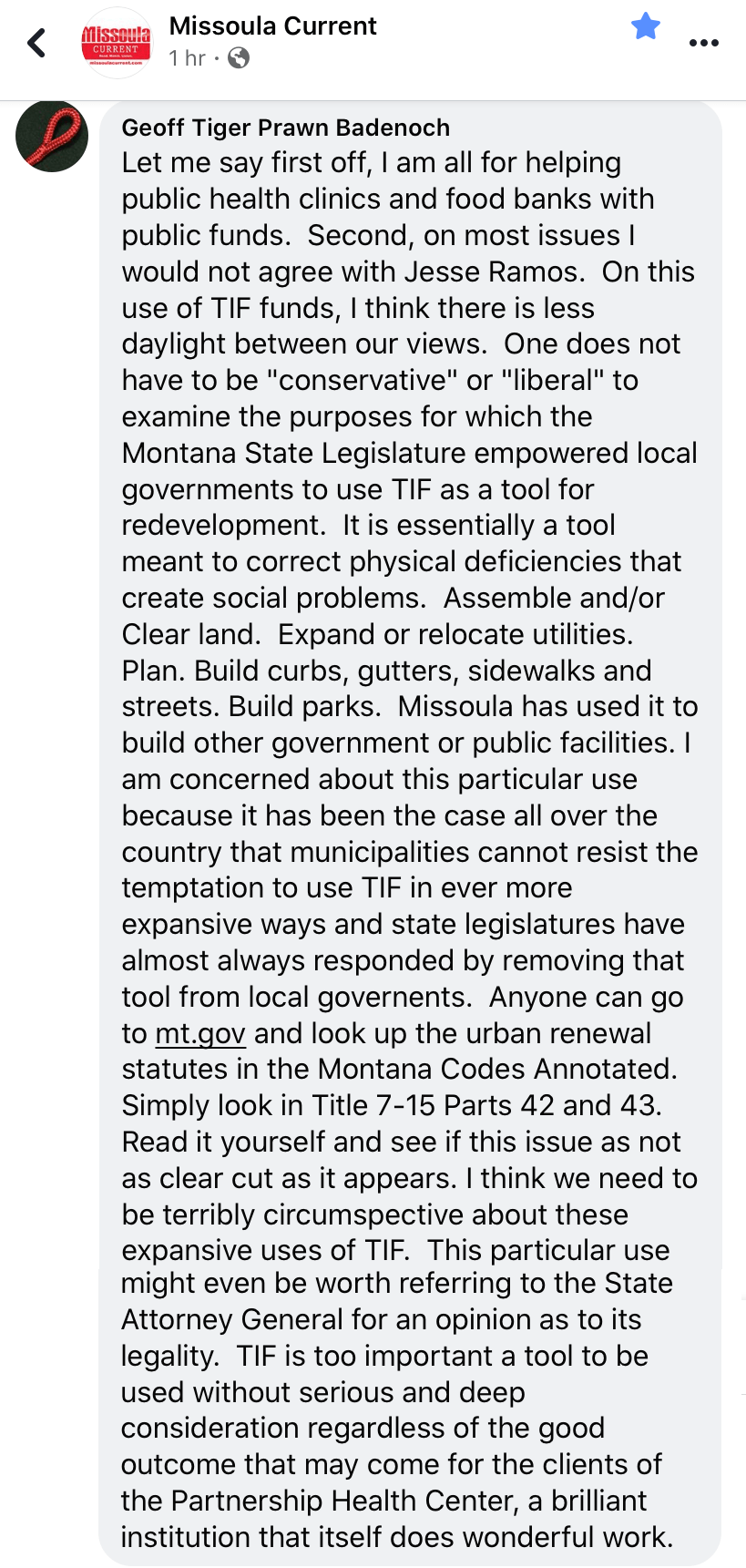
“Let me say first off, I am all for helping public health clinics and food banks with public funds. Second, on most issues, I would not agree with Jesse Ramos. [But] on this issue of TIF funds, I think there is less daylight between our views. One does not have to be “conservative” or “liberal” to examine the purposes for which the Montana State Legislature empowered local governments to use TIF as a tool for redevelopment. It is essentially a tool meant to correct physical deficiencies that create social problems. Assemble and/or Clear land. Expand or relocate utilities. Plan. Build curbs, gutters, sidewalks and streets. Build parks. Missoula has used it to build other government or public facilities.

“I am concerned about this particular use because it has been the case all over the country that municipalities cannot resist the temptation to use TIF in ever more expansive ways and state legislatures have almost always responded by removing that tool from local governments.

“Anyone can go to mt.gov and look up the urban renewal statutes in the Montana Codes Annotated. Simply look in Title 7-15, Parts 42 and 43. Read it yourself and see if this issue as not as clear cut as it appears. I think we need to be terribly circumspective about these expansive uses of TIF. This particular use might even be worth referring to the State Attorney General for an opinion as to its legality.

“TIF is too important a tool to be used without serious and deep consideration, regardless of the good outcome that may come for the clients of the Partnership Health Center, a brilliant institution that itself does wonderful work.”

Geoff Tiger Prawn Badenoch

Fun fact about Geoff Badenoch: he worked Ellen Buchanan’s job as MRA director for 18 years, from 1985 to 2003. I’m betting he probably knows what he’s talking about.

This is not to suggest that Ellen Buchanan doesn’t know what she’s talking about. The above quote is a concise illustration of how the evolution of the TIF law since the 1970’s consistently results in wider and wider interpretations of the law, lending itself to misuse and abuse over time.

When TIF addicts hit the TIF pipe too much, they force legislators at the state level to take this “imperfect tool” away from municipalities. Historically this is invariably what occurs in every state where dependent municipalities inevitably fall victim to TIF addiction. Tax Increment Financing in California has driven several cities to declare bankruptcy, compelling California legislators to take away the TIF toys forever.

Buchanan declared that blighted areas constitute a serious and growing menace. But for many Missoulians, the only serious and growing menace that directly threatens the health and safety of their families is the prospect of raised rents that price them out of Missoula. Property owners are worried about the serious and growing menace of exploding property tax bills that force them to sell their property to speculators. And our fragile community is terrified about the serious and growing menace of gentrification.

As of this writing, Missoula housing prices have soared to a record high of $315k. As reported by David Erickson last week:

“Housing prices continue to behave like a runaway helium balloon in the Garden City, while wages behave like a child on the ground with hands toward the sky, watching as the gap gets larger. Missoula’s median home sales price soared to a record high of $315,000 in 2019, a jump of 8.62% from the 2018 price of $290,000. … Andrea Davis, the executive director of the nonprofit Homeword in Missoula… noted that a person or a family would need an income of around $100,000 a year to afford a median-priced home in Missoula.”

The constant abuse of taxpayer money through endless TIF results in runaway housing prices that in-turn cause property taxes to explode, thereby displacing entire generations out of the neighborhoods they grew up in but can no longer afford. Then those newly abandoned areas are declared “blighted” enabling subsequent waves of gentrification to violently uproot the last vestiges of formerly-strong communities.

As Ryan McMaken further authenticates:

“Tax Increment Financing (TIF) legislation is geared not toward low-cost housing, but toward new commercial development. Often, that development is built where “unsightly” (but affordable) housing once existed. Its destruction is encouraged by government policy.”

Missoula-born local Lily Elison identifies how everybody loses when communities become gentrified:

“It is the inner-woven lives of individuals which creates a community … If we do not hold space for our local people and historic places, we will lose what makes this city worth living in. We will see a serious loss of security in our streets as life-long neighbors and childhood friends are replaced with strangers who have no community ties or responsibility to this place.

“I don’t want to see our history bulldozed. I don’t want to see skyscrapers instead of mountains. And I definitely don’t want to see my people in tent villages, because that’s what’s happening in Portland right now, because of their gentrification, because they’re pushing people out.

“And just think. What if it was your home that they were asking you to leave? What if it was your home?”


YOU JUST DON’T LIKE IT BECAUSE YOU DON’T UNDERSTAND IT

A persistent myth elected officials use to justify these taxpayer giveaway schemes is that ordinary folks are just “too dumb” to understand TIF. Indeed, any TIF addict relies on this myth as their primary rebuttal to the concerns of locals. Earlier at Monday’s meeting, Missoula local and longtime TIF critic Robert Moore — a man who spent the bulk of his career as the Chief Financial Officer for Fortune 500 Companies — approached the lectern to dispel an awful myth:

“Here’s an article where some of the members of the City Council are saying that the reason we don’t agree with TIF is that we don’t understand it. Well let me tell you – I do understand it. And I think all of you all understand it. You’ve just got a different purpose in mind. You want to give ten-million-dollars to the shopping center; four-million-dollars to Stockman Bank, that’s got a balance sheet of 2 or 3 billion dollars, and a surplus of 300-million-dollars.

“Tax Increment Financing is something we all need to learn more about, but at the same time Mrs. Harp [deflects] question[s] about it by saying, ‘You just don’t like it because you don’t understand it.’

“I understand it very well. It’s nothing but taking taxpayer money and giving it to developers and builders, and calling it ‘investment’.

“I think TIF oughta be disbanded.”

HH

Councilwoman Heather Harp

When it was Heather Harp’s turn to speak to Mr. Moore’s comments, she reiterated the very myth he sought to dispel, suggesting once again that people just don’t understand the law:

“I think one of the things that has often eluded a lot of folks, and frankly I don’t blame you, is because you don’t necessarily have all the facts. And I think we have a long ways to go in this community in terms of being able to tell a compelling story about why TIF is good. We know it has been good for us for 40 years. But going forward how how can we reshape that, so that folks understand?

“We also face the fact that we only have one tool in our toolbox in terms of being able to actually remedy our economic decline in these certain neighborhoods.

“Jesse, from time to time we’ve gotten into conversations about the merits and the demerits of our one and only tool. And I come down to this point of view that you can’t throw the baby out with the bathwater. This is the only thing we have. And at this point in time we have 600 people that need services of all types.”

I’m sure that Mrs. Harp, like everyone supporting this project, thinks she’s doing the right thing. After all, how can you go wrong endorsing either the Food Bank or Partnership? There is no questioning the good these organizations do on a daily basis for the many people who depend on their services.

But that isn’t the issue at all.

Critics don’t dispute the merits of TIF, but the negative side effects that occur later as a direct result. Negative side effects that we can’t afford to ignore for much longer.


ENTER PRINZING JONES

Councilwoman Harp is not the only one gas-lighting citizens about TIF. She has a lot of help from her fellow ideologues – like Natasha Prinzing Jones.

As William Skink noted this January, “The Missoulian is launching a new quarterly publication focusing on doing PR for businesses called Missoula Business. This vapidly titled quarterly will feature a notable business person and other things … The first notable business person is a lawyer for the Missoula Redevelopment Agency and the topic will be PR spin for Tax Increment Financing.”

Prinzing

Natasha Prinzing Jones is an un-elected MRA board member, married to a banker who works for a bank that benefited from TIF the same way Stockman Bank did, loaning us their own corporate handout and stiffing taxpayers with the interest payments. What’s more, Prinzing Jones happens to work in an office that itself benefited from TIF subsidies.

Natasha Prinzing Jones is also the attorney who underestimated Missoula’s Mountain Water legal fees by over $12 million!

So what does this “competitive spirit” have to say about citizen criticism regarding TIF?

“My observation is that many of the individuals who voice either concerns or opposition of TIF funding misunderstand its role and application,” she said. “Many individuals who are critics, I’ve never seen at a single (MRA board) meeting. Big picture, I think folks just don’t understand what’s going on. Their objections to the agency and the concept of TIF would benefit from a deeper review of what’s actually happening at those meetings.”

There you have it folks.

Once again, with painful predictability, there are NO specific responses whatsoever to either criticisms or concerns about TIF. The Missoulian had a whole cover story to do so. An entire centerfold’s worth of material, and only a few short paragraphs dedicated to beating Missoulians

Instead of responding to specific concerns, Prinzing Jones defaults to the same politically expedient tactic as all the other TIF addicts, claiming that Missoula’s citizens are just too brainless, too ignorant, and too stupid to understand how TIF works.

The reason that TIF addicts don’t debate the specific concerns is because they know they’ll lose if they argue the points before them. Critics don’t question the merits of TIF, but focus instead on it’s many unintended consequences.

TIF addicts seem to prefer employing STRAWMAN arguments: they substitute their opponent’s actual position with a distorted version that’s easy to dismiss. The debate is NOT about what TIF can do, but what it’s effects are. It’s about multi-million dollar taxpayer giveaways to banks, shopping centers and entertainment monopolies that unnecessarily and inappropriately increase everyone else’s property taxes to the point that locals are displaced completely by wealthy out-of-staters.

The Missoulian recently featured such a Strawman, quoting Linda McCarthy, executive director of the Missoula Downtown Association. Not only does McCarthy claim that, despite all the businesses closing all around us, “Downtown Missoula is without question a thriving commercial and community hub today.” The strawman comes in the form of trying to show all the good that TIF has done for local businesses – something critics don’t usually dispute.

McCarthy

Linda McCarthy, executive director of the Missoula Downtown Association


What TIF addicts don’t seem to realize is that by constantly using TIF to finance everything in the city from Lord Checota’s Ego-Dome to Stockman Bank’s Crony-Tower to Peter Lambros’ Shopping Maul to Andy Holloran’s Hotel Holocaust, what they’re actually doing is dooming Missoula to a fiscal death-by-a-thousand-cuts. And just like any addiction, the more they do it, the more they must continue doing it.

It doesn’t take that much time for these policies to produce negative side effects of increasing relative tax burdens for everyone, by artificially raising property values across the board.

TIF addicts claim that they’re trying to alleviate poverty, while actually helping to worsen the very conditions that exacerbate poverty in the first place: rising housing costs!

Mrs. Harp’s comment seems especially perplexing within the context of its timing. The previous week, on the 8th of January, she was stripped of her chairmanship on the Finance Committee, apparently because of her willingness to sincerely listen to citizen anxieties about TIF, and its constant overuse.

Her replacement, Gwen Jones, consistently displays an unapologetic contempt for citizens concerned about the effects of TIF, and was therefore the logical choice to Chair Missoula’s Finance Committee, at least from the point of view of wealthy developers, their cronies, and the useful idiots who go along to get along. Gwen’s cold, calculating indifference is further revealed by her recent declaration that “battle lines have been drawn.” Because apparently our community is nothing but a battlefield.

Those on the Council who helped unseat Mrs. Harp have sent a chilling message both to the people of Missoula as well as the rest of our elected representatives: don’t ever work with the people of your community, or you’ll lose what little authority we allow you to have.

I concede that at least this Food Bank/Partnership TIF is aimed at doing some good. Unlike the proposed $16.5 million TIF for Nick Checota’s LogJam Monopoly to further dominate Missoula’s entertainment scene with a giant monstrosity that they alone will have rights to operate for the next 75 years, all on the taxpayer dime.

As Missoula’s debt engines speed toward the cliff of bankruptcy, the TIF addicts are hitting the nitrous boosters while screaming, “Can’t this thing go any faster?” And the only operator who even discussed tapping the brakes was just pulled from the driver’s seat.

Jones isn’t merely a TIF addict; she’s a TIF dealer.

Under these circumstances, what possible benefit exists in continuing to patronize taxpayers with the same condescending claim that Tax Increment Financing is just too complicated a subject for ordinary folks to wrap their heads around?

john-holcroft-5-5d073d80139f9__700

Gabrielle Lafayette is the executive producer for the Outer Limits Radio Show.
This cache of thought is presented free of charge as a service and gift to you.
May our eternal vigilance help liberate all beings from the smoke-and-mirrors deceptions of the Samsaric Panopticon.


We Can’t Prevent War By Starting War

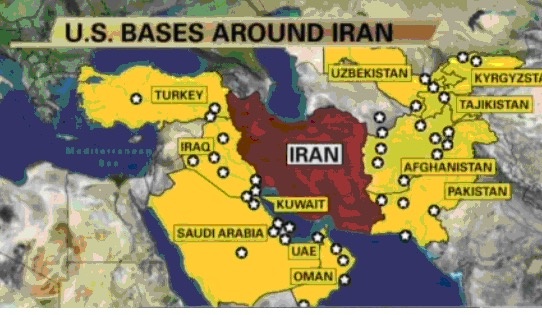
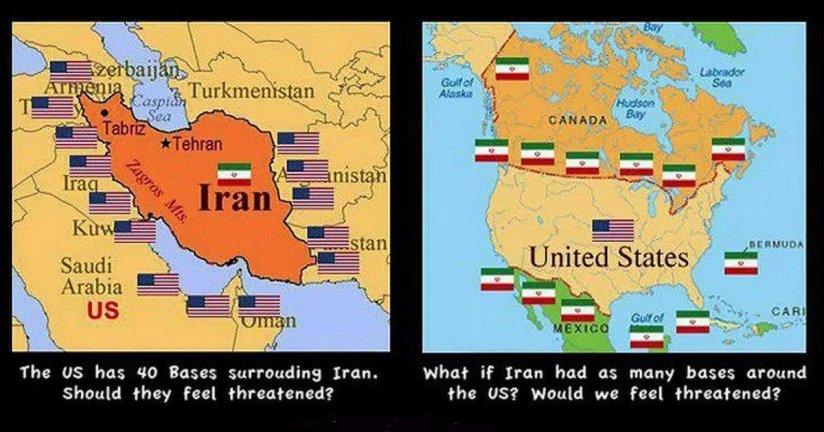
Trump has united Iran against America. The Pentagon’s unprovoked drone assassination of the Iranian general responsible for the defeat of ISIS should confuse most Americans. But the fact that General Soleimani was murdered while negotiating a peace deal signals that America ’s oligarchs are finally ready to ignite World War III. The attack corroborates General Wesley Clark’s revelation that the “War on Terror” involved invading and overthrowing seven Middle-Eastern countries in five years – finishing with Iran. Since the War on Terror began, America has surrounded Iran with over 40 military bases, mirroring the intentions set by the Brookings Institution’s 2009 regime change strategy guide: “Which Path to Persia? Options for a New American Strategy Toward Iran.” And ever since the Mossad’s ill-advised deployment of the STUXNET virus and the resulting cyber war that followed, Iran has proven capable of defending itself with a deterrent far more effective than nuclear arms.

main-qimg-4d67205db3b8a9d820ca77d77364f94a

bases.jpg

Your Luxury Is Our Displacement

Missoula’s battle against gentrification rages into 2020. WGM Group is pushing for a development of unaffordable condos on 4th Street near Missoula’s Hip Strip. The plan involves destroying several century-old houses to construct in their place, a glassy eyesore for the enjoyment of the very rich. The proposed development is on property currently owned by former Griz and Roughrider Quarterback Cole Bergquist. Mr. Bergquist happens to be the realtor put on probation “for unprofessional conduct” after selling the University’s Salmon Lake Lodge to Paws Up in 2017. Since he owns these historic 4th street buildings, Bergquist now wants to displace Missoula’s neighbors from these historic homes to erect multi-million-dollar condominiums that no locals will ever be able to afford. To maximize profits, Bergquist is asking City Council to rezone the property and surrender public right of way around it, in-turn displacing locals, leveling history, and uprooting neighborhood foundations.

bear


Reclaim Your Cognitive Liberty

Western society has only recently begun to accept the merit of indigenous wisdom that stretches back to time immemorial concerning psychedelic plant medicines. And though psychedelics have become trendy throughout pop culture in recent years, the psychedelic experience itself remains a mystery still for society at large. But the psychedelic experience is as central to understanding our humanness as having sex or birthing children or accepting responsibilities. And yet it is illegal. This prohibition deliberately thwarts our collective potential, renders the citizenry infantile and undermines America’s freedom of religious expression. Our culturally immature empire allows its inhabitants to wander the sanctioned playpen of ordinary consciousness, but boundary-dissolving hallucinogens that provide a sense of unity with our fellow humans are somehow forbidden. If we are not sovereign to make free choices over our own consciousness then we are not free in any sense of the word.

prayer.jpg

tumblr_nunvjgKh3c1unuhkso1_1280-1


The Antidote To Despair

America is plagued by an array of pathologies that arise from hopelessness, despair, and the seizure of civil society. The suicide epidemic is a direct manifestation of a society ravaged by corporate pillaging. Neither of the two corporate-owned political parties address our systemic problems, and the obscene concentration of resources in an incredibly small number of hands reveals America’s greatest hypocrisy. Competition disappears before our eyes as Amazon secures total monopoly over online commerce and distribution. If Amazon’s acquisition of Whole Foods and the Washington Post didn’t frighten us, their wider move into the global business of law enforcement and security certainly should. Our antitrust commissions abdicate their responsibilities by allowing this level of consolidation of power to continue when 70% of the population can no longer generate enough income to afford basic necessities. Until our corporate coup d’état is reversed these diseases will only grow.